

HR is one of the few careers open to graduates from almost any background: commerce, arts, science, engineering or management. It also offers unusually varied work, from recruitment and payroll to analytics, training and leadership. That variety is also what confuses beginners: “HR” isn’t one job, it’s a family of jobs.
This lesson maps the main types of HR roles, a typical HR career path in India, and practical ways to get started.
Why choose a career in HR?
- Every organisation needs HR, across IT, manufacturing, healthcare, retail, banking, logistics and startups.
- Many paths, one foundation. Start as a generalist and later specialise in recruitment, payroll, L&D, analytics or HR business partnering.
- People plus business. HR suits people who enjoy working with others and also like structure, data and problem-solving.
- A route to leadership. Senior HR leaders sit in top management and shape culture and strategy.
Types of HR roles
Generalist roles
- HR Executive / HR Associate: the most common entry role, covering recruitment support, onboarding, records, attendance, payroll inputs and employee queries.
- HR Generalist: handles most HR activities for a business unit or a smaller company.
- HR Business Partner (HRBP): works with business leaders on people decisions, performance, restructuring and talent.
Specialist roles
| Role | What they do |
|---|---|
| Recruiter / Talent Acquisition Specialist | Sourcing, screening, interviewing and hiring |
| HR Operations Executive | Records, onboarding and exit processes, HRMS, compliance documentation |
| Payroll Executive / Specialist | Salary processing, statutory deductions, tax and payroll reports |
| Compensation and Benefits Analyst | Salary structures, benchmarking, benefits design |
| Learning and Development (L&D) Specialist | Training needs, programmes, leadership development |
| Employee Relations / Engagement Specialist | Grievances, engagement surveys, recognition, culture |
| HR Analyst / People Analytics | HR data, dashboards, attrition and workforce analysis |
| HRIS / HR Technology Specialist | HR software configuration, data quality, automation |
| Labour Law and Compliance Officer | Statutory compliance, audits, labour authority interactions |
Leadership roles
HR Manager, Senior HR Manager, HR Head, VP HR, and Chief Human Resources Officer (CHRO).
A typical HR career path
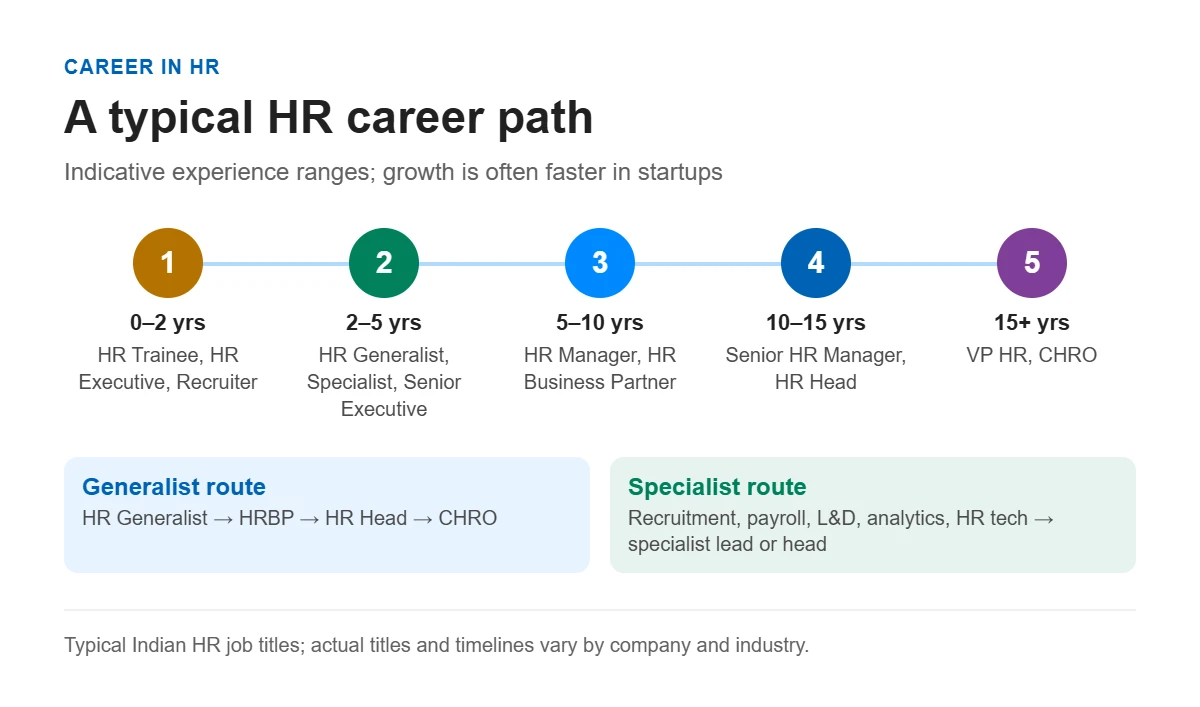
A typical HR career path in India.
| Stage | Typical experience | Typical roles | What you focus on |
|---|---|---|---|
| Entry | 0–2 years | HR Trainee, HR Executive, Recruiter | Learning processes, accuracy, communication |
| Early career | 2–5 years | Senior Executive, HR Generalist, Specialist | Owning processes, handling employee issues independently |
| Mid career | 5–10 years | HR Manager, HRBP, Specialist Lead | Leading teams, advising managers, designing programmes |
| Senior | 10–15 years | Senior HR Manager, HR Head | Running HR for a business or region, strategy |
| Leadership | 15+ years | VP HR, CHRO | Organisation-wide people strategy, culture, leadership team member |
These ranges are indicative. People move faster in startups and growing companies, and more slowly in large, structured organisations.
Generalist or specialist?
Most people start as generalists, which gives a view of the whole HR function. After two or three years, many specialise in an area they enjoy, such as recruitment, payroll or analytics. Others stay generalists and move towards HR business partner and leadership roles. Both paths can lead to senior positions.
How to start a career in HR
- Get the basics. A degree in any discipline works. An MBA or PG diploma in HR helps for management trainee roles in larger companies, but it isn’t the only route.
- Learn practical tools. Excel, an HRMS platform, payroll basics and labour law fundamentals make freshers job-ready.
- Build communication skills. HR is about explaining, listening and persuading.
- Get hands-on exposure. Internships, HR assistant roles or volunteering to handle HR tasks in a small business all count.
- Pick a first role that teaches breadth. HR executive and recruiter roles expose you to the most processes.
For a realistic view of starting pay by role, see this guide on what HR freshers earn in India.
HR certifications that help
Certifications aren’t mandatory for HR jobs in India, but they can strengthen a resume, especially when switching careers or moving up. Commonly considered options include:
- SHRM-CP and SHRM-SCP from the Society for Human Resource Management. SHRM-CP is aimed at people performing general HR work and is also open to students and people pursuing an HR career.
- HRCI credentials such as aPHR (entry-level, no HR experience required), PHR and SPHR, which focus on HR operations and are US-law heavy.
- CIPD qualifications from the UK, recognised internationally.
- NIPM programmes from the National Institute of Personnel Management, recognised in India.
- Specialist certificates in HR analytics, payroll or HR software such as SAP SuccessFactors or Workday.
Choose based on your career goal: generalist or specialist, India or global, plus budget and time. Fees and eligibility change, so check the issuing body’s official site before applying.
If you’d like a structured route into HR with practical training and placement support, you can explore this HR certification programme for beginners and career switchers.
