Table of Contents
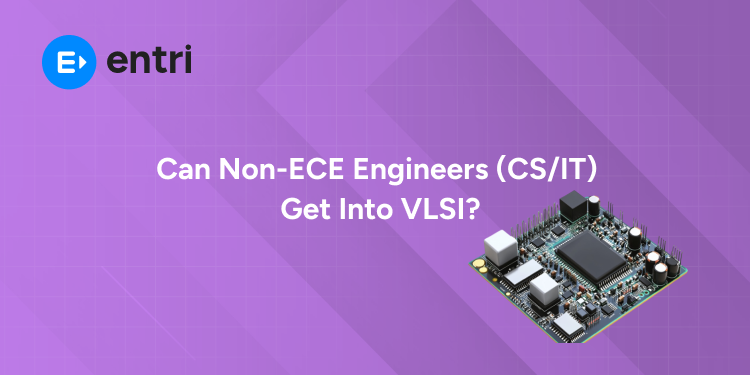
CS/IT graduates can definitely build a career in VLSI. This is particularly possible in functional verification, RTL-adjacent design, FPGA prototyping, and design automation. This is a case where they deliberately fill the hardware-fundamentals gap most CS curricula skip.
The path is real but steeper than for ECE/EEE graduates, as you are learning digital electronics, CMOS basics, and HDLs from scratch instead of building on four years of coursework.
Verification and EDA/CAD automation are the domains where non-ECE candidates transition fastest, since both lean on programming, scripting, and OOP thinking. These are skills a CS/IT degree already builds.
Kickstart Your Embedded Systems Career and Turn Your Tech Passion into High-Demand Skills!
Key Takeaways
- CS/IT can enter VLSI. Physical/analog roles are rare at entry and need strong electronics.
- Functional verification and CAD scripting are the easiest entry points.
- 6 to 9 months – fundamentals → HDL → specialization → projects.
- SystemVerilog/UVM projects beat the degree branch in hiring.
- Master one track (verification, RTL/FPGA, or automation).
- Salaries vary by company tier. Numbers are only guides.
- A clear GitHub (README, tests, waveforms) often matters most.
Who this Guide is for
This roadmap suits final-year CS/IT students exploring core hardware careers and 0 to 3 year software/IT engineers wanting to pivot into semiconductors. Most importantly this one goes for every self-learner who is ready to commit 6 to 12 months to structured upskilling and hands-on projects.
You are a strong fit if you
- Enjoy logic and debugging
- Are comfortable with math-adjacent reasoning like Boolean algebra and timing analysis
- Are willing to learn electronics fundamentals rather than expecting a shortcut.
Reconsider if you are hoping for a one- or two-month jump into chip design. Also, think twice if concepts like clocks, concurrency, and timing constraints don’t interest you. They sit at the core of almost every VLSI role.
Master Embedded Systems Programming!
Launch your tech career with our Embedded Systems Course, designed for hands-on learning and industry readiness.
Know MoreWhy CS/IT Engineers have a Real Shot
Many CS/IT graduates assume VLSI is “pure electronics” territory. In practice, chip design and verification workflows lean on software-style thinking more than expected.
Your background already gives you
- Programming and scripting ability (Python, Perl, TCL power automation and EDA tool integration)
- Software engineering discipline (version control and structured testing translate directly into verification environments)
- Algorithmic thinking (useful for coverage planning)
The real gap is missing hardware primitives and HDL fluency. This can be closed with a focused roadmap.
Roles Where Non-ECE Candidates Actually Get Hired
Verification and automation roles tend to be the most realistic entry points. Physical design and analog/mixed-signal design are typically much harder without a formal electronics background.
| Role | Why it suits CS/IT | Core skills | Common tools |
| Functional Verification Engineer | Testbenches, OOP, coverage metrics resemble software testing | SystemVerilog, UVM basics, waveform debugging | SystemVerilog, UVM, Verdi/DVE, Git |
| RTL Design Engineer (Digital) | Achievable with strong digital fundamentals; projects matter more than degree label | FSMs, pipelining, timing awareness | Verilog/SystemVerilog, FPGA boards |
| FPGA Prototyping Engineer | Hands-on, project-driven; rewards logical reasoning | RTL on FPGA, constraints, timing closure | Vivado/Quartus, FPGA dev kits |
| Design Automation / CAD / EDA Scripting | Directly leverages CS strengths | Python/Perl/TCL, flow automation | EDA tool flows, Linux |
Treat physical design and analog/mixed-signal roles as longer-term goals rather than entry targets.
The Non-ECE VLSI Roadmap: 6 to 9 Months

Phase-1 (Month 1 to 2): Hardware Fundamentals
Learn to think in hardware terms. This includes
- Number systems
- Boolean algebra
- K-maps
- Combinational/sequential circuits
- Flip-flops, counters
- FSMs
- Clocking concepts
- Conceptual CMOS basics
- A high-level pass through microprocessor concepts (registers, memory-mapped I/O, interrupts)
By the end, you should read a digital schematic and reason qualitatively about timing. Work through a structured digital electronics resource and solve truth-table, FSM, and timing-diagram problems daily rather than just reading theory.
Phase-2 (Month 3 to 4): HDL and RTL Thinking
Start with Verilog, then move into SystemVerilog constructs used for design and verification. Practice
- Combinational blocks (adders, muxes, decoders)
- Sequential blocks (counters, shift registers, FIFOs)
- Small functional units like ALUs or UART/SPI controllers
It is equally important that you write testbenches, inspect waveforms, and use assertions rather than trusting a simulation that just passes.
Treat HDL as a new programming paradigm. This includes concurrency, clocks, and hardware semantics behave differently from sequential software code, and that shift is where most CS/IT learners stumble if they rush it.
Phase 3 (Month 5 to 6): Pick One Domain and Go Deep
Resist learning everything that comes under VLSI. Choose one track and commit to it:
Verification (most recommended for CS/IT):
- SystemVerilog classes
- OOP for verification
- UVM basics (transactions, sequences, agents)
- Coverage metrics
Closest match to a software testing mindset. Strong demand across India’s design services and GCC hubs.
RTL/FPGA:
- Advanced RTL patterns
- Basic clock-domain crossing concepts
- FPGA implementation flow
- Timing constraints
It is good if you enjoy hands-on hardware.
Design automation/CAD:
- TCL/Python scripting for tool flows
- Log parsing
- Small EDA-adjacent utilities
- Plus general VLSI flow awareness
This leans hardest on existing CS strengths.
Phase-4 (Month 7 to 9): Projects, Portfolio, and Interview Readiness
Build two to three substantial projects rather than a dozen shallow ones.
- A RISC-V core subset (such as RV32I) with a testbench and ISA tests
- An AXI/AHB-lite interconnect or DMA controller with verification and coverage
- An FPGA-based peripheral (UART/SPI/I2C) with on-board testing
Document everything like a professional:
- A clear README
- Block diagrams
- Test plans
- Coverage snapshots
- Waveform evidence
- Reproducible instructions
For interviews, practice digital fundamentals, Verilog/SystemVerilog coding and debugging, and scenario questions like “how would you verify a FIFO?”
Master Embedded Systems Programming!
Launch your tech career with our Embedded Systems Course, designed for hands-on learning and industry readiness.
Know MoreSkill Stack Checklist
| Must-have (non-negotiable) | Nice-to-have (differentiators) |
| Digital electronics fundamentals | Basic static timing analysis (setup/hold, timing paths) |
| Verilog + SystemVerilog fluency | UVM methodology for verification roles |
| Testbench design and waveform debugging | FPGA implementation experience |
| Linux and scripting (Python/TCL/Perl) | RISC-V or bus-protocol projects (AXI/AHB) |
| Clear, documented projects on GitHub | Exposure to industry EDA tools via courses or labs |
Common Myths, Corrected
“Only ECE can do VLSI.”
EEE, instrumentation, and CS/IT graduates all enter VLSI once they have done the structured upskilling. This is especially through verification and automation. The degree label matters far less once you have working projects.
“VLSI is impossible for freshers.”
It’s challenging, not impossible. Structured roadmaps consistently get motivated freshers to job-ready skill levels within roughly 6 to 12 months.
“You need every VLSI domain before applying.”
Specializing early improves your odds far more than spreading thin across domains at once. Breadth comes later, with experience.
Salary Expectations: Directional, Not Guaranteed
Compensation varies enormously by company tier, city, and specialization, so treat these as orientation, not a promise:
Freshers:
Roughly ₹4 LPA to ₹10 LPA at design services and mid-sized firms; strong candidates with solid projects at top product companies or EDA vendors can see meaningfully higher offers.
Mid-level (3 to 6 years):
Pay typically climbs into the low-to-mid double digits (LPA), with verification and RTL specialists often commanding a premium.
Senior (7+ years):
Engineers at leading product companies and EDA firms can reach considerably higher packages, particularly in verification, physical design, and analog roles where talent stays scarce.
Verification skills (SystemVerilog, UVM) tend to be scarcer than generalist RTL skills at fresher level, and product companies/EDA vendors typically outpay domestic services firms for the same experience band. College brand matters at entry, but a strong project portfolio narrows that gap fast.
Actionable Next Steps – Start this Week

- Audit your basics. Spend two weeks on digital logic and CMOS fundamentals using a solid textbook or structured course.
- Pick one domain. Choose verification, RTL/FPGA, or automation, and commit for at least 3–4 months before branching out.
- Start daily HDL practice. Write and simulate Verilog/SystemVerilog code daily, and get comfortable reading waveforms, not just watching simulations “pass.”
- Plan two flagship projects. Define scope, a test plan, and documentation format before writing a single line of RTL.
- Align your resume. Lead with hardware projects, tools, and domain skills; de-emphasize unrelated software stacks.
Kickstart Your Embedded Systems Career and Turn Your Tech Passion into High-Demand Skills!
Conclusion
Non-ECE engineers don’t need to abandon a VLSI ambition. They need a realistic, sequenced plan. CS/IT graduates bring genuine advantages in scripting, testing discipline, and algorithmic thinking that map onto verification and design automation work.
What closes the gap isn’t talent. It is deliberately building digital fundamentals, HDL fluency, and a documented project portfolio over 6 to 9 months.
Pick one domain, go deep, and have strong projects to show for in interviews.
Master Embedded Systems Programming!
Launch your tech career with our Embedded Systems Course, designed for hands-on learning and industry readiness.
Know MoreFrequently Asked Questions
Which VLSI role is easiest for a non-ECE engineer to break into?
Functional verification and design automation/CAD scripting are generally the smoothest transitions, since both lean on skills CS/IT graduates already have.
Is physical design a good starting point for non-ECE engineers?
It’s one of the harder entry points without an electronics background, so non-ECE learners are better served starting in verification or automation first.
Do I need to learn both Verilog and SystemVerilog?
Yes. Start with Verilog for core HDL concepts, then move to SystemVerilog, since most verification and modern RTL roles expect fluency in it.
Is UVM necessary for a non-ECE candidate targeting verification roles?
Basic UVM knowledge is increasingly expected, so build it once you’re comfortable with core SystemVerilog and testbench concepts.
What programming languages matter most for VLSI automation roles?
Python and TCL are the most widely used for EDA tool automation and flow scripting, with Perl still appearing in legacy environments.
Do I need a certification to enter VLSI as a non-ECE engineer?
It isn’t mandatory, but a structured course with well-documented projects usually carries more weight than certificates alone.
What is a good first project for a CS/IT beginner in VLSI?
A well-documented FIFO, UART, or simple ALU with a testbench and waveform analysis is a strong first project before attempting something like a RISC-V core.
How important is GitHub documentation for VLSI job applications?
Very important. A clear README, block diagrams, test plans, and waveform evidence help interviewers evaluate your skills quickly.
Can I skip physical design entirely and still have a long-term VLSI career?
Yes. Verification, automation, and RTL design are all substantial career tracks on their own; specialization is common rather than covering every domain.
What is the biggest mistake non-ECE learners make when starting VLSI?
Skipping hardware fundamentals to rush into HDL coding, which leads to shallow understanding of timing that shows up quickly in interviews.