
Table of Contents
Introduction
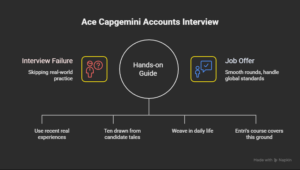
Think about stepping into that Capgemini interview room in places like Chennai or Noida, where fresh faces from Kerala and across India have shared stories of turning basic accounting knowledge into job offers back in 2025 and even early 2026, as folks on Glassdoor recount smooth rounds on basics like journal entries and vendor management. Plenty of candidates from spots near Payyanur stumble because they skip practicing real scenarios from recent experiences, but you can change that right now with this hands-on guide packed with ten key Capgemini Accounts Interview questions drawn from actual candidate tales, complete with answers that weave in everyday examples to help you speak naturally and grab attention.
Roles in accounts at Capgemini pull in people to manage client books in tech, finance, and more, often starting with screening on aptitude, then technical chats on payables or financial planning, and wrapping with HR probing your fit, so nailing these shows you handle global standards like those in ACCA papers, which match perfectly since Entri’s ACCA course in Kerala covers exactly this ground with live classes tailored for locals aiming at firms like Capgemini.
Become an Accounting Pro – Learn from Industry Experts!

Question 1: What is the difference between accrual and cash basis accounting?
Accrual accounting logs revenues and costs right when they happen, even if money hasn’t swapped hands yet, but cash basis waits until the cash actually flows in or out, which makes accrual the go-to for bigger setups because it pairs up earnings with the costs that produced them for a real sense of how the business stands each month or year. Take a service job finished in late December with payment hitting in early January; accrual puts that income in December’s books to keep the yearly profit true, just like Capgemini teams do for clients following IFRS rules that freshers learn early in ACCA through Entri’s flexible Kerala sessions.
Small shops might stick to cash basis for its simplicity on daily cash checks, yet it often masks building debts or delayed inflows that trip up planning. When Glassdoor users from 2025 Chennai interviews faced this, they won points by noting how accrual aids forecasts in fast client cycles at Capgemini, so in your spot, tie it to a quick story of spotting mismatched reports in past work or studies, proving you keep financial views sharp and reliable for team decisions.
Question 2: Explain the three main financial statements and their purposes.
Those core financial statements, the balance sheet for a frozen moment of what a company holds versus owes including owner stakes, the income statement tracking sales minus costs to show gains over months, and the cash flow statement mapping real money shifts across daily ops, asset buys, and funding moves, all link up to paint the full money story that Capgemini accountants lean on for client audits as shared in recent Indeed posts from India hires.
The balance sheet lists cash or inventory against bills due soon, while income flags profit dips from rising expenses, and cash flow uncovers why high earnings might leave pockets empty, like slow customer pays eating ops cash. In 2025 Noida rounds per Glassdoor, candidates shone by linking a sample where strong sales on income hid investing outflows on cash flow, urging better collections. For your Capgemini Accounts Interview, draw from ACCA syllabus basics that Entri drills in Kerala with mock reports, saying these tools spot trends like liquidity squeezes early, helping clients grow without shocks, and add how you’ve pieced them in class projects to analyze real firm data.
Question 3: What is depreciation, and how do you calculate it?
Depreciation takes a fixed asset’s price tag like a truck or office gear and stretches it out over years of service to match costs with the revenue it helps bring in, using straight-line by grabbing purchase cost minus end scrap value then splitting even yearly, or declining balance hitting harder upfront on fading book worth for stuff that wears quick.
Picture gear bought for fifty thousand bucks, scrap at five thousand after ten years; straight-line hits four thousand five hundred annually, but declining at double straight rate chews more early for tax perks, as Capgemini payable pros noted in 2025 Glassdoor tips on asset tracking. Pick straight for steady use items, declining for tech dropping fast, ensuring books don’t puff assets or mess taxes, a point freshers nailed in AmbitionBox fresher stories by adjusting for client accuracy. In your chat, pull an Entri ACCA example from Kerala training on picking methods to avoid profit swells early, sharing how it fixed a sample overvalue, showing you safeguard reports in high-volume team work.
Question 4: Describe accounts payable and receivable, and their impact on cash flow.
Accounts receivable hold what buyers owe post-delivery as assets waiting to turn cash, while payable list supplier debts as short-term owes that hold cash back if rushed, yet smart stretching preserves funds if vendors stay happy, directly shaping cash flow where slow receivables choke ops even with solid sales per Glassdoor 2025 AP round recounts on invoice flows. Quick receivable pulls, say cutting days from sixty to forty-five via aging lists, floods cash for pays or buys, but piled payables risk cuts off, so balance keeps wheels turning as Capgemini finance associates stress in India interviews. Recent hires mentioned Excel tracks for duplicates saving thousands; for you, link to Entri ACCA modules on working capital in Kerala, noting how better terms dropped borrow needs in a past case, proving you grasp daily liquidity hits beyond mere ledger posts.

Question 5: What are Generally Accepted Accounting Principles (GAAP), and why do they matter?
GAAP establishes a clear, uniform regime in the US for companies to record revenues, value assets and disclose financial information. The rules of each firm are the same so financial statements across sectors can be comparable. Such consistency means that banks, investors and business owners are able to weigh firms side by side without the need for any assumptions or guesswork. It also limits creative accounting as more detailed disclosures leave room for manipulation, and therefore creates greater trust in the reported numbers.
While many multinational firms, such as Capgemini, have switched to IFRS reporting in order to serve clients on the international scale, GAAP principles are still a vital part of that reporting. According to recent Glassdoor 2026 analyst ratings, GAAP training remains a topic of attention for the internal auditor to ensure that client books are compliant, particularly in the US. Professions need to be flexible in order to meet periodically changing requirements, like changes in lease accounting, or they could face unreliable comparisons, audit concerns, and fines.
The new information from novices on AmbitionBox will bolster GAAP’s role in M&A. Strong GAAP foundations prove credibility, help valuation, and make easier fair deal making. Likewise, maintaining up to date is important. Entri, who provides ACCA coaching in Kerala where FASB updates are delivered in interactive webinars, suggests that professionals can observe changes in real-time. In the context of changing financial situations, this learning strategy provides audit teams with the advantage of preventing restates, defending clients, and ensuring accuracy of reporting.
Question 6: How would you handle a discrepancy in financial records?
Recognizing a discrepancy begins with careful reconciliation. In practice that means fetching invoices, bank slips, and ledgers and matching them step by step, not skimming for quick fixes. Disagreements are quickly spotted and identified in the correct journal entry, such as the reversed postage on a double-posted 5 lakh cheque, an experience discussed by 2025 Chennai workers on Glassdoor. Each correction has the support of evidence for clean audit trail and patterns are flagged up to avoid repeat mistakes or identify potential red flags. This flow of data is secure, and reporting is immediately credible.
This order is a priority for Capgemini, as it directly promotes client trust. Accounts Payable leads are frequently asked about refunds, reconciliations, and audit readiness where even minor errors can spike profits or alter liabilities. Previously, duplicate postings were eliminated and review checks increased to ensure profit over-estimation was reduced, which also minimized audit friction. Double-checking at critical points also reduces risk and increases trust across teams.
A similar issue was reported in Kerala during an Entri ACCA mock practice where sample accounts included overspending due to duplicate entries. During this exercise, the sample amounts “saved” into thousands by tracing source documents calmly, changing journals and capturing the fix. The lesson was simple: methodical thinking under pressure is reliable – just as pressure-proof as it is during project rushes of large numbers.
Question 7: What is working capital, and how do you calculate it?
Working capital subtracts short owes like payables from quick assets such as cash, receivables, and stock to gauge daily run funds post-bills, positive signaling smooth ops sans loans, figured as two hundred thousand assets minus one hundred fifty thousand liabilities for fifty thousand buffer as Noida 2025 Glassdoor finance queries highlighted with reserve types. Weak levels warn crunch risks; Capgemini watches for client steadies, using current ratios over one-point-five. Lift via swift collects or stock spins; tie to Entri ACCA Kerala cases where tweaks cut loan costs, sharing how it fueled sample growth to underline strategic eyes.
Question 8: Explain the cash flow statement and its sections.
Cash flow breaks money moves into ops from core sales tweaks for non-cash like depreciation, investing on gear shifts, and financing via debts or payouts, revealing why profits shine yet cash dips from slow pays or buys, a 2026 Glassdoor staple for FP&A explains. Ops positive screams health; trends forecast gaps. In Capgemini, it flags risks beyond income; answer with steady ops as top sign, pulling Entri ACCA Kerala analysis of public sheets that dodged shortfalls, proving insight for client wins.
Question 9: How do you stay current with accounting changes?
Today, accounting needs to be current, not just waiting for the annual reports. I do regularly check the new releases from FASB and IASB as soon as they appear, especially when they are related to recognition, measurement, or disclosure. I also attend webinars and live sessions often to understand what new standards are all about, not just the wording. The peer discussions are important as well; they help interpret the meaning of the stress test and reveal the problems of practice that may not always appear in formal guidance.
In order to continue learning, I test new things on real-world examples. Revenue change timings, contract change, and judgment-heavy topics are assessed against sample books. This allows for faster applications in live environments, especially useful for firms such as Capgemini who expect immediate compliance and accuracy as seen in recent employee and project reviews. Speed is important, but only when it is paired with precision.
This approach is well supported by Entri’s Kerala ACCA program. Their content is structured, their classes are live and their mock exams are practice-based in the application of technical knowledge. I watched the updates to the lease rules for 2025, such as those that change with regards to the re-examination of the lease term, variable lease payments, and enhanced disclosure expectations during live sessions. Maintaining this pattern will provide a focused compliance mindset, while maintaining a constant edge in fast-paced accounting roles.
Question 10: Why do you want to work in accounts at Capgemini?
Capgemini offers accountant precision coupled with global delivery making it an ideal solution for a finance professional who value structure, accuracy, and an exchange with international clients. The firm, bolstered by advanced tools and processes, continues to expand its audit, reporting, and financial planning capabilities from India with the aid of its hubs. This is a practical, not a theoretical alignment for ACCA hopefuls and professionals, especially those trained at Entri Kerala. The main ACCA knowledge base, including audit planning, financial analysis, compliance and risk assessment, is directly linked to the work Capgemini provides to its accounting and consulting staff.
Those who take Capgemini interviews in 2025-2026 share information on Glassdoor and AmbitionBox: “…the successful candidates in Capgemini interviews first have high basic knowledge and then show how they apply those basics in practice” . For hiring managers, attention to detail, consistency, and the ability to balance previous experience with client-facing responsibilities are critical. The job offers often include structured growth, cross-domain experience, and long-term stability, but also are often a positive; but, there is an additional high review score for the role of finance.
Become an Accounting Pro – Learn from Industry Experts!
Conclusion
1: Accounting provides information on
If candidates prepare properly, they could be eligible for stable positions that will grow over time. Capgemini wants more than knowledge in the textbook; they want people who understand accounting principles, can apply them in real-world business situations, and can be persuasive. Those candidates who did well during recent interviews had one thing in common: a strong foundation of preparation and practical knowledge.
It is important to learn basic accounting principles such as journaling, final accounts, taxation and cost accounting. Interviewers often ask you if you understand basic accounting principles like golden rules of accounting, revenue recognition, provisions, and variances. They may not ask for definitive definitions, but present short scenarios and expect logical explanations. The struggle here is common to many candidates, not because they don’t know, but because they don’t apply.
That’s why it’s important to review real interview questions, and to adapt them to your own experience. When you link topics with situations that have occurred in your internship, project, or other role, your answers sound confident and authentic. Using a real cost control situation to explain variance analysis, or reconciling from an accounting test makes a strong impression. Interviewers value potential employees who can provide immediate value to their teams.
Preparation in structured fashion is also crucial. Practicing mock questions, revising the most commonly asked questions, and self-testing yourself in short quizzes brings clarity and speed. Candidate programs such as Entri’s ACCA program in Kerala, provide an understanding of this readiness that integrates conceptual study and practice. The focus is on how to pass exams, but also in building confidence for interviews.
Placement Oriented PWC Business Accounting Course
PWC Certified Business Accounting Course by Entri App: Master in-demand skills, ace interviews, and secure top-tier jobs.
Join Now!Frequently Asked Questions
Beyond the definitions, how do accrual and cash accounting fundamentally shape business strategy and reporting at a firm like Capgemini?
While the textbook distinction—accrual records transactions when they occur, cash basis when money moves—is a starting point, its strategic implications are what truly matter in a global consultancy like Capgemini. Accrual accounting isn’t just a preference; it’s the language of strategic decision-making. It enforces the matching principle, ensuring revenues are paired with the expenses incurred to generate them within the same reporting period. This creates a “true and fair” view of profitability that is independent of cash flow timing. For a Capgemini team managing the books for a multinational tech client, this means recognizing revenue from a software implementation project as milestones are met over several quarters, even if the client pays on a net-90 basis. This accurate period-to-period view is critical for assessing project performance, calculating executive bonuses correctly, and providing stakeholders with reliable trend analysis.
Cash basis accounting, in contrast, offers simplicity but paints a potentially misleading, short-term picture. It can show a profitable month because a large receivable was collected, while masking the fact that no new sales were closed. For Capgemini’s clients, especially smaller ones or those in specific niches, this can lead to poor strategic choices, like assuming robust health while actually accumulating debt. In an interview, you can elevate this discussion by noting that Capgemini, adhering to IFRS or Ind AS, must use accrual accounting for its own and its clients’ consolidated reporting. This ensures comparability for investors and compliance with regulatory standards. A powerful way to demonstrate understanding is to describe a scenario: “If a client using cash basis completes a project in late March but receives payment in April, their Q1 appears weak and Q2 artificially strong. Our role would be to transition them to accrual, smoothing out the financial picture and enabling better resource planning and valuation—a common value-add we provide.”
The three financial statements are interlinked. Can you walk through a specific business event and trace its impact across all three?
This question tests your ability to see the financial ecosystem as a whole, not as isolated reports. Let’s take a common event: A company purchases a delivery vehicle for ₹500,000, paying ₹100,000 in cash and financing the remaining ₹400,000 with a loan.
-
Impact on the Balance Sheet (The Snapshot):
-
-
Assets: The “Cash” asset decreases by ₹100,000. A new “Fixed Asset (Vehicle)” of ₹500,000 is added. Net change in Assets: +₹400,000.
<l
-
i>
Liabilities: A “Loan Payable” liability of ₹400,000 is created.
-
-
Equity: Remains unchanged at this instant. The accounting equation (Assets = Liabilities + Equity) holds: (+₹400,000 Assets) = (+₹400,000 Liabilities).
-
Impact on the Income Statement (The Performance):
-
There is no immediate impact on the Income Statement from the purchase itself. Revenue and expenses are not yet affected. However, in subsequent periods, depreciation on the vehicle will become an operating expense, reducing net profit.
-
-
Impact on the Cash Flow Statement (The Movement):
-
Operating Activities: Unaffected by this transaction.
-
Investing Activities: Shows a cash outflow of ₹500,000 for the “Purchase of Fixed Assets.”
-
Financing Activities: Shows a cash inflow of ₹400,000 from “Proceeds of a Loan.”</p>
-
Net Change in Cash: (-₹500,000 Investing) + (+₹400,000 Financing) = -₹100,000. This perfectly matches the cash reduction on the Balance Sheet.
-
Furthermore, in future years, the depreciation expense (from the Income Statement) gets added back in the Operating Activities section of the Cash Flow Statement (as it’s a non-cash charge), while the loan principal repayment will be a cash outflow under Financing Activities. Explaining this cascade of effects shows you understand how Capgemini’s accounting teams build dynamic financial models for clients, forecasting how investment decisions today will impact future profitability, tax liabilities, and cash reserves.
Depreciation is more than a calculation; it's a strategic assumption. How do you choose between methods, and what are the implications for a client's financial health and taxes?
Selecting a depreciation method (Straight-Line vs. Reducing Balance) is a key judgment that reflects the asset’s economic reality and influences both reported results and tax strategy. The choice communicates management’s expectations about how the asset generates value.
-
Straight-Line Method assumes the asset provides equal utility each year. It’s ideal for assets with a long, stable life where obsolescence is low, like office furniture, buildings, or certain types of industrial machinery. Its predictability aids in steady budgeting and presents a consistent, lower expense profile on the Income Statement, resulting in stable reported profits. From a Capgemini client-service perspective, this method is often preferred for internal management reporting when simplicity and consistency are paramount.
-
Reducing Balance (or Declining Balance) Method assumes the asset is most productive in its early years, losing value faster upfront. This matches the expense pattern to the revenue pattern more closely for assets like computers, servers, vehicles, or any technology prone to rapid obsolescence. It leads to higher expenses and lower reported profits in the initial years, which can be a strategic tool for tax deferral—reducing taxable income now when the asset is new and potentially more revenue-generating.
The strategic implication for a Capgemini accounts team is profound. For a fast-growing tech startup client, using the reducing balance method for its server fleet could significantly lower its tax burden in critical early years, preserving cash for reinvestment. However, this would also show lower net income, which could impact its ability to secure certain types of loans or attract investors who focus on short-term profitability. A consultant must weigh these factors, often aligning the book depreciation (for financial reporting) with the most appropriate economic view, while separately calculating tax depreciation as per the local laws (like the Companies Act in India). Demonstrating you grasp this duality—accounting integrity versus strategic tax planning—shows you’re ready for the nuanced advisory aspects of the role.
Managing Accounts Payable (AP) and Receivable (AR) is a core liquidity function. Describe a proactive process for optimizing both to improve a client's cash conversion cycle.
This moves beyond definitions into operational excellence, a key expectation for accounts roles at Capgemini. The Cash Conversion Cycle (CCC)—the time it takes to convert inventory and other resources into cash flows—is directly driven by AP and AR efficiency. A proactive process involves several interconnected steps:
1. For Accounts Receivable (Accelerating Inflows):
-
Credit Policy & Onboarding: Before a sale, establish clear credit terms, run credit checks, and ensure the sales contract has unambiguous payment terms, late fees, and milestone triggers. This is a preventive control.
-
Invoicing Excellence: Issue accurate, clear, and immediate invoices upon delivery or milestone completion. Electronic invoicing (e-invoicing) with automated reminders can slash days in the cycle.
-
Aging Analysis & Active Collections: Regularly review the Aging Schedule. Segment customers: prioritize follow-ups on past-due accounts. For large balances, a personal call is more effective than an email. Offer early payment discounts (e.g., 2/10 Net 30) strategically.
-
Deductions Management: Systematically track and resolve payment deductions (short payments due to disputes). A root-cause analysis can reveal issues with delivery, quality, or pricing that need fixing.
2. For Accounts Payable (Optimizing Outflows):
-
Leverage Payment Terms: Do not pay early unless a significant early payment discount is offered. Standardize payment runs to process invoices just before their due date, maximizing the use of free credit from suppliers.
-
Procurement Alignment: Work with the procurement team to negotiate favorable terms (e.g., extending from Net 30 to Net 45 or 60) as part of vendor contracts.
-
Process & Fraud Control: Implement a three-way match (Purchase Order, Goods Receipt Note, Invoice) before any payment is approved. This prevents overpayments and duplicate payments, a common source of cash leakage.
-
Dynamic Discounting: If the company has excess cash, it can offer to pay supplier invoices early in exchange for a discount, creating a return on cash that often beats short-term investment rates.
For a Capgemini client, implementing this holistic process might involve deploying and managing a module within their ERP system (like SAP). The impact is tangible: reducing the average collection period from 60 to 45 days and extending the average payment period from 30 to 40 days can free up millions in working capital, reducing or eliminating the need for expensive overdraft facilities. You can cite this as a direct contribution to client value.
With the global convergence towards IFRS, why is understanding US GAAP still critically important for an accounts professional at a global firm like Capgemini?
The landscape is indeed shifting towards IFRS as the global standard. However, US GAAP remains monumentally important for several pragmatic reasons, especially for a consultancy serving multinational clients.
1. The Scale of the US Market: The United States houses the world’s largest capital markets. Any client of Capgemini that is a US-based entity, listed on a US exchange (like the NYSE or NASDAQ), or seeking US investment must file financial statements prepared in accordance with US GAAP with the Securities and Exchange Commission (SEC). Ignorance of GAAP would render an accounts team incapable of servicing a massive segment of the global economy. For Capgemini’s practice, this means teams, even in India, must be proficient in GAAP to handle the accounting, reporting, and audit support for US-facing clients or subsidiaries.
2. Key Conceptual Differences: While converging, significant differences persist that have real business impacts. A prime example is inventory costing. Under IFRS, the LIFO (Last-In, First-Out) method is prohibited. Under US GAAP, it is permitted. A manufacturing client using LIFO under GAAP during periods of rising prices will report lower ending inventory values and higher cost of goods sold, thus lower taxable income and tax liability. An accounts professional must understand this to accurately compare financials, manage tax strategies, or guide a client through a transition.
3. The “Rules-Based” vs. “Principles-Based” Mentality: US GAAP is often described as more detailed and rules-based, with extensive industry-specific guidance. IFRS is more principles-based, relying on broader concepts and requiring more professional judgment. A professional trained in GAAP develops a rigorous, detail-oriented mindset focused on literal compliance with specific rules—a discipline that is invaluable when precision and audit-defense are critical. This complements the broader judgment required for IFRS. At Capgemini, this dual-awareness allows teams to navigate complex consolidation for a parent company using IFRS with a US subsidiary using GAAP, ensuring seamless and compliant group reporting.
In essence, understanding GAAP is not about living in the past; it’s about possessing a critical, in-demand skill set that allows Capgemini to serve a crucial market, manage complex multi-standard reporting, and bring a disciplined, rule-oriented perspective to financial problem-solving.
Describe a structured, step-by-step protocol you would follow to investigate and resolve a complex discrepancy during a month-end close for a high-priority client.
A systematic protocol is what separates a junior clerk from a reliable accounts professional. For a high-priority client during the tense period of month-end close, a calm, methodical approach is essential.</p>
Phase 1: Identification & Triage
-
Step 1 – Isolate the Discrepancy: Precisely identify the nature and amount. Is it a bank reconciliation out of balance by a specific sum? Does a sub-ledger not match the general ledger control account? Quantify the gap (e.g., “The Accounts Payable sub-ledger total is ₹10,47,500, but the GL control account shows ₹10,50,000—a discrepancy of ₹2,500”).
-
Step 2 – Gather Documentation: Immediately secure all relevant documentation for the period: bank statements, invoice copies, payment records, journal entry listings, and previous reconciliation reports.
Phase 2: Systematic Investigation
-
Step 3 – Check for Common Errors First: Efficiently rule out frequent, simple errors:
-
Transposition/Slide Errors: Is the difference divisible by 9? (e.g., ₹2,500 could be a transposition of ₹2,050).
-
Timing Differences: Are there transactions recorded in one system but not yet in the other (outstanding checks, deposits in transit)?
-
Duplicate Posting/Missing Entry: Scan journal entries for any amount matching the discrepancy that may have been posted twice or omitted.
-
-
Step 4 – Segment and Conquer: If simple errors are ruled out, break the problem down. For the AP example, divide the discrepancy by vendor or by week. Check the last period where the accounts matched and review every transaction since.
-
Step 5 – Source Document Verification: Go back to the original source—the supplier invoice, the signed purchase order, the goods receipt note. Match them line-by-line to the entries in the system.
Phase 3: Resolution & Control
-
Step 6 – Determine Root Cause & Correct: Once the error is found (e.g., a ₹2,500 invoice was posted to the wrong expense account), determine the root cause (human error, unclear chart of accounts, lack of review). Prepare the precise correcting journal entry with full supporting documentation.
-
Step 7 – Review & Approve: Have the correction reviewed by a senior or team lead before posting, especially during a sensitive close proc
ess.
-
Step 8 – Communicate & Document: Log the discrepancy, its cause, the correction made, and the approving individual in a discrepancy log. Briefly inform the relevant stakeholder (e.g., team lead, client contact) that the issue has been resolved.
-
Step 9 – Implement Preventive Control: Propose a change to prevent recurrence. This could be a new review step, a tweak to the chart of accounts, or a quick team training on a specific process. This step demonstrates proactive thinking and adds long-term value, a trait highly valued at Capgemini.
Working capital is a measure of operational liquidity. How would you analyze a client's declining working capital position and present actionable recommendations to the management?
A declining working capital position (Current Assets – Current Liabilities) is a red flag requiring diagnostic analysis and strategic advice. Your role would be to move from observation to prescription.
<p><p class=”ds-markdown-paragraph”>Step 1: Granular Analysis of Components
Don’t just look at the net number. Break it down:
-
Analyze Current Assets:
-
Cash: Is it being depleted? Why?
-
<strong>Accounts Receivable: Calculate the Days Sales Outstanding (DSO). Is it increasing? This points to slower collections. Perform an aging analysis—is the increase concentrated with a few large clients or widespread?
-
Inventory: Calculate the Inventory Days (DIO). Is it rising? This could indicate overstocking, slow-moving/obsolete stock, or production bottlenecks.
-
-
Analyze Current Liabilities:
-
-
Accounts Payable: Calculate Days Payable Outstanding (DPO). Is it decreasing? The company may be paying suppliers too quickly, often due to poor cash manageme
-
-
nt or to
secure discounts.<li>
Short-term Debt: Has it increased to plug cash gaps?
Step 2: Identify the Root Cause(s)
The trend reveals the story. Common scenarios:
-
Scenario A: “Growth Trap.” Sales are growing rapidly, requiring more inventory and leading to higher receivables, but the company isn’t financing this growth with longer payables or equity; it’s draining cash. The balance sheet is expanding, but cash is vanishing.
-
Scenario B: “Operational Inefficiency.” Sales are flat, but DSO is rising (poor collections) and DIO is rising (poor inventory management). This is pure operational deterioration.
-
Scenario C: “Supplier Pressure.” DPO has sharply fallen, perhaps because suppliers tightened terms due to the client’s own credit risk, forcing faster cash outflow.
<strong>Step 3: Formulate Actionable Recommendations
Tailor these to the root cause:
-
For Receivables: “Implement a tiered collections process: email reminders at 30 days, calls at 45, and escalate to sales/management for key accounts at 60 days. Re-evaluate credit terms for customers with consistently high DSO.”
-
<strong>For Inventory: “Run an ABC analysis. For ‘C’ category slow-movers, initiate a clearance sale. Work with production/sales for better demand forecasting to reduce safety stock levels.”
-
For Payables: “While maintaining supplier relationships, centralize payments to align with negotiated terms. Explore dynamic discounting opportunities where beneficial.”
-
Strategic Financing: “If the issue is a growth trap, recommend arranging a working capital line of credit to smooth the cycle, rather than depleting cash reserves.”
Presenting this as a clear narrative—”We’ve identified that your working capital decline is primarily due to DSO increasing from 45 to 60 days, driven by three major clients. Here are three steps to address it…”—positions you as a business partner, not just a bookkeeper. This advisory mindset is at the heart of Capgemini’s value proposition.
The Cash Flow Statement reconciles net income to cash movement. Explain, with a detailed example, how a profitable company can face a severe cash crunch, and what the CFS reveals.
This is the quintessential test of financial acumen. Profit, an accrual concept, is not cash. A company can be profitable on paper while running out of cash to pay bills, a situation often revealed dramatically by the Cash Flow Statement.</p>
The Scenario: Imagine “TechGrowth Ltd.” shows a Net Income of ₹50,00,000 for the year. However, the CEO is panicking because the bank account is nearly empty. The Cash Flow Statement holds the answers.
Analysis of the Cash Flow Statement:</stro
ng>
-
Operating Activities (Starts with Net Income): Net Income: +₹50,00,000
-
Add-back non-cash expenses: Depreciation & Amortization: +₹10,00,000.
-
Adjust for changes in Working Capital:</strong>
-
Increase in Accounts Receivable: -₹1,00,00,000 (Massive increase—sales were on credit, cash not collected).
-
Increase in Inventory: -₹30,00,000 (Heavy investment in raw materials and finished goods).
-
Increase in Accounts Payable: +₹20,00,000 (Delayed payments to suppliers, a temporary cash help).
-
-
Cash from Operations: ₹50L + ₹10L – ₹100L – ₹30L + ₹20L = -₹50,00,000. Despite ₹50L profit, operations consumed ₹50L in cash! The core business is hemorrhaging cash due to uncontrolled receivables and inventory.
-
-
s=”ds-markdown-paragraph”>Investing Activities:
-
Purchase of New Office & Equipment: -₹1,00,00,000. The company invested heavily in fixed assets for expansion.
-
-
Financing Activities:
-
Proceeds from a Long-Term Loan: +₹1,20,00,000. The company took on debt to finance its growth and cash shortfall.
-
Dividend Payments: -₹10,00,000.
-
Net Change in Cash: (-₹50L Operating) + (-₹100L Investing) + (₹120L – ₹10L Financing) = -₹40,00,000.
lass=”ds-markdown-paragraph”>The Revealing Story: The CFS tells us TechGrowth is in a high-growth, cash-intensive phase. It is selling on generous credit (draining cash), building inventory for future sales (draining more cash), and making capital investments. Its operations are not self-funding. The entire operation and expansion are being financed by debt. The crunch is caused by aggressive growth without corresponding cash management. The Income Statement showed profitable growth. The Balance Sheet showed more assets and more debt. But only the Cash Flow Statement sounded the alarm that this growth model is unsustainable without careful management of the operating cycle or an endless supply of external financing. For a Capgemini consultant, analyzing this would lead to urgent recommendations on tightening credit, managing inventory, and potentially pacing capital expenditures—advice that saves the business.
In a field governed by standards like IFRS and GAAP, what does "staying current" truly entail? Describe your personalized, proactive system for continuous professional development.
“Staying current” is a professional imperative, not a passive activity. It requires a multi-channel, engaged system.
1. Primary Source Monitoring (Going to the Source):
-
ss=”ds-markdown-paragraph”>Standard-Setter Websites: I have dedicated bookmarks and RSS feeds (or email alerts) for key sections of the IASB (IFRS) and FASB (US GAAP) websites, specifically their “News & Updates,” “Exposure Drafts,” and “Effective Dates” pages. Reading exposure drafts is crucial—it allows me to understand the rationale behind future changes and prepare in advance.
-
Regulatory Bodies: Following summaries from local regulators like the MCA (Ministry of Corporate Affairs) in India for updates to the Companies Act and Ind AS (Indian Accounting Standards) carve-outs.</p>
2. Leveraging Professional Bodies & Curated Content:
-
ACCA/CPA/CA Resources: As a member or student, I actively use their technical articles, webinars, and member magazines. These bodies excel at interpreting raw standards into practical guidance.
-
Reputable Financial Publications:</strong> I subscribe to newsletters from sources like the CFA Institute, Bloomberg Quint, or Economic Times’ corporate law section for analysis of how changes impact industries and specific companies.
3. Applied Learning & Peer Engagement:
-
Internal Training & Forums: At a firm like Capgemini, I would fully utilize internal knowledge portals, mandatory training on new standards (e.g., on IFRS 17 Insurance Contracts), and internal discussion forums where practitioners share implementation challenges.
-
Scenario-Based Practice: When a major update is released (e.g., the new lease accounting standard, IFRS 16), I don’t just read it. I take a simple example—”How would this change how we report a 5-year office lease?”—and draft the old and new journal entries and disclosures. This cements understanding.
-
Network Discussion: Engaging with peers, either informally or in structured groups, to discuss “How are you implementing this?” or “What systems changes does this require?” reveals practical hurdles not mentioned in the standard.
This system is not sporadic; it’s habitual. It might involve setting aside 30 minutes every Monday morning to scan updates or listening to a technical podcast during a commute. The goal is to shift from being a recipient of information to an active participant in the professional dialogue, ensuring that when a client asks about the impact of a new revenue recognition standard, I can provide a confident, practical answer, not just a textbook definition. This proactive ownership of knowledge is what distinguishes a true professional.
Capgemini hires thousands. Why should they choose you for this accounts role, and what specific value do you see yourself adding in the first 90 days?
This is your closing argument, synthesizing knowledge, attitude, and foresight.
“Capgemini seeks professionals who blend technical rigor with client-centric problem-solving. You should choose me because I offer that blend, grounded in a solid foundation from my ACCA preparation and a deep understanding of the practical challenges discussed in forums like Glassdoor. I don’t just see accounting as compliance; I see it as the language of business health, and I’m driven to use it to deliver clear insights.
Specifically, in the first 90 days, my focus would be on rapid integration and tangible contribution:
Phase 1 (Days 1-30): Listen, Learn, and Master Processes.
My priority is to absorb Capgemini’s way of working. I will diligently learn the specific ERP tools (like SAP), internal reporting templates, and quality protocols. I will study my assigned client portfolios, understand their contracts, and their key financial drivers. I aim to move from being trained to being trainable, asking targeted questions to understand the ‘why’ behind processes.
Phase 2 (Days 31-60): Execute with Accuracy and Begin Proactive Analysis.
I will take ownership of my assigned deliverables—be it a monthly close process, a reconciliation pack, or a set of journal entries—with a commitment to zero-defect accuracy and on-time delivery. Beyond routine tasks, I will begin to analyze the work. For example, while processing payables, I might start tracking the most common invoice errors or suggest a minor tweak to the aging report format for better clarity, demonstrating initiative within my scope.
Phase 3 (Days 61-90): Identify an Efficiency Opportunity and Contribute to Team Goals.
By this point, I will have enough context to identify one specific, small-to-medium process that could be improved. This could be creating a checklist for a recurring task to reduce review time, drafting a standard email template for a common client query, or identifying a reconciliation step that could be semi-automated with a simple Excel formula. I would research the idea and present it constructively to my team lead.
My value is that I combine the fresh, updated technical knowledge from my qualifications with the pragmatic mindset of a practitioner who wants to get things right and then make them better. I am not just looking for a job; I am seeking to start a career where I can grow into a trusted advisor for Capgemini’s clients, and I am eager to begin that journey by proving my reliability and proactive mindset from day one.”