Table of Contents
Key Takeaways
- Elections usually bring short-term volatility, but long-term growth is driven by fundamentals.
- Stability and continuity in government policies are favoured by domestic and foreign investors.
- Infrastructur, Defense, and PSU sectors often emerge as winners during stable regimes.
- Market sentiment is heavily influenced by the “exit polls” vs. actual “results day” reality.
- Long-term investors should avoid panic selling during sudden result-day fluctuations.
Join our Online Course and Learn Stock Marketing the Right Way. Enrol Now!
In India, elections are often viewed as a “festival of democracy.” However, for millions of investors, elections are also times of intense nervousness and excitement. The stock market reaction to election results is one of the most studied phenomena in the financial world.
As our country goes to the polling booth every five years, the Dalal Street indices i.e. Nifty and Sensex become a barometer of political sentiment. It does not matter whether you are a seasoned trader or a beginner looking to start your investment journey. For making informed decisions, it is crucial to understand how political shifts influence your portfolio.
Assembly election results 2026 – How did Indian Stock Markets React?
1: What is a stock?
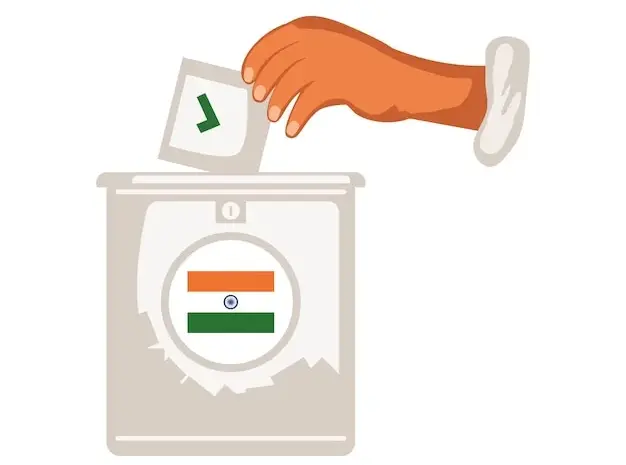
The Assembly elections 2026 results were announced in West Bengal, Tamil Nadu, Kerala, Assam, and Puducherry on 4th May. As a result, strong buying interest was seen in the Indian stock market.
The Sensex rose by 1,000 points or 1.3% to an intraday high of 77,911. On the other hand, Nifty 50 surged by 1.2% to hit 24,290. Believe it or not, in a single session, investors earned nearly Rs.6 lakh crore. There was a surge in the overall market capitalisation of BSE-listed firms from Rs. 463 lakh crore in the previous session to Rs.469 lakh crore.
At the end of the day, Sensex closed at 77,269.40, up 356 points. Nifty was up 122 points and closed at 24,119.30.
How Elections Affect the Psychology of Markets?
The golden rule of finance is that markets hate uncertainty. Before an election, the stock market often trades in a range-bound manner. In other words, markets will go through “pre-election jitters.”
Investors often try to guess which party or coalition will come to power. If the consensus points toward a stable, pro-reform government, generally there will be a rally in the market. The other extreme is the fear of a “hung parliament” or a coalition that might struggle with decision-making. Such a situation often leads to a sell-off.
The stock market reaction to election results is essentially a reaction to the perceived future of economic policy. Will the new government continue the existing infrastructure projects? Will there be a shift toward populist schemes that might increase the fiscal deficit? These are the questions that drive the buying and selling pressure on the result day.
How India has Reacted in the Past?
If we look back at history, we can observe a pattern. In 2004, the markets were shocked by an unexpected result. Finally it resulted in a massive crash and even a temporary halt in trading.
However, once the new government clarified its economic stance, the markets recovered and eventually entered a long-term bull run. In 2014 and 2019, the clarity of a majority mandate led to euphoric celebrations on the floor, with indices hitting record highs.
The takeaway from this example is that while the immediate stock market reaction to election results can be extreme, the dust eventually settles. The market’s long-term trajectory is always tied to corporate earnings, GDP growth, and global economic conditions rather than just the name of the Prime Minister.
Winners: Sectors that Shine

When a stable government is elected, certain sectors tend to outperform the rest of the market. Generally, they are often industries that rely heavily on government spending and policy support.
1. Infrastructure and Capital Goods
Government-led spending on roads, bridges, railways, and ports is a priority for any growth oriented administration. Companies operating in cement, steel, and construction sectors usually see a significant uptick in their order books when a pro-development government takes charge. The market anticipates faster approvals and larger budgetary allocations for these sectors.
2. Defense and Manufacturing
With the push for ‘Make in India’ and self-reliance in defense, this sector has become a darling of the stock market in recent years. Election results that promise continuity in these policies lead to massive interest in defense Public Sector Undertakings (PSUs) and private defense contractors. Investors look for stability in long-term contracts which only a stable government can provide.
3. Banking and Financial Services (BFSI)
A stable government implies a stable economy, which is good for banks. Credit growth usually picks up when businesses feel confident about the political environment. Furthermore, public sector banks often see a re-rating if the government is expected to continue with banking reforms and privatization agendas.
Stock Market Training Reviewed & Monitored by SEBI Registered Investment Advisor
Trusted, concepts to help you grow with confidence. Enroll now and learn to start investing the right way.
Know moreLosers: Sectors that might Struggle
 On the flip side, some sectors might face headwinds depending on the election outcome. If the results suggest a shift toward populist measures, certain industries might feel the pinch.
1. Consumer Staples (Rural Dependence)
Suppose a government focuses heavily on urban infrastructure at the cost of rural subsidies. In that case, companies that rely on rural consumption might see slower growth. At the same time, if a government spends too much on doles and subsidies, it might lead to inflation. This eventually hurts the margins of Fast-Moving Consumer Goods (FMCG) companies.
2. Regulated Industries
Sectors like Oil and Gas or Power are often subject to government pricing controls. An election result that brings in a government prone to “populist pricing” (like freezing petrol prices to curb inflation) can be negative for the stocks of companies in these sectors. The stock market reaction to election results in these cases is often a quick exit by institutional investors.
The Trading Opportunity: How to Play the Volatility
For traders, the period around election results is a goldmine of opportunity—if they can manage the risk. The volatility provides enough “price action” for intraday and swing traders to make profits.
The Pre-Result Strategy
Many traders look at the “Exit Polls.” If the polls predict a clear winner, the market starts moving 2-3 days before the actual result. Traders often take “long” positions in index futures or call options to benefit from a potential gap-up opening on the result day. However, this is high-risk because exit polls can be wrong.
The Result Day Strategy
On the day of the count, the first two hours are chaotic. As trends emerge, the market can swing 3-5% in either direction within minutes. Safe traders often wait for the “First Hour Range” to be broken before entering a trade. If the Nifty stays above its opening price after the first hour of counting, it is generally considered a bullish sign for the day.
The Post-Result Opportunity
The real opportunity for long-term investors comes after the noise dies down. If the market crashes due to a “surprise” result, it often creates a “buying the dip” opportunity in high quality blue-chip stocks. History shows that the stock market reaction to election results is a temporary blip on a long-term upward chart.
The Role of Foreign Institutional Investors (FIIs)
FIIs play a massive role in Indian markets. They prefer political stability and a predictable tax regime. An election result that ensures the continuation of GST reforms, insolvency laws, and ease of doing business will attract billions of dollars in foreign capital. If FIIs start buying post-election, it provides a “floor” to the market, preventing deep falls and pushing the indices to new heights.
3 Common Mistakes to Avoid
Many retail investors lose money during election cycles by following the herd. The 3 common mistakes you should avoid are:
- Over-leveraging: Never make the mistake of trading with more money than you can afford to lose as the volatility can wipe out your capital in minutes.
- Panic Selling: If you are a long-term investor, a 5% drop on result day shouldn’t matter. Your goals are 5-10 years away, not 5 hours away.
- Chasing the Hype: Avoid buying stocks that have already rallied 20% in two days. The “priced-in” factor means the smart money might be exiting just as you are entering.
Join our Online Course and Learn Stock Marketing the Right Way. Enrol Now!
Conclusion
Elections are a cornerstone of our country, and their impact on our finances is undeniable. While the stock market reaction to election results can be a rollercoaster ride of emotions and numbers, it is important to remember that the market is a “weighing machine” in the long run.
It weighs the efficiency of companies and the strength of the economy and it does not matter whether the “bulls” celebrate or the “bears” take control on result day. Whatever be the case, your focus should remain on disciplined investing. Always make sure that you stay informed, keep your emotions in check, and look for opportunities where others see only chaos.
Stock Market Training Reviewed & Monitored by SEBI Registered Investment Advisor
Trusted, concepts to help you grow with confidence. Enroll now and learn to start investing the right way.
Know moreFrequently Asked Questions
Does the stock market always crash after elections?
No. If the result is stable and expected, the market often rallies. Crashes only happen during major unexpected upsets.
Which sector is safest during election volatility?
Large-cap IT and Pharma stocks are often considered “defensive” as they depend more on global factors than local politics.
Should I sell my stocks before election results?
Not necessarily. Long-term investors should hold. Only short-term traders might reduce positions to avoid high volatility.
How long does the election impact last on the market?
The immediate impact usually lasts 1-2 weeks. After that, the market focuses on the Union Budget and corporate earnings.
Are PSU stocks good to buy during elections?
PSUs are highly sensitive to government policy. They can give high returns if a pro reform government wins but are risky.
What is a 'gap-up' or 'gap-down' opening?
It’s when the market opens significantly higher or lower than the previous day’s close due to overnight news (like results).
Can I use Exit Polls for trading?
Exit polls provide a hint but are often inaccurate. Using them for heavy trading is very risky and not recommended.