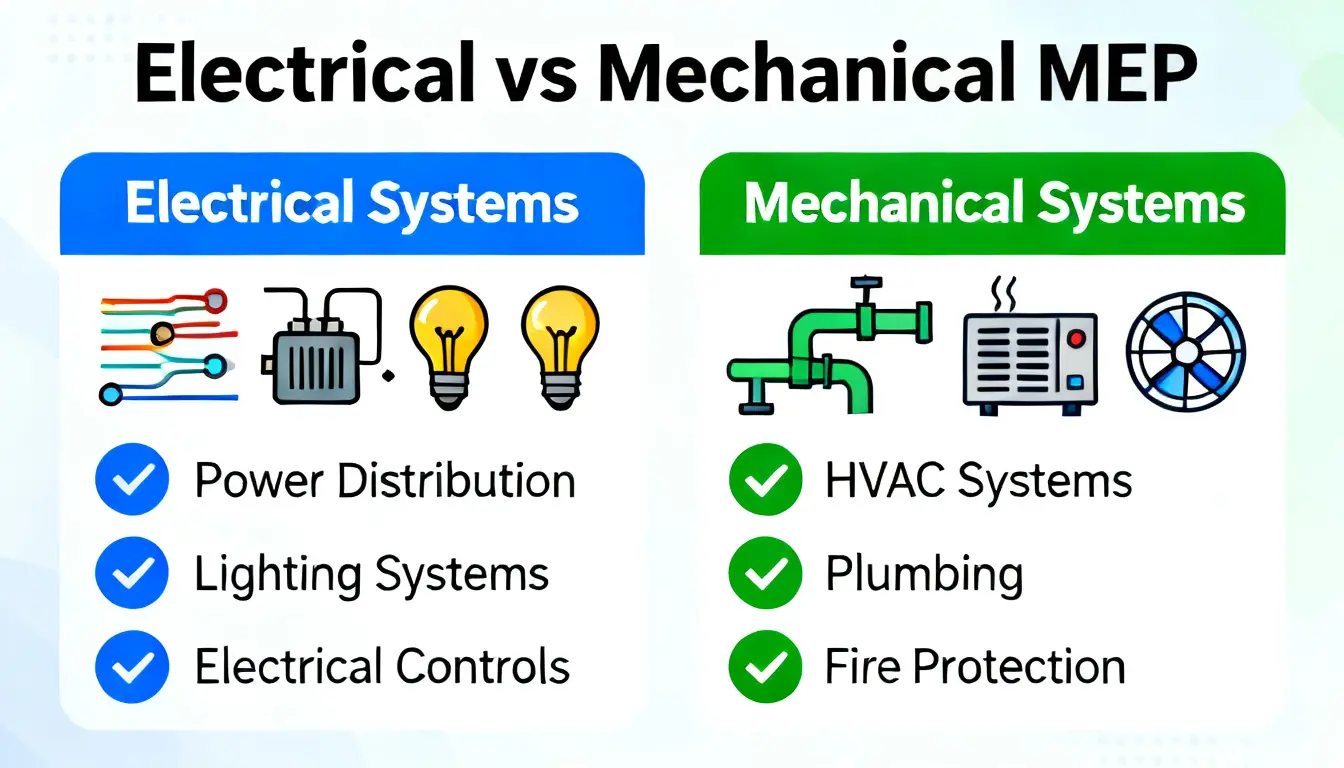
Mechanical MEP is concerned with heating, ventilation, and air conditioning (HVAC), plumbing, and thermal comfort, whereas electrical MEP is concerned with power supply, lighting, and control systems. Both of these are crucial in the building services industry, and they offer excellent career prospects with varying requirements for professional technical skills.
Electrical MEP covers power, lighting, and automation.
MEP mechanically addresses HVAC, plumbing, and thermal comfort.
Both domains are crucial and interrelated in construction.
Both fields provide promising careers, especially in growing markets.
Choose based on electrical or mechanical system interest.
AI and technology improve both, but do not replace engineers.
Design software training and practice are essential.
Career success requires ongoing skill development.
Introduction
At the moment, mechanical, electrical, and plumbing systems, which are abbreviated as MEP systems, are employed in each and every building, both in the infrastructure and in the new construction projects that are being undertaken.
It is necessary for the safety, functionality, and comfort of buildings to include MEP systems, which stand for mechanical, electrical, and plumbing systems, as they are commonly referred to. The provision of water, heat, air flow, and cooling are the responsibility of mechanical systems, whereas the maintenance of power, lighting, and automation are the responsibility of electrical systems.
MEP systems, which are an abbreviation that stands for mechanical, electrical, and plumbing systems, are becoming an increasingly important component for students, engineers, and professionals that are interested in achieving success in the building industry.
Due to the fact that every job requires a unique collection of information, interests, and talents, it is of the utmost importance that you choose a suitable career path based on the skills you possess and the objectives you have for your professional life.
What Does MEP Stand For?
The MEP acronym stands for Mechanical, Electrical, and Plumbing. The three fundamental engineering systems in a building provide safety and efficiency. Plumbing supplies water, drainage, and firefighting systems, Electrical powers, lights, and safety systems, and Mechanical provides HVAC. MEP systems are the foundation of residential, commercial, and industrial building comfort, safety, and usability.
Why MEP Roles Matter in Modern Construction?
It is important for MEP responsibilities to be present in modern construction because they are responsible for forming the vital systems that ensure the functionality, safety, and comfort of any structure. In order to guarantee that buildings are equipped with adequate power supply, lighting, heating, cooling, ventilation, clean water, drainage, and fire prevention systems, mechanical, electrical, and plumbing engineers are responsible for maintaining these systems. MEP systems are essential to the successful operation of any structure, regardless of how well it was built. The Mechanical, Electrical, and Plumbing (MEP) industry is an essential component of residential, commercial, and industrial construction projects because it plays a significant position in energy efficiency, smart building automation, safety compliance, and sustainability in modern construction.
Electrical MEP vs Mechanical MEP: Core Difference
What is Electrical MEP?
Electrical, mechanical, and plumbing, sometimes known as MEP, is a subfield of building services engineering that is responsible for managing all of the electrical systems that are required for stable and effective operation during construction.
Distribution of electrical power, lighting, wiring, fire alarms, emergency power supply (generators and UPS), closed-circuit television, and building automation controls are all included in this department. These systems are designed, constructed, and maintained by electrical engineers that specialise in MEP.
They want to make sure that electrical equipment used in homes, businesses, and factories is safe, dependable, and powered so that they can fulfil their mission.
What is Mechanical MEP?
In the field of building services engineering, the term “Mechanical MEP” is used to refer to the portion of the profession that is concerned with the operations of the systems that control the temperature, air, and water within a building.
Systems such as plumbing, drainage, water supply systems, and fire prevention systems such as sprinklers and pumps are included in this category of electrical components. Assuring that homes, businesses, and factories have enough air quality, thermal comfort, clean water, and safe ways to handle waste and fire are the responsibilities of engineers who work on the design, installation, and maintenance of mechanical, electrical, and plumbing systems.
Gain in-depth knowledge of Mechanical, Electrical, and Plumbing (MEP) Design with expert-led courses. Learn HVAC, fire safety, sustainable building strategies, and BIM applications to excel in the construction industry.
Electrical systems, including power and lighting systems
Heating, ventilation, and air conditioning, plumbing, and thermal comfort
Primary Tasks
Design of electrical systems, wiring, and distribution of loads
System design for heating, ventilation, and air conditioning, water supply, and drainage
Systems That Are Crucial
Automated lighting, fire alarms, power distribution, and emergency lighting
Firefighting, heating, ventilation, and air conditioning
Primary Abilities
Construction of circuits, calculation of loads, and control systems
Heat and fluid mechanics, thermodynamics, and
Calculations for heating, ventilation,
Common Software
ETAP, AutoCAD, and Dialux
AutoCAD, Revit MEP, HAP
Work Nature
More design and control-oriented
More site execution and system installation
Primary Goal
Ensure safe and efficient power supply
Ensure comfort, air quality, and water systems
Career Roles
Electrical MEP Engineer, Design Engineer
Mechanical MEP Engineer, HVAC Engineer
Industry Demand
High in buildings, infrastructure, smart systems
High in construction, industrial, and HVAC projects
Career Scope and Job Opportunities
Both Electrical Mechanical, Electrical, and Plumbing (MEP) offer strong and steady job prospects. This is due to the fact that any construction project, whether it be residential, commercial, or industrial, requires both systems to perform efficiently.
Especially in nations such as the United Arab Emirates, the Gulf Cooperation Council region, India, and Europe, the demand for mechanical, electrical, and plumbing engineers is growing as building and smart infrastructure continue to expand.
Career Scope in Electrical MEP
Electrical mechanical, electrical, and plumbing workers are in high demand as a result of the proliferation of energy-efficient systems, automation, and smart spaces. The following are some of career roles:
Electrical Design Engineer
Site Engineer (Electrical)
Building Automation Engineer
Power Systems Engineer
Fire Alarm and Low Current Systems Engineer
Career Scope in Mechanical MEP
Mechanical MEP experts are needed on every construction site because HVAC, plumbing, and firefighting systems are all important for the building to work. Some of the jobs in a career are:
HVAC Design Engineer
Mechanical Site Engineer
Plumbing Engineer
Fire Protection Engineer
Commissioning Engineer
Advantages and Concerns
Electrical and mechanical engineering and construction (MEP) areas are both crucial in the building industry and offer great career options; yet, each field comes with its own set of advantages and difficulties.
Advantages of Electrical MEP
Demand is high in contemporary projects involving automation and smart buildings
Strong professional growth opportunities in the Internet of Things, artificial intelligence-based building systems, and energy management
The potential for growth in the areas of electricity distribution, safety systems, and renewable energy
A broad range of possibilities for commercial and industrial projects
Concerns in Electrical MEP
A strong understanding of both the technical design and the safety requirements is required in order to fulfill this requirement.
Continuous education is required since technological advancements are constantly being made.
A very high level of responsibility is required to ensure that the electrical safety of buildings is protected.
Advantages of Mechanical MEP
Continuous demand across all construction projects worldwide
Plumbing, fire protection, heating, ventilation, and air conditioning are installed in every construction.
Work with hospital, mall, airport, and other staff.
Long-term stable infrastructure construction
Concerns in Mechanical MEP
Working on a site can be hard on the body and require a lot of time in the field.
Needs to know a lot about complicated thermal and fluid systems
Problems with coordinating with other engineering teams on site
Gain in-depth knowledge of Mechanical, Electrical, and Plumbing (MEP) Design with expert-led courses. Learn HVAC, fire safety, sustainable building strategies, and BIM applications to excel in the construction industry.
The water, power, and industrial requirements of contemporary buildings are met by mechanical, electrical, and plumbing (MEP) systems. They work together to create environments that are not just secure but also practical and pleasant to be in.
Electrical mechanical engineering, on the other hand, is responsible for all things related to electricity, including lighting and computer systems. Plumbing, heating, and cooling are all areas that fall under the purview of mechanical engineering, which covers mechanical engineering.
The alternative that best suits your abilities, interests, and career aspirations should be chosen rather than the option that is considered to be the “better” option. Working in the field of mechanical, electrical, and plumbing engineering, sometimes known as MEP engineering, is a job that is both secure and gratifying.
People all around the world are interested in both jobs, and this will continue to be the case for a considerable amount of time.
Gain in-depth knowledge of Mechanical, Electrical, and Plumbing (MEP) Design with expert-led courses. Learn HVAC, fire safety, sustainable building strategies, and BIM applications to excel in the construction industry.