Table of Contents
Learning English is a gateway to work and career advancement. Your English ability is important whether you want a new job or to improve your performance. You can express yourself, build relationships with coworkers, and impress customers and superiors with good communication skills.
English may increase your security, relationships, prospects overseas, and ability to take responsibility for others. This essay discusses techniques to improve your employment, communication, and career prospects.
How to learn English at home! Learn English with Entri Now!
Why English Speaking Skills Matter for Career Growth
English has become the prevalent industrial standard for communication, technology, and commerce as a result of the interconnectedness of the contemporary world. People from a variety of countries, cultures, and professions are brought together by it. Your professional destiny can be significantly influenced by your proficiency in English, regardless of whether you are employed by a local or global organisation.
When you master English, you can:
- Maintain self-confidence when talking with clients, coworkers, and superiors.
- Interviews, presentations, and meetings require your best effort.
- Effectively expressing your thoughts can boost your work relationships.
- Take advantage of global career, educational, and joint venture opportunities.
- Being well-prepared and professional shows that you want to impress an audience.
To be considered for leadership, promotions, and abroad postings, many companies want individuals to speak English well. People listen to you and trust your leadership talents when you talk with conviction.
| Free PDFs for download | |
Common English Speaking Problems at Work
1: Which of the sentences below is grammatically correct?
Even with decent written English, many professionals fail to talk confidently at work. The workplace requires rapid thinking, good communication, and fluid concept expression, which can be difficult. The following are common professional English-speaking issues:
- Mistake phobia
Many people avoid speaking due to grammatical or pronunciation issues. Fear typically hinders fluency and confidence. - Few Words
Repeating words can make your speech sound simple or imprecise. Lack of vocabulary makes it hard to describe thoughts precisely. - Poor Pronunciation
Disagreements might arise in international meetings and phone conversations due to poor pronunciation. - Low Confidence
Even when they have good ideas, nervousness and self-doubt prevent people from speaking out in conversations. - Trouble understanding accents
Global workers speak English with varied accents. Understanding and responding fast can be tough. - Native-language translation
Thinking in your native tongue before speaking English slows you down and reduces fluency.
Spoken English Course for Guaranteed Confidence and Career Growth
Spoken English Course by Entri App: Enhance your communication skills, gain certification, and boost your career with confidence.
Join Now!English Speaking Tips for Freshers
In their first year, students may struggle to speak English confidently. The first year of school can be difficult for students. However, if you practice and utilize the right technique, learning a language may get easier with time. This lets you improve your linguistic skills. Enhancing your English abilities makes it simpler to speak with others and boosts your confidence in job interviews, presentations, and daily interactions. Because you’ll speak easier. Because it simplifies communication. This is why it helps. You must remember the following, as they are crucial:
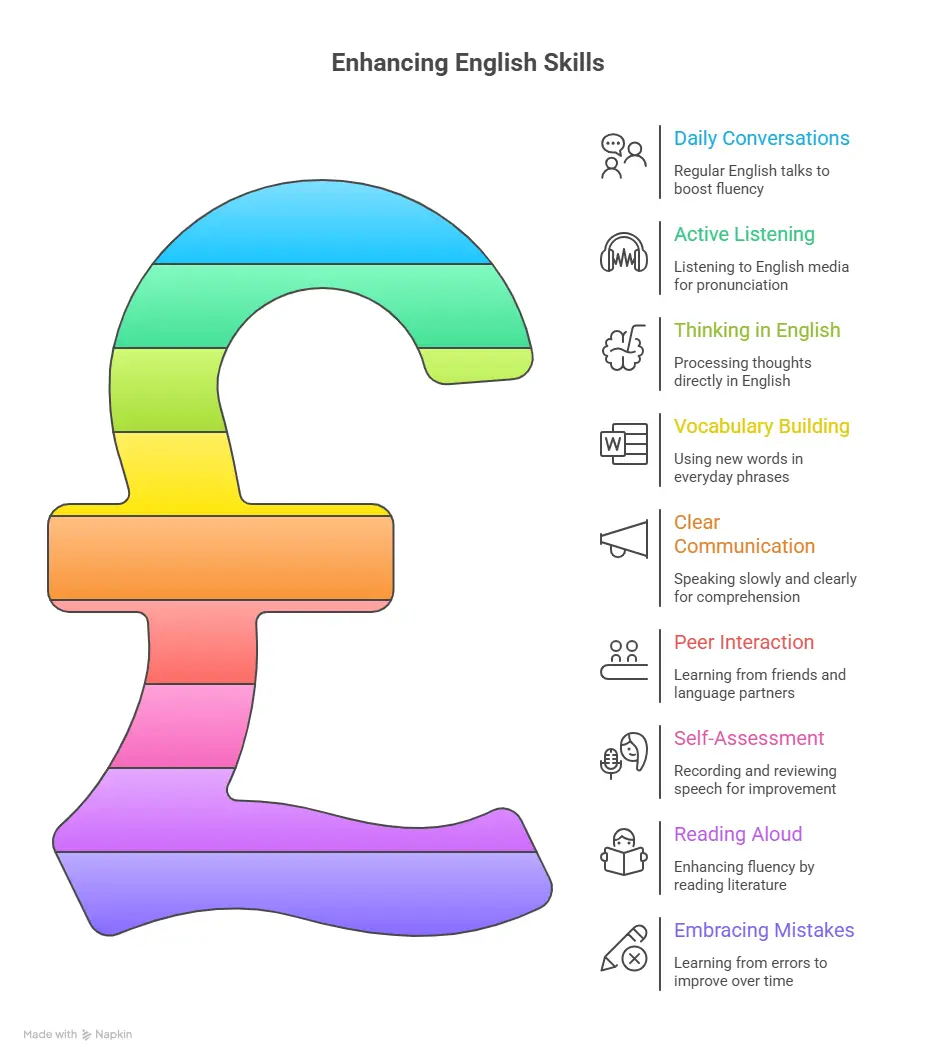
- It is to your advantage to have talks in English on a daily basis, even if they are only for a short amount of time. This will only help you improve your English language skills. Over time, fluency will increase as a result of consistent practice, which will lead to improvements.
- The practice of active listening is a method that can assist you in enhancing your pronunciation, modifying your vocal tone, and writing phrases. Watching films in English, listening to English news programs, or
- Listening to podcasts in English are all excellent way to improve active listening.
Instead of translating from the language that you normally speak, you should make an effort to think directly in English (English). Participate in the process of acquiring English language skills. - You should engage in frequent study and apply the new language in everyday phrases in order to incorporate new vocabulary into your active vocabulary. This will help you absorb new vocabulary. Your vocabulary will be able to become more comprehensive as a result of this.
- I ask that you please explain your thoughts in a manner that is slow and clear: It is more vital to make an emphasis on clarity than it is to place an emphasis on speed when it comes to lowering the amount of errors and further boosting comprehension.
- Individuals’ Conversations with One Another: Those individuals who are interested in learning via experience will discover that chatting with friends, teachers, or online language partners is beneficial to their language learning endeavors.
- This is a fantastic technique to assist in the finding of grammatical or verbal difficulties, as well as the evaluation of your development. Recording oneself and doing an aural self-assessment is a smart way to do this.
- By reading out loud, you can enhance your reading and verbal fluency. This is because reading out loud gives you the opportunity to articulate works of literature such as plays, essays, and novels.
- It is important to remember that making errors is an essential component of the learning process, you should not be afraid of them. Not being frightened of making mistakes is something that will serve you well in the long run. There is a correlation between increasing the amount of time spent practicing and a lesser number of errors made over the course of time.
Speak confidently and fluently with our Spoken English Course!
English Speaking Tips for Working Professionals
English proficiency is essential for working professionals. Leadership, teamwork, and job advancement require strong English communication. This is because English is the language of English. English proficiency helps build trust and trustworthiness. Whether presenting ideas, leading a team, or talking to customers. No matter the communication context, this is true. At work, try these tips to improve your communication skills:
- Speak more like a business person than you usually do.
Find out how to converse about things in your field. You may make sure that your message is clear and precise by utilizing the right words. - Get together with other people and be a part of them.
Don’t be hesitant to voice what you believe and feel. “I’d like to add…” and “In my experience…” are two phrases that will make you sound polite and confident. - Check to see if your voice and words sound right.
Keeping the lines of communication open and stable. For conversation to succeed, it needs to be clear; hurried is not. - Try to receive good feedback.
You should talk to your employer or coworkers about what you’re doing wrong. Giving feedback all the time speeds up the process of progress. - Good communication at work.
People who write emails, reports, and tales for a living can talk about how to use tone and structure. The first thing you should do is practice talking in ways that are comparable. - Use technology to assist you study.
You can stay up to date by going to workshops, listening to business podcasts, or using language-learning tools. - Don’t lose your calm.“Could you please…” and “Thank you for your time” are two examples of polite phrases that can aid you. This is a professional move that displays respect.
- Do not leave the room.
Even if you already know enough of the language to get by, taking classes can help you keep up to date and flexible.
How to Speak Confidently in Meetings
When you are at a meeting with other people, one of the most effective ways to leave a positive impression on them is to demonstrate that you are capable of communicating effectively. In spite of this, a significant number of individuals are reluctant to express their opinions, particularly when they are in the company of a large group of people or when they are in the company of an elderly person. There is a possibility that you may be able to confidently meet expectations if you put in some effort to prepare, gain some experience, and have an optimistic outlook. Be sure to have a look at these helpful recommendations:
- Prep before the event.
Check the meeting agenda and highlight your top issues or ideas to share with the company. Preparations can enhance your confidence and give you new views. - Start with minor contributions.
Having many words isn’t necessary. Start by agreeing with someone’s idea or asking a brief question on the topic. After a while, you’ll feel comfortable contributing more. - Use straightforward language throughout.
Avoid complicated vocabulary and long sentences when talking. Simple language is usually more effective than complex syntax for communication. - Always make eye contact and use pleasant body language.
When appropriate, smile, make eye contact, and sit up straight. It shows your involvement and self-confidence. - Speak slowly and calmly.
When anxious, people speak too quickly. Consider taking deep breathes, pausing between sentences, and speaking slowly to appear more confident and in control. - Be attentive when listening.
Be attentive to others’ comments. It keeps the discourse relevant and helps you answer appropriately. - When employing phrases, be professional.
Use phrases like these: I want to discuss this with you. Bringing up the topic is obviously fascinating. Please note that…”Should I dare…Because of my achievements…” - Own your faults.
If you say anything wrong, apologize and proceed. Everyone makes mistakes, but self-confidence and clear thinking are most important.
Speaking confidently in meetings isn’t about being perfect; it’s about expressing your ideas clearly and participating actively. The more you practice, the more natural and professional you’ll sound.
Spoken English Course for Guaranteed Confidence and Career Growth
Spoken English Course by Entri App: Enhance your communication skills, gain certification, and boost your career with confidence.
Join Now!Daily English Practice Tips for Career Success
For the purpose of improving your English-speaking abilities, it is not required to devote a significant amount of time to studying on a daily basis; rather, continuous practice on a daily basis is sufficient. It is possible to significantly improve your fluency, confidence, and ability to communicate effectively in the workplace by establishing even the most basic of habits. Incorporating English language practice into your daily routine can be accomplished in a variety of efficient methods, including the following:
- Daily English Reading
Read 10–15 minutes of English newspapers, blogs, or professional publications. This aids vocabulary and sentence comprehension. - Hear English Daily
Follow English news, YouTube talks, and field-related podcasts. Regular listening enhances pronunciation, accent, and sentence flow. - Use English Whenever Possible
Talk to friends, coworkers, or yourself in English! More speech feels natural. - Five New Words Daily
Write down, understand, and utilize new words in sentences. It quickly expands your vocabulary. - Talk Recording
Record yourself talking for one minute on a daily routine or job assignment. It helps you find improvement areas. - In English, think
Think in English instead of translating. Improves fluency and decreases hesitancy. - Brief Journal
Write a few paragraphs about your English education to end the day. Writing helps with sentence formation and recall. - Try Technology
Develop speaking and listening skills with English-learning applications or online groups.
Consistency is the key to success. Even 20 minutes of focused English practice every day can transform your communication skills and boost your professional confidence.
Speak confidently and fluently with our Spoken English Course!
How Spoken English Improves Job Opportunities
Speaking and understanding English is a highly desired professional ability in the worldwide job market. Employers desire someone who can communicate with international clients, coworkers, and teams. Being fluent in English helps you get employment, advance faster, and work internationally.
If you speak and write English fluently, you may have greater work prospects:
- Improving job conversations
Speaking English well lets you say anything in a job interview. They’ll choose you if you look good. - Write Well for Business
Employers demand clear communicators for meetings, speeches, and client calls. - Open global employment markets
Many companies worldwide need English-speaking workers for international initiatives. You can work or study overseas if you speak English well. - Communicate More
You must speak English to attend conferences, develop international friends, and do business. - Opportunities to advance
Communicators often hold leadership and customer-facing positions. Speaking multiple languages boosts honesty and confidence. - Better reputation for all
Potential managers will perceive your confidence, knowledge, and skill when you speak appropriately.
You must speak and write English well for spotlight, work, and promotion. Better communication increases chances.
Conclusion
Making improvements to your level of English proficiency is one of the most beneficial things you can do for the work prospects that you may have in the future. One of the most important skills for leaders to possess is the ability to communicate effectively, regardless of the specific field of knowledge they already hold.
When it comes to things like stress management, communication, and participation in the workplace, knowledge of English is far more favorable than knowledge of other languages. While having excellent grammar and accentuation is important, having confidence and being honest are much more important. The possession of these objects is not required in any way. These two characteristics are definitely vital in a substantial sense, and they are both essential.
In order to accomplish one’s objectives, time is what is required. You should make it a habit to interact with the English language on a regular basis by engaging in activities such as reading, listening, talking, and thinking. This will help you improve your fluency in the English language. Not only does the passage of time improve your perception of yourself, but it also broadens the range of opportunities that are available to you about your professional life.
Spoken English Course for Guaranteed Confidence and Career Growth
Spoken English Course by Entri App: Enhance your communication skills, gain certification, and boost your career with confidence.
Join Now!Frequently Asked Questions
Why are English speaking skills important for career growth?
English is the global language of business. Good communication skills help you express ideas clearly, build confidence, and connect with professionals worldwide.
How can I improve my English while working full-time?
Dedicate 15–20 minutes a day to reading, listening, or speaking practice. Even short, consistent efforts make a big difference.
What are some daily habits to improve spoken English?
Read English articles, watch English videos, speak with friends or colleagues, and learn five new words each day.
Can good English help me get a better job?
Yes. Fluent English increases your chances of performing well in interviews, handling clients, and qualifying for international roles.
Is grammar important in spoken English?
Yes, but communication matters more. Focus on expressing ideas clearly—grammar will improve naturally with practice.
What’s the best way to sound confident while speaking English?
Prepare key points, maintain eye contact, speak slowly, and use simple, clear language. Confidence comes from practice, not perfection.