Table of Contents
How to crack the Google interview in 2026? To crack the Google interview in 2026, you need to do the following: write code using strong problem-solving skills, write algorithms using data structures, practice system design questions for senior roles, and prepare stories that show leadership and Googliness using the STAR method. The entire process, from first contact to offer, typically takes four to eight weeks and tests far more than your coding speed.
Key Takeaways
- The Google interview process includes resume screening, technical phone screens, and 4-6 onsite rounds covering coding, system design, and “Googliness” .
- For software engineers, mastery of arrays, trees, graphs, and dynamic programming is non-negotiable.
- Experienced candidates face system design questions requiring knowledge of scalable architecture, caching, and load balancing.
- The “Googliness” round evaluates cultural fit through questions about conflict, failure, and collaboration.
- Candidates should clarify requirements before coding, think aloud during problem-solving, and optimize initial solutions.
1. About the Company
Google is a multinational tech giant that’s been around since 1998, when two Stanford University PhD students started it all. These days, the company is headquartered in Mountain View, California, a place it’s been for a while now. To give you a sense of just how massive Google has grown it now employs over 180,000 people, and generates more than $300 billion in revenue every year from advertising and all the other stuff its got going on.
Experience the power of our web development course with a free demo – Enroll now!
2. Google Interview Process (2026 Updated)
1: Which of the following data structures allows elements to be added and removed in a Last-In, First-Out (LIFO) order?

So here’s the lowdown on the Google interview process – its a pretty standard, multi-step drill that they follow & each interviewer has to calibrate with the others. What Im saying is that no one person gets the final say, the hiring committee reviews all feedback independently.
When they first start looking at resumes, theyll give a quick once-over to see if you really have some solid foundation in computer science, and that youve got some decent projects under your belt with actual numbers to back up your claims (like ‘managed to shave 20% off the latency’ or ‘handled 100,000 requests without breaking a sweat’). And let me tell you, a resume with all these kinds of achievements formatted neatly and to the point is gonna get a whole lot more attention from the recruiters.
Online Test:
For entry-level roles or those with little experience, the candidate is given a 60-90-minute coding test consisting of 1-2 medium-to-hard algorithmic problems that are centered around algorithms and data structures.
Technical Phone Screen
This is a 30 to 60-minute interview conducted via Google Meet or Hangouts. Candidates solve one or two problems by coding in a shared Google Doc that does not have auto-completion.
Technical Interviews (2 to 3 Rounds)
Each round consists of one or two coding questions. Common topics include arrays, hashing, trees, graphs, recursion, and dynamic programming. Interviewers evaluate candidate’s clarification of problem requirements, logical problem-solving approach, code structure, and attempts at code and time complexity improvement.
System Design Interview (Experienced Roles)
For experienced roles, this round of interviewing is conducted with 3+ years of experience candidates. This interview focuses on designing scalable APIs, Distributed System Design, database schema design, database selection, caching mechanism, and load balancers. Interviewers look for clarity in the proposed system design and understanding the trade-offs of their design decisions.
Googliness and Leadership Round
This assessment focuses on cultural fit and teamwork potential. Questions revolve around navigating uncertain situations, resolving disagreements, leading others, and deriving lessons from mistakes. Respondents should provide organized, result-oriented responses.
Review by Hiring Committee
All feedback from interviewers is independently reviewed by a centralized hiring committee. The committee calibrates the feedback and makes recommendations for hiring at the various levels.
Team MatchingIf approved, candidates discuss with potential managers to align skillset and team needs. This stage can take weeks, depending on team availability.
- 💡 Average Duration: 4 to 8 weeks
- 💡 Difficulty Level: Very High
- 💡 Acceptance Rate: ~2%
Build Better, Together. 🛠️ Join the Entri Coding Community!
Beyond syntax, there’s strategy. 🚀 Join our subreddit for: Exclusive Coding Roadmaps 📍,Project Case Studies 📂 ,Interview Prep Tips 💡and more
👉 Join our Reddit community3. Google Technical Interview Questions (Role-Based)

For Software Engineers
DSA Questions
- Find the lowest common ancestor of two nodes in a binary tree .
- Write a program to detect a cycle in a graph .
- Find the longest increasing subsequence from an array .
- Implement a queue using two stacks .
- Write a program to return all possible IP address combinations from a string of digits .
System Design
- Design a URL shortening service like TinyURL .
- Design a global ride-hailing service with multiple payment methods .
- Design an API rate limiter for a distributed system .
- Design a chat application like WhatsApp .
Coding Rounds
- Question: “Write a program to determine if a given binary tree is a binary search tree.”
- Answer Approach: Perform an in-order traversal and check if values are sorted. Alternatively, recursively validate that each node’s value falls within a valid range (min, max). Communicate both approaches, explain why recursion works well here, and handle edge cases like null nodes or duplicate values .
For Data Analysts
SQL
- Use window functions to calculate running totals or moving averages.
- Write queries with multiple CTEs to decompose complex logic .
Python
- Manipulate DataFrames using Pandas for data cleaning and aggregation.
- Implement statistical tests to validate A/B test results .
Case Studies
- Question: “How would you analyze user engagement trends for a new Google Maps feature?”
- Answer Approach: Define key metrics like feature click-through rate, usage frequency, and retention. Identify data sources such as user behavior logs. Segment users by geography or device type. Build a funnel analysis to spot drop-off points. Communicate findings to stakeholders with clear visualizations .
For Product Managers
Product Design
- “Design a product for seniors who want to use technology.” Focus on simplified interfaces, voice control, and family admin features .
- “Improve Google Maps for cyclists.” Consider different cyclist profiles, real-time obstacle reporting, and air quality integration .
Estimation
- “Estimate the number of gas stations in the United States.” Walk through assumptions logically, such as population, vehicles per person, and stations per vehicle.
Metrics
- “Define success metrics for YouTube Shorts.” Balance views, watch time, creator retention, and cross-pollination to longer videos .
Experience the power of our web development course with a free demo – Enroll now!
4. Real Interview Experience (Story Format)
My first round was plodded through a massive dataset. I was asked to write a search algorithm that could give me results. I described a brute force approach, had to pull out some stats on its time complexity and how it would never scale. The interviewer nodded along, then asked how I’d be able to make it better. I proposed indexing the data and had a chat with her about the trade-offs between slapdash memory use and straight-up speed. She then threw me a curveball –
“What if this data is spread across multiple servers?” – and I was stuck for a second, before getting my head around it and pitching consistent hashing. By that point we were both scribbling out bits on the whiteboard. I’d been asked to give a perfect answer off the bat and I didn’t know it, but what I did know was that I could think on my feet and I was still in the running.
My round for Googliness was some pretty intense one-on-one interviews. The interviewer asked me to describe a time when I disagreed with my manager. I told a story about a project where I thought we were botching a solution for just a handful of users. I explained how I went out and got my facts straight to back up my viewpoint, then scheduled a meeting with my manager to run over the numbers and propose an alternative plan. We did a small experiment in the end and in the end my manager’s solution turned out to be better for scaling long-term. The interviewer looked impressed and said, “That’s exactly how we sort that sort of thing out here, with respect and a little bit of data – although hopefully without the two weeks it took us to get to the end of that experiment!”
5. How to Crack Google Interview (Step-by-Step Strategy)

Step 1: Mastering the DSA
Focus on arrays, hashing, trees, graphs, recursion, binary search, and dynamic programming. Get a good few hundred practise problems under your belt that range from easy to hard, and think about pattern recognition rather than just trying to memorise the answers
Step 2: Mock Interviews
Having a mock interview with a hiring manager or a colleague is some of the best feedback you can get. It helps with your communication skills, timing and reliving the experience of talking on your feet. Plus it shows you how to articulate your thought process.
Step 3: Build Projects
Get some projects that you can really be proud of and can actually show off to people. Write up what you’ve achieved, e.g. how much latency you cut or what sort of traffic your app can handle. When you’re presenting them, use the STAR format to tell the story.
Step 4: Leadership Principles
Get 6-8 solid stories of where you’ve demonstrated some good leadership qualities, such as conflict resolution, failure and collaboration. Get them down pat so that you can adapt them to whatever the interviewer throws at you.
Step 5: Time Management
Plan on at least 10 weeks of solid prep work. Spend the first 4 weeks getting your head around the core concepts, the next 4 weeks getting good at solving problems and doing mock interviews, and then the last 2 weeks fine-tuning your system design and behavioural answers.
Build Better, Together. 🛠️ Join the Entri Coding Community!
Beyond syntax, there’s strategy. 🚀 Join our subreddit for: Exclusive Coding Roadmaps 📍,Project Case Studies 📂 ,Interview Prep Tips 💡and more
👉 Join our Reddit community6. Common Mistakes Candidates Make
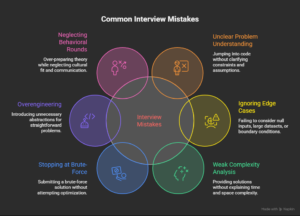 Jumping into code without clarifying the problem. Many candidates begin coding immediately without confirming constraints, assumptions, or edge cases. This leads to incorrect solutions or rework .
Ignoring edge cases. Failure to consider null inputs, large datasets, or boundary conditions signals incomplete problem analysis .
Weak complexity analysis. Providing a working solution without explaining time and space complexity is treated as incomplete. Candidates must justify performance trade-offs explicitly .
Stopping after the first correct solution. Submitting a brute-force solution without attempting optimization weakens evaluation. Interviewers expect refinement toward efficiency .
Overengineering simple problems. Introducing unnecessary abstractions for straightforward problems reflects poor judgment rather than sophistication .
Over-preparing theory while neglecting behavioral rounds. Strong technical answers cannot compensate for weak cultural fit or poor communication .
7. Salary Insights
Compensation at Google is competitive and heavily equity-driven. Packages vary by level, location, and experience. The figures below represent total compensation ranges including base salary, annual bonus, and restricted stock units (RSUs) for US-based roles.
| Role / Level | Experience Level | Total Compensation Range (Annual) |
|---|---|---|
| Software Engineer L3 | Entry-level (0-2 years) | $150,000 – $200,000 |
| Software Engineer L4 | Mid-level (3-5 years) | $200,000 – $300,000 |
| Software Engineer L5 | Senior (6-8 years) | $300,000 – $450,000 |
| Software Engineer L6 | Staff (8+ years) | $450,000 – $600,000+ |
| Data Scientist / Product Analyst | Mid to Senior | $180,000 – $280,000 |
| Product Manager | Mid to Senior | $200,000 – $350,000 |
| Research Scientist (AI/ML) | PhD / Senior Level | $300,000 – $700,000+ |
Note: Figures are approximations based on industry data from levels.fyi and public compensation reports. Actual offers vary by location, interview performance, and specific team budgets.
8. Final Verdict Section
The Google interview process is notorious for being a real challenge – & thats exactly the point. With an estimated success rate of around 2%, the company sets out to put candidates through their paces – in a bid to test ’em beyond just their technical know-how. Interviewers are looking for more than just ones technical chops – they want to see how well you can think on your feet when faced with tricky problems, how you go about explaining your ideas, & whether or not you’re able to break down complex problems into manageable bits.
So who’s a good fit for this rather daunting challenge ? The opportunity is well suited to engineers, data scientists & product managers who have a passion for solving really big problems and building solutions that can actually change people’s lives – whether its millions, or billions of users. Candidates who’ve got a solid foundation in their field, a genuine curiosity & a willingness to learn are going to do pretty well here.
Experience the power of our web development course with a free demo – Enroll now!
Final Preparation Checklist
- Master core DSA topics: arrays, trees, graphs, DP
- Practice 100+ coding problems with pattern recognition
- Complete 5–10 mock interviews with feedback
- Prepare 8 behavioral stories using STAR format
- Study system design fundamentals for experienced roles
- Clarify requirements before coding during interviews
- Think aloud and explain trade-offs clearly
Build Better, Together. 🛠️ Join the Entri Coding Community!
Beyond syntax, there’s strategy. 🚀 Join our subreddit for: Exclusive Coding Roadmaps 📍,Project Case Studies 📂 ,Interview Prep Tips 💡and more
👉 Join our Reddit communityFrequently Asked Questions
How long does the Google interview process take?
The complete process from application to offer typically takes 4 to 8 weeks. Factors like team matching and committee reviews can extend this timeline depending on role availability and candidate volume.
Does Google ask LeetCode hard questions?
Yes, Google frequently asks LeetCode medium to hard questions. The focus is on problem-solving approach and optimization rather than memorization. Candidates should practice pattern recognition across arrays, trees, graphs, and dynamic programming.
Is system design asked for entry-level roles?
No, system design is generally not asked for entry-level L3 roles. It becomes mandatory for L4 and above positions. Entry-level candidates focus on coding, algorithms, and foundational computer science concepts.
What is the Googliness round?
The Googliness round evaluates cultural fit and behavioral alignment. Interviewers assess collaboration, intellectual humility, comfort with ambiguity, and how candidates handle conflict, failure, and feedback using real past experiences.
How many rounds are in the Google onsite interview?
The onsite interview typically includes 4 to 6 rounds. This covers 2 to 3 coding rounds, 1 system design round for experienced roles, 1 Googliness round, and sometimes a lunch or extra discussion round.
Does Google conduct interviews virtually?
Yes, Google conducts most interviews virtually through Google Meet or its proprietary video platform. Candidates share code using a Google Doc or CoderPad-style interface without auto-completion features.
What is the acceptance rate for Google interviews?
The estimated acceptance rate is approximately 2%. This reflects the high volume of applications, rigorous screening, and multi-level hiring committee review process that ensures consistent quality standards.
Can I switch teams after joining Google?
Yes, Google encourages internal mobility. Employees can apply for new roles after 12 to 18 months through the internal transfer process, subject to performance and team manager approvals.
What coding languages are accepted in Google interviews?
Google accepts most mainstream languages including Python, Java, C++, and Go. Candidates should choose a language they are most comfortable with for efficient problem-solving and clear communication.
How far in advance should I prepare for Google interviews?
Most successful candidates prepare for 10 to 12 weeks. This includes 4 weeks for concept revision, 4 weeks for active problem-solving, and 2 to 4 weeks for mock interviews and behavioral story preparation.