Table of Contents
Introduction
Been through that A1 German course and now you’re wondering how to actually have a conversation in German, but still finding yourself stuck on a few words? Don’t worry – you’re far from alone. a lot of learners are stuck at the same point and end up asking the same question – how long is it going to take to actually be able to speak German fluently?
The A2 level thats where the real progress starts to happen. That is when the complete beginner is transformed into a person that has all the necessary abilities to cope with day-to-day tasks in German – ordering food, asking for directions and discussing their favorite pastimes. It is here that the usefulness of the language becomes evident.
The Straight Answer
It will normally take between 150 and 250 hours of effort before you reach the A2 stage in German. With daily practice of two or three hours, you can reach it within two months. In case you can put in five to ten hours of study weekly, then you will likely spend four to six months on it. On the other hand, if you study slowly on your own, putting in just a few hours weekly, you may require six to twelve months.
Key Takeaways
1: How do you say "Good Morning" in German?
- Most people need 150 to 250 hours of study to reach A2 level – and that’s not just class time, it includes homework and self-practice too.
- Intensive learners can crack A2 in 2 to 3 months, while regular learners might need 4 to 6 months. And then there are the casual learners who take 6 to 12 months.
- As is often the case, how well you do depends on consistency, how much practice you get, any language experience you already have, how you study, and of course, how much speaking practice you get.
- Putting together a structured plan that includes daily vocabulary practice, listening and speaking will seriously cut down on your learning time.
Free German A1 Mock Tests – Powered by AI!
Test your skills on our interactive platform. Get instant feedback from our AI to help you communicate better and track your progress. Start your free German mock test now.
Test Your German A1 for FreeWhat is A2 Level?

The CEFR is an international standard for measuring language ability. It breaks language skills down into six levels: A1, A2, B1, B2, C1, and C2. A1 is for complete beginners, and A2 is the next step up – a bit of a bigger step, but still very achievable.
At the A2 level, you can start to understand sentences on everyday stuff like family, shopping, work, and where the local shops are. You can have simple conversations that require a direct exchange of information – basically, you can get your point across. You can tell people a bit about yourself, what you study, and what your immediate needs are.
In simple terms, an A2 learner can do all these things:
- Order a meal at a restaurant without having to point at a picture on the menu board.
- Ask a stranger where something is – not with a map or even an app – but just with a simple “Excuse me, can you tell me where…”
- Have a conversation about what they did last weekend, without stumbling over their words much.
- Write a short email or even text to a friend without needing to look up every sentence.
- Understand signs and basic announcements and announcements in a German speaking environment.
Learn A2 German in your own language! Get free Demo Classes Here!
How Long Does It Take to Reach A2 Level?
lets get to the truth from people who really know. The German government and language schools like the Goethe Institute and Telc, they say you need to put in 150 to 250 hours of formal learning time before you can reach A2. Thats hours of class time plus homework. And dont even get me started on watching German TV or listening to music – thats just bonus stuff.
So lets talk about what those hours really add up to.
If you’re one of those people who likes to immerse themselves in the language and study every day for several hours, then good for you. You can reach A2 in 2 to 3 months, just like people do before they move to Germany. Lots of language schools even offer 4 week A1 courses and then another 4 to 8 weeks to get to A2.
But most of us arent that hardcore. We study 5 to 10 hours a week and that’s it. That’s a common pace for university students or people who still have a 9-5 job. So at this pace, you can expect to reach A2 in 4 to 6 months. Thats if you take a class twice a week and study a bit on the weekends.
Factors That Affect Learning Time
Lets face it – not everyone learns at the same speed. There are a bunch of things that will either help or hinder your progress to A2.
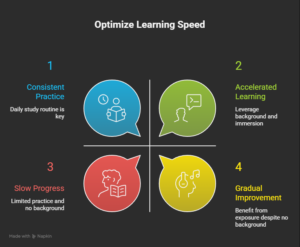
The most important one is probably your study routine. Studying a bit every day is way better than cramming all your studying into one day a week. Daily practice keeps the language fresh in your head and builds a habit. And trust me, forgetfulness will kick in otherwise.
Another thing that’ll help or hinder your progress is your language learning background. Have you learned a second language before? Do you speak English fluently? German shares a lot of roots with English so youve got a head start. And if you already speak Dutch or Swedish youll find German way easier. Those languages are basically cousins.
Your extra exposure to German outside of studying really makes all the difference. Do you listen to German music in your free time, watch German shows with the English subtitles switched off, or just chat with your neighbours or coworkers in German? Every little bit counts and even just a few extra minutes of exposure adds up. I’ve met learners who made the effort to practice speaking every single day, and guess what? They were able to achieve A2 twice as fast as those who only stuck to grammar exercises.
|
German A2 Exercises – Download Free PDF |
||
Free German A1 Mock Tests – Powered by AI!
Test your skills on our interactive platform. Get instant feedback from our AI to help you communicate better and track your progress. Start your free German mock test now.
Test Your German A1 for FreeA Study Plan to Get to A2 Quickly
A good plan beats out talent, let’s face it. Here’s a weekly study plan for someone who wants to finish A2 in 4 months – a pretty standard timeframe.
Daily routine (about an hour to an hour and a half)
Start each day off by spending 15 minutes going over new vocabulary. Use flashcards, and try to commit 10 new words to memory every day. That works out to a nice 300 new words a month – and A2 needs somewhere in the range of 1,000 to 1,500 words to feel like you’ve got a solid handle on things.
Next up, spend about 30 minutes on grammar and exercises – I like to use textbooks like Menschen or Begegnungen to get the hang of things. Focus on one topic per day – so if it’s monday, for instance, let’s say you focus on present tense verbs. Tuesday is for learning how to build a sentence, Wednesday for modal verbs ( like können, müssen, and wollen). You get the idea.
Weekly schedule for a fairly regular learner
- Monday: Learn 20 new words, spend some time on present tense verbs, and then try to squeeze in 20 minutes of listening in.
- Tuesday: Go over new vocabulary, spend some time on sentence structure (don’t worry if verb second rule still confuses you), and then listen some more.
- Wednesday: Learn another 20 new words, get comfortable with modal verbs, and have a go at speaking in German.
- Thursday: Go over new vocab, practice past tense of some common verbs, and have another listen.
- Friday: Learn some more words, learn about cases (that’s nominative and accusative for those new to German), and speak in German some more.
- Saturday: Take a break from all that sitting around to review what you’ve learned this week, take a practice test, and try writing a short paragraph in German.
- Sunday: Take it easy – either take a break, or watch a German movie with English subtitles. Your choice!
Pro tips to learn faster
Learn the gender on nouns from day one. Get used to der, die, das being part of the word – trust me, it’s a lot easier to get into good habits now, rather than having to unlearn everything later.
Make a point of focusing on the most common words first – after all, the 1,000 most frequently used words make up about 80 % of all conversations in German. Get those under your belt before worrying too much about the rest.
And remember – speaking even when you make loads of mistakes is key. A bad sentence or two a minute might not be perfect, but it’s a lot better than not trying at all. Mistakes are an opportunity to learn, not a sign of failure.
Mistakes to Avoid
Don’t waste months on bad habits! These are the top mistakes to steer clear of if you want to reach A2 in no time.
Irregular practice is basically the death of progress. Doing a solid 3 hours of studying on saturday but barely lifting a finger the rest of the week is way worse for your progress than doing 30 minutes every single day. Your brain needs the repetition to really move that info from short term to long term memory.
And don’t make the mistake of focusing solely on grammar rules – it’s just not enough. If you can’t speak decent German, then all the grammar in the world won’t help. Make sure to balance out your studying with some speaking and listening practice.
Not speaking enough is a common problem for shy learners. Reading and writing are easier because you have time to think. Speaking happens in real time. You have to practice speaking to get better at speaking. There is no shortcut.
Is A2 Enough for Jobs or Study Abroad?

This is an honest question. The answer is no for most situations.
German employers expect at least B1 for simple jobs. B1 is the level for permanent residency applications. For professional jobs, they want B2 or higher. A2 will not get you hired at a German company.
German universities require B2 or C1 for admission. Some programs accept B1 for a preparatory year. None accept A2. You cannot follow a lecture or write an academic paper at A2.
So why learn A2 at all? Because A2 is the foundation for everything above it. You cannot jump from A1 to B1. The gap is too big. A2 gives you the basic tools you need. It builds your vocabulary. It teaches you sentence structure. It gives you confidence.
Think of A2 as the first floor of a building. You cannot live there permanently. But you cannot build a second floor without it. Finish A2. Then move to B1. Then B2. Each level unlocks new opportunities.
Tips to Reach A2 Faster
These practical tips can give you a huge boost and shave weeks or months off the learning process
Use language apps to get your head around new words but dont rely on them as your go to for grammar and speaking. Duolingo can be a good starting point for vocab but don’t expect it to turn you into a native in no time. Limit your app use to 15 minutes a day, its better to have a solid foundation elsewhere.
Use flashcards with spaced repetition to really drill the information in. Anki is the best tool for this – grab a pre-made A2 deck and study it every day – you’ll be amazed at how much you’ll retain, probably around 90 percent, rather than half.
Learn A2 German in your own language! Get free Demo Classes Here!
Conclusion
The truth is A2 in German is achievable for most people. You’ll need to put in around 150-250 hours of focused effort, that’s around 1 hour a day for a year. If you can really commit to it you might be done in 2 or 3 months, but if you just learn a bit each day the regular students will take about 4 to 6 months, and the more relaxed learners will take 6 to 12 months.
Consistency is key, learn a little each day, make an effort to speak even if you feel silly making mistakes, and review the stuff you learned before until it becomes second nature. Mix up your learning with a bit of everything – apps, books, and even just talking to people.
Free German A1 Mock Tests – Powered by AI!
Test your skills on our interactive platform. Get instant feedback from our AI to help you communicate better and track your progress. Start your free German mock test now.
Test Your German A1 for FreeFrequently Asked Questions
Is A2 German difficult to learn?
No, A2 is manageable with regular practice. It builds directly on A1. The grammar adds a few new rules like past tense and accusative case. Most learners find it easier than A1 because they already know basic sentence structure.
Can I reach A2 in one month?
Only if you study full time. You need 150 to 250 hours. That means 5 to 8 hours every day for 30 days. Most people cannot maintain this pace. A realistic timeline for intensive learners is 2 to 3 months.
Do I need a teacher to learn German A2?
No, but a teacher helps you move faster. Self‑study works if you are very disciplined. You will need good textbooks, listening materials, and speaking practice. A teacher corrects your mistakes early. This saves time later.
How many words do I need for A2 German?
You need 1,000 to 1,500 active words. Active words mean you can use them in a sentence without thinking. Passive recognition is not enough. Focus on high‑frequency words first. Learn nouns with their gender from day one.
Can I pass the A2 exam without speaking well?
No, the exam has a speaking section. You must talk with an examiner for 10 to 15 minutes. Tasks include introducing yourself, asking simple questions, and describing a picture. Practice speaking out loud every day, even if you are alone.
Is Goethe A2 harder than Telc A2?
Both tests are similar. They follow the same CEFR standard. Goethe has more academic language. Telc feels more practical for daily life. Neither is harder overall. Choose the one accepted by your employer or university.
What happens after I finish A2?
You move to B1. B1 requires another 300 to 400 hours. At B1, you can handle most travel situations, talk about your job, and understand simple TV shows. B1 is the minimum for German permanent residency.
Can a child learn German A2 faster than an adult?
Children learn pronunciation faster. Adults learn grammar rules faster. Both groups take roughly the same total hours. Children have more time for exposure. Adults have better study strategies. Consistency matters more than age.
Do I need to memorize all A2 grammar rules?
No, memorization alone does not work. You need to use the rules in speaking and writing. Focus on the most common rules first. These include past tense of haben and sein, modal verbs, and sentence structure for weil and dass.