Table of Contents
The practice of employing digital systems and software to handle employee-related data and HR operations such as recruiting, payroll, attendance, performance monitoring, and reporting is referred to as HRIS Management, which stands for Human Resource Information System Management. Organisations are able to streamline their human resources operations, minimise the amount of manual labour, and make decisions that are more precise and data-driven.
What is HRIS Management?

The practice of utilising specialised software systems to organise, store, and manage information pertaining to employees and human resources inside a company is referred to as HRIS Management, which stands for Human Resource Information System Management. The HR department is able to handle tasks such as recruitment, payroll, attendance, performance tracking, and personnel records in a manner that is quick, accurate, and automated with the assistance of this tool.
Why HR Management Needs Digital Systems Today?
Modern workplaces include vast amounts of employee data and complex processes that are hard to manage manually, thus HR management needs digital technologies. Work is faster, more accurate, and more organised with digital HR systems.
The main causes are:
- Efficiency: Automates payroll, attendance, and leave monitoring.
- Record and calculation accuracy: Reduces human error
- Live data and HR analytics improve decision-making.
- Better employee experience: Faster, more accessible HR services
- Helps organisations comply with labour regulations and keep records.
- Scalability: Easily handles major organisations’ expanding personnel needs
- HR processes run easily from anywhere with remote work assistance.
Become an HR Expert – Enroll in Our HR Management Course Today!
Unlock the secrets to effective Human Resource Management with our expert-led course! Learn recruitment, employee relations, performance management, and more to build a thriving workplace. Start your journey toward a successful HR career today!
Know MoreUnderstanding the Basics of HRIS
An HRIS (Human Resource Information System) centralises employee and HR data. It organises data and automates HR activities.
HRIS basics include:
- Employee database: Personal, employment, and work history recorded.
- Payroll system: Sets up deductions and payments.
- Logs work hours, leaves, and absences.
- Hiring stuff: Management of job posts and applications
- Tracks employee goals and reviews
- Creating HR decision-making reports
Main Functions of HRIS Management
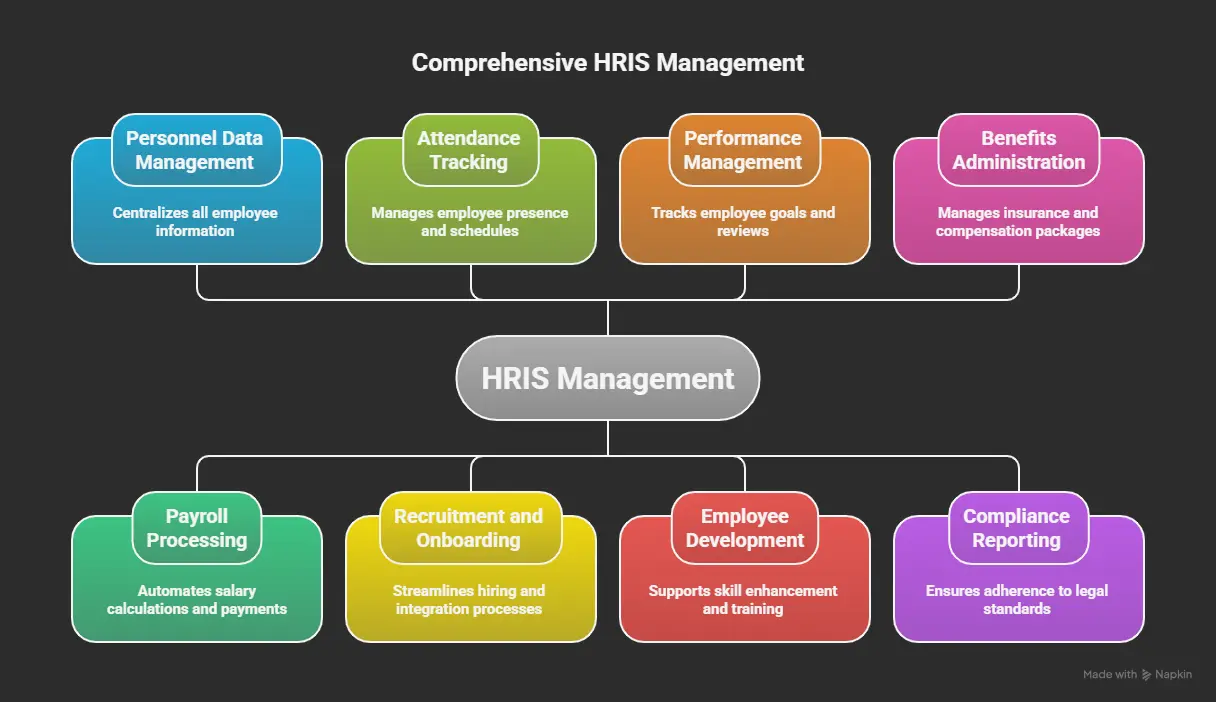
Using a digital system, HRIS management helps HR departments manage personnel and HR operations.
Principal functions:
- Manages all personnel data in one system.
- Auto-calculates, deducts, and pays salaries.
- Management of attendance, shifts, holidays, and absences
- Interviews, hires, and onboards new hires.
- Tracks employee goals, assessments, and reviews.
- Development: Tracks employee skill and training programs.
- Manage benefits: Manages insurance, bonuses, and allowances.
- Checks legal and organisational compliance with reports.
Different Types of HRIS Software
HRIS software, which stands for human resource information system, is typically divided into a number of distinct categories according to the functionality and range of features it offers. Each category caters to a certain level of human resource requirements inside a company.
1. HRIS for operational purposes
The day-to-day operations of human resources, including employee data, payroll, attendance, and leave management, are the primary focus of this category.
In addition to improving accuracy, it assists in automating typical HR tasks.
2. Tactics for the HRIS
Recruiting, training, performance management, and compensation planning are all examples of decisions that are supported by tactical human resource information systems (HRIS).
As a result, HR managers are able to make more informed workplace decisions.
3. HRIS with a Strategic Approach
For the purpose of making decisions and preparing for the long term, strategic HRIS is utilised.
Workforce planning, talent management, succession planning, and advanced HR analytics are all included in this comprehensive solution.
4. an all-encompassing HRIS
A single platform is used to perform all of the functions of an all-in-one system, which includes operational, tactical, and strategic functions.
Many huge organisations make use of it on a regular basis.
5. A HRIS with few functionalities
One or a few particular human resources tasks, such as payroll or attendance tracking, are the primary focus of this type of HR.
When it comes to human resources (HR) solutions, it is frequently utilised by smaller organisations.
Become an HR Expert – Enroll in Our HR Management Course Today!
Unlock the secrets to effective Human Resource Management with our expert-led course! Learn recruitment, employee relations, performance management, and more to build a thriving workplace. Start your journey toward a successful HR career today!
Know MoreHRIS vs HRMS vs HCM — What’s the Difference?
The management of human resource operations is handled via HRIS, HRMS, and HCM software. Every one of these three systems is capable of performing a variety of tasks and applications. In addition to storing personnel information, the Human Resource Information System (HRIS) is responsible for managing critical HR functions. In addition, the Human Resource Management System is responsible for managing payroll, tracking performance, and recruiting new employees. At this point in time, the system that is the most advanced is human capital management (HCM). Priorities include talent management, staff development, workforce planning, and long-term strategy when it comes to this organization.
| System | Full Form | Main Focus | Key Features |
|---|---|---|---|
| HRIS | Human Resource Information System | Simple human resource management | Records pertaining to employees, payroll, and attendance |
| HRMS | Human Resource Management System | Procedures for human resource management | Management of performance, recruitment, payment, and training for employees |
| HCM | Human Capital Management | Labour force management that is strategic | Management of talent, analytics, workforce planning, and employee development are all important. |
Advantages of Using HRIS in Organizations
The utilisation of a Human Resource Information System (HRIS) offers numerous advantages to organisations by enhancing the effectiveness and precision of HR operations.
1. Information about Employees That Is Centralised
HRIS is a system that saves all of the employee data in a one, secure location, making it simple to access and manage the information.
2. Reduces the amount of manual labour and saves time
Increasing the speed and efficiency of HR teams’ work can be accomplished through the automation of processes such as payroll, attendance, and leave management.
3. Enhances the Accuracy
As a result of digital technologies, human errors in calculations, reports, and employee records are significantly reduced.
4. Better Decision-Making Capabilities
Reports and analytics are provided by HRIS, which assists management in making educated decisions regarding the workforce.
5. Improves the Working World for Employees
Employees have the ability to check their paystubs, submit requests for time off, and simply update their personal information by using self-service tools.
6. Assists in Achieving Legal Compliance
Through the use of HRIS, organisations are able to comply with business policy and labour laws, as well as retain accurate records.
7. Strengthens the protection of data
The sensitive information pertaining to employees is stored in a safe location with access that is restricted and backup systems.
8. Contributes to the expansion of businesses
HRIS systems are able to manage the growing amount of employee data and HR activities that come with expanding organisations.
Common Challenges in HRIS Management
Despite the fact that HRIS management provides numerous advantages, organisations may encounter a number of obstacles during the process of putting these systems into place and keeping them operational.
1. Expensive methods of implementation
Setting up human resource information system (HRIS) software, providing personnel with training, and maintaining the system can be costly, particularly for smaller organisations.
2. Instruction of Staff Members and Compatibility
When it comes to learning how to make efficient use of the new technology, employees and HR professionals could require some time and training.
3. Dangers to the Privacy and Security of Data
The Human Resources Information System (HRIS) stores sensitive employee information; therefore, it is highly necessary to safeguard data from cyber threats and unauthorised access.
4. Problems with the Integration of Systems
When it comes to accounting, payroll, or other business processes, there are situations when HRIS software may not simply connect with those systems.
5. Problems with technology and preventative maintenance
If they are not managed appropriately, software updates, technical issues, and system downtime can all have an impact on human resources operations.
6. Obstacles to Data Accuracy
When it comes to the effectiveness of the HRIS system, inaccurate or out-of-date personnel data can be a real problem.
7. Defiance in the Face of Change
The transition to digital human resource management systems may be resisted by some employees or managers who choose more conventional approaches.
8. Compliance Adjustments and Regulatory Alterations
In order to remain in compliance with ever-evolving labour rules and regulations, organisations are required to regularly upgrade their systems.
Where HRIS Management is Commonly Used
The Human Resource Information System (HRIS) Management system is frequently utilised by organisations that have a requirement to effectively handle employee data, payroll, recruitment, attendance, and other HR services. Across a wide range of industries and sectors, it assists firms in automating HR operations, thereby improving accuracy and efficiency and saving time. When it comes to streamlining personnel management and supporting improved decision-making, human resource information systems (HRIS) are relied on by both small and large organisations today.
- Companies for payroll, personnel records, and performance management.
- Government agencies manage administrative HR processes and staff data.
- Schools handle teacher and staff data, payroll, and leave records.
- Employee scheduling, compliance, and labour management in healthcare.
- Retail and hospitality: shift scheduling, attendance, and personnel tracking.
- Manufacturing businesses manage big workforces and attendance systems.
- IT and IT firms—for hiring, talent management, and engagement.
Essential Skills Needed for HRIS Management Roles
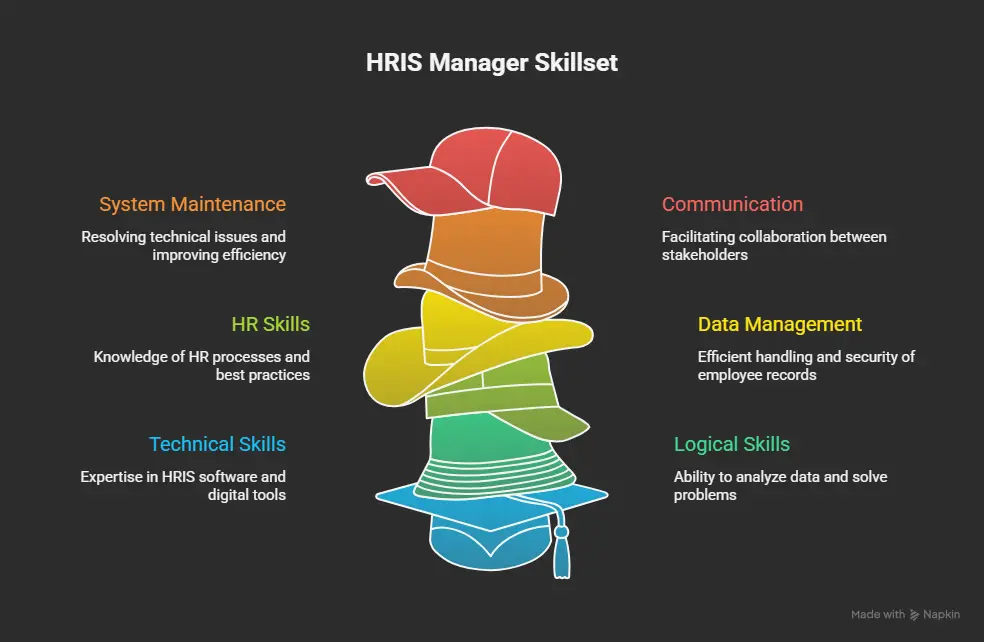
Human resource information systems (HRIS) managers need technical, logical, and HR skills to succeed. These skills help businesses streamline HR, handle data accurately, and make better decisions.
- Learn HR tasks include hiring, compensating, tracking attendance, and managing performance.
- database, HRIS, and digital tool expertise
- Data like workforce and HR records can improve decision-making.
- Detail: correct staff notes and less errors
- Resolving system difficulties and improving HR efficiency
- Collaboration between management, employees, and HR through communication
- Managing plenty of employee data effectively
- Secure employee data and follow pay regulations
Future Trends in HRIS and HR Technology
Future human resource information systems (HRIS) and HR technology will focus on automation, improved decision-making, and the employee experience. The transition to digital workplaces is resulting in HR operations that are more employee-friendly, more efficient, and speedier thanks to advancements in HR technology.
- Artificial Intelligence (AI): AI for the purpose of personnel analytics, screening of resumes, and recruitment
- Cloud-based HR systems: Access to HR data from a remote location is made possible by cloud-based HR systems.
- Mobile HR applications: Managing human resources obligations is made easier for employees by mobile HR apps for cellphones.
- Automation of HR processes: HR process automation, which reduces the amount of manual labour required for payroll, attendance, and reporting
- Data analytics and predictive insights: By utilising data analytics and predictive insights, businesses have the potential to improve their people decisions.
- Remote and hybrid workforce support: Management can be improved by providing support for remote and hybrid personnel.
- Enhanced cybersecurity and data protection : Additional measures to protect sensitive employee data, including improved cybersecurity and data protection.
Is being an HR your dream? Enrol now for our course on Human Resource!
Conclusion
HRIS Management is an essential component of modern organisations since it streamlines and automates the activities that are associated with human resources. In a manner that is both more efficient and more organised, it assists in the management of personnel data, payroll, recruitment, performance, and compliance. The Human Resources Information System (HRIS) enables human resource teams to concentrate more on strategic decision-making and employee development by lowering the amount of manual work and enhancing accuracy. When artificial intelligence (AI), automation, and cloud-based solutions are added to human resource information systems (HRIS), it will become an even more advanced tool, making it an indispensable instrument for every firm.
Become an HR Expert – Enroll in Our HR Management Course Today!
Unlock the secrets to effective Human Resource Management with our expert-led course! Learn recruitment, employee relations, performance management, and more to build a thriving workplace. Start your journey toward a successful HR career today!
Know MoreFrequently Asked Questions
Is HRIS difficult to learn?
Most modern HRIS tools are user-friendly and require basic training.
Does HRIS replace HR professionals?
No, it supports HR professionals by automating repetitive tasks.
What is the main goal of HRIS?
To improve efficiency, accuracy, and organization of HR processes.
Is HRIS only used in large companies?
No, even small and medium businesses use HRIS to manage HR tasks efficiently.
Can HRIS work without internet?
Some older systems may work offline, but most modern HRIS platforms are cloud-based and require internet access.
Is HRIS difficult to learn?
No, most HRIS platforms are user-friendly and require only basic training.
What is the main purpose of HRIS?
The main purpose is to automate HR processes and manage employee data efficiently.
What skills are needed to use HRIS?
Basic HR knowledge, computer skills, and understanding of data management are important.
What is the future of HRIS?
The future includes AI, automation, and cloud-based systems that make HR processes smarter and faster.