Table of Contents
The gap between Data Centre Construction and IT Data Centre jobs shows up clearly in headcount. The industry workforce studies put short-term construction demand at anywhere from a few hundred to several thousand workers on a large campus.
The same facility typically settles into a permanent operations team of only 50 to a few hundred people once it is live. This is a pattern seen consistently across hyperscale and colocation projects worldwide.
Get Career Oriented BIM Certification Course with Expert Mentors! Get Free Demo Here!
Key Takeaways
- Construction builds whereas IT runs.
- Construction hires many temporarily. Operations keep a small permanent team.
- Skills rarely overlap – Construction (civil/MEP, BIM), Operations (networking, systems, security).
- Pay follows expertise – commissioning/infrastructure versus uptime / automation / cloud / security.
- Careers –Construction is project-based, Operations is long-tenure progression.
- AI shifts demand –Construction (power, cooling, Operations (automation, security, hybrid-cloud).
- Crossover needs reskilling.
Quick Comparison at a Glance
| Dimension | Data Centre Construction Jobs | IT Data Centre Jobs |
| Core focus | Build the facility: civil, structure, MEP, commissioning | Run the facility: servers, network, cloud, security, facilities ops |
| Work phase | Design → Build → Commission → Handover (project-based) | Operate → Maintain → Upgrade → Optimise (ongoing) |
| Typical location | Construction site (often greenfield/industrial zones) | Live data centre campus, NOC, or remote ops centre |
| Key employers | EPC contractors, MEP firms, consultants, OEMs | Cloud providers, colocation operators, enterprises, MSPs |
| Career pattern | Project to project; possible travel or relocation | Stable shifts; long-term site or team |
| Peak demand now | AI-driven hyperscale builds, liquid cooling, HV power | AI workloads, automation/SRE, security, hybrid cloud |
Master BIM and Elevate Your Career – Enroll Today!
Stay ahead in the construction and design industry with our comprehensive BIM Course! Learn Building Information Modeling (BIM) from experts, gain hands-on experience with top software, and boost your career prospects. Join now and become a certified BIM professional!
Know MoreWhat Each Role Actually does

Data centre construction jobs build the physical facility through the shell, power backbone, and cooling systems. IT data centre jobs run, secure, and optimize the servers, networks, and cloud workloads as the facility goes live.
Construction is project-based as well as site-heavy. It is tied to a fixed build-and-commission timeline. IT/operations work is continuous along with being shift-based. It is centred on uptime, performance, and security long after the ribbon-cutting.
Data Centre Construction Jobs
These roles design and physically deliver not just the building but also its critical infrastructure. This includes power, cooling, fire safety, and physical security. This is engineered to meet strict uptime along with resilience standards.
Work is organized around clear project phases – design, procurement, construction, commissioning, and handover. It ends once the facility is ready to go live.
Typical responsibilities include:
- Interpret drawings and BIM. Coordinate MEP clashes.
- Manage civil, structural, and architectural site work.
- Install and test electrical systems – HV/MV/LV switchgear, generators, UPS, PDUs.
- Install and test mechanical systems – chillers, HVAC, CRAH/CRAC, piping, and liquid-cooling loops.
- Run commissioning and integrated systems tests. Complete handover documentation.
- Controlling cost, schedule, quality, and site safety.
IT Data Centre Jobs
These roles keep the servers, storage, and network running around the clock once the facility is operational. They lay a heavy focus on monitoring, incident response, and security compliance.
Typical responsibilities include:
- Monitor power, cooling, and environment via BMS/DCIM.
- Perform hardware tasks – racking, cabling, replacements, firmware updates.
- Manage network devices – routing, firewalls, cloud and on-prem connectivity.
- Run change management, backups, patching, and DR drills.
- Track power, space, and cooling capacity. Plan for high-density AI racks.
- Enforcing access control and security compliance standards.
Skills and Qualifications that Matter
Construction Side
Data centres are high-stakes assets. Here, safety and commissioning accuracy are non-negotiable. So the employers look for strong engineering fundamentals.
This is combined with project-delivery and critical-infrastructure experience.
- Educational background: Civil, Electrical, Mechanical, or MEP engineering
- Tools: AutoCAD, Revit, Navisworks, MS Project or Primavera P6
- Standards knowledge: Uptime Institute tier concepts, IEC/IEEE electrical codes, ASHRAE cooling guidelines
- Commissioning know-how: Integrated systems testing, FAT/SAT, staged commissioning levels, handover documentation
- Safety certifications: NEBOSH or IOSH, plus site permit and audit experience
IT/Operations Side
Employers prioritize hands-on experience with servers, networks, and monitoring tools. They look for automation and security skills becoming baseline expectations as AI workloads scale up.
- Networking fundamentals: TCP/IP, VLANs, basic routing, firewalls, load balancers
- Systems knowledge: Linux and Windows server administration, virtualisation, SAN/NAS storage
- Monitoring tools: BMS, DCIM platforms, ITIL-based ticketing and alert triage
- Automation: Basic scripting (Python or PowerShell), exposure to configuration management
- Security and compliance: Access control, audit logging, awareness of frameworks like ISO 27001
Day-to-Day Reality: Site vs Shift
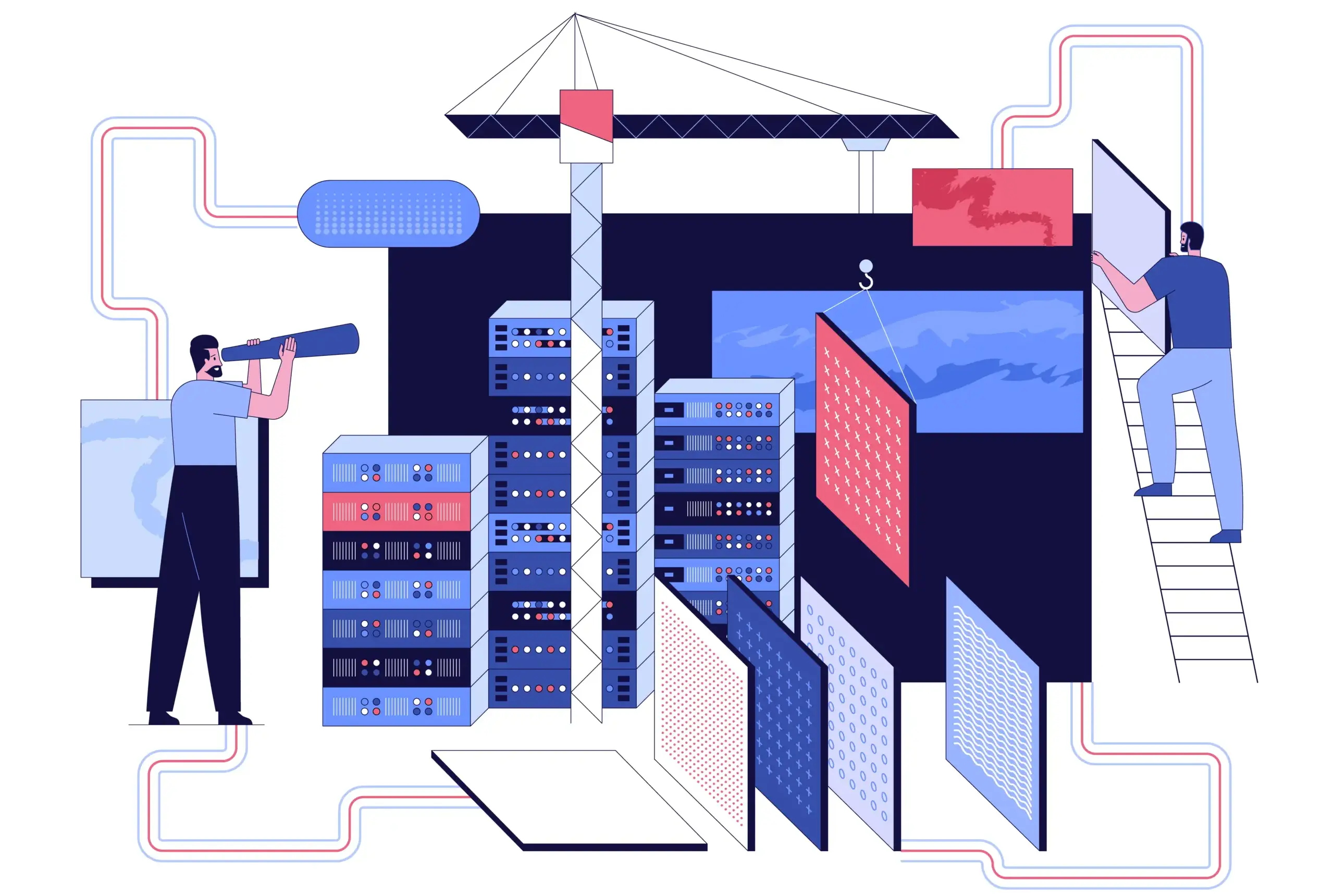
Construction Professionals
They spend their days on site walks, coordination meetings, and inspections against a tight schedule. Work intensity peaks during MEP installation and commissioning.
This is often with long hours as deadlines approach. Roles frequently move between projects as new campuses break ground.
IT/operations Professionals
They work in shifts covering 24/7 coverage. Some fully remote from a NOC, others on-site with rotational or on-call duties. A typical shift starts with reviewing alarms and the change calendar. It then moves into planned maintenance or vendor coordination. It ends with documentation and handover notes for the next shift.
Career growth here tends to follow a steadier ladder. This can be technician to engineer, then senior engineer, team lead, and eventually site or facilities manager. This is usually over five to ten years at the same organisation or campus.
Master BIM and Elevate Your Career – Enroll Today!
Stay ahead in the construction and design industry with our comprehensive BIM Course! Learn Building Information Modeling (BIM) from experts, gain hands-on experience with top software, and boost your career prospects. Join now and become a certified BIM professional!
Know MorePay, Growth, and Job Stability (India & GCC Focus)

Construction Roles
Pay scales with project complexity and specialised experience in critical power and cooling systems. Entry-level positions start modestly. But commissioning specialists and HV/MEP experts command a strong premium at senior levels.
Indicative ranges (broad industry bands, subject to city, employer, and project scale):
- India entry-level is roughly ₹4 LPA to ₹7 LPA
- India mid-level (5 to 10 years) is roughly ₹10 LPA to ₹25 LPA
- India senior/commissioning specialists can exceed ₹40 LPA to ₹60 LPA at top-tier projects
- GCC site-focused engineering roles is broadly AED 8,000 to AED 18,000/month, higher for managers and specialists
Typical growth path:
Engineer → Senior Engineer → Package Lead → Commissioning Manager → Project/Construction Manager
IT/Operations Roles
The criticality of the role, scarcity of networking and security skills, and facility scale drive the pay. Senior network, infrastructure, and facilities management roles carry a clear premium over general operations staff.
Indicative ranges (broad industry bands):
- GCC mid-level data centre operations are roughly AED 9,500 to AED 13,000/month.
- GCC senior network/infrastructure engineers and facilities managers can be roughly AED 15,000 to AED 25,000+/month.
- India salaries vary widely by city and employer. This is generally tracking similar experience-based bands. Cloud and security skills add a clear premium.
Typical growth path:
Technician/Junior Engineer → Engineer → Senior Engineer → Team Lead → Site/Facilities Manager → Head of Operations
Note:
Construction generates far more jobs at any given moment on a large campus. However, most of that employment is temporary. Permanent operations headcount is smaller by design.
Automation and centralised monitoring on modern hyperscale campuses are strong factors. They indicate that fewer and more specialised staff are on demand to run a facility.
Which One Should You Choose?

Choose data centre construction if
- You enjoy taking large, complex infrastructure from drawings to a live facility
- Are comfortable with site-based work and possible travel between projects
- Want to build expertise in HV power, advanced cooling, or commissioning
Choose IT data centre jobs if
- You prefer stable, long-term roles focused on keeping systems running and improving them over time
- Are comfortable with shift work and on-call rotations
- Want a career path that can extend into cloud engineering, automation, or security
How to Enter Each Path
For construction careers:
- Start with a relevant engineering degree or diploma
- Build proficiency in BIM and scheduling tools
- Earn safety and commissioning-related certifications
- Target EPC contractors or MEP firms working on data centre projects
For IT/operations careers:
- Build networking and systems fundamentals first
- Then move into data centre technician or NOC roles
Certifications in networking, Linux, ITIL, and basic security help you stand out, and cloud fundamentals (AWS, Azure, or GCP) are increasingly expected even at entry level.
Get Career Oriented BIM Certification Course with Expert Mentors! Get Free Demo Here!
Conclusion
Data centre construction and IT data centre jobs are not actually two distinct options for you. They are, in fact, two variants of the same services you can offer. To put it precisely, when the former brings the facility to life, the latter keeps it alive. For the same reason, you cannot name one of them as the better option.
The factors that make them different are skill sets, temperaments, and timelines. A good number of professionals prefer building things from the ground up and can handle a project’s start-to-finish intensity. If you are one among them, construction is the right option as it offers strong pay for specialised critical-infrastructure skills.
There are others who would rather own a system long-term and grow steadily within one organisation. For them, IT/operations offers stability. Moreover, they see a clear path into cloud, security, and automation roles. The AI-driven data centre boom ensures a favourable environment that continues to reshape both sides of the industry.
Master BIM and Elevate Your Career – Enroll Today!
Stay ahead in the construction and design industry with our comprehensive BIM Course! Learn Building Information Modeling (BIM) from experts, gain hands-on experience with top software, and boost your career prospects. Join now and become a certified BIM professional!
Know MoreFrequently Asked Questions
Which pays more – data centre construction or IT operations roles?
It depends on specialisation and seniority: commissioning and HV specialists in construction can out-earn general operations staff, but senior network, security, and facilities management roles in IT/operations also command strong premiums.
Do data centre construction jobs offer long-term stability?
Individual construction projects are temporary, typically lasting 18 to 36 months, but professionals in active data centre hubs often move seamlessly between new projects, creating de facto continuity.
Are IT data centre jobs more stable than construction jobs?
Generally yes, because a live facility needs continuous staffing for as long as it operates, whereas construction roles wind down once a project reaches handover.
Can someone switch from construction to IT data centre roles?
It’s possible but usually requires re-skilling; construction professionals often move more naturally into facilities management roles that bridge both worlds.
Why is data centre construction hiring growing so fast right now?
AI workloads are driving a wave of hyperscale campus construction that needs high-voltage power infrastructure and advanced cooling systems, pushing up demand for specialised construction talent.
Do data centres create more construction jobs or more permanent jobs?
Construction typically creates far more jobs in the short term while permanent operations headcount is much smaller once the facility is automated and running. Sometimes thousands on a large campus.
Is remote work possible in IT data centre jobs?
Some monitoring and network operations roles can be run from a centralized NOC or remotely, but hands-on hardware and facilities roles still require on-site presence.
Which career path has better long-term growth potential – construction or IT operations?
Both offer strong growth: construction professionals can rise into commissioning and delivery leadership, while IT/operations professionals can branch into cloud engineering, automation, and cybersecurity, all high-demand specialisations.