
Table of Contents
When it comes to the management of a company’s financial responsibilities and cash flow, accounts payable (AP) is an extremely important function. It is the responsibility of professionals working in this industry to ensure that invoices are handled properly, payments are made on schedule, and vendor relationships are managed in an effective manner. It is crucial to have a thorough understanding of not just the technical abilities required for the position, but also the practical and analytical elements of the function if you are preparing for an interview with the AP. A comprehensive guide to the top twenty interview questions that you could be asked is presented here.
Become an Accounting Pro – Learn from Industry Experts!
Key Takeaways
- Invoices, three-way matching, and reconciliation are primary AP concepts in most interviews.
- Interviewers want sensible, problem-solving responses, not definitions.
- You must understand AP workflows, notably invoice approval and payment periods.
- You should describe how you manage mistakes, inconsistencies, and duplicate invoices.
- Selection frequently depends on AP software and tool experience.
- Questions generally evaluate time management, payment prioritization, and deadlines.
- During interviews, accuracy, detail, and communication are stressed.
What Skills Are Required for Accounts Payable role?
1. Paying Attention to the Specifics of the Situation
Invoices, payment schedules, and reconciliations are all tasks that fall within the purview of accounting professionals. Being careful is absolutely necessary since even little errors can lead to overpayments or disagreements with suppliers. This is why it is crucial to exercise caution.
2. An Education in the Fundamentals of Accounting
It is absolutely necessary to have a thorough grasp of accounting principles in order to be able to process invoices and maintain accurate financial records. The principles that are included in this category include ledger administration, debits and credits, and accruals.
3. The Management of One’s Own Moments
It is necessary to manage a number of invoices and deadlines in the accounts payable department. When it comes to preventing late payments, having the capacity to prioritise tasks, schedule payments, and properly manage workload is one of the most critical elements to consider.
4. Effectiveness in Communicating with Others
When it comes to collaborating with external suppliers, settling differences of opinion, and working together with internal teams, the ability to communicate effectively both verbally and in writing is very necessary.
5. Proven history of dealing with the accounting software
It is beneficial to have knowledge of accounting or accounts payable software such as SAP, Oracle NetSuite, QuickBooks, or Microsoft Dynamics when it comes to automating activities and maintaining accurate records. One example of such software is Microsoft Dynamics.
6. Problem-Solving Capabilities
Professionals that specialise in accounts payable are faced with the responsibility of resolving difficulties like as mistakes in bills, delays in payment, and complaints from suppliers. The capacity to analyse using analytical methods and to solve issues using logical reasoning is a fundamental requirement.
7. The organization of records and their ongoing maintenance
With excellent organisational skills and techniques that are suitable for documentation, one must be able to properly handle large volumes of bills, vendor statements, and payment schedules. This is a prerequisite for successful management.
8. An understanding of the internal controls and compliance standards that are in place
When it comes to preventing fraud and maintaining compliance with company norms, it is helpful to have an awareness of audit needs, the division of duties, approval procedures, and corporate rules.
9. Capacity for Experiencing Change
When it comes to accounts payable activities, the ability to be flexible is absolutely necessary because these jobs may entail working under stringent deadlines, managing urgent payments, or changing to new software systems or procedures.
10. Collaborating together and cooperating with one another
The capacity to cooperate while working closely with procurement, finance, and vendors is required in order to ensure that operations run smoothly and to maintain positive connections with suppliers. This is vital in order to guarantee that ties with suppliers are maintained.
Top 20 Accounts Payable Interview Questions And Answers
1: Accounting provides information on

1. What’s accounts payable?
Companies owe suppliers and vendors for products and services using accounts payable. Company balance sheets show it as a liability until paid. AP promptly tracks and pays all financial commitments.
2. What are the main duties of accounts payable professionals?
A specialist in AP processes invoices properly, ensures payments are paid on schedule, reconciles AP accounts, maintains vendor information, and resolves problems. To follow business policies, they monitor purchase orders and invoice approvals.
3. What is AP three-way match?
In a three-way match, the purchase order, receiving report, and supplier invoice are matched before payment. This assures the corporation only pays for products and services received at the agreed-upon price.
4. Explain the difference between Accounts Payable and Accounts Receivable?
Payable reflects the company’s debt to vendors, whereas receivable indicates its customer debt. AR is an asset, AP a liability. Both are managed well to maintain cash flow and financial stability.
5. What is a payment run?
A payment run schedules several vendor payments. It is organised according to due dates, cash flow, and vendor priority using human or automated AP software to ensure timely payments.
6. What AP software do you use most?
Tally ERP, SAP, Oracle NetSuite, QuickBooks, and Microsoft Dynamics are AP software. To increase efficiency and accuracy, these solutions automate invoice processing, manage payments, and provide financial reports.
7. How are vendors paid on time?
Keeping vendor bills on schedule, monitoring due dates, engaging with suppliers, and utilising automated technologies to avoid delays ensures timely payments. Planning and finance team collaboration are essential.
8. Define AP “accrual accounting”
Instead of cash payment, accrual accounting tracks expenditures when incurred. No matter the payment schedule, AP ensures that the company’s financial accounts appropriately represent its financial commitments.
9. How are duplicate invoices handled?
Address duplicate bills by comparing invoice numbers, dates, and amounts to purchase orders and past payments. To avoid overpaying, duplicates are rejected and vendors alerted.
10. Reconcile AP accounts?
Comparing vendor statements to firm data and resolving inconsistencies reconciles AP accounts. Regular reconciliation assures the AP ledger meets the general ledger and accurate financial reporting.
11. Invoice approval workflow?
Before payment is released, authorized staff evaluate and approve invoices in an invoice approval pipeline. It avoids fraud, assures correctness, and follows corporate regulations.
12. How about late payments?
We contact suppliers, analyze the causes of late payments, change payment schedules where possible, and prevent future delays. Vendor trust requires communication and record-keeping.
13. How do credit and debit memos differ?
Credit memos lower vendor debt owing to returns or discounts, whereas debit memos raise debt due to underbilling or extra charges. AP records are correctly adjusted using both.
14. Do you keep vendors?
Timely payments, professional communication, swift dispute resolution, and compliance with conditions preserve vendor relationships. Having good ties helps negotiate better rates and minimize supply interruptions.
15. Explain why AP aging reports matter?
Due date-based AP aging reports classify bills. They assist find late payments, monitor cash flow, and prioritise vendor payments. Financial reporting and audits require aging reports.
16. Why is corporate accounts payable important?
Accounts Payable helps a firm meet financial obligations on time, maintain vendor relationships, manage cash flow, and report accurately. AP methods improve the company’s finances.
17. What prevents Accounts Payable fraud?
Segregation of roles, approval protocols, vendor data and bills, and transaction audits prevent AP fraud. This reduces unauthorised payments and financial losses.
18. Have you processed foreign invoices?
Understanding foreign currency conversions, tax requirements, worldwide suppliers, and cross-border payments are needed to handle international invoicing. Understanding payment methods and banking procedures is also required.
19. What Accounts Payable issues have you faced?
Managing a high volume of bills, errors, tight deadlines, and delayed approvals are common issues. Organization, prioritization, and vendor and internal team communication usually solve these issues.
20. How would you handle missing invoices?
AP professionals contact vendors to obtain missing invoices, review internal records to confirm receipt of products or services, and verify documents before processing payment.
Placement Oriented PWC Business Accounting Course
PWC Certified Business Accounting Course by Entri App: Master in-demand skills, ace interviews, and secure top-tier jobs.
Join Now!Tips to Crack an Accounts Payable Interview
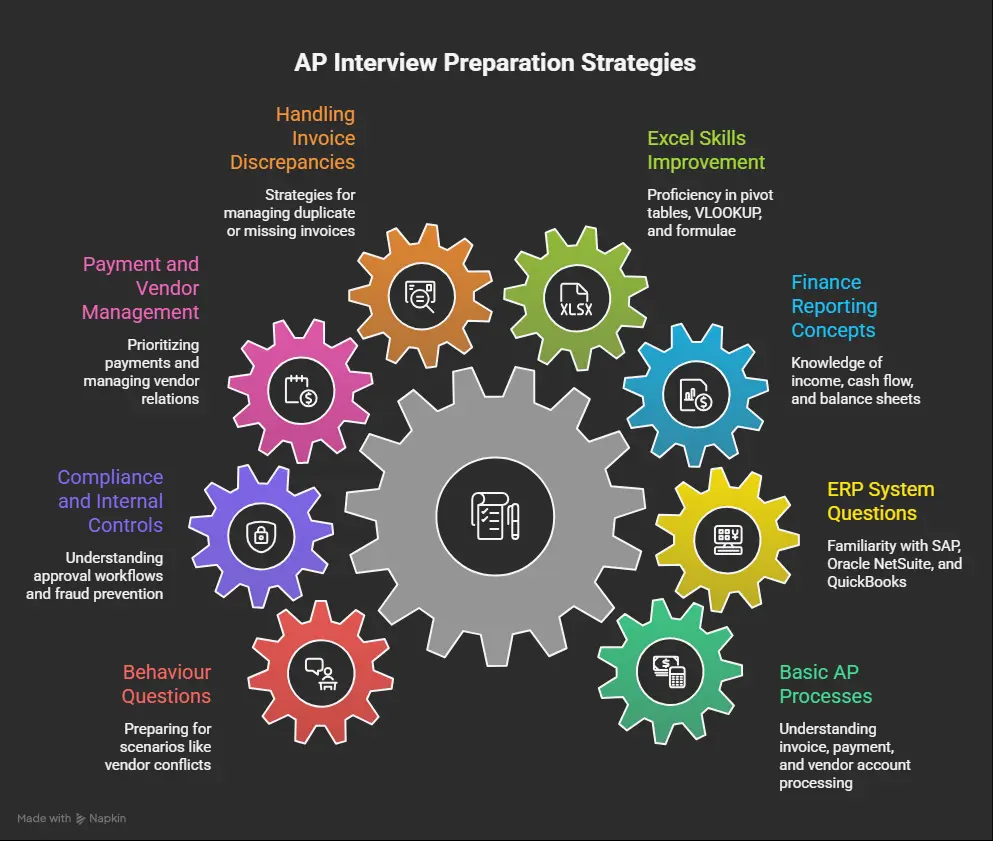
Learn Basic AP Processes
- Learn invoice, payment, and vendor account processing.
- Learn three-way matching and reconciliation.
- Knowledge of journal entries and AP procedures improves replies.
- Prepare to explain how AP affects financial statements.
Practice ERP System Questions
- ERP solutions like SAP, Oracle NetSuite, and QuickBooks handle most AP activities.
- Understand how these systems handle financial transactions and approvals.
- ERP workflow knowledge displays practicality and efficiency.
- Knowledge of ERP features boosts interview credibility.
Finance Reporting Concepts
- Know income, cash flow, and balance sheets.
- Discuss how AP impacts obligations and cash flow.
- Knowledge of AP transactions and reporting displays accounting expertise.
- It aids technical or scenario-based interviews.
Excel Skills Improvement
- Summarise big data sets via pivot tables.
- Check invoices against POs using VLOOKUP/XLOOKUP.
- Calculate and analyse using fundamental formulae.
- Excel abilities show effectiveness and precision.
How to handle invoice discrepancies
- Explain how to manage duplicate or missing invoices.
- Explain problem-solving: researching, contacting vendors, updating records.
- Shows precision and dependability.
- Real examples strengthen replies.
Payment and Vendor Management
- Learn invoice prioritisation and payment scheduling.
- Apply early payment savings.
- Effectively manage urgent or high-priority payments.
- Shows vendor relations skills.
Compliance, Internal Controls
- Know the value of approval workflows and task separation.
- Know audit and fraud prevention requirements.
- Control awareness indicates professionalism and risk awareness.
- Explaining controls demonstrates you grasp AP duties.
Be Ready for Behaviour Questions
- Prepare for invoice inconsistencies and vendor conflicts.
- Explain your approach and reasoning.
- Give examples from internships, academics, or experience.
- Shows problem-solving and AP skills.
Common Mistakes to Avoid During the Interview
Some mistakes can affect interview performance. Candidates often overlook practical examples.
Common mistakes include:
- Not reviewing AP processes, accounting basics, or scenario questions.
- Lack of SAP, QuickBooks, or ERP process expertise.
- Poor detail—Giving unclear replies or omitting problem-solving procedures.
- Poor communication—cannot explain things professionally.
- Ignoring behavioral questions—not preparing invoice or vendor conflict examples.
- Compliance ignorance—unaware of internal controls, approvals, and audits.
- Missing the potential to demonstrate interest in the firm or career by not asking questions.
- Overconfidence or underconfidence—not being professional and balanced.
Become an Accounting Pro – Learn from Industry Experts!
Conclusion
The accounts payable department is an essential component of the financial administration of any firm. When an experienced accounts payable expert is in charge, they make certain that invoices are processed correctly, payments are paid on time, and that connections with vendors are maintained. The mastery of accounts payable procedures, which include invoice reconciliation, three-way matching, payment scheduling, and fraud protection, not only helps to maintain the company’s financial health but also contributes to the efficient flow of cash and the correct reporting of financial information. Candidates will be able to exhibit both their technical competence and their practical understanding if they properly prepare for these top 20 AP interview questions. This will make them excellent assets to any financial team.
Placement Oriented PWC Business Accounting Course
PWC Certified Business Accounting Course by Entri App: Master in-demand skills, ace interviews, and secure top-tier jobs.
Join Now!Frequently Asked Questions
What skills are required to crack an Accounts Payable interview?
Candidates need strong attention to detail, basic accounting knowledge, familiarity with AP processes, and good communication skills. Employers also look for time management and problem-solving abilities.
How should I prepare for an Accounts Payable interview?
Preparation should include revising accounting basics, understanding AP processes, practicing common interview questions, and learning about the company you are applying to.
What type of questions are usually asked in AP interviews?
Interviewers typically ask a mix of technical, practical, and behavioral questions to assess knowledge, experience, and problem-solving skills.
Are technical skills important in Accounts Payable interviews?
Yes, technical knowledge such as invoice processing, reconciliation, and accounting software usage is very important.
How important is knowledge of accounting software?
It is highly important. Familiarity with tools like SAP, QuickBooks, or Oracle can significantly increase your chances of getting hired.
What are interviewers looking for in an Accounts Payable candidate?
They look for accuracy, reliability, ability to meet deadlines, understanding of AP workflows, and strong organizational skills.
What common mistakes should I avoid in an AP interview?
Avoid giving vague answers, lacking knowledge of basic concepts, poor communication, and not preparing for the interview in advance.
How can I make a good impression in an AP interview?
Being confident, answering clearly, showing practical understanding, and demonstrating attention to detail can help create a strong impression.