Table of Contents
Introduction
There is an increasing need for companies that test software as more and more businesses adopt digital goods and services. Make sure that every piece of software operates safely, well, and without any problems. This includes anything from basic mobile apps to complex commercial systems. Testing software is becoming an important element of making software and a solid job choice.
In 2026, there will be no more manual testing of software. AI, automation, and DevOps are all making testing smarter, faster, and more related to the process of developing software. Modern software testers need to know about automation tools, code, and how to work with development and operations teams to make sure… Do software testers need coding skills? The product they put into use is of high quality.
This article provides software testers with the most crucial things they need to know to do well. They talk about both basic and complex manual testing subjects, like testing on the cloud, automation, and AI-driven testing. This guide will help you keep ahead of the competition in the fast-paced world of software testing, whether you’re new to the field or want to improve your skills.
Key Takeaways
- In the year 2026, artificial intelligence, automation, and DevOps are all contributing to the evolution of software testing.
- A strong manual testing ability, in addition to expertise in automation, coding, API testing, and performance testing, is required.
- You can gain a competitive advantage by acquiring advanced skills like as cloud, CI/CD, AI testing, and security.
- Learning tools like as Selenium, Postman, and JIRA is an absolute necessity.
- When it comes to long-term success and job advancement, soft skills and ongoing education are essential components.
Develop a foundational understanding in Software Testing through our free materials!
Why Software Testing Skills Are Evolving in 2026
1: What is software testing?

Impact of AI and Automation
AI and automation are changing software testing. Intelligent technology can now perform regression testing, data validation, and problem identification. This technology saves time and reduces human mistake. AI-powered testing systems can analyse prior test results to predict fault locations. This move allows testers to focus more on critical thinking, exploratory testing, and software quality than on test cases.
Shift from Manual to Intelligent Testing
Manual testing takes too long in modern development environments. More companies are using intelligent testing, which combines automation and AI. Testers must now analyse user behaviour, assess hazards, and create smarter testing procedures. Modern testing involves strong analytical skills, programming knowledge, and automation technology knowledge.
Importance of Continuous Testing in DevOps
Faster software development and release cycles are achieved by implementing DevOps methods. Because of this, testing is now an essential aspect of the development process rather than a separate phase. Product quality is enhanced, and costs are decreased by the early detection of problems made possible by continuous testing. One approach testers are collaborating with operations teams and developers to achieve faster and more reliable software delivery is by integrating tests into CI/CD pipelines.
Master Testing Skills with Industry Experts
Become a Test Engineer: Learn Core Skills from Industry-Leading Mentors and Land High-Paying Testing Jobs!
Explore ProgramCore Technical Skills Every Tester Must Have
Manual Testing Fundamentals
Despite automation and AI, manual testing is still essential to software testing careers. It teaches testers how users interact with apps and develops advanced testing abilities.
Test Case Design
To ensure a feature works properly, test case design creates explicit and structured test cases. Test cases should have inputs, expected results, and execution stages. Writing good test cases enhances software quality, coverage, and error reduction.
Bug Tracking
Identifying, reporting, and managing testing flaws is bug tracking. To help developers understand and fix issues, testers must precisely articulate them. JIRA is used to log defects, assign priorities, and track their status during development.
SDLC & STLC
Every tester must know the SDLC and STLC.
- SDLC describes software planning, development, testing, and deployment.
- STLC emphasises testing phases such requirement analysis, test preparation, execution, and reporting.
Automation Testing
In today’s world, software testers need to be proficient in automation testing. Within situations that are characterised by rapid development, it expedites testing, enhances accuracy, and simplifies operations that are repetitive.
Tools
- Selenium
Popular online app automation tool for C#, Python, and Java. Selenium automates browser clicks, typing, and navigation, making it ideal for regression testing. - Playwright
The innovative testing framework Playwright is successful throughout. The new tool is faster, more reliable, and delayed. It supports Chrome, Firefox, and WebKit.
Basic Scripting Knowledge
Testers need to know how to program or write scripts in order to use automation technologies correctly. This includes:
- Writing easy test scripts
- Getting to know loops, conditions, and variables
- Dealing with test data and claims
Java, Python, and JavaScript are some of the most prevalent languages used for automation testing. Testers that know even a little bit about coding can write better scripts, fix bugs, and work closely with developers.
Programming Knowledge Languages
Programming skills are now needed for software testers to move from manual to automated and intelligent testing.
Languages to Learn
- Java—Selenium and other automation tools use Java.
- Python is easy to learn and popular for automation, API testing, and AI-based testing.
- JavaScript is used in Playwright and Cypress to test web projects. Used with Playwright and Cypress to test web apps.
Why coding matters
- Automation Testing: Creating tools that repeat test cases
- Better Understanding of Applications: It helps testers grasp how code works behind the scenes.
- Debugging: Debugging helps identify problem causes.
- API Testing: Coding simplifies request, answer, and validation processing.
- Career Growth: Increases career prospects, including Software Development Engineer in Test roles.
API Testing
Modern testers must know API testing because many apps use backend services. API testing verifies data exchange across systems, not just the user interface.
Tools: Postman
- Popular API testing tool Postman
- It lets testers send GET, POST, PUT, DELETE queries and analyse results.
- Checks status codes, response speed, and data accuracy
Understanding REST APIs
- Web services typically use REST (Representational State Transfer) architecture.
- Testers must comprehend endpoints, headers, JSON/XML formats, and authentication to ensure seamless integration of backend services with the frontend.
Performance Testing
Performance testing ensures that the program works well under varied settings, especially with many users.
Use Apache JMeter.
- For load and performance testing, Apache JMeter is popular.
- Multiple users are accessing the system simultaneously.
- Measures speed, stability, and scalability.
Stress and load testing basics
- Test system performance under expected user load.
- System stress testing: The system is put through rigorous tests.
- These tests uncover bottlenecks, improve system performance, and provide a pleasant user experience amid high traffic.
Advanced Skills to Stay Ahead
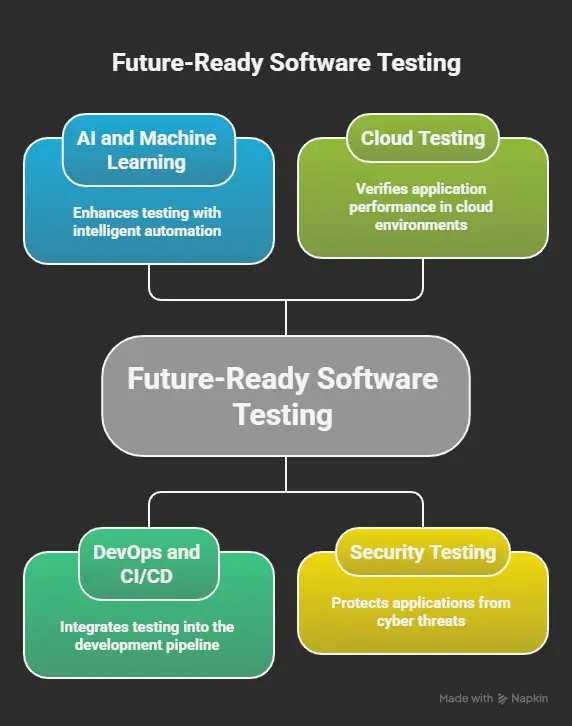
It is necessary for software testers to go beyond fundamental skills and integrate cutting-edge technologies that are reshaping the future of testing in order to maintain their competitive edge in the year 2026.
AI and Machine Learning in the Testing Process
Artificial intelligence and machine learning are bringing about a revolution in software testing by making it both more intelligent and faster.
- Testing Tools Driven by Artificial Intelligence: These tools have the ability to automatically recognize trends, to identify dangerous areas, and to optimize test coverage.
- Artificial intelligence has the ability to develop test cases based on the behavior of applications, which can reduce the amount of manual labor required and improve productivity.
In this way, testers are able to concentrate more on strategy and the resolution of complicated problems rather than on jobs that are repetitive.
The Knowledge of DevOps and CI/CD
Due to the fact that testing is increasingly incorporated into the development pipeline, it is vital for modern testers to have a complete understanding of DevOps processes.
- The use of tools such as Jenkins and GitHub Actions is widely prevalent.
- Continuous testing is a process in which tests are carried out automatically at each level of development in order to guarantee continuous feedback.
In addition to enhancing the general quality of the software, this permits speedier releases.
Cloud Testing
Testers are required to have knowledge of cloud settings because the majority of applications are moving to the cloud.
- Overview of the fundamentals of Microsoft Azure and Amazon Web Services
- Testing software applications in environments that are both scalable and dispersed
Through cloud testing, applications are tested to verify that they work well across a variety of user loads, devices, and geographic locations.
Fundamentals of Security Testing
Software security is more important owing to cyber threats.
- Security vulnerabilities, including SQL injection, cross-site scripting, and authentication, are frequent.
- Security hazards can be better identified and avoided by testers who know OWASP standards.
For application and user data protection, testers must understand security rules and processes.
Key Soft Skills
Soft skills are essential to software testing, along with technical expertise. These qualities let testers think critically, work together, and provide outstanding outcomes.
- Analytical Thinking
- Detail-oriented
- Strong communication abilities
- Problem-solving mindset
- Adaptable
Master Testing Skills with Industry Experts
Become a Test Engineer: Learn Core Skills from Industry-Leading Mentors and Land High-Paying Testing Jobs!
Explore ProgramTools Every Software Tester Should Learn in 2026
Software testers must use the latest tools. These tools boost testing efficiency, accuracy, and quality.
Selenium
Popular open-source web application testing automation tool. Regression and functional testing are ideal because it supports many programming languages and browsers.
Cypress
A fast and reliable front-end testing framework. Running in the browser allows real-time reloading and better web application debugging.
Playwright
A powerful cross-browser testing automation tool. Its auto-waiting and parallel execution make tests more stable and efficient.
JIRA
Frequently used for project and bug tracking. It lets testers submit bugs, track progress, assign tasks, and work with developers.
TestRail
An organizing, tracking, and managing test case management tool. This lets teams manage test cases, monitor execution, and provide thorough reports.
Career Path & Salary Trends
As you learn, software testing offers clear career growth:
- Starting (0–2 years)
Quality Assurance, Manual Testing
Test cases, issue reporting, and SDLC are basic topics.
- Intermediate (3–5 years)
QA Analyst, Automation Tester
Automation, API testing, and scripting
- Senior (6+)
Senior QA, Test Lead, SDET
Design framework, lead team, integrate CI/CD
- Advanced Career
Test Architect, QA Manager, or DevOps/SRE
Future Demands
The need for software testers is being driven by the complexity of apps and the move to digital. Quality, safety, and efficiency are becoming more and more important to businesses.
- There aren’t enough qualified people in many places, so robotic testers are in high demand.
- As of 2026, QA jobs are some of the best-paying and fastest-growing.
- People with skills in automation, AI, and the cloud are being hired for specialized jobs.
Tips to Learn These Skills Faster
If you follow the appropriate method, learning software testing is easier and faster. Practical tips for fast growth:
Includes online courses
Join Coursera, Udemy, or edX-organized courses. To lay the groundwork, these courses offer step-by-step instruction, real-world examples, and hands-on exercises.
Practice Projects
Testing is best learned by doing. Perform simple tasks, including website, mobile app, and API testing. Test scenarios, detect flaws, and automate them with Selenium or Postman.
Certifications
Certifications boost your skills and work prospects. For fundamentals, ISTQB and automated testing certifications are popular. Understand industry norms with their guidance.
Open Source Contribution
Open-source projects provide valuable experience. Testing live apps, reporting defects, and collaborating with developers worldwide. That boosts your talents and resume.
Develop a foundational understanding in Software Testing through our free materials!
Wrapping Up
Technical and soft skills are needed for software testing in 2026. From manual testing basics to automation tools, scripting, API testing, and performance testing, each skill is crucial to a successful career. AI-driven testing, DevOps, cloud, and security help testers compete in a fast-changing business.
Success depends most on ongoing learning. To stay current, testers must continually learn new technology. You may learn faster and improve your job by practicing, trying new tools, and working on real projects.
Start learning today, take baby steps, and improve. You may build a successful software testing profession with the correct attitude and drive.
Frequently Asked Questions
Do software testers need coding skills?
Yes, basic coding is important for automation testing, debugging, and understanding how applications work. Languages like Python, Java, and JavaScript are commonly used.
Is automation testing better than manual testing?
Neither is “better”—both are important. Manual testing is useful for exploratory and usability testing, while automation testing is best for repetitive and large-scale test cases.
What is the future of software testing?
The future is driven by AI, automation, and continuous testing in DevOps. Testers who learn these technologies will have strong career growth opportunities.
Can I become a software tester without experience?
How long does it take to become a software tester?
It usually takes 3–6 months to learn the basics and 6–12 months to become job-ready, depending on practice and learning consistency.