Table of Contents
Fashion design sketches are the first step in creating any outfit. They help designers put their ideas on paper before turning them into actual garments. For beginners, sketching is an easy and useful way to be exceptionally creative and better understanding the layout
For beginners, you don’t need to be perfect in drawing. With the right tools and practice, anyone can learn how to create basic fashion sketches. This blog will guide you learn about the tools needed and easy tips to improve your fashion sketching skills.
Key Takeaways:
- Fashion sketches are the first step – they help turn ideas into clear outfit designs before garments are created.
- Simple equipment to start with is enough – basic supplies like pencils, paper and paint are all you need as a beginner.
- Learn basic techniques in classes – start with easy shapes and easy sketches, and slowly add information.
- Practice and staying power are important – regular practice improves your sketching skills over time.
- Both hand and digital sketching are useful – Start with hand drawing and later try digital tools for better results.
Learn Advanced Designing & Boutique Skills ith Experts. Join Now!
What are Fashion Design Sketches?
Fashion design sketches are like simple drawings that show ideas for making designer outfit. Designers use these sketches to visualize how an outfit will look before making it. It is the first step in creating any kind of outfit.
Why are Fashion Sketches Important?
Fashion sketches are very important for designers. They help in planning and improving designs before making the final product.
Key Reasons:
- Shows Your Ideas Clearly: Sketching help you explain your design to others like tailors or team members.
- Saves Time and Effort: You can make change in sketches instead of changing the actual outfit later.
- Improves Creativity: Drawing helps you visualize new ideas and styles.
- Helps in Planning: Planning gives a clear idea of colors, patterns, and other design details.
What Does a Fashion Sketch Include?
A fashion design sketch usually has different elements that show how the outfit will look.
1. Figure (Model Drawing): Most sketches are drawn as a figure, often called a fashion figure. This will helps designer to know how the outfit will look when worn.
2. Clothing Design: This includes the main outfit like dresses, tops, or pants. Designers draw the shape, style, and details of the clothing during sketching itself.
3. Details and Patterns: Designers add small details like buttons, zips, embroidery, and prints during sketching. These details make the design more clear.
4. Colors and Fabrics: Sometimes designers add colors to show how the outfit will look. Designers may also mention the type of fabric like cotton, silk, or denim.
Types of Fashion Sketches
1. Rough Sketches: These are quick drawings used to note down rough ideas. They are not very detailed but help in capturing thoughts quickly.
2. Detailed Sketches: These sketches are more clear and neatly maintained. Which show proper shapes, designs, and details of the entire outfit.
3. Technical Sketches: These are more precise drawings used for production. Which including measurements and exact details for making an outfit.
Essential Tools for Sketching
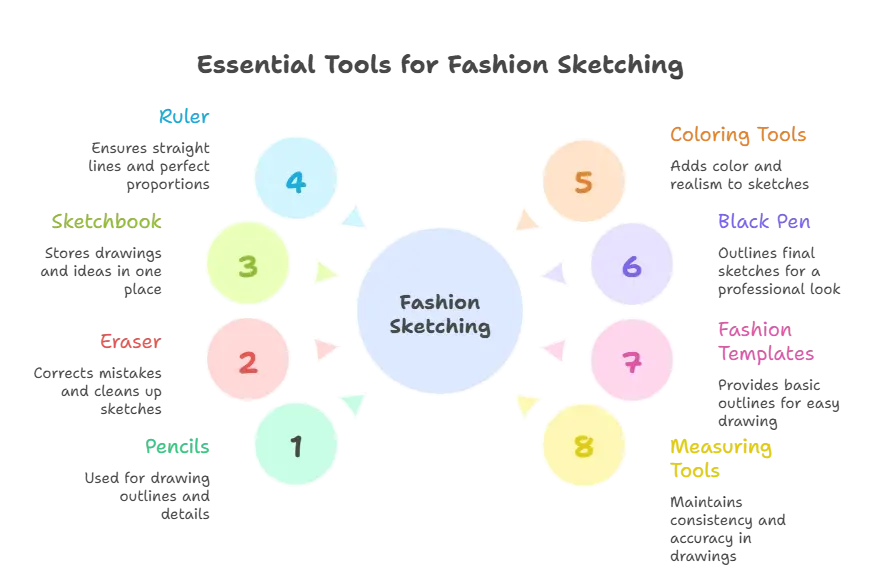
To start fashion design sketching, you don’t need expensive tools. Simple and basic items are enough for beginners. The right equipment will help the designer draw better and improve their skills step by step. Here are the essentials tools for sketching:
1. Pencils
Pencils are one of the basic tool in sketching. The designer can use different types of pencils like HB, 2B, or 4B. Light pencils help to draw rough outlines, and darker pencils help you add details. Pencils are easy to use and erase when any mistakes occured, which is perfect for beginners.
2. Eraser
An eraser will help the designer to correct any mistakes. Mistakes are normal when sketching, so it’s important to have a good eraser. Also it allows designers to erase extra lines and makes the sketch looks neat and clear.
3. Sketchbook or Drawing Paper
A sketchbook is used for practicing and store the drawings clearly. Choose a a good quality sketchbook is important, which is easy to draw. A sketchbook helps designer to keep all their ideas in one place.
4. Ruler
Ruler allows you to instantly draw lines and keep perfect proportions. It is especially useful when drawing patterns or borders to create smooth and neat drawings.
5. Coloring Tools
Designers can use shading pencils, sketch pens, or markers to color over the design. Colors make their sketch extra attractive and show realistic. Start with simple coloring materials and slowly use more options.
6. Black Pen or Fine Liner
Use a black pen or a good liner to outline the final sketch. This makes the drawing look clean and professional. After you finishing the pencil sketch, you can use the pen to focus on the layout.
7. Fashion Figure Templates
Beginners can use well-designed fashion parenting templates. These are primary outlines that will help you draw designs with ease. It saves time and gives you focus more on the design.
8. Measuring Tools
A simple measuring tool will help you maintain consistency and in your drawings. This is useful when drawing garments that desire symmetry and accuracy.
Basic Techniques for Beginners
Even learning fashion sketching can feel complicated in the beginning, but with easy techniques and daily practice, anyone can improve their. You don’t need to be perfect in the beginning, just start with simple drawings and keep practicing.
1. Start with Simple Shapes
Begin sketches with basic shapes like circles, lines, and rectangles. These shapes help the designer to create the body outline and clothing structure. It makes drawing easier and more balanced.
2. Draw a Basic Fashion Figure
Before drawing clothes, sketch a simple human figure. This is called a fashion figure. It helps the designer to understand how the outfit will look when worn.
3. Focus on Proportions
Try to keep the body parts in the right size and position. This is called proportion. For beginners, it’s okay if it’s not perfect. With practice, the drawings will get improve.
4. Sketch Lightly First
In the beginning always draw simp[le light lines. This helps the designer make changes easily. Once the sketch is perfect, then you can darken the lines to make it clear.
5. Add Clothing Step by Step
Start adding clothes over the figure slowly. . First, draw the basic look of the garment, then add details like sleeves, collar, or length. This makes the layout look neat and clear.
6. Show Fabric Flow
Clothes do not stay stiff—they move and fall naturally. Try to show folds and flow in your sketch. This makes your design look more realistic.
7. Add Small Details
Details like buttons, zips, pockets, and patterns make your design complete. Do not rush—add these details carefully to improve your sketch.
8. Practice Simple Shading
Shading helps show depth and shape. You can use light and dark pencil strokes to get better look for the sketch. Make it simple in the beginning.
9. Use References
Look at real clothes, photos, or fashion images for ideas. This will help you understand how clothes look and improve your drawing skills.
10. Practice Regularly
Practice is the most important method. Draw sketches every day, even light drawings. Your skills will obviously improve over time.
Tips to Improve Your Sketching Skills
Improving your fashion sketching skills takes time, practice daily is important. You can become better in drawing with easy steps and regular effort.
1. Practice Every Day
One adequate way to improve is frequent practice. Even drawing for a short time each day will help you get better. Start simple sketches and slowly try extra detailed designs.
2. Start Simple
Don’t try to draw complex designs in the beginning. Start with basic shapes and simple outfits. Once you feel confident, you can draw more unique and creative designs.
3. Observe Real Outfits
Look at clothes around you or online pictures. Notice how the fabric falls, how the sleeves are created, and how unusual outfits look. This will additionally help draw a realistic design.
4. Use References
Using reference images is very helpful. Using snapshots you can discover how to draw poses, clothes and information. It gives you a clear concept of how your sketches should look like.
5. Focus on Proportions
Try to keep the body and clothes in proper shape and form. This can be tricky at first, but with practice the drawing looks more balanced.
6. Experiment with Styles
Don’t go with one type of design now. Try specific patterns like casual, traditional, or modern. This will boost your creativity and help you discover your personal style.
7. Improve Your Shading
Shading makes your sketch look more clear. Practice using light dark strokes to show intensity and texture. Keep it simple in the beginning and improve slowly.
8. Learn from Mistakes
Making mistakes is part of learning. Do not feel upset if your sketch is not perfect. if there mistakes in the sketch find it out and improve in the next drawing.
Digital vs Hand Sketching
Fashion designers can create sketches in two method—hand sketching and digital sketching.
What is Hand Sketching?
Hand sketching means drawing designs on paper using tools like pencils, pens, and colors. It is the traditional way of sketching and is usually the first step for beginners.
Features of Hand Sketching:
- Easy to start with basic tools like pencil and paper
- Helps improve drawing and creativity skills
- Gives a natural and personal touch to designs
- No need for electronic devices
What is Digital Sketching?
Digital sketching means creating designs using a tablet, computer, or mobile apps. Designers use software to draw and color their sketches.
Features of Digital Sketching:
- Easy to edit and correct mistakes
- Offers many tools like brushes, colors, and effects
- Saves time in coloring and detailing
- Easy to store and share designs
Difference Between Digital and Hand Sketching
1. Tools Used
- Hand sketching done by using paper, pencils, and colors.
- Digital sketching done by using devices like tablets and design software.
2. Ease of Editing
- Hand sketches are difficult to correct.
- Digital sketches can be easily edited and changed throughout sketching.
3. Learning Process
- Hand sketching is best for beginners to learn the basics.
- For Digital sketching need some technical knowledge.
4. Speed and Efficiency
- Hand sketching were time consuming.
- Digital sketching is faster, especially for coloring and finalizing the designs.
5. Final Output
- Hand sketches look more natural and artistic.
- Digital sketches look very clean and professional touch.
Which One Should You Choose?
Hand sketching is better to start, if you are a beginner in fashion industry. It helps you learn basic drawing skills and improve your creativity. Once you learn the basic drawing skill, then you can try digital sketching.
Many designers use both methods. Mnay designer uses basic outline by hand sketching and then convert their designs into digital format for better presentation.
Learn Advanced Designing & Boutique Skills with Experts. Join Now!
Master Fashion Designing and Create Your Signature Style
Unlock your creative potential with our expert-led Fashion Designing course. Build in-demand skills and step confidently into the world of fashion!
Begin Your Fashion Career Today!Conclusion
For a fashion designer sketching is the first step in turning ideas into real outfits. With the right tools and techniques, beginners can easily start hand sketching and improve their skill gradually. Hand sketching and virtual drawings have their on advantages. You can start with some simple hand sketching and as you improved then you can try digital sketching. The secret is to draw, to work and to maintain the search for new ideas.
Master Fashion Designing and Create Your Signature Style
Unlock your creative potential with our expert-led Fashion Designing course. Build in-demand skills and step confidently into the world of fashion!
Begin Your Fashion Career Today!Frequently Asked Questions
What are fashion design sketches?
Fashion design sketches are simple drawings that show ideas for clothes. Designers use them to plan how an outfit will look before making it. These sketches help in turning creative ideas into real designs.
Do I need to be good at drawing to start fashion sketching?
No, you do not need to be perfect at drawing. Beginners can start with simple shapes and basic sketches. With regular practice, your drawing skills will improve over time.
What tools are needed for fashion sketching?
Basic tools like pencils, erasers, sketchbooks, and colors are enough to start. As you improve, you can explore markers, fine liners, and even digital tools like tablets and design apps.
What is the difference between hand sketching and digital sketching?
Hand sketching is done using paper and pencil, while digital sketching is done using devices like tablets and software. Hand sketching is good for beginners, while digital sketching is faster and easier to edit.
How can I improve my fashion sketching skills?
You can improve by practicing regularly, starting with simple designs, observing real outfits, and using reference images. Learning from mistakes and taking feedback also helps a lot.
How long does it take to learn fashion sketching?
It depends on your practice and interest. Some people learn basic sketching in a few weeks, while mastering it may take months or more. Regular practice is the key to improvement.
Can I use fashion sketches for a career?
Yes, fashion sketches are very important for a career in fashion designing. They are used to present ideas, plan designs, and communicate with teams. Strong sketching skills can help you grow in the fashion industry.