
Table of Contents
If you are considering becoming a quality assurance tester, one of the most important things you should ask yourself is, “How long will it take?” The response is not the same for each and every person. Your history, the rate at which you learn, the amount of time you devote each day, and whether you want to perform manual or automated testing are all factors that will determine the outcome.
What is the good news? One of the most rapidly growing fields in the technology industry is quality assurance testing. It is possible to become job-ready in a few months if you use the appropriate strategy and remain consistent. So that you are aware of everything that is going to happen, let’s break down a realistic timeline.
Key Takeaways:
- Become a QA tester in 3–6 months (manual) or 6–12 months (automation).
- No coding experience is needed, yet it improves professional progression.
- Manual testing, test case writing, issue reporting, and SQL basics are essential.
- JIRA, Selenium, and Cypress boost employment.
- Practical experience and projects are more vital than theory.
- Beginners, non-IT students, and freshmen can join QA simply.
- Portfolios and practical experience boost career prospects.
- Career progression in QA testing leads to senior and automation roles.
Join Entri’s Software Testing Course Today!!
What Does a QA Tester Do?

Before software is released to the public, a quality assurance tester (QA tester) tests its functionality. They want to find problems early so they can give customers a seamless, error-free experience.
Selection of Manual or Automated Test
Manual Testing
Testers replicate users by filling out forms, pressing buttons, and testing several tasks to ensure software quality. It ensures the program is error-free.
Automated Testing
The tester can automate testing with Cypress or Selenium. This makes testing huge apps or repetitive tasks efficient.
Key Responsibilities
- Testing:
Carry out the test cases in order to ensure that all of the features function as intended. - Bug Tracking:
Using software such as JIRA, you should locate problems and record them. - Reporting:
Take screenshots, clearly describe the procedures involved, and compare the predicted results to the actual ones.
How Long Does It Take to Become a QA Tester?
1: What is software testing?
The amount of time it will take you to become a quality assurance tester is going to be determined by your past experiences as well as the path that you choose to take. A brief explanation can be summarized as follows:
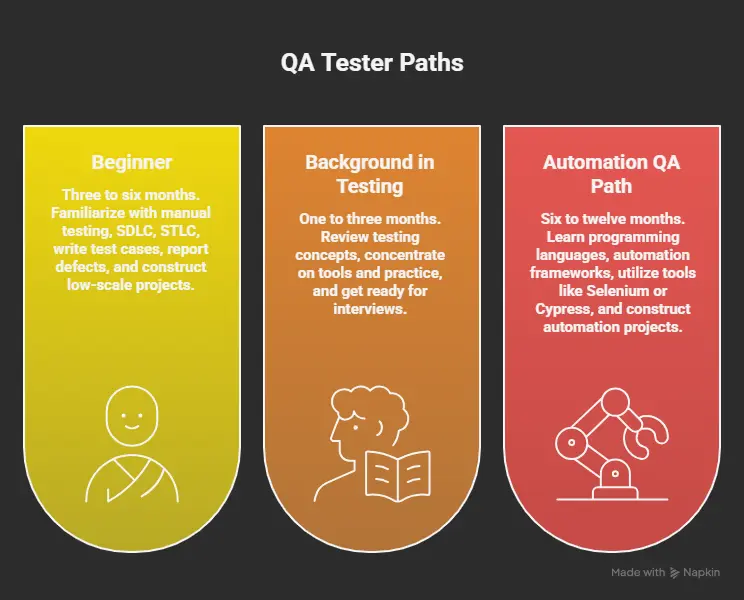
Beginner (with no prior experience in technology)
Three to six months.
- Become familiar with the fundamentals of manual testing.
- Knowledge of the SDLC and STLC
- Learn how to write test cases and report defects through practice.
- Construct low-scale projects to get experience.
Perfect for those who are just starting out and are new to the world.
Having a background in (one to three months)
- Immediately review the concepts of testing.
- Concentrate on the tools and practice in real time.
- Get ready for the interviews.
More rapid advancement as a result of prior technical knowledge.
The Automation Quality Assurance Path (Six to twelve months)
- Programming languages such as Java, Python, or JavaScript should be learned.
- Get familiar with the automation frameworks.
- Utilise tools like as Selenium or Cypress in your work.
- Construction of automation projects
The best option for long-term career advancement and increased remuneration
Master Testing Skills with Industry Experts
Become a Test Engineer: Learn Core Skills from Industry-Leading Mentors and Land High-Paying Testing Jobs!
Explore ProgramStep-by-Step Timeline to Become a QA Tester
If you want to get ready for a job, here is a straightforward and phased plan that you can follow:
Step 1: Start with the Basics (Months 1–2)
- Software Development Life Cycle training
- The Software Testing Life Cycle
- Learn manual testing basics.
- Understand functional, regression, smoke, etc. testing.
- Learn software development and testing.
Step 2: Learn Core Testing Skills (Months 3–4)
- Use bug tracking tools like JIRA.
- Practice exam case writing
- Understand bug reporting and documentation.
- Try demo webpages or apps.
- Know test case execution and defect lifecycle
Step 3: Advanced Practice & Job Prep (Months 5–6)
- Work on live or mock projects
- Practice test case writing and reporting.
- Database testing requires basic SQL.
- Get ready for QA interviews
- Create a small testing portfolio
Step 4: Optional but Important: Learn Automation (6+ Months)
- Learn Cypress or Selenium automation.
- Know Java, Python, or JavaScript essentials
- Practice building simple automation scripts
- Handle modest automation projects
Skills You Need to Learn
Focus on acquiring these vital abilities if you want to become a great quality assurance tester:
Theories Regarding Manual Testing
- Become familiar with the process of testing software step by step.
- Study the several kinds of testing, such as functional, regression, and usability testing.
- Possess the ability to recognise faults from the point of view of a user
Test Case writing
- Create test scenarios that are simple and well-organized.
- Describe a variety of situations, including good, negative, and edge instances.
- Make sure that each and every feature has been thoroughly tested.
Iteration of Bugs
- Defects should be accurately identified and documented.
- Employ tools such as JIRA.
- There should be screenshots, procedures to reproduce, and a comparison of predicted and actual results.
SQL Standard
- Master the fundamental queries (SELECT, INSERT, UPDATE…).
- Ensure the accuracy of the information stored in databases.
- Very helpful for testing the backend
The use of automation tools is optional (for career advancement).
- Get familiar with tools such as Selenium and Cypress.
- Comprehension of fundamental programming languages (Java, Python, or JavaScript)
- To automate test cases that are repeated.
Factors That Affect Your Learning Time
A number of important factors can cause the amount of time it takes to become a quality assurance tester to vary.
Knowledge of the Technology in Hand
- If you already have a background in information technology or programming, learning will go considerably more quickly.
- First-timers might require additional time to fully comprehend fundamental ideas.
Technical foundation is the key to accelerating progress.
Practicing on a Daily Basis
- Learning can be considerably accelerated by practicing for two to four hours every day.
- You might make less progress if you practice in an inconsistent manner.
It is more vital to maintain consistency than to devote a significant amount of time to studying.
Course versus Independent Study
- Taking structured classes not only saves time but also provides a clear plan.
- Even if it is more flexible, self-learning can take longer if it is not accompanied by assistance.
Having a path that is directed helps to avoid confusion and delays.
Activity-Based Projects
- When it comes to quality assurance, practical experience is absolutely necessary.
- The process of working on real or fake projects is a simple way to improve comprehension.
- Assists you in becoming job-ready more quickly
It is true that the more you practice, the faster you will learn.
Master Testing Skills with Industry Experts
Become a Test Engineer: Learn Core Skills from Industry-Leading Mentors and Land High-Paying Testing Jobs!
Explore ProgramFastest Way to Become a QA Tester
If you want to become a quality assurance tester in a short amount of time, you should concentrate on taking a clever and practical approach rather than merely relying on theory.
Courses That Are Scheduled
- Continue down a path that is well-organized and has a distinct road map.
- Avoid squandering time trying to figure out what you should learn next.
- Step by step, you will acquire knowledge of concepts such as manual testing, tools, and real-world procedures.
Helps you save time and maintain your concentration on learning
Currently Running Projects
- Develop your skills via live or demo applications.
- You should act as if you are working in a real company when you write test cases and report defects.
- Make quick use of what you have learned.
Employers are looking for candidates who have practical experience.
A Mock Experience or an Internship
- Experiment with internships, even if they are unpaid or only for a short period of time.
- If you are unable to access real work, you can replicate it by testing websites and apps.
- Work as a quality assurance tester, monitoring bugs, generating reports, and adhering to procedures.
This will provide you with real-world experience and confidence.
The process of constructing a portfolio
Putting together a portfolio with:
- Test scenarios
- Reported errors
- Example of a project
- In the course of interviews, demonstrate your work.
Sometimes, a solid portfolio might serve as a substitute for experience.
Can You Get a QA Job Without Coding?
You can easily acquire a job in quality assurance even if you don’t have any coding experience.
The Roles of Manual Testing
- Manual testing is the primary emphasis of many entry-level quality assurance positions.
- Programming expertise is not necessary in any way.
Software will be tested by you:
- Test cases are being carried out
- Detecting faults
- Clearly reporting any problems that arise
Beginning your career in quality assurance in this manner is the simplest way to get started.
What about advances in one’s career?
- Although coding is not essential to begin, having abilities in automation can help you advance in your job.
Getting familiar with tools such as Selenium or Cypress can assist you:
- Do your work more quickly.
- Take care of difficult projects.
- Your earnings will increase.
Over the course of time, there will be a greater demand for automation testers.
Final Verdict
Starting in the technology business as a quality assurance tester is one of the quickest ways to get started. Adding automated skills could take anywhere from six to twelve months, whereas manual testing could have you ready for work in as little as three to six months for a realistic scenario. The timeframe you choose is determined by your history, your level of consistency, and the amount of practical experience you gain.
One of the most straightforward ways to achieve success is to learn on a constant basis, practice on a daily basis, and work on actual tasks. Every day, even a little bit of development can add up to significant outcomes over the course of time.
Your first quality assurance task will be closer to you than you think if you begin today and maintain your commitment to the process.
Frequently Asked Questions
Do I need coding to become a QA tester?
No. You can start with manual testing roles without coding. However, learning coding helps if you want to move into automation testing later.
Can I get a QA job as a fresher?
Yes. Many companies hire freshers for manual QA roles, especially if you have practice projects or a portfolio.
Can I learn QA testing from home?
Absolutely. You can learn QA testing through online courses, YouTube, and practice websites without attending physical classes.
Do I need a degree to become a QA tester?
Most companies prefer a degree, but it is not always mandatory. Skills, projects, and knowledge matter more than your degree.
Is QA testing a stressful job?
It can be detail-focused, especially during deadlines, but it is generally less stressful than development roles when managed well.
Is QA testing a repetitive job?
Some tasks can be repetitive (like regression testing), but automation tools help reduce repetition and improve efficiency.
How important is practice in QA testing?
Very important. Real learning happens when you write test cases, find bugs, and work on real projects.