Table of Contents
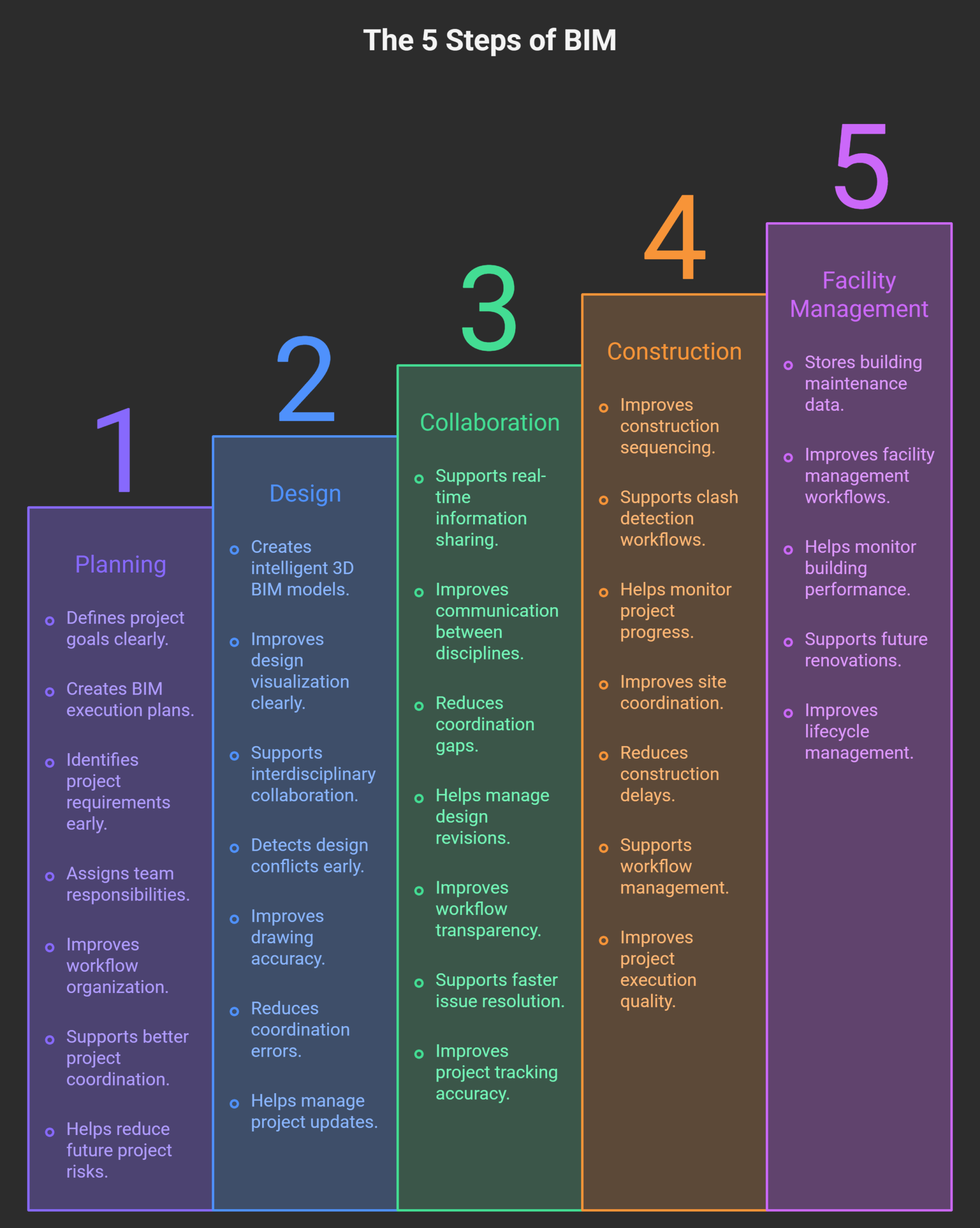
The 5 steps of BIM explain the complete BIM workflow. These steps include planning, design, collaboration, construction, and facility management. Each stage improves coordination and communication between teams. BIM also helps reduce project delays, errors, and costly rework during construction.
- Improves project coordination and workflow management.
- Supports better planning and team communication.
- Reduces construction errors, delays, and rework.
Key Takeaways:
- The BIM workflow follows five important project stages.
- Planning defines project goals and BIM standards.
- Design creates intelligent 3D BIM models.
- Collaboration improves communication between project teams.
- Construction uses BIM for coordination and monitoring.
- Facility management supports building operations after construction.
- BIM improves project visualization and data management.
- Digital workflows reduce delays and construction errors.
- BIM supports better coordination across different disciplines.
- Many industries now depend heavily on BIM workflows.
Get Career-Oriented BIM Certification Course with Expert Mentors! Get a free demo here!


Master BIM and Elevate Your Career – Enroll Today!
Stay ahead in the construction and design industry with our comprehensive BIM Course! Learn Building Information Modeling (BIM) from experts, gain hands-on experience with top software, and boost your career prospects. Join now and become a certified BIM professional!
Know MoreFrequently Asked Questions
What are the 5 steps of BIM?
The 5 steps of BIM include planning, design, collaboration, construction, and facility management. These stages improve project coordination, communication, and workflow management throughout the building lifecycle.
Why are the BIM steps important?
The BIM steps organize construction workflows more efficiently. They help teams reduce project errors, improve coordination, and manage project information better.
What happens during the BIM planning stage?
Teams define project goals, workflows, and BIM standards during planning. This stage improves project organization and resource management significantly.
How does the design stage work in BIM?
The design stage creates intelligent 3D BIM models for projects. Architects and engineers coordinate designs using shared digital information.
Why is collaboration important in BIM?
Collaboration improves communication between different project disciplines. Shared BIM models help teams manage updates and resolve issues faster.
How does BIM help during construction?
Construction teams use BIM models for coordination and workflow management. BIM improves sequencing, clash detection, and project progress monitoring.
What is facility management in BIM?
Facility management uses BIM data after project completion for operations and maintenance. It helps manage building performance and future renovations efficiently.
Which industries use BIM workflows?
Infrastructure, commercial, residential, and industrial sectors use BIM workflows widely. Smart city and transportation projects also depend heavily on BIM systems.
What are the advantages of BIM workflows?
BIM improves project visualization, communication, and coordination significantly. It also reduces construction errors, delays, and costly project rework.
What is the future scope of BIM?
The future scope of BIM remains highly promising across global construction industries. Advanced technologies and digital workflows will increase BIM adoption further.