Table of Contents
What started as an experimental convenience has turned into a massive retail revolution. Delivering small orders within minutes requires an expensive network of neighbourhood warehouses called “dark stores.” For a long time, experts were doubtful whether this business model could ever make money.
However, today the topic of discussion has changed altogether. Investors and shoppers alike are asking a critical question: among the big three—Zepto, Blinkit, and Swiggy Instamart—which platform is winning the race for quick commerce profitability India?
Learn Stock Marketing with a Share Trading Expert! Explore Here!
Key Takeaways
- Blinkit is the current king of quick commerce profitability India, becoming the first major player to hit positive adjusted EBITDA.
- Zepto has overtaken Instamart in terms of order volume and revenue, capturing a strong second place, but its massive expansion has resulted in the highest net cash burn.
- Swiggy Instamart has fallen to third place in terms of growth speed and order volumes, but it is focusing on a cautious, margin-led recovery using private labels.
- Advertising and non-grocery items (like electronics and beauty products) are the secret pillars driving margins across all platforms.
Introduction
1: What is a stock?
Are you someone living in any major Indian city? If yes, in all probabilities, your shopping habits would have undergone a major change in the last few years. Let’s take the example of buying a single lemon, a phone charger, or a bottle of shampoo.
Gone are the days when you had to walk to the local kirana store. Neither you have to wait a day for an e-commerce delivery. Now, all you have to do is to tap an app. In less than ten minutes, a delivery partner arrives at your doorstep.
Kearney expects that the quick commerce grocery market would grow threefold between 2024 and 2027, hitting somewhere between Rs. 1.5 lakh crore to Rs.1.7 lakh crore. This is the magic of quick commerce, a sector that has taken urban India by storm.
Let’s look at the latest financial performance data, operational metrics, and monetization strategies to find out who leads the pack.
The Financial Scorecard: Scale vs. Profit
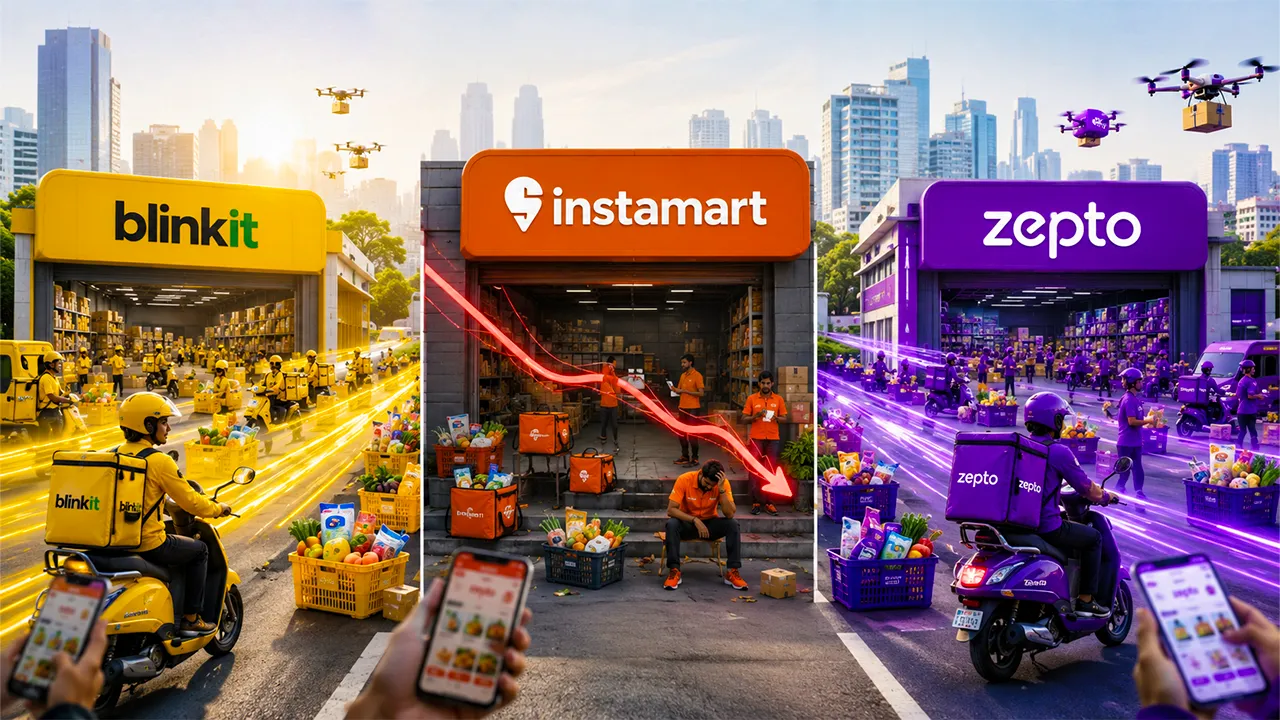
To understand the race for quick commerce profitability India, we must look closely at the financial numbers from the latest fiscal period. The scale of operation and the financial losses tell a very clear story of divergence among the top three players.
| Key Metric (FY26) | Blinkit | Zepto | Swiggy Instamart |
| Annual Revenue | ₹37,779 crore | ₹22,623 crore | ₹3,859 crore |
| Adjusted EBITDA | Positive (₹37 cr in Q4) | Loss of ₹5,041 crore | Loss of ₹3,511 crore |
| Total Orders | 91.6 crore | 64.01 crore | 41.2 crore |
| Dark Store Count | 2,243 | 1,139 | 1,143 |
| Market Share | 46% | 22% | 24% |
1. Blinkit: The Runaway Profit Leader
In terms of both scale and financial sustainability, Blinkit has emerged as the clear market leader. After it was acquired a few years ago, the platform focused aggressively on expanding its dark store network.
At the same time, it paid attention to improving its warehouse efficiencies. In terms of market orders, Blinkit is leading in the 2026 March quarter with 273.9 million orders. It is followed by Zepto with 210 million orders and Instamart at the third position with 112.6 million orders. Blinkit crossed a significant milestone by reporting a positive adjusted EBITDA of ₹4 crore and ₹37 crore in consecutive quarters.
It commands nearly 46% of the market share and operates over 2,243 dark stores—almost double the network size of its competitors. By spreading its fixed corporate costs over a massive base of 91.6 crore annual orders, Blinkit has unlocked the secret to structural profitability.
2. Zepto: High Growth, High Burn
Zepto has achieved extraordinary growth, more than doubling its revenue to ₹22,623 crore. It has comfortably pushed past Instamart in daily order counts, handling around 17.53 lakh orders per day. Zepto’s dark stores operate at a remarkably high throughput level, extracting more orders per store than its peers.
In terms of active delivery partners, Zepto’s numbers surged from 49,278.25 in FY24 to 118,919.25 in FY25 and 221667.17 in FY26.However, this hyper-growth has come at a steep price. With Zepto preparing for its initial public offering (IPO), its annual adjusted EBITDA loss stands at ₹5,041 crore.
The company is in deep investment mode, aggressively setting up new dark stores and spending money on customer acquisition. While its unit economics are improving mathematically—with the cost per delivery dropping significantly—it remains the heaviest cash burner among the three.
3. Swiggy Instamart: The Calibrated Pioneer
Swiggy Instamart was an early pioneer in this space. However, the firm has recently experienced a slowdown in growth relative to its aggressive rivals. With a revenue of ₹3,859 crore, Instamart has slipped in terms of overall market volume.
Suffering a loss of ₹3,511 crore, Instamart has consciously chosen to stay away from reckless capital spending. Rather than replicating Blinkit’s massive store expansion or Zepto’s aggressive discounting, Instamart is taking a measured approach.
It is prioritizing higher average order values and strict cost controls over rapid geographic expansion. To add on, in terms of AOV (Average Order Value), Instamart is on the top among its peers with an AOV of Rs.700.
How the Dark Store Network Shapes Profitability
The core unit of quick commerce is the dark store. How well a company manages these micro-warehouses determines its path to financial survival.
[Dark Store Density] ➔ [Shorter Delivery Radius] ➔ [More Deliveries Per Rider Hour] ➔ [Lower Cost Per Order]
Blinkit’s dominance is directly linked to its massive network of 2,243 dark stores. A dense network means that delivery riders travel shorter distances to fulfill orders. Shorter distances allow a single rider to complete more deliveries per hour, bringing down the delivery cost per order.
Zepto operates fewer stores (1,139) but manages them with incredible operational intensity. By optimizing spatial layouts and using high-tech picking systems, Zepto has reduced its average delivery distance from over 2 km to 1.83 km. Across millions of daily transactions, saving a few hundred meters per delivery cuts fuel and labour costs dramatically, directly aiding the push for quick commerce profitability in India.
Instamart operates a comparable number of dark stores (1,143) to Zepto but handles lower order volumes through them. This lower throughput means its fixed store operating costs – such as rent and electricity – are spread over fewer orders, creating a temporary drag on its profit margins.
The Secret Margin Boosters: Beyond Groceries

Selling fresh vegetables, milk, and bread is an excellent way to get users to open the app every morning. However, standard grocery items carry very low single-digit profit margins. To achieve real financial sustainability, all three platforms have quietly diversified into higher-margin business engines.
High-Margin Product Categories
The platforms are rapidly expanding their inventory into non-grocery items like electronics accessories, beauty items, apparel, and home appliances.
While a packet of milk might offer a 3% to 5% margin, selling a pair of wireless earphones, a lipstick, or a mixer-grinder can fetch profit margins ranging between 20% and 50%. Instamart commands a higher average basket value because its users tend to buy these larger, higher-value items.
Learn Stock Marketing with a Share Trading Expert! Explore Here!
High-Margin Private Labels
Creating in-house brands allows platforms to cut out distributors and retain a massive share of the profit.
- Swiggy Instamart has introduced its private label brand, Noice.
- Blinkit sells household goods under Whole Farm.
- Zepto features essentials under Daily Good.
These private labels mimic premium consumer brands but offer vastly superior profit margins to the delivery platforms.
The Real Money Machine: Brand Advertising
The most lucrative engine driving quick commerce profitability India is digital advertising. Quick commerce apps have become premium media channels for consumer brands. Because users open these apps with a clear intent to buy immediately, consumer goods companies are willing to pay a premium to feature their products at the top of search results.
Blinkit and Zepto have each turned their search pages into powerhouse ad networks, pulling in hundreds of crores in advertising revenue per quarter. Because ad revenue carries an almost 100% net profit margin, it acts as a massive cushion against the high physical costs of fuel, riders, and real estate.
Stock Market Training Reviewed & Monitored by SEBI Registered Investment Advisor
Trusted, concepts to help you grow with confidence. Enroll now and learn to start investing the right way.
Know moreWho is the Ultimate Winner in Profit Race?
The Indian quick commerce battleground is no longer just about who can deliver a packet of chips the fastest. The narrative has completely shifted toward structural efficiency, financial discipline, and monetization.
Currently, Blinkit is the undisputed leader in profitability. With an upper hand of scaling early, securing a massive dark store footprint, and leveraging its parent ecosystem, it has unlocked positive EBITDA margins while sustaining healthy growth.
Zepto is the high-velocity challenger. It possesses incredible operational efficiency per dark store and is expanding faster than anyone else. However, with its heavy investments, true profitability will take longer to achieve, making its upcoming IPO a crucial test of investor patience.
Swiggy Instamart is the cautious strategist. Even though it has lost the crown of market share leader, its disciplined focus on cost control, private labels, and higher order values could help it achieve a sustainable financial model without burning through infinite capital.
Ultimately, the Indian market is vast enough to support multiple players. However, the crown of profitability stays firmly with Blinkit for now.
Stock Market Training Reviewed & Monitored by SEBI Registered Investment Advisor
Trusted, concepts to help you grow with confidence. Enroll now and learn to start investing the right way.
Know moreFrequently Asked Questions
Which quick commerce app is currently profitable in India?
Blinkit is the only major quick commerce platform in India that has successfully achieved positive adjusted EBITDA, making it the clear leader in financial sustainability.
Why do quick commerce platforms burn so much cash?
Platforms burn cash primarily because setting up a vast network of urban dark stores, managing cold-chain logistics, and acquiring customers through discounts requires massive upfront capital.
How do these platforms make money if delivery fees are so low?
They rely on a multi-pronged revenue model: product markups, high-margin advertising fees paid by brands, customer subscription programs, and high-margin private label products.
Is Zepto bigger than Swiggy Instamart?
Yes, latest financial disclosures show that Zepto has overtaken Swiggy Instamart in both operational revenue and daily order volumes, securing the number two spot nationwide.
What are the highest-margin items sold on these apps?
While daily staples like milk have thin margins, non-grocery categories like cosmetics, electronic accessories, festive gifts, and private labels offer high margins of 20% to 50%.
What role does advertising play in platform profitability?
Advertising is the most lucrative revenue stream. Consumer brands pay heavily for prime visibility on the app interface, providing high-margin cash that directly offsets delivery losses.
Will entry of e-commerce giants affect quick commerce profitability?
Yes. The entry of massive retail giants scaling their own instant-delivery services increases competition for dark store real estate and riders, keeping short-term cash burn elevated across the sector.