Table of Contents
Key Takeaways:
- Accounting records and reports financial transactions of a business.
- Accountancy studies the principles guiding accounting practices.
- Accounting focuses on practical financial record keeping tasks.
- Accountancy provides the rules and frameworks for accounting.
- Accounting prepares financial statements for organizations.
- Accountancy ensures financial reporting follows standard guidelines.
- Both fields support financial management and business decision making.
Accounting records financial transactions within business operations. Businesses rely on accounting for daily financial tracking. Accountants record transactions using structured financial systems. These records appear in journals and ledgers. Financial statements summarize business financial performance. Accountancy explains principles behind financial record keeping. It studies rules guiding financial reporting practices. The discipline also defines accounting standards and methods. These frameworks ensure consistency in financial reporting.
Both terms appear similar in many situations. However, their meaning differs in finance and commerce. Accounting handles financial data processing. Accountancy governs financial reporting systems. Professionals usually study accountancy in academic programs. Daily work mainly involves accounting activities. Businesses depend on both for financial transparency. Understanding the difference improves financial knowledge. Students also benefit from this distinction. Employers value knowledge of both fields.
Become an Accounting Pro – Learn from Industry Experts!

Introduction
Financial information supports everyday business decisions. Organizations require accurate financial records for proper management. Reliable records help businesses measure performance and growth. Financial systems ensure transactions remain properly documented.
Accounting and accountancy manage financial information systems. Both terms appear frequently in business and education. Many people assume both terms share identical meanings. However, each term represents a different financial concept.
Accounting focuses on managing financial transactions practically. Accountancy studies principles guiding accounting processes. Accounting performs operational financial tasks daily. Accountancy builds the framework behind those activities.
Businesses depend on accounting for financial tracking. Accountancy ensures accounting practices follow standard guidelines. Both fields help maintain financial transparency. Financial professionals rely on both areas extensively.
Commerce education explains these concepts clearly. Students study accountancy during academic programs. They also practice accounting procedures regularly. Both knowledge areas support professional development.
Understanding this difference improves financial knowledge. Businesses also benefit from trained financial professionals. Clear financial systems support organizational growth.
Key areas explained in this article include:
-
Meaning and purpose of accounting
-
Definition and scope of accountancy
-
Key differences between both financial fields
-
Practical importance of the distinction
-
Career opportunities within accounting and accountancy
Evolution of Accounting as a Discipline
1: Accounting provides information on
2: To figure out the worth of the end stock during the finish of the monetary year we,
3: Deals invoices are first placed in
4: Entered in the Purchases Journal is
5: Copyrights, Patents, and Trademarks are instances of
Ever wondered how much you really know? It's time to put your brain to the test!
Accounting developed gradually alongside human economic activity. Trade and commerce created the need for financial records. Over centuries, accounting systems became structured and reliable. Modern accounting now supports global financial reporting systems.
The discipline evolved through several important historical stages.
Early Record Keeping in Ancient Civilizations
Early societies practiced simple financial record keeping. Traders documented exchanges of goods and resources. Basic records tracked debts, payments, and supplies. Clay tablets stored some of the earliest records. Ancient Mesopotamia used written documentation for trade. Egyptians tracked grain storage and distribution carefully. Roman merchants also maintained simple financial records. These systems improved accountability in trading activities.
Important characteristics of early accounting included:
-
Manual recording of trade transactions
-
Tracking of goods, payments, and debts
-
Absence of standardized accounting rules
-
Records mainly used for trade monitoring
These practices formed the earliest accounting foundations.
Development of Double Entry Bookkeeping
Accounting evolved significantly during the fifteenth century. European trade expanded rapidly during this period. Merchants required more accurate financial recording systems.
Double entry bookkeeping introduced systematic transaction recording. Each transaction affected two separate accounts. One account recorded debit entries.
Another account recorded matching credit entries. This method improved accuracy and financial reliability. Errors became easier to detect and correct.
Major developments during this stage included:
-
Introduction of debit and credit system
-
Structured financial transaction recording
-
Improved reliability of financial information
-
Wider adoption among merchants and traders
Double entry bookkeeping remains widely used today.
Industrial Revolution and Modern Accounting
Industrialization transformed business operations across industries. Large companies required more detailed financial information systems. Accounting expanded to support complex business structures.
Cost accounting emerged for production cost management. Companies tracked expenses, inventory, and manufacturing costs. Financial reporting also became increasingly important. Investors needed reliable information about company performance.
Modern accounting later adopted standardized financial frameworks. Governments introduced financial regulations and reporting requirements. Technology further transformed accounting practices worldwide.
Key features of modern accounting include:
-
Standardized financial reporting systems
-
Strong regulatory oversight and compliance
-
Global accounting standards for businesses
-
Extensive use of digital accounting software
Accounting continues evolving with economic and technological developments.
Placement Oriented PWC Business Accounting Course
PWC Certified Business Accounting Course by Entri App: Master in-demand skills, ace interviews, and secure top-tier jobs.
Join Now!What is Accounting?
Meaning of Accounting
Accounting records financial transactions of businesses and organizations. It helps track income, expenses, assets, and liabilities. Businesses rely on accounting for financial information. Accurate records support better business decisions.
Accounting ensures financial data remains organized and clear. Managers, investors, and authorities use financial reports. These reports explain the financial position of businesses.
Purpose of Accounting
Accounting helps businesses understand financial performance clearly. Financial records reveal profits, losses, and operational efficiency. Organizations analyze accounting information for strategic planning.
The main purposes of accounting include:
-
Recording financial transactions systematically
-
Tracking income and business expenses
-
Measuring profits and financial performance
-
Preparing financial statements for stakeholders
-
Supporting planning and financial decision making
Core Accounting Activities
Accounting follows structured steps for handling financial data. Each step ensures accuracy and reliability of records. These activities occur regularly in business operations.
Core accounting activities include:
-
Recording transactions in journals
-
Classifying transactions into ledger accounts
-
Summarizing financial information periodically
-
Preparing financial statements for reporting
-
Analyzing financial performance and trends
Importance of Accounting in Business
Accounting supports transparency and financial accountability. Businesses monitor financial health through accounting systems. Investors depend on reliable accounting information. Regulatory authorities also require accurate financial reports.
Without accounting, businesses cannot track financial performance. Therefore, accounting remains essential for organizational success.
What is Accountancy?
Meaning of Accountancy
Accountancy studies principles guiding financial record keeping. It forms the broader discipline behind accounting practices. Accounting operates within accountancy frameworks and standards. The field explains how financial information should appear.
Accountancy also develops methods for financial reporting systems. These methods ensure consistency in financial information. Organizations follow these frameworks for reliable financial reporting.
Purpose of Accountancy
Accountancy provides rules guiding accounting procedures. These rules ensure accurate and standardized financial reporting. Financial frameworks improve transparency in business reporting.
The main purposes of accountancy include:
-
Establishing principles guiding accounting practices
-
Creating standards for financial reporting systems
-
Ensuring consistency in financial information
-
Supporting compliance with financial regulations
-
Improving reliability of financial data
Areas Covered in Accountancy
Accountancy includes several financial knowledge areas. These areas extend beyond basic financial record keeping. Professionals study these areas during commerce education.
Major areas of accountancy include:
-
Financial accounting principles and reporting systems
-
Auditing practices verifying financial information
-
Taxation systems governing financial obligations
-
Cost accounting methods for expense analysis
-
Financial management concepts for business decisions
Importance of Accountancy
Accountancy strengthens reliability of accounting practices. Standard rules improve comparability of financial reports. Investors depend on consistent financial information. Regulators also rely on structured financial frameworks.
Accountancy therefore supports financial transparency in organizations. It also improves understanding of financial reporting systems.
Become an Accounting Pro – Learn from Industry Experts!
Key Differences Between Accounting and Accountancy
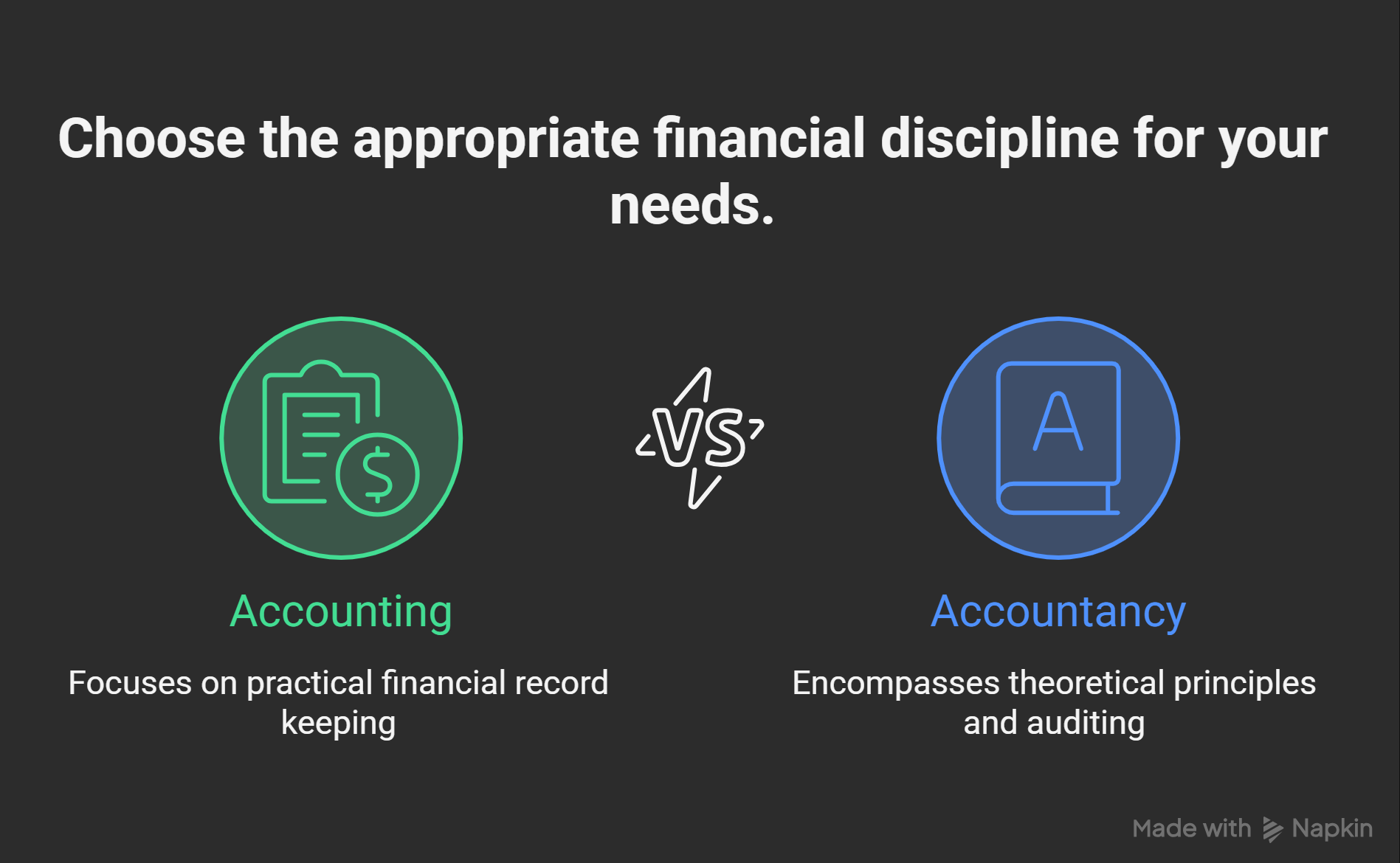
Accounting and accountancy appear closely related concepts. However, both terms represent different financial meanings. Many students and professionals confuse these terms. Understanding their difference improves financial knowledge. Accounting focuses on recording financial transactions systematically. It manages practical financial activities within businesses. Accountants record transactions and prepare financial statements. These activities support daily financial management.
Accountancy represents the broader financial discipline. It studies principles guiding accounting practices. The field also defines financial reporting standards. Accountancy builds frameworks for financial reporting systems. Accounting performs operational financial tasks regularly. Accountancy explains rules behind those financial processes. Both disciplines support financial transparency in organizations. Students usually learn accounting methods through accountancy study.
Comparison Table: Accounting vs Accountancy
| Basis | Accounting | Accountancy |
|---|---|---|
| Meaning | Recording financial transactions | Discipline studying accounting principles |
| Nature | Practical financial activity | Theoretical financial field |
| Focus | Transaction recording and reporting | Principles guiding financial reporting |
| Scope | Limited to financial record keeping | Broad discipline covering financial systems |
| Purpose | Maintain financial records | Develop accounting rules and frameworks |
| Activities | Journals, ledgers, financial statements | Standards, auditing, taxation principles |
| Application | Used in daily business operations | Studied in commerce and finance education |
| Role | Operational financial management | Conceptual financial discipline |
| Relationship | Part of accountancy | Broader field including accounting |
Placement Oriented PWC Business Accounting Course
PWC Certified Business Accounting Course by Entri App: Master in-demand skills, ace interviews, and secure top-tier jobs.
Join Now!Practical Implications – Why the Difference Matters
Understanding this difference provides practical advantages. The distinction affects education, careers, and business management. Clear knowledge improves financial understanding and application.
Academic Learning
Commerce programs usually teach accountancy as a subject. The subject explains financial principles and reporting frameworks. Students learn accounting methods during academic training. They also study taxation concepts and auditing frameworks. This knowledge builds strong financial foundations. Students understand how financial systems operate properly.
Professional Practice
Workplaces require practical financial record management. Professionals handle transactions and prepare financial statements. They also maintain company financial records regularly. However, their work follows established financial principles. These principles guide proper financial reporting practices. Clear frameworks improve reliability of financial tasks.
Financial Compliance
Businesses must follow financial regulations carefully. Authorities require accurate and transparent financial reporting. Organizations follow standards while preparing financial statements. These rules improve reliability of financial information. Consistent reporting strengthens trust in financial records.
Decision Making
Financial reports help managers evaluate business performance. Managers review data before making strategic decisions. Clear financial interpretation improves business planning. Structured frameworks help analyze financial information properly.
Financial Transparency
Regulatory authorities monitor financial reporting systems. Standard practices improve consistency in financial statements. Transparent reporting builds confidence among investors. Strong financial systems support responsible business operations.
Accounting vs Accountancy in Career Path
The distinction between accounting and accountancy also plays an important role in career development within the finance and commerce fields.
Students typically study accountancy as an academic subject, while professional roles involve performing accounting functions.
Careers Related to Accounting
Professionals working in accounting roles handle financial transactions and reporting.
Common accounting roles include:
-
Accountant
-
Bookkeeper
-
Financial Analyst
-
Payroll Accountant
-
Accounts Executive
These professionals focus on maintaining accurate financial records and generating financial reports.
Careers Related to Accountancy
Accountancy careers often involve broader financial expertise, regulatory knowledge, and advisory roles.
Examples include:
-
Chartered Accountant
-
Certified Public Accountant
-
Auditor
-
Tax Consultant
-
Financial Controller
These professionals rely on accountancy principles to interpret financial information and ensure compliance with financial regulations.
Skills Required in the Field
Professionals working in accounting and accountancy typically require the following skills:
-
Financial analysis
-
Knowledge of accounting standards
-
Attention to detail
-
Analytical thinking
-
Regulatory compliance knowledge
With increasing digitization, knowledge of accounting software and financial technologies has also become essential.
Conclusion
Accounting and accountancy remain closely connected financial concepts. However, both terms represent different roles in finance. Accounting focuses on recording financial transactions accurately. Businesses use accounting for daily financial management activities. Accountancy explains principles guiding those accounting practices. It provides frameworks for consistent financial reporting systems.
Understanding this difference improves financial knowledge and clarity. Students benefit during commerce and finance education. Professionals also gain clearer understanding of financial responsibilities. Businesses achieve stronger financial management through structured systems. Together, accounting and accountancy support transparency and reliability.
Placement Oriented PWC Business Accounting Course
PWC Certified Business Accounting Course by Entri App: Master in-demand skills, ace interviews, and secure top-tier jobs.
Join Now!Frequently Asked Questions
Is accounting the same as accountancy?
No. Accounting refers to the process of recording and reporting financial transactions, while accountancy is the broader discipline that includes accounting principles and frameworks.
Which is broader: accounting or accountancy?
Accountancy is broader because it includes accounting, auditing, taxation, and financial reporting systems.
Why do students study accountancy instead of accounting?
Accountancy includes both theoretical concepts and practical accounting techniques, making it suitable as an academic subject.
Can someone work in accounting without studying accountancy?
Basic accounting tasks may be performed with practical training, but advanced roles usually require knowledge of accountancy principles.
Are accountants and chartered accountants the same?
No. Accountants manage financial records, while chartered accountants have specialized professional qualifications and broader financial responsibilities.
What does an accountant do in a business?
An accountant records financial transactions, prepares financial statements, and manages financial records for organizations.
What subjects are included in accountancy?
Accountancy includes financial accounting, auditing, taxation, cost accounting, and financial management concepts.
Why is accounting important for businesses?
Accounting helps businesses track income, expenses, assets, and liabilities while supporting financial planning and decision making.
Can accounting exist without accountancy?
No. Accounting practices rely on accountancy principles, standards, and frameworks to ensure proper financial reporting.
What careers are available in accounting and accountancy?
Common careers include accountant, auditor, tax consultant, financial analyst, and chartered accountant.