Table of Contents
The IT industry is booming, and DevOps engineering is one of the in-demand career opportunities. Modern technology is developing rapidly, and the career growth of DevOps is accelerating.
The organisations nowadays are depending mostly on cloud computing, software development, and automation; the need for DevOps engineers is increasing.
-Build a strong foundation in Git, Linux, and scripting before moving to the advanced toolkits.
-Essential DevOps technologies should be tackled in the initial stage of becoming a DevOps engineer.
-Gain practical knowledge from real-world experience to boost your portfolio.
-A structured and systematic roadmap makes you job-ready
Introduction
Being a skilled DevOps engineer, your career growth is key to your financial stability and social security. DevOps engineers connect with the development and operational teams and make the software deployment a seamless process.
They bridge the gap between software development and IT operations, which results in faster and higher-quality development of the software. The reliability of application development has gained currency with the efforts of the DevOps engineers. The DevOps engineers help in the collaboration and collective development of the software.

Understanding the DevOps engineers’ roadmap helps you work more goal-oriented, along with helping with career changes.
Even if you are an IT professional who has the skills and knowledge to build a DevOps career, you can work towards a focused career by knowing the roadmap to success. Read on to understand the qualifications, certifications, and skill sets required to excel in the field of DevOps engineering.
What is DevOps?
The methodology of software development that combines both the development (Dev) of the software and IT operations (Ops) together is known as DevOps.
The DevOps engineers help in collaboration between both teams and facilitate the smooth automation, integration and deployment of quality applications in the market on demand. To streamline the software development cycle, DevOps engineers are an integral part.
Start learning the basics and then move to the advanced learning stages. As a beginner, you have to start working on networking, scripting, and Linux and then move on to advanced tools such as Kubernetes, Git, and Docker. The monitoring, logging and infrastructure codes will help you boost your performance.
Definition of DevOps
DevOps combines the development and operations of software development for the quality deployment of software applications.
The DevOps work in integration with both the development and operational teams. The communication, collaboration, continuous learning, reliability and assurance make DevOps engineering distinct from software engineering.
Core principles of DevOps
DevOps works basically on the core principles of collaboration, automation, continuous integration (CI), continuous delivery (CD) and monitoring.
- In collaboration, the developer team and the operations team work together to create a seamless output.
- Automation reduces manual risks and errors, and human task assignments are reduced with the help of tools and scripts.
- In continuous integration, code changes are made frequently to reduce errors.
- Continuous Delivery ensures more reliable and faster delivery of the software.
- Monitoring involves the Infrastructure and applications, which can be monitored and enhanced
Web Development courses at your fingertips. Join Entri now
Benefits of DevOps
DevOps engineering helps in the faster deployment of the software with precision and accuracy. The quality applications are designed and developed by constantly testing and assessing.
The reduced downtime is another perk of DevOps. DevOps connects and correlates between the development and operations teams, and this will help in the long-term growth of the sector. In short, the key benefits of DevOps include the following:
- Faster deployments
- Better software quality, reduced downtime
- Improved collaboration
Why Choose a Career in DevOps?
The DevOps job market is growing as organisations are depending mainly on cloud technologies for the development of software.
The demand for DevOps is tremendously increasing as most of the systems are being automated; this, in turn, reduces human errors and risks.
Here are the top reasons why DevOps is a great career.
- Startups and enterprises mainly depend on DevOps.
- Highly competitive job position
- Exclusive salary packages across the globe
- Various remote work opportunities
- Highly demanding career growth opportunities in the SRE, cloud and platform industries
Industry reports suggest that DevOps is one of the fastest-growing technology-related career opportunities available now, as the demand for cloud adoption is increasing.
The digital transformation of the world has positively impacted the growth of DevOps engineers.
Industry Demand
The demand for DevOps engineers is tremendously increasing since the way the world has transformed. The organisation now relies upon automation for the smooth delivery and deployment of the software application. The qualified DevOps professionals are in high demand. The skill set and the experience can make you industry-ready. Your experience with real-world projects can increase your chances of getting into high-salary roles.
Salary Potential
The salary of the DevOps engineer largely depends upon the skills, DevOps certification, knowledge in handling the tools such as Kubernetes, Jenkins, and Terraform; expertise in handling the platforms such as Google Cloud, AWS, and Azure; and industry knowledge. This is one of the highest-paying industries. In India, experienced DevOps engineers can expect a salary scale ranging between 20 LPA and 60 LPA. Whereas in the global market, they can expect a salary range of over $180,000 per year.
Remote Work Opportunities
DevOps engineering is one of the most remote-friendly work opportunities in the IT industry. With a stable internet connection, the professionals can work on automation, CI/CD pipelines, infrastructure, monitoring, etc. The development of cloud environments and deployments can be ensured while working remotely. Remote working professionals often collaborate with Docker, AWS, Azure, Jenkins, etc.
Career Growth Prospects
DevOps offers long-term career opportunities since most of the organisations now depend on cloud computing, automation and fast deployment of software applications.
The digital transformation boosts the career growth prospects of skilled DevOps professionals across the globe. Your certification, hands-on project experience, skill sets in handling tools and experience in handling platforms will make you industry-ready.
Web Development courses at your fingertips. Join Entri now
DevOps Roadmap for Beginners (Step-by-Step)
Here is the beginner-friendly step-by-step roadmap on how to become a DevOps engineer.
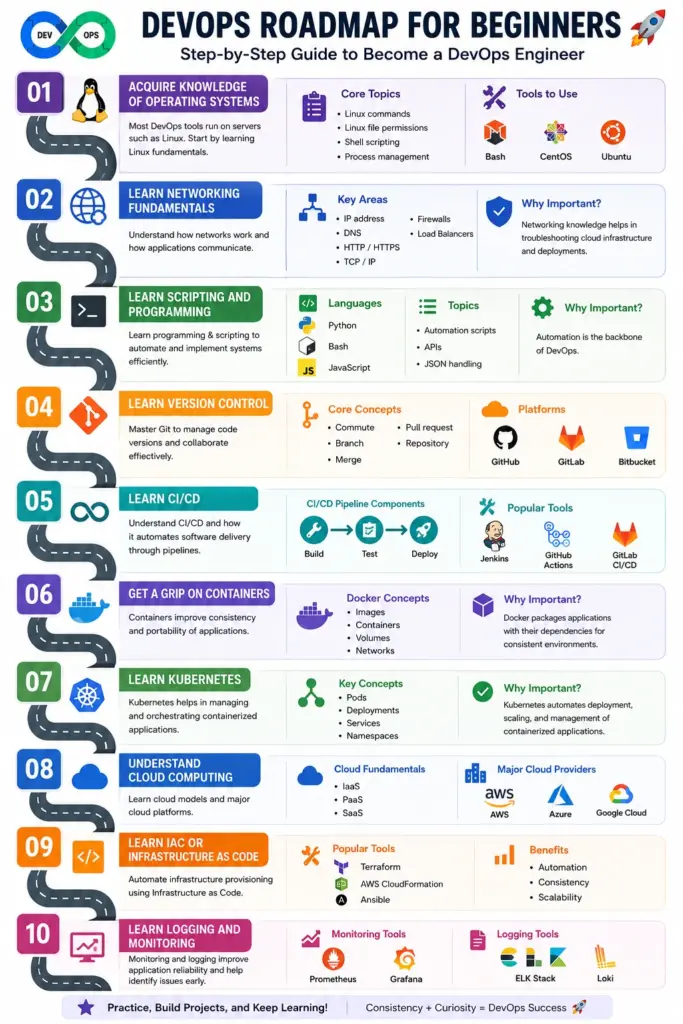
Acquire knowledge of operating systems
Most of the DevOps tools run on servers such as Linux. So it is better to start learning Linux. The core topics that should be learned as part of learning Linux server include
- Linux commands
- Linux file permissions
- Shell scripting
- Process management
The tools that can be used for learning include
- Bash
- Centos
- Ubuntu
Learn networking fundamentals
Learn how the fundamentals of networks function. To learn about the fundamentals, you need to understand the way in which the applications communicate.
Give more focus on the key areas such as
- Ip address
- DNS
- HTTP
- HTTPS
- TCP
- IP
- Firewalls
- Load Balancers
The cloud infrastructure and deployments can be troubleshot with the aid of networking knowledge.
Learn scripting and programming
Learn the programming languages to decode the system language. This is really important since the automation helps in the development and implementation process of the system.
Learn scripting, JSON, and API handling tools and techniques as well.
- Phython
- Bash
- Javascript
- Languages
Topics
- Automation scripts
- APIs
- JSON handling
Learn version control
To manage the code, you need to understand and master Git. Git helps in controlling the versions to avoid errors.
You have to have a grip on the core topics, including the following:
- Commute
- Branch
- Merge
- Pull request
- Repository
Platforms that can help in version control include,
- Bitbucket
- Github
- Gitlab
Learn CI/CD
Understand the working nature of CI/CD. The software delivery has become automated with the use of the integrated delivery system. The pipeline stages should be understood and identified.
Building, testing, and deploying the system is rather important for the automation. The popular tools such as Jenkins, GitHub Actions and GitLab CI/CD tools can be used for smooth functioning.
CI/CD Pipeline Components
- Build
- Test
- Deploy
- Popular Tools
- Jenkins
- GitHub Actions
- GitLab CI/CD
Get a grip on the containers
The consistency and portability of the software application will be enhanced and improved with the aid of containers.
The dependencies can be used for the benefits. The images, networks, volumes, and containers should learn well. Docker supports applications, and it can improve the quality and performance of the software.
Docker Concepts should be thoroughly understood
- Images
- Containers
- Volumes
- Networks
Learn Kubernetes
Containerised applications can be managed well by Kubernetes. The container orchestration can be made easy by understanding the concepts such as services, namespaces, pods and deployments.
Learn the key concepts such as,
- Pods
- Deployments
- Services
- Namespaces
Web Development courses at your fingertips. Join Entri now
Understand cloud computing
The cloud computing models are really important for the automation and deployment of the software. The knowledge about the cloud service models such as SaaS, PaaS, and IaaS should be thoroughly understood. The learning should start from Google Cloud Platform, AWS, Microsoft Azure, etc.
Cloud Fundamentals
- IaaS
- PaaS
- SaaS
- Major Cloud Providers
- AWS
- Azure
- Google Cloud
Learn IaC or Infrastructure as Code
The infrastructure provisioning can be automated with the aid of IaC. The Terraform should be understood thoroughly. The popular tools such as Ansible, AWS CloudFormation, and Terraform should be learned well.
The practical knowledge and experience these tools provide provide a solid background for professionals. The implementation of IaC will help in maintaining consistency and scalability. The automation finds a more intuitive solution with the use of these popular tools.
Popular Tools
- Terraform
- AWS CloudFormation
- Ansible
- Benefits
- Automation
- Consistency
- Scalability
Learn logging and monitoring
The application reliability can be enriched with the aid of monitoring. Logging the data can help in identifying the errors at an earlier stage.
You can make use of these popular tools, such as Prometheus or Grafana for monitoring, and Loki and the ELK stack for logging can be used effectively.
Monitoring Tools
- Prometheus
- Grafana
- Logging Tools
- ELK Stack
- Loki
Essential DevOps Tools Every Beginner Should Learn
DevOps tools play a vital role in software development and operations. The DevOps engineer should have the skills to use the tools to run the system smoothly. Your skill and expertise distinguish you from the rest. Here is the list of essential DevOps tools and their relevance.
| Category | Tools |
| OS | Linux |
| Version Control | Git, GitHub |
| CI/CD | Jenkins, GitHub Actions |
| Containers | Docker |
| Orchestration | Kubernetes |
| Cloud | AWS |
| IaC | Terraform |
| Configuration Management | Ansible |
| Monitoring | Prometheus, Grafana |
Recommended DevOps Certifications
The certification in DevOps engineering distinguishes you from others. More certifications show your knowledge and skill level. Here is the list of certifications you should get a strong hold on
- AWS Certified Cloud Practitioner
- AWS Certified DevOps Engineer
- Certified Kubernetes Administrator (CKA)
- Docker Certified Associate
- HashiCorp Terraform Associate
DevOps Projects for Beginners
Mastering DevOps is both challenging and exciting at the same time. Working on real-time projects will give you a strong hold on the DevOps field. Practical knowledge in DevOps helps you to understand the real-world challenges more professionally.
You can follow the steps to work on a DevOps project.
- Static website creation and hosting on AWS
- web application dockerisation
- Using Jenkins, build a CI/CD pipeline
- Kubernetes application initiation
- Deployment of the application
- Using Terraform, automate the infrastructure
Such projects will make you job-ready and strengthen your portfolio. The projects will show the organisation your experience and expertise in handling real-world risks. The smooth deployment of the application will benefit from your experience. This will help you to develop and maintain a balanced portfolio and better career prospects. To be more precise, your project lists should look exactly like the one given below.
- Project 1: Host a Static Website on AWS
- Project 2: Dockerise a Web Application
- Project 3: Build a CI/CD Pipeline
- Project 4: Deploy an App on Kubernetes
- Project 5: Automate Infrastructure Using Terraform
Common Mistakes Beginners Make While Learning DevOps
While working as a DevOps professional, you may be constantly dealing with software development and collaborative operations.
Make sure you avoid the following mistakes: Never learn about the tools without understanding their purpose and the fundamentals of the same.
- Never skip the Linux basics.
- Network concepts should never be ignored.
- Avoiding the hands-on experience on projects
- Learning the concept of all the tools in one go.
- Focusing on mastering multiple skills at a time without having a grip on either
6-Month DevOps Learning Plan
You can tackle all the concepts of DevOps within six months with a structured and organised plan. The systematic way of approaching DevOps learning can benefit your career. Are you confused about how to implement a six-month learning plan? Follow the structured plan to build a progressive practical experience and expertise in the field.
| Month | Plan |
| Month 1 | Linux + Networking |
| Month 2 | Git + GitHub + Scripting |
| Month 3 | Docker |
| Month 4 | CI/CD + Jenkins |
| Month 5 | AWS + Terraform |
| Month 6 | Kubernetes + Monitoring |
DevOps Career Opportunities
The DevOps engineering sector is currently booming due to the high demand for DevOps engineers in the sector. After carefully following the road map to become a DevOps engineer, you pursue the following career paths –
- Cloud engineer
- Platform engineer
- Site reliability engineer
- DevOps engineer
- Infrastructure Engineer
The IT, healthcare, e-commerce, telecommunications, fintech, and SaaS companies are hiring DevOps engineers on a large scale.
Conclusion
Learning the concepts of DevOps may seem challenging, but it becomes interesting for the enthusiast. Following a structured route, Mal can pull the best career paths out of you. The journey becomes manageable if you are prioritising the learning and following an organised journey.
Make sure that you are working on hands-on projects to boost your experience, productivity, and exposure. The certifications will also provide you with an enriched portfolio that will automatically make you job-ready.
The consistency, practice expertise, experience and exposure can only help you to build a strong career as a DevOps engineer in 2026. Using a structured roadmap, you can build a successful and strong career as a DevOps engineer.
| RELATED POSTS | |
| DevOps Engineer Career Path | CI/CD Pipeline Explained: Complete Beginner’s Guide |
| Continuous Integration vs Continuous Delivery: What’s the Difference? | DevOps Engineer Salary in Germany |
Frequently Asked Questions
What is DevOps?
DevOps combines the development and operations of software development for the quality deployment of software applications.
What is the signifiance of DevOps project for Engineers?
Working on real-time projects will give you a strong hold on the DevOps field. Practical knowledge in DevOps helps you to understand the real-world challenges more professionally.
What is the key function of DevOps engineer?
The DevOps engineers help in collaboration between both teams and facilitate the smooth automation, integration and deployment of quality applications in the market on demand. To streamline the software development cycle, DevOps engineers are an integral part.
Define DevOps tools?
DevOps tools play a vital role in software development and operations. The DevOps engineer should have the skills to use the tools to run the system smoothly.
What are the main DevOps certiifcations available?
The major certifications include AWS Certified Cloud Practitioner, AWS Certified DevOps Engineer, Certified Kubernetes Administrator (CKA), Docker Certified Associate, and HashiCorp Terraform Associate
Define IaC?
The infrastructure provisioning can be automated with the aid of IaC. The Terraform should be understood thoroughly. The popular tools such as Ansible, AWS CloudFormation, and Terraform should be learned well.