Table of Contents
An Embedded Test Engineer ensures product quality and reliability. The role focuses on testing embedded systems. Hardware and software performance are evaluated carefully.
Technical skills play a major role. Strong demand exists across many industries. Excellent career opportunities continue growing.
Kickstart your embedded systems career and turn your tech passion into high-demand skills!
Key Takeaways:
- Product Quality Remains the Primary Focus: Embedded systems require thorough testing. Reliable performance improves customer satisfaction.
- Technical Knowledge Supports Daily Responsibilities: Programming skills strengthen testing capabilities. Hardware understanding improves troubleshooting accuracy.
- Different Testing Methods Are Used: Functional testing validates product behavior. Integration testing verifies component compatibility.
- Many Industries Require Embedded Testing: Modern products depend on embedded systems. Demand continues growing across industries.
- Testing Tools Improve Efficiency: Automation reduces repetitive work. Advanced tools simplify defect identification.
- Career Growth Opportunities Remain Strong: Specialized roles offer future advancement. Leadership positions become accessible with experience.
🔍 Why Embedded Testing Matters in Modern Electronics
Modern electronics rely on embedded systems. Many critical functions depend on them. Product quality cannot be compromised. Thorough testing helps ensure reliability.
Role of Testing in Product Development
Testing supports every development stage.
Key objectives include:
- Verifying system functionality.
- Identifying product defects.
- Improving system reliability.
- Supporting successful product launches.
Quality issues become easier to detect. Development risks can also be reduced.
Preventing Product Failures
Defects often create unexpected problems.
Common examples include:
- System crashes.
- Communication failures.
- Slow performance.
- Incorrect outputs.
Early testing reduces these issues.
Importance in Safety-Critical Devices
Some products directly affect safety.
Examples include:
- Automotive systems.
- Medical equipment.
- Aerospace electronics.
- Industrial machinery.
Reliable operation becomes essential.
Protecting Users and Operations
System failures can create serious consequences.
Testing helps ensure:
- Safe operation.
- Stable performance.
- Regulatory compliance.
- Reliable functionality.
Safety remains a top priority.
Importance in Consumer Devices
Consumer products require consistent performance.
Examples include:
- Smartphones.
- Smart televisions.
- Smart speakers.
- Wearable devices.
Users expect dependable experiences.
Supporting Customer Satisfaction
Poor performance affects brand reputation.
Effective testing helps:
- Improve product quality.
- Reduce product returns.
- Increase customer confidence.
- Strengthen user satisfaction.
Positive experiences encourage customer loyalty.
Growing Demand Across Industries
Embedded technology continues expanding rapidly. More industries adopt smart systems.
Examples include:
- Automotive.
- Healthcare.
- Consumer electronics.
- Industrial automation.
- Internet of Things.
Testing demand continues increasing.
Automotive Industry
Modern vehicles contain many embedded systems.
Common applications include:
- Engine control units.
- Safety systems.
- Infotainment platforms.
- Driver assistance systems.
Reliable testing remains essential.
IoT Industry
Connected devices require continuous validation.
Examples include:
- Smart homes.
- Smart sensors.
- Connected appliances.
- Wearable technology.
Reliable communication must be ensured.
Medical Devices
Medical products require high accuracy.
Examples include:
- Patient monitors.
- Diagnostic equipment.
- Infusion pumps.
- Portable medical devices.
Strict testing standards apply.
Consumer Electronics
Consumer products evolve continuously.
Examples include:
- Smartphones.
- Tablets.
- Gaming devices.
- Smart televisions.
Product quality influences customer satisfaction.
Industrial Automation
Factories increasingly use intelligent systems.
Examples include:
- Robotics equipment.
- Industrial sensors.
- Control systems.
- Manufacturing devices.
Operational reliability remains critical.
👨💻 Who is an Embedded Test Engineer?
Embedded Test Engineers validate embedded products. Product quality receives continuous attention. Reliability remains a major objective.
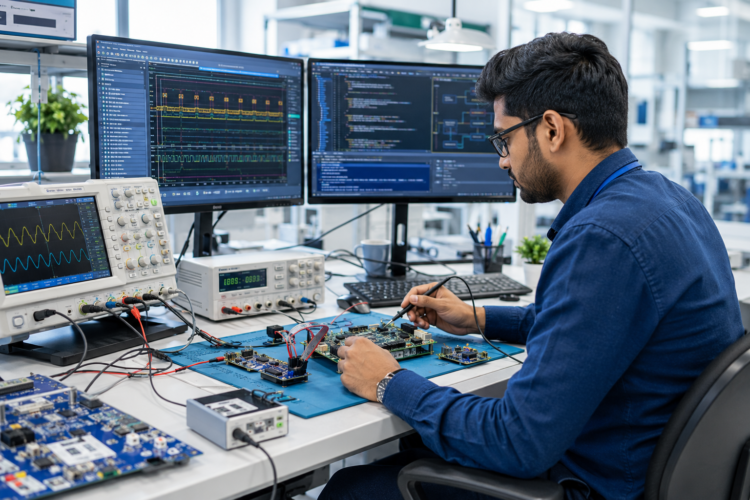
Definition and Core Role
This role focuses on testing activities.
Key responsibilities include:
- Verifying functionality.
- Identifying defects.
- Improving reliability.
- Supporting product releases.
Testing remains the central responsibility.
Where they Fit in the Product Development Lifecycle
Testing occurs throughout development.
Close collaboration happens with:
- Software engineers.
- Hardware engineers.
- Product managers.
- Quality teams.
Teamwork improves overall quality.
During Development
Testing begins early.
Typical activities include:
- Reviewing requirements.
- Designing test cases.
- Planning test coverage.
- Preparing test environments.
Early validation reduces future issues.
Before Product Release
Final testing becomes extremely important.
Engineers verify:
- Product functionality.
- System stability.
- Performance requirements.
- Reliability standards.
Release readiness must be confirmed.
Industries that Hire Embedded Test Engineers
Many industries hire these professionals.
Common sectors include:
- Automotive.
- Healthcare.
- Telecommunications.
- Consumer electronics.
- Aerospace.
- Industrial automation.
- Semiconductor companies.
Career opportunities remain diverse.
Master Embedded Systems Programming!
Launch your tech career with our Embedded Systems Course, designed for hands-on learning and industry readiness.
Know More🛠️ Key Responsibilities of an Embedded Test Engineer
Embedded Test Engineers handle many testing activities. Product quality remains the primary goal.
Understanding Product Requirements
Testing starts with requirements analysis.
Important areas include:
- Functional requirements.
- Technical specifications.
- Product expectations.
- Performance objectives.
Clear understanding improves test coverage.
Designing Test Plans and Test Cases
Structured planning improves testing quality.
Common activities include:
- Defining testing objectives.
- Creating test cases.
- Identifying test scenarios.
- Planning test coverage.
Good planning reduces testing gaps.
Functional Testing of Embedded Systems
Functional testing validates system behavior.
Testing verifies:
- Inputs.
- Outputs.
- Features.
- User interactions.
Expected functionality must remain consistent.
Hardware and Software Integration Testing
Hardware and software must work together.
Testing focuses on:
- Communication accuracy.
- System compatibility.
- Data exchange.
- Operational stability.
Integration issues require early detection.
Automation Testing and Script Development
Automation improves testing efficiency.
Common activities include:
- Creating test scripts.
- Running automated tests.
- Expanding test coverage.
- Reducing manual effort.
Automation saves valuable time.
Debugging and Defect Reporting
Defects require detailed investigation.
Typical tasks include:
- Reproducing issues.
- Finding root causes.
- Reporting defects.
- Supporting corrective actions.
Strong analysis skills become important.
Performance and Reliability Testing
Performance affects product quality.
Testing evaluates:
- Response times.
- Resource consumption.
- System stability.
- Long-term reliability.
Consistent performance remains essential.
Regression Testing Before Releases
Product updates require additional testing.
Regression testing helps:
- Verify existing features.
- Detect unexpected issues.
- Maintain system stability.
- Support release quality.
Reliable releases remain important.
Documentation and Compliance Support
Documentation supports quality processes.
Important records include:
- Test reports.
- Validation documents.
- Compliance records.
- Defect logs.
Accurate records improve traceability.
💡 Essential Technical Skills Required
Strong technical skills support testing success. Hardware and software knowledge remain equally important.
Embedded Systems Fundamentals
Fundamental knowledge creates strong foundations.
Important topics include:
- System architecture.
- Memory management.
- Device operation.
- Embedded workflows.
Core concepts support advanced learning.
Microcontrollers and Microprocessors
Many products use processors extensively.
Important knowledge areas include:
- Processor architecture.
- Peripheral interfaces.
- Device communication.
- Processing behavior.
Hardware familiarity improves testing effectiveness.
Programming Languages
Programming knowledge supports many testing activities.
C
C remains widely used.
Applications include:
- Embedded software testing.
- Low-level validation.
- System verification.
C++
Many embedded projects use C++.
Common uses include:
- Embedded applications.
- Software modules.
- Testing frameworks.
Python
Python simplifies testing activities.
Common applications include:
- Test automation.
- Script development.
- Data analysis.
Automation becomes easier with Python.
RTOS Knowledge
Many systems use RTOS platforms.
Important concepts include:
- Task scheduling.
- Synchronization.
- Timing behavior.
- Resource allocation.
RTOS knowledge improves testing accuracy.
Hardware Interface Testing
Communication interfaces require validation.
UART
UART supports serial communication.
SPI
SPI enables fast data transfer.
I2C
I2C connects multiple devices.
CAN
CAN supports automotive communication.
Interface testing remains highly important.
Test Automation Skills
Automation skills improve productivity.
Useful abilities include:
- Script development.
- Framework usage.
- Automated execution.
- Result analysis.
Automation knowledge increases efficiency.
Debugging and Troubleshooting
Problem-solving remains a core skill.
Common investigation areas include:
- Software defects.
- Communication issues.
- Hardware failures.
- Integration problems.
Strong debugging skills save time.
Version Control Tools
Version control supports collaboration.
Common uses include:
- Managing source code.
- Tracking script changes.
- Maintaining documentation.
- Reviewing project history.
Git remains widely used.
Basic Electronics Knowledge
Electronics knowledge supports testing activities.
Important concepts include:
- Voltage.
- Current.
- Circuits.
- Electronic components.
Hardware troubleshooting becomes much easier.
💻 Important Tools Used by Embedded Test Engineers
Testing becomes easier with the right tools. Different tools support different activities. Engineers use these tools regularly.
Debugging Tools
Debugging tools help identify issues.
Common purposes include:
- Finding software defects.
- Tracking system behavior.
- Investigating failures.
- Analyzing performance.
Oscilloscopes and Logic Analyzers
Hardware testing requires specialized equipment.
These tools help:
- Monitor signals.
- Verify communication.
- Analyze timing.
- Detect hardware issues.
Test Automation Frameworks
Automation reduces repetitive work.
These frameworks support:
- Script execution.
- Automated validation.
- Faster testing cycles.
- Better test coverage.
Simulation and Emulation Tools
Testing often begins before hardware availability.
These tools help:
- Simulate environments.
- Validate functionality.
- Reduce development delays.
- Improve testing efficiency.
Defect Tracking and Collaboration Tools
Defects must be documented properly.
These tools support:
- Issue tracking.
- Team communication.
- Progress monitoring.
- Release management.
Tool Comparison Table
| Tool Category | Common Tools | Purpose |
|---|---|---|
| Debugging Tools | GDB, JTAG | Identify system issues |
| Oscilloscopes | Keysight, Tektronix | Analyze electrical signals |
| Logic Analyzers | Saleae, Logic Pro | Verify communication signals |
| Automation Tools | Python, Robot Framework | Automate testing activities |
| Simulation Tools | QEMU, Proteus | Simulate embedded systems |
| Defect Tracking Tools | Jira, Bugzilla | Manage defects and tasks |
Master Embedded Systems Programming!
Launch your tech career with our Embedded Systems Course, designed for hands-on learning and industry readiness.
Know More🤝 Soft Skills that Improve Success in the Role
Technical skills remain important. Soft skills also contribute greatly. Successful engineers develop both areas.
Analytical Thinking
Complex systems require analysis.
Important benefits include:
- Better decision-making.
- Faster investigations.
- Improved test coverage.
- Accurate conclusions.
Problem Solving
Problems occur frequently during testing.
Strong problem-solving helps:
- Identify root causes.
- Resolve issues quickly.
- Improve efficiency.
- Support development teams.
Communication Skills
Testing involves teamwork.
Good communication supports:
- Clear reporting.
- Better collaboration.
- Faster issue resolution.
- Stronger teamwork.
Attention to Detail
Small issues can create large problems.
Attention to detail helps:
- Detect hidden defects.
- Improve accuracy.
- Reduce missed issues.
- Strengthen quality assurance.
Team Collaboration
Embedded projects involve many teams.
Collaboration supports:
- Better coordination.
- Shared knowledge.
- Faster progress.
- Improved outcomes.
⚖️ Embedded Test Engineer vs Embedded Software Engineer
Both roles support product development. However, their responsibilities differ significantly.
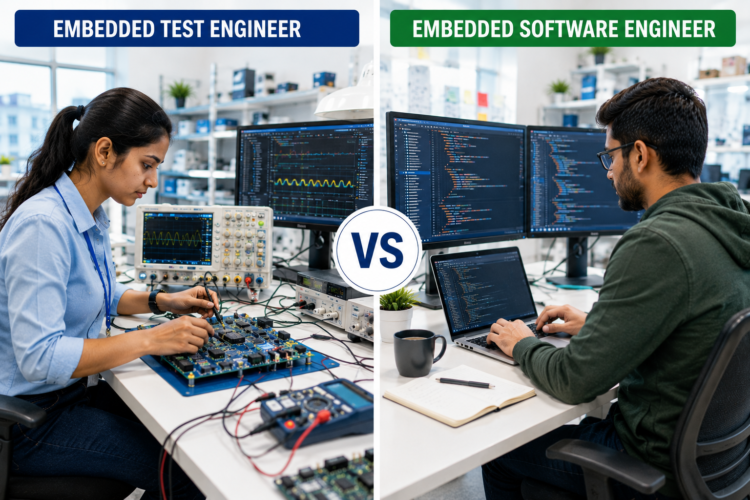
| Aspect | Embedded Test Engineer | Embedded Software Engineer |
|---|---|---|
| Primary Goal | Ensure product quality | Develop embedded software |
| Daily Tasks | Testing and validation | Software development |
| Coding Requirement | Moderate | Extensive |
| Testing Involvement | High | Moderate |
| Career Path | Testing leadership | Development leadership |
Which Career Path Should You Choose?
Career preferences often guide decisions.
Choose Embedded Testing if:
- Quality interests you.
- Testing feels enjoyable.
- Problem-solving motivates you.
- Validation work seems rewarding.
Choose Embedded Development if:
- Software creation interests you.
- Coding feels enjoyable.
- System design motivates you.
- Product development excites you.
⚠️ Common Challenges Faced by Embedded Test Engineers
The role offers many rewards. However, several challenges exist.
Hardware Dependency
Testing often depends on hardware availability.
Common issues include:
- Hardware delays.
- Limited devices.
- Equipment shortages.
- Configuration challenges.
Real-Time System Validation
Real-time systems require precision.
Challenges include:
- Timing verification.
- Response measurement.
- Synchronization checks.
- Performance validation.
Complex Debugging Scenarios
Defects may involve multiple components.
Examples include:
- Hardware issues.
- Software defects.
- Communication failures.
- Integration problems.
Root causes may remain hidden.
Testing under Resource Constraints
Embedded systems often have limitations.
Common constraints include:
- Memory restrictions.
- Processing limitations.
- Power consumption.
- Storage capacity.
Testing must consider these factors.
Ensuring Product Reliability
Reliability remains a critical objective.
Products must perform consistently under:
- Different conditions.
- Long durations.
- Heavy workloads.
- Real-world environments.
🌟 Benefits of Choosing Embedded Testing as a Career
Embedded testing offers many advantages. Career opportunities continue expanding.
Strong Industry Demand
Demand continues increasing globally.
Growth drivers include:
- Smart devices.
- Connected products.
- Industrial automation.
- Advanced electronics.
Opportunities Across Multiple Domains
Many industries hire these professionals.
Examples include:
- Automotive.
- Healthcare.
- Aerospace.
- Telecommunications.
- Consumer electronics.
Competitive Salary Growth
Technical expertise remains valuable.
Salary growth often follows:
- Experience.
- Specialization.
- Certifications.
- Leadership responsibilities.
Exposure to Cutting-Edge Technologies
Technology evolves constantly.
Engineers work with:
- IoT platforms.
- Smart devices.
- Robotics systems.
- Automotive technologies.
Learning opportunities remain continuous.
Transition Opportunities into Specialized Roles
Experience creates additional opportunities.
Specialized paths include:
- Automation testing.
- Validation engineering.
- Functional safety testing.
- Automotive testing.
- IoT testing.
📈 Career Path and Growth Opportunities
Career growth follows multiple paths. Experience opens new opportunities.
Entry-Level Roles
Many professionals begin with:
- Test Engineer.
- QA Engineer.
- Validation Engineer.
- Junior Embedded Tester.
Foundational skills develop here.
Mid-Level Progression
Experience leads to broader responsibilities.
Typical roles include:
- Embedded Test Engineer.
- Senior Test Engineer.
- Validation Specialist.
- Test Lead.
Leadership skills often develop.
Senior and Leadership Positions
Advanced roles focus on strategy.
Examples include:
- Test Manager.
- QA Manager.
- Engineering Manager.
- Validation Manager.
Decision-making responsibilities increase.
Specialized Career Tracks
Test Automation
Focus areas include:
- Automation frameworks.
- Script development.
- Process optimization.
Validation Engineering
Focus areas include:
- Product verification.
- System validation.
- Quality assurance.
Functional Safety Testing
Focus areas include:
- Safety standards.
- Risk reduction.
- Compliance requirements.
Automotive Testing
Focus areas include:
- Vehicle systems.
- CAN communication.
- Automotive standards.
IoT Testing
Focus areas include:
- Connected devices.
- Wireless communication.
- Device interoperability.
Career Roadmap
Junior Test Engineer
⬇
Embedded Test Engineer
⬇
Senior Embedded Test Engineer
⬇
Test Lead
⬇
Test Manager
⬇
Engineering Manager
🚀 How to Become an Embedded Test Engineer
A structured approach improves career preparation.
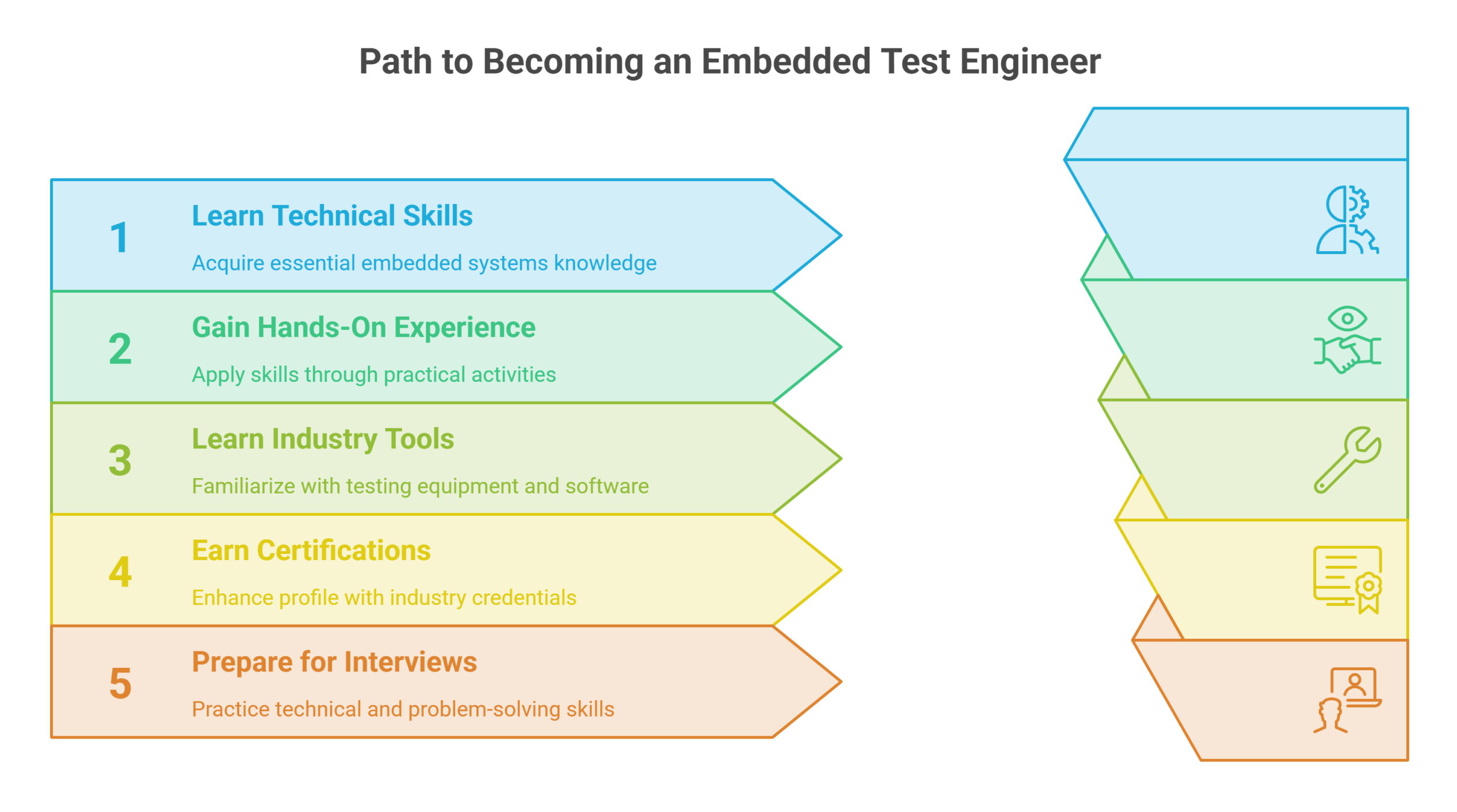
Step 1: Build the Right Educational Background
Relevant fields include:
- Electronics Engineering.
- Electrical Engineering.
- Embedded Systems.
- Computer Engineering.
Step 2: Learn Core Technical Skills
Focus on:
- Embedded systems.
- Programming languages.
- Hardware interfaces.
- Debugging techniques.
Step 3: Gain Hands-On Experience
Practical exposure remains valuable.
Activities include:
- Personal projects.
- Internships.
- Laboratory work.
- Testing assignments.
Step 4: Learn Industry Tools
Become familiar with:
- Debugging tools.
- Oscilloscopes.
- Automation frameworks.
- Version control systems.
Step 5: Earn Relevant Certifications
Certifications strengthen profiles.
Examples include:
- Embedded Systems Certifications.
- Automation Testing Certifications.
- Quality Assurance Programs.
Step 6: Prepare for Interviews
Interview preparation should include:
- Technical concepts.
- Programming fundamentals.
- Testing methodologies.
- Problem-solving exercises.
Kickstart your embedded systems career and turn your tech passion into high-demand skills!
📊 Advantages and Challenges of the Role
| Advantages | Challenges |
|---|---|
| Strong industry demand | Complex debugging |
| Diverse industries | Hardware dependency |
| Continuous learning | Tight deadlines |
| Technical specialization | Technology changes |
| Career growth | Resource limitations |
🏁 Final Thoughts
Embedded Test Engineers play a vital role. Product quality depends heavily on testing. Hardware and software reliability must be verified carefully. Strong technical skills remain essential.
Demand continues increasing across industries. Career opportunities remain diverse and rewarding. Specialized roles provide additional growth paths. For professionals who enjoy testing and problem-solving, embedded testing offers a strong long-term career choice.
Master Embedded Systems Programming!
Launch your tech career with our Embedded Systems Course, designed for hands-on learning and industry readiness.
Know MoreFrequently Asked Questions
What does an Embedded Test Engineer do daily?
An Embedded Test Engineer tests products, identifies defects, validates functionality, and supports quality improvement.
Is coding required for embedded testing?
Yes, coding is often required for automation, debugging, and test script development.
Which programming language is most important?
C is widely used because many embedded systems are developed using it.
What is the difference between embedded testing and software testing?
Embedded testing involves hardware and software validation, while software testing mainly focuses on software applications.
Which industries hire Embedded Test Engineers?
Automotive, healthcare, consumer electronics, aerospace, IoT, and industrial automation industries hire these professionals.
Is embedded testing a good career choice?
Yes, the field offers strong demand, career growth, and learning opportunities.
What tools should beginners learn?
Beginners should learn Git, Python, debugging tools, oscilloscopes, and automation frameworks.
What salary can an Embedded Test Engineer expect?
Salary varies by experience, industry, and location, but growth opportunities remain strong.
How can freshers enter this field?
Freshers can build projects, learn core skills, and gain practical testing experience.
What skills are most important?
Embedded systems knowledge, programming, debugging, automation, and problem-solving skills are highly important.