
Table of Contents
Introduction
Adverbs are an important part of English grammar. They add detail to sentences by explaining how, when, where, how often, or to what extent an action happens. For example, compare these two sentences:
- The girl sang.
- The girl sang beautifully.
The second sentence gives us more information about the action. The word beautifully is an adverb because it describes how the girl sang.
This guide explains the meaning, types, rules, examples, position, comparison, and common mistakes related to adverbs.
Elevate your speaking skills with our Spoken English Course!
What Is an Adverb?
1: Which of the sentences below is grammatically correct?
An adverb is a word that modifies or gives more information about:
- A verb.
- An adjective.
- Another adverb.
- A pronoun.
- A preposition.
- A conjunction.
- A phrase.
- An entire sentence.
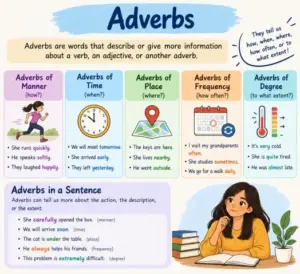
Adverbs commonly answer questions such as:
- How? — She spoke politely.
- When? — We arrived yesterday.
- Where? — Please wait outside.
- How often? — He usually walks to work.
- To what extent? — The bag is extremely heavy.
- Why or with what result? — It was raining; therefore, the match was cancelled.
Many adverbs end in -ly, such as slowly, carefully, quietly, and happily. However, not every adverb ends in -ly. Words such as fast, hard, well, often, here, and now are also adverbs.
Examples of adverbs modifying different words
| Word modified | Example | Explanation |
|---|---|---|
| Verb | The child laughed loudly. | Loudly describes how the child laughed. |
| Adjective | The mountain is very high. | Very modifies the adjective high. |
| Adverb | She finished the work quite quickly. | Quite modifies the adverb quickly. |
| Pronoun | Almost everybody attended the meeting. | Almost modifies everybody. |
| Preposition | The shop is well within walking distance. | Well modifies the prepositional phrase. |
| Conjunction | He stayed home only because he was ill. | Only adds emphasis to the conjunction because. |
| Complete sentence | Fortunately, we carried an umbrella. | Fortunately expresses the speaker’s attitude towards the sentence. |
Join our Spoken English program today and communicate with ease!
Spoken English Course for Guaranteed Confidence and Career Growth
Spoken English Course by Entri App: Enhance your communication skills, gain certification, and boost your career with confidence.
Join Now!Main Types of Adverbs
Adverbs are classified according to the information they provide. The most common types are adverbs of manner, time, place, frequency, degree, duration, purpose, interrogative adverbs, relative adverbs, and conjunctive adverbs.
1. Adverbs of Manner
Adverbs of manner explain how an action takes place. They usually appear after the verb or after the object of the verb.
Common examples:
quickly, slowly, carefully, carelessly, politely, boldly, happily, sadly, quietly, loudly, easily, well, badly, beautifully, cheerfully
Examples in sentences:
- The students listened carefully.
- She completed the assignment quickly.
- The old man walked slowly.
- The singer performed beautifully.
- Please speak politely to the receptionist.
- The driver stopped the car abruptly.
- The child smiled cheerfully.
- Riya answered the question boldly.
- He completed the task easily.
- The baby slept peacefully.
2. Adverbs of Time
Adverbs of time explain when an action happens or has happened. They can refer to the present, past, or future.
Common examples:
now, today, yesterday, tomorrow, soon, later, early, late, already, recently, eventually, afterward, still, yet, before, ago
Examples in sentences:
- I finished my homework yesterday.
- We will leave tomorrow.
- The food will arrive soon.
- Please call me later.
- She reached the station early.
- He came home late.
- We are leaving now.
- They have already submitted the form.
- I visited the museum last week.
- She completed the course recently.
- We will discuss the issue afterward.
- Have you finished the assignment yet?
- He met his teacher two years ago.
- I had seen that film before.
Adverbs of time are often placed at the end of a sentence:
- We are travelling to Delhi tomorrow.
- The meeting ended early.
They may also appear at the beginning for emphasis:
- Yesterday, we visited our grandparents.
- Soon, the results will be announced.
3. Adverbs of Place
Adverbs of place explain where an action happens. They can indicate direction, position, or location.
Common examples:
here, there, everywhere, nowhere, somewhere, inside, outside, upstairs, downstairs, nearby, abroad, away, below, above, behind, ahead, downhill
Examples in sentences:
- Please sit here.
- The children are playing outside.
- She went upstairs to get her books.
- We searched everywhere for the missing key.
- They opened a small café nearby.
- Please come inside; it is raining.
- The cat is hiding underneath.
- He looked everywhere for his wallet.
- The hikers walked downhill.
- The answer can be found below.
- We travelled abroad last summer.
- The dog ran away.
4. Adverbs of Frequency
Adverbs of frequency show how often an action occurs. They are sometimes called adverbs of number.
Common examples:
always, usually, generally, often, frequently, regularly, sometimes, occasionally, rarely, seldom, hardly ever, never, daily, weekly, monthly, annually
Examples in sentences:
- I always complete my work on time.
- She usually walks to college.
- They often visit their relatives.
- He frequently travels for work.
- We sometimes eat at a restaurant.
- My brother occasionally plays tennis.
- She rarely watches television.
- He seldom misses a class.
- I never skip breakfast.
- They hardly ever complain.
- The bus arrives regularly.
- She exercises daily.
- The magazine is published monthly.
- The event takes place annually.
With a one-word verb, an adverb of frequency usually appears before the verb:
- She always studies at night.
- They often play football.
With the verb be, the adverb usually comes after the verb:
- He is always punctual.
- She is never careless.
- They are usually ready.
Elevate your speaking skills with our Spoken English Course!
5. Adverbs of Degree
Adverbs of degree show how much, how strongly, or to what extent something happens. They can modify verbs, adjectives, or other adverbs.
Common examples:
very, too, quite, rather, almost, nearly, extremely, completely, totally, fully, deeply, fairly, highly, barely, just, enough, so, really
Examples in sentences:
- The water is very cold.
- She was extremely tired after the journey.
- The box is too heavy to lift.
- I am quite satisfied with the result.
- He almost missed the bus.
- The room was completely empty.
- She barely knew her neighbour.
- The doctor was fully aware of the patient’s condition.
- The teacher was highly respected.
- The task was fairly easy.
- The child was deeply disappointed.
- The answer is nearly correct.
- The dress fits perfectly.
- The movie was rather interesting.
Some adverbs of degree modify adjectives:
- The lake is very beautiful.
- The examination was quite difficult.
Some modify other adverbs:
- She ran very quickly.
- He spoke extremely politely.
- The train moved rather slowly.
6. Adverbs of Duration
Adverbs of duration show how long an action continues.
Common examples:
briefly, temporarily, permanently, forever, continuously, indefinitely, recently, still
Examples in sentences:
- The manager spoke briefly.
- The office is temporarily closed.
- The machine operates continuously.
- They decided to move permanently.
- I will remember your kindness forever.
- The project has been postponed indefinitely.
- She is still waiting for the reply.
7. Adverbs of Purpose or Result
Adverbs of purpose or result explain why something happens or indicate the result of an action.
Common examples:
therefore, thus, hence, consequently, accordingly, so, otherwise
Examples in sentences:
- It was raining; therefore, the match was cancelled.
- The road was blocked; consequently, we took another route.
- He worked hard and thus achieved his goal.
- The instructions were unclear; hence, many students made mistakes.
- Please leave now; otherwise, you may miss the bus.
- The company changed its policy and acted accordingly.
When these adverbs connect two independent clauses, they are commonly preceded by a semicolon and followed by a comma:
- The shop was closed; therefore, we returned home.
8. Interrogative Adverbs
Interrogative adverbs are used to ask questions. The most common interrogative adverbs are when, where, why, and how.
Examples:
- When will the class begin?
- Where did you keep the documents?
- Why are you upset?
- How did she solve the problem?
- How often do you exercise?
- How far is the railway station?
- How much does this book cost?
Start speaking English like a native with our comprehensive course.
9. Relative Adverbs
Relative adverbs join two clauses and refer back to a noun or idea mentioned earlier. The main relative adverbs are where, when, and why.
Examples:
- This is the house where my grandfather lived.
- I remember the day when we first met.
- Nobody understood the reason why he resigned.
- That was the moment when everything changed.
- This is the place where the accident happened.
In these sentences, where refers to a place, when refers to a time, and why refers to a reason.
10. Conjunctive Adverbs
Conjunctive adverbs connect ideas between independent clauses or sentences. They show relationships such as contrast, addition, result, or sequence.
Common examples:
however, therefore, moreover, furthermore, nevertheless, otherwise, instead, meanwhile, consequently, similarly, alternatively, otherwise
Examples:
- The course was difficult; however, I completed it.
- She prepared well; therefore, she passed the examination.
- The hotel was affordable; moreover, it was close to the airport.
- He was tired; nevertheless, he continued working.
- You can take the bus; alternatively, you can walk.
- The children played outside; meanwhile, their parents prepared dinner.
- The first plan failed; instead, we followed a different strategy.
- The instructions were incomplete; otherwise, the task would have been easy.
How Adverbs Modify Different Parts of a Sentence
Adverbs modifying verbs
Adverbs most commonly modify verbs. They explain how, when, where, or how often an action takes place.
- The athlete ran quickly.
- We arrived early.
- The children played outside.
- She often reads before bed.
- The company is entirely owned by its employees.
Adverbs modifying adjectives
Adverbs can add intensity or detail to adjectives. They usually appear directly before the adjective.
- The building is very tall.
- The lake looks incredibly beautiful.
- The soup is too spicy.
- She is quite confident.
- The explanation was surprisingly clear.
Adverbs modifying other adverbs
An adverb can modify another adverb to show degree or intensity.
- She sings very beautifully.
- He completed the task quite quickly.
- The car moved extremely slowly.
- They arrived almost immediately.
Using several adverbs together is grammatically possible, but too many may make a sentence unclear or awkward:
- The speaker talked rather unusually loudly.
A clearer alternative may be:
- The speaker’s unusually loud voice attracted attention.
Adverbs modifying whole sentences
Sentence adverbs express the speaker’s attitude, opinion, certainty, or reaction.
- Fortunately, everyone arrived safely.
- Surprisingly, the small team won the competition.
- Clearly, more research is needed.
- Admittedly, the plan has some weaknesses.
- Hopefully, the weather will improve.
- Naturally, the children were excited.
Also read: The 8 Parts of Speech
Position of Adverbs in Sentences
The position of an adverb can affect clarity and meaning. As a general rule, place an adverb as close as possible to the word it modifies.
Position with single-word verbs
Adverbs of manner and place commonly appear after the verb:
- She smiled happily.
- The children played outside.
When a transitive verb has an object, the adverb usually comes after the object:
- She completed the assignment carefully.
- They decorated the hall beautifully.
Avoid placing an adverb between a transitive verb and its object:
- Incorrect or awkward: She completed carefully the assignment.
- Better: She completed the assignment carefully.
Position with verb phrases
An adverb can appear in the middle of a verb phrase:
- We are quickly approaching the deadline.
- She has always loved music.
- They will probably arrive soon.
Position of adverbs of frequency
With a single-word verb, the adverb generally comes before the main verb:
- He usually takes the train.
- They never complain.
With forms of be, the adverb generally comes after the verb:
- She is always helpful.
- We are often late.
With auxiliary or modal verbs, the adverb commonly comes after the first auxiliary:
- She has never visited London.
- They will probably agree.
- He can easily solve the problem.
Position of adverbs of time
Adverbs that answer “when” commonly appear at the end of a sentence:
- We will meet tomorrow.
- She returned home late.
They may also be placed at the beginning:
- Yesterday, we visited the library.
Position of adverbs of place
Adverbs of place generally appear after the verb or its object:
- The children are playing outside.
- Please put the books there.
- She looked everywhere for her phone.
Order of multiple adverbs
When manner, place, and time adverbs occur together, the usual order is:
Manner + place + time
- The students worked quietly in the library yesterday.
- The choir sang beautifully at the concert last night.
This order is a general guideline, not an unbreakable rule. Writers may change the order to emphasise a particular detail.
Spoken English Course for Guaranteed Confidence and Career Growth
Spoken English Course by Entri App: Enhance your communication skills, gain certification, and boost your career with confidence.
Join Now!Special Uses of Common Adverbs
Very and much
Very generally modifies positive-degree adjectives and adverbs:
- She is very kind.
- He walked very slowly.
- The examination was very difficult.
Much is commonly used with comparative forms:
- She feels much better today.
- This option is much more affordable.
- He worked much harder than before.
Much can also modify some past participles:
- He was much disturbed by the news.
- I am much obliged to you.
In standard usage, very usually does not directly modify a verb. Instead of saying “I very like this book,” say:
- I like this book very much.
Very and too
Very means “to a high degree”:
- The room is very cold.
- She is very intelligent.
Too generally means “more than necessary” or “to an excessive degree”:
- The tea is too hot to drink.
- He arrived too late to attend the meeting.
- The box is too heavy for the child to carry.
Compare:
- The bag is very heavy.
This means the bag has a high weight. - The bag is too heavy to lift.
This means its weight creates a problem.
Fairly and rather
Both fairly and rather can mean “moderately,” but they often create different impressions.
Fairly is commonly used with favourable or neutral descriptions:
- She performed fairly well.
- The test was fairly easy.
- He is fairly confident.
Rather is often used with negative or unexpected descriptions:
- The room is rather small.
- The question was rather difficult.
- The weather is rather unpleasant.
Before, ago, and since
Before refers to an earlier time or occasion:
- I had seen the film before.
- She had never visited the city before.
Ago counts backwards from the present:
- He left three hours ago.
- They moved here five years ago.
Since refers to the period from a specific time in the past until another time, usually the present:
- I have lived here since 2020.
- She has not called since Monday.
Comparison of Adverbs
Some adverbs have positive, comparative, and superlative forms. These forms compare the way actions are performed.
Positive, comparative, and superlative forms
| Positive | Comparative | Superlative |
|---|---|---|
| fast | faster | fastest |
| hard | harder | hardest |
| high | higher | highest |
| soon | sooner | soonest |
| politely | more politely | most politely |
| carefully | more carefully | most carefully |
| slowly | more slowly | most slowly |
| sincerely | more sincerely | most sincerely |
Examples:
- Arun ran fast.
- Binu ran faster than Arun.
- Chitra ran the fastest of all.
- She spoke politely.
- He spoke more politely than his colleague.
- The receptionist spoke most politely.
Irregular comparison
Some adverbs have irregular comparative and superlative forms.
| Positive | Comparative | Superlative |
|---|---|---|
| well | better | best |
| badly | worse | worst |
| much | more | most |
| little | less | least |
| far | farther/further | farthest/furthest |
| late | later | latest/last |
| near | nearer | nearest/next |
Examples:
- She performed well.
- He performed better than last time.
- Maya performed the best in the group.
- The patient felt badly.
- He felt worse after the journey.
- She felt the worst in the morning.
Not every adverb can be compared. Words such as now, here, there, always, never, today, and once generally do not have comparative or superlative forms.
Flat Adverbs
Flat adverbs have the same form as related adjectives. Common examples include:
fast, hard, late, early, straight, high, low, close, right, wrong, long, near
Examples:
- The car was moving fast.
- She works hard.
- Please arrive early.
- The bird flew high.
- He came late.
Some flat adverbs have alternative -ly forms:
- Drive safe or drive safely.
- The moon is shining bright or brightly.
- The turtle moved slow or slowly.
In formal writing, the -ly form is often preferred when it is available and natural. However, some flat adverbs are standard and should not be changed:
- He works hard.
Not: He works hardly.
The word hardly has a different meaning. It means “almost not”:
- He hardly works.
This means he does very little work.
Adverbs Ending in -ly
Many adverbs are formed by adding -ly to an adjective:
| Adjective | Adverb |
|---|---|
| careful | carefully |
| quiet | quietly |
| happy | happily |
| gentle | gently |
| quick | quickly |
| polite | politely |
| easy | easily |
| beautiful | beautifully |
However, not every word ending in -ly is an adverb. Some are adjectives:
- a lovely dress
- a friendly neighbour
- a lively child
- an elderly man
- a costly mistake
- a lonely traveller
Compare:
- She is a friendly person.
Here, friendly is an adjective. - She spoke friendlily to the new student.
This form is grammatically possible but uncommon. A clearer sentence is: “She spoke in a friendly manner.”
Some words ending in -ly can function as adjectives or adverbs depending on the sentence:
- Daily exercise is useful.
Here, daily is an adjective. - She exercises daily.
Here, daily is an adverb.
Common Mistakes with Adverbs
1. Misplacing the adverb
An incorrectly placed adverb can change the meaning of a sentence.
Compare:
- Only Rohan completed the project.
Rohan completed it, but nobody else did. - Rohan only completed the project.
Completing the project was the only thing Rohan did. - Rohan completed only the project.
He completed the project and nothing else.
Place only directly before the word or phrase it limits.
2. Confusing good and well
Good is usually an adjective, while well is usually an adverb.
- She is a good singer.
- She sings well.
However, well can also be an adjective when it refers to health:
- I do not feel well today.
3. Using an adverb after a linking verb
Linking verbs such as feel, seem, look, sound, smell, and appear are usually followed by adjectives when they describe the subject.
- She feels bad about the mistake.
- The soup smells delicious.
- Your idea sounds interesting.
- He looks tired.
Compare:
- She sings badly.
Here, badly modifies the action sings. - She feels bad.
Here, bad describes her condition or emotion.
4. Assuming every adverb ends in -ly
Words such as fast, hard, often, never, here, now, and well are adverbs even though they do not end in -ly.
5. Confusing hard and hardly
- He works hard.
He puts in a lot of effort. - He hardly works.
He does almost no work.
6. Overusing intensifiers
Words such as very, really, extremely, and quite can lose their impact when used too often.
- Weak: The presentation was very, very, very interesting.
- Better: The presentation was engaging.
- Better: The presentation held the audience’s attention from beginning to end.
A stronger verb or adjective can often replace an unnecessary adverb:
- The board forcefully took away control from the founder.
- The board wrested control from the founder.
7. Using vague sentence adverbs
Words such as clearly, obviously, certainly, and inarguably should be used carefully, especially in academic and persuasive writing.
- Weak: Obviously, this is the best solution.
- Better: The survey results support this solution because it reduced costs and improved completion rates.
Practice: Identify the Adverbs
Identify the adverb or adverbs in each sentence.
- The dog barked loudly.
- We will meet tomorrow.
- She rarely eats fast food.
- The children are playing outside.
- He solved the problem very quickly.
- Fortunately, nobody was injured.
- They worked hard throughout the night.
- The train arrived late.
- She spoke politely to the guests.
- The room was extremely cold.
Answers
- Loudly — adverb of manner.
- Tomorrow — adverb of time.
- Rarely — adverb of frequency.
- Outside — adverb of place.
- Very modifies quickly; quickly modifies solved.
- Fortunately — sentence adverb.
- Hard — adverb of manner.
- Late — adverb of time.
- Politely — adverb of manner.
- Extremely modifies cold and expresses degree.
Spoken English Course for Guaranteed Confidence and Career Growth
Spoken English Course by Entri App: Enhance your communication skills, gain certification, and boost your career with confidence.
Join Now!Frequently Asked Questions
What is an adverb?
An adverb is a word that modifies a verb, adjective, another adverb, or sometimes an entire sentence. It provides information about manner, time, place, frequency, degree, or purpose.
What are five examples of adverbs?
Five common examples are:
- Quickly.
- Yesterday.
- Here.
- Always.
- Very.
How can I identify an adverb?
Ask whether the word answers one of these questions:
- How?
- When?
- Where?
- How often?
- To what extent?
- Why?
Remember that not all adverbs end in -ly.
What are the main types of adverbs?
The main types include:
- Adverbs of manner.
- Adverbs of time.
- Adverbs of place.
- Adverbs of frequency.
- Adverbs of degree.
- Adverbs of duration.
- Adverbs of purpose or result.
- Interrogative adverbs.
- Relative adverbs.
- Conjunctive adverbs.
Where should an adverb be placed?
An adverb should usually be placed close to the word it modifies. Adverbs of manner often come after the verb or its object, adverbs of frequency commonly come before the main verb, and adverbs of time often appear at the end of a sentence.
Do all adverbs end in -ly?
No. Words such as fast, hard, well, often, never, here, and now are adverbs but do not end in -ly. Some words ending in -ly, such as friendly and lovely, are adjectives.
What is the difference between very and too?
Very indicates a high degree:
- The bag is very heavy.
Too indicates an excessive degree, often creating a problem:
- The bag is too heavy to lift.
Can an adverb modify another adverb?
Yes. For example:
- She ran very quickly.
- He spoke quite softly.
In these examples, very and quite modify the adverbs quickly and softly.
What is the difference between good and well?
Good is generally an adjective:
- She is a good writer.
Well is generally an adverb:
- She writes well.
How can I use adverbs effectively?
Use adverbs when they add meaningful information. Place them carefully, avoid unnecessary intensifiers, and choose a stronger verb or adjective when it expresses the idea more clearly.