Table of Contents
The Applied Skills level of the ACCA Qualification includes the ACCA Audit and Assurance (AA) paper as one of its primary components. Auditing principles, including professional ethics, risk analysis, internal controls, and the audit report, are covered in this course. This isn’t an exam on memorization. Assessing your ability to apply auditing principles to practical business scenarios is the main focus. All the information you need to pass the ACCA Audit and Assurance (AA) exam is provided in this post, including the curriculum, exam structure, vital competencies examined, best strategies to prepare, usual traps to avoid, and more.
Key Takeaways:
- Concepts related to auditing, including reporting, ethics, internal controls, risk assessment, and principles, are discussed in the Applied Skills paper titled ACCA Audit and Assurance (AA).
- One hundred points will be awarded for the three-hour test. It takes a score of fifty to pass.
- The ability to apply auditing ideas to real-world situations is more important to the performance of AA auditors than the ability to memorize theory.
- Being knowledgeable about auditing procedures, professional ethics, and international standards for auditing will help you achieve a high grade.
- In order to get ready for the real thing, you should practice simulated tests and scenarios.
- If you are successful in AA, you will be able to proceed to AAA and work in professions such as auditing, compliance, finance, and accounting.
Become an Accounting Pro – Learn from Industry Experts!
Audit and Assurance (AA) at a Glance

ACCA Audit and Assurance (AA) is an Applied Skills level paper. This exam will broaden your knowledge of the auditing process and the function of the auditors in ensuring the accuracy and reliability of financial statements. This publication covers, in particular, some of the major topics of audit planning, risk assessment, internal controls, audit evidence, professional ethics, and audit reporting. It is a major step for students who are looking to pursue a career in auditing, accounting and finance. The exam is designed to examine your ability to apply auditing principles to real-world business problems.
| Particular | Details |
|---|---|
| Exam Level | Applied Skills |
| Exam Duration | 3 Hours |
| Exam Mode | Computer-Based Exam (CBE) |
| Total Marks | 100 |
| Passing Marks | 50% |
| Question Types | Objective Test Questions (OTQs) and Constructed Response Questions (CRQs) |
| Main Topics | Audit Framework, Risk Assessment, Internal Controls, Audit Evidence, Ethics, Audit Reporting |
| Skills Tested | Analytical thinking, professional judgment, risk identification, audit procedures, communication |
Why the ACCA AA Paper Matters?
1: Accounting provides information on
The Audit and Assurance paper of the ACCA qualification is considered as one of the most practical papers. If you are interested in a career in finance management, accounting, auditing or management of financial analysis, it is important that you have a good understanding of auditing concepts.
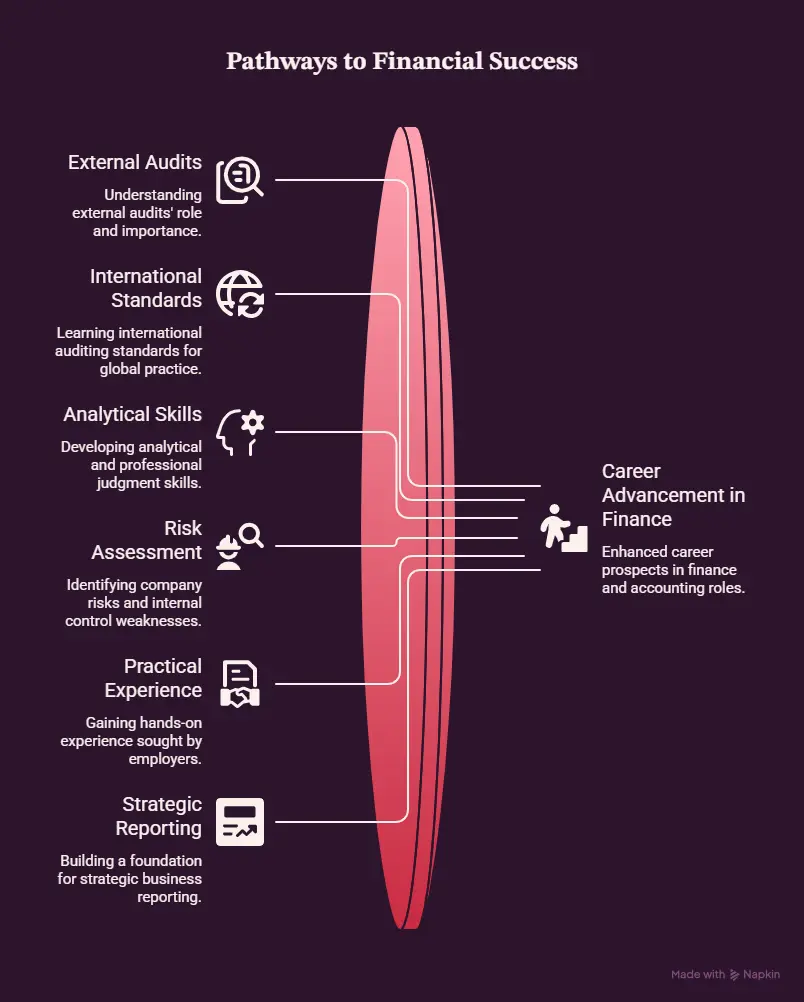
Students benefit from the paper in the following ways:
- Acquire an understanding of the function and significance of external audits.
- Learn about the international standards for auditing.
- Develop the capacity for analysis and professional judgment.
- Determine the dangers to the company and inadequate internal controls.
- Acquire the hands-on experience that auditing companies and corporate finance departments seek.
- SBR stands for strategic business reporting, and AAA stands for advanced auditing and assurance. Establish a solid foundation for both of these.
Companies are looking for people who have a good knowledge of auditing, as this is a key element in terms of compliance and financial transparency.
Placement Oriented PWC Business Accounting Course
PWC Certified Business Accounting Course by Entri App: Master in-demand skills, ace interviews, and secure top-tier jobs.
Join Now!ACCA Audit and Assurance (AA) Syllabus
In order to offer students with a comprehensive grasp of the auditing process, the ACCA advanced auditing course is broken up into several major topics.
1. Audit Framework and Regulation
Students learn:
- Purpose of external audit
- Types of assurance engagements
- Regulatory environment
- International Standards on Auditing (ISAs)
- Professional ethics and independence
2. Planning and Risk Assessment
This section covers:
- Audit planning
- Understanding the business
- Materiality
- Audit risk
- Business risks
- Analytical procedures
- Fraud and error
3. Internal Control
Topics include:
- Internal control systems
- Control objectives
- Control deficiencies
- Internal audit
- Testing controls
- Recommendations for improvement
4. Audit Evidence
Students learn how auditors gather sufficient and appropriate evidence through:
- Inspection
- Observation
- External confirmation
- Recalculation
- Reperformance
- Analytical procedures
- Inquiry
5. Review and Reporting
This section includes:
- Subsequent events
- Going concern
- Written representations
- Audit completion
- Auditor’s report
- Modified opinions
- Emphasis of Matter paragraphs
ACCA AA Exam Pattern
Objective and scenario-based questions are included in the ACCA AA examination, which is conducted entirely on a computerised platform.
| Section | Question Type | Marks |
|---|---|---|
| Section A | Objective Test Questions | 30 |
| Section B | Objective Test Case Questions | 30 |
| Section C | Constructed Response Questions | 40 |
| Total | — | 100 |
Exam Duration
- 3 hours
Passing Mark
- 50 marks out of 100
The test places more emphasis on application than memorizing. Students must examine scenarios and provide suitable audit processes for the majority of questions.
Become an Accounting Pro – Learn from Industry Experts!
Skills Tested in the AA Exam
ACCA’s Audit and Assurance (AA) exam tests more than auditing theory. Auditing principles, professional judgment, and real-world business scenarios are assessed. Audit principles must be understood and applied in practise to pass the exam.
1. Assess Risk
Candidates must identify and assess financial statement and audit risks. Business hazards and audit risks must be distinguished, and their effects on the audit methodology understood.
2. Planning audits
You must comprehend the client’s business, assess materiality, identify significant risk areas, and devise an audit strategy to pass the exam.
3. Internal Control Assessment
Students evaluate an organization’s internal control systems, identify flaws, and suggest solutions to decrease risks and enhance financial reporting.
4. Auditing
Recommending audit techniques for distinct financial statement sectors is a key competence. Use scenario-specific responses instead than generic ones.
5. Analyzing Audit Evidence
The AA exam tests your knowledge of how auditors gather necessary evidence. You should evaluate audit evidence’s trustworthiness, relevance, and adequacy.
6. Career Ethics and Decision-Making
Integrity, objectivity, professional competence, confidentiality, and professional behavior must be demonstrated by candidates. Expert skepticism and complicated decision-making are also tested.
7. Audit Report
Learn how to assess audit results and choose an audit opinion. Identifying situations that necessitate updated opinions, matter paragraph emphasis, or other reporting adjustments.
8. Communicate and Analyze
The exam involves well-structured responses that explain audit results, justify recommendations, and evaluate business scenarios. Scoring requires analytical thinking and clear communication.
Placement Oriented PWC Business Accounting Course
PWC Certified Business Accounting Course by Entri App: Master in-demand skills, ace interviews, and secure top-tier jobs.
Join Now!How to Prepare for ACCA Audit and Assurance
The ACCA Audit and Assurance (AA) exam demands more than auditing standards memorization. Although the paper is application-based, you must comprehend principles, practice scenario-based questions, and build excellent analytical and professional judgment abilities. A well-planned study schedule and regular review might boost your exam prospects.
1. Understand Auditing Completely
Study audit planning, risk assessment, internal controls, evidence gathering, and reporting. Understand how each stage connects to improve your ability to answer scenario-based questions.
2. Remember the ACCA AA Syllabus
Research each syllabus subject and comprehend the fundamental concepts rather than just memorizing definitions. Because they’re tested, you should focus on audit risk, internal controls, audit evidence, professional ethics, and audit reports.
3. Apply ISA Standards
Understand the goal, major requirements, and how they’re implemented in audit circumstances, but don’t memorize every ISA. Answering objective and constructed response questions requires knowledge of applicable standards.
4. Do Scenario Questions
Most AA test questions are based on actual business scenarios. Recognize audit risks, suggest audit techniques, assess internal controls, and explain audit results. Instead of generalizing, personalize your answers to the situation.
5. Do Mock Exams and Past Papers
Repeating ACCA past problems and mock tests will help you understand the exam style, improve your time management, and discover areas for review. Reviewing examiner reports might reveal prevalent errors and high-scoring answer approaches.
6. Improve Answering
Focus on responding precisely to constructed response questions. Write brief, relevant points with clear headings and logical explanations. Avoid long theoretical talks that don’t match the question.
7. Plan Regular Revisions
Create a study timetable that enables time for new and revised information. Summary notes, flashcards, mental maps, and self-tests help you remember and understand.
8. Develop Professional Judgement
Auditor-like thinking is tested on the AA exam. Evaluate business circumstances, recognize hazards, and make ethical, professional decisions. With this approach, you may confidently answer complex scenario-based questions.
9. Study ACCA Resources
Study with ACCA-approved resources, learning providers, revision packages, and platforms. These latest syllabus-aligned resources might help you grasp the exam’s style and difficulty.
10. Organise Time
Divide the exam time by question marks. Leave time to evaluate your answers before submitting the exam and avoid spending too long on each question.
Common Mistakes Students Make
Unavoidable mistakes cause a significant number of students to lose marks.
The following are examples of common errors:
- Committing information to memory rather than comprehending new ideas
- There is confusion between audit risk and business risk.
- Developing standard operating procedures for audits
- Ignoring the prerequisites in the scenario questions for the scenario
- It is difficult to manage time.
- Absence of adherence to professional ethics
- Refusing to provide justification for suggestions
- A lack of practice with constructed response questions during practice
ACCA AA vs Other Applied Skills Papers
With an emphasis on practical application, professional judgment, and analytical thinking, the ACCA Audit and Assurance (AA) examination is one of the Applied Skills exams that candidates must take. AA is a unique Applied Skills exam because it assesses your ability to evaluate company scenarios, identify audit risks, assess internal controls, and recommend appropriate audit processes. Other Applied Skills papers focus on subjects such as financial reporting, taxation, or performance management—but AA is completely different.
The following is a comparison of Applied Skills with other popular papers that can be found in the field:
| Feature | Audit & Assurance (AA) | Financial Reporting (FR) | Taxation (TX) | Performance Management (PM) |
|---|---|---|---|---|
| Main Focus | Auditing | Financial Statements | Tax Rules | Business Performance |
| Question Style | Scenario-based | Numerical & Theory | Calculations | Analysis & Calculations |
| Practical Application | Very High | High | High | High |
| Writing Requirement | High | Medium | Low | Medium |
| Calculations | Low | Medium | High | High |
Is ACCA Audit and Assurance Difficult?
The Auditing and Accounting paper is frequently considered to be moderately challenging due to the fact that it requires students to apply auditing concepts rather than simply recalling facts. A significant number of candidates have difficulty answering scenario-based questions and drafting audit procedures that are appropriate.
On the other hand, the paper becomes significantly more doable if constant practice is performed, a comprehensive comprehension of International Standards on Auditing (ISAs) is achieved, and regular study of previous test problems is performed. Students that place a strong emphasis on improving their analytical and professional judgment skills typically achieve high levels of success.
Final Takeaway
By employing the ACCA Audit and Assurance (AA) paper, students have the opportunity to acquire knowledge regarding the intricacies of auditing, including the identification of risks, the evaluation of internal controls, the collection of evidence for an audit, and the straightforward presentation of their results. It is more beneficial to focus on understanding the subject, following the International Standards on Auditing, and routinely practicing scenario-based questions in order to achieve success in AA than it is to rely on memorizing the material. It is possible for students to easily pass the paper and establish the framework for future ACCA courses and professions in accounting, finance, and auditing if they have a well-planned study regimen, numerous practice examinations, and a confident exam style.
Placement Oriented PWC Business Accounting Course
PWC Certified Business Accounting Course by Entri App: Master in-demand skills, ace interviews, and secure top-tier jobs.
Join Now!Frequently Asked Questions
Is ACCA Audit and Assurance a theory paper?
It contains theory but mainly tests practical application through business scenarios.
Is AA easier than Financial Reporting?
The difficulty depends on your strengths. AA involves less calculation but requires stronger analytical and writing skills.
Are International Standards on Auditing (ISAs) important?
Yes. Understanding the principles and application of ISAs is essential for success in the exam.
How should I practice audit procedures?
Practice writing procedures based on business scenarios and ensure they are specific to the facts given rather than using generic responses.
How many hours should I study for AA?
Most students benefit from around 100–150 hours of focused study, depending on their prior knowledge and experience.
Is the ACCA AA exam calculation-heavy?
No. The exam emphasizes analytical thinking, audit procedures, risk assessment, and professional judgment more than calculations.
Which paper comes after AA?
Many students progress to Strategic Business Reporting (SBR) and later Advanced Audit and Assurance (AAA), although the order can vary based on their study plan.