Table of Contents
Key Takeaways:
- Learn the basics of HR.
- Learn Excel and HR tools.
- Practice your skills regularly.
- Gain work experience.
- Keep learning new things.
- HR Analytics is a growing career.
To become an HR Analyst, you need the right education, skills, and experience.
Follow these simple steps:
- Complete a bachelor’s degree.
- Learn HR Analytics.
- Learn Excel and HR tools.
- Complete HR courses or certifications.
- Gain HR work experience.
- Apply for HR Analyst jobs.
👉 Keep learning new skills to grow your career and earn a better salary.
Is being an HR Analyst your dream? Enrol now for our course on Human Resource!
Who is an HR Analyst?
Why Choose a Career as an HR Analyst?
An HR Analyst career is a good choice. It offers good jobs, good salary, and career growth.
Good Job Opportunities
Many companies need HR Analysts.
You can work in:
- IT companies.
- Banks.
- Hospitals.
- Retail companies.
- Manufacturing companies.
👉 There are many job openings.
Good Salary
HR Analysts can earn a good salary.
Your salary can increase with:
- Experience.
- Skills.
- Better job roles.
👉 You can earn more over time.
Career Growth
You can grow to higher positions.
For example:
- Senior HR Analyst.
- HR Manager.
- HR Business Partner.
👉 There are many chances to grow.
Learn Useful Skills
You can learn skills like:
- HR Analytics.
- Excel.
- Power BI.
- HR software.
👉 Many companies look for these skills.
Work in Different Companies
You are not limited to one industry.
You can work in:
- IT.
- Banking.
- Healthcare.
- Education.
- Retail.
👉 You have many career options.
Help Employees
HR Analysts help companies:
- Hire good employees.
- Improve employee performance.
- Keep employees happy.
👉 Your work helps both employees and the company.
Interesting Work
Every day can be different.
You may:
- Study data.
- Make reports.
- Solve HR problems.
- Help managers.
👉 The work stays interesting.
Growing Demand
More companies now use HR Analytics.
They need people who can:
- Study employee data.
- Make reports.
- Support HR decisions.
👉 The demand for HR Analysts is growing.
Future Career
HR Analytics is becoming more popular. More companies are using data in HR.
👉 This makes it a good career for the future.
Step-by-Step Guide to Becoming an HR Analyst
Becoming an HR Analyst is simple if you follow the right steps. Learn the right skills, gain experience, and keep improving.
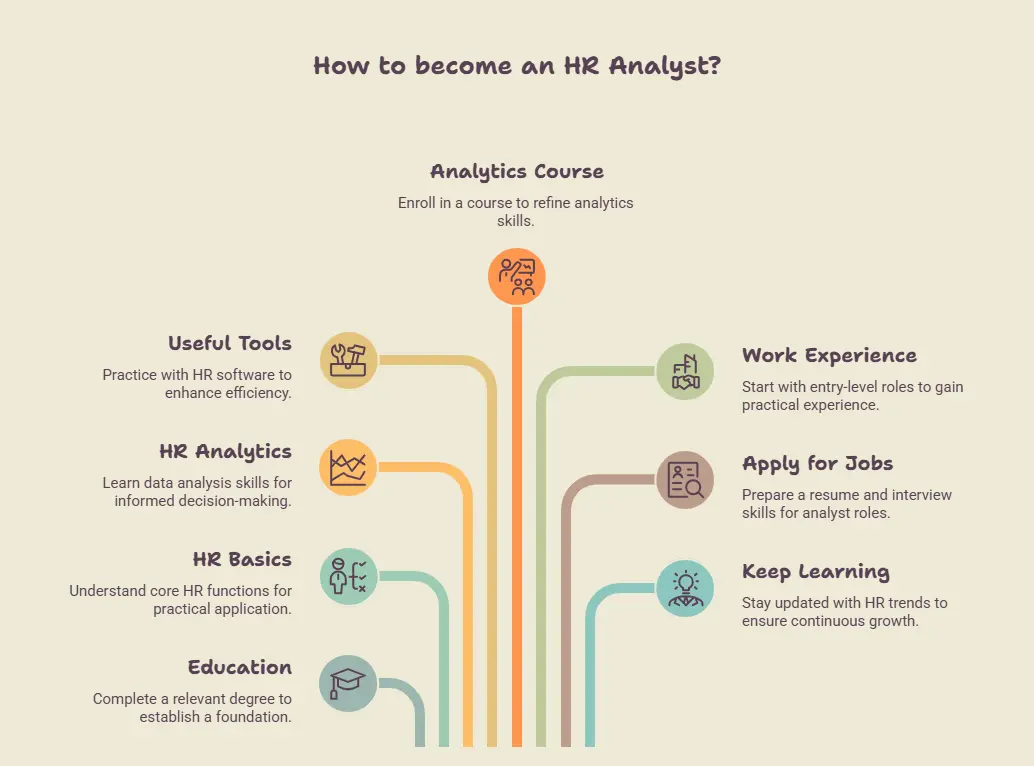
Step 1: Complete Your Education
Start by completing your degree.
You can study:
- BBA.
- BCom.
- BA.
- MBA in HR.
👉 A degree helps you start your HR career.
Step 2: Learn HR Basics
Understand basic HR topics such as:
- Recruitment.
- Attendance.
- Leave.
- Employee records.
👉 Basic HR knowledge is important.
Step 3: Learn HR Analytics
Learn how to work with employee data.
You should know:
- HR Analytics.
- Data analysis.
- HR reports.
👉 This is one of the most important skills.
Step 4: Learn Useful Tools
Practice using simple HR tools like:
- Microsoft Excel.
- Power BI.
- HR software.
👉 These tools make your work easier.
Step 5: Join an HR Analytics Course
A course helps you improve your skills.
You can learn:
- HR Analytics.
- Excel.
- Reporting.
- HR tools.
👉 A course can improve your knowledge.
Step 6: Gain Work Experience
Start with an entry-level HR job.
For example:
- HR Intern.
- HR Assistant.
- HR Executive.
👉 Experience helps you learn real HR work.
Step 7: Apply for HR Analyst Jobs
After learning the skills and gaining experience, apply for HR Analyst jobs.
Prepare:
- A good resume.
- Basic HR knowledge.
- Interview skills.
👉 You will be ready for HR Analyst roles.
Step 8: Keep Learning
HR Analytics keeps changing.
Always try to:
- Learn new tools.
- Improve your skills.
- Gain more experience.
👉 Learning helps you grow faster.
Simple Career Path
You can grow step by step:
- HR Intern
- HR Assistant
- HR Executive
- HR Analyst
- Senior HR Analyst
- HR Manager
👉 Each step gives you more experience and better career opportunities.
Skills Every HR Analyst Should Develop
An HR Analyst needs a few important skills. These skills help them work better and grow in their career.
HR Knowledge
An HR Analyst should understand:
- Hiring.
- Attendance.
- Leave.
- Employee records.
👉 Basic HR knowledge is important.
Excel Skills
Excel is used every day.
It helps to:
- Store data.
- Make tables.
- Create reports.
👉 Excel is one of the most useful skills.
Data Skills
HR Analysts work with employee data.
They should know how to:
- Read data.
- Check data.
- Understand reports.
👉 Good data helps in better decisions.
Communication Skills
HR Analysts work with many people.
They should be able to:
- Speak clearly.
- Listen carefully.
- Explain reports.
👉 Good communication helps everyone.
Problem-Solving Skills
Sometimes HR problems happen.
An HR Analyst should:
- Find the problem.
- Think of simple solutions.
- Help the HR team.
👉 Solving problems is part of the job.
Attention to Detail
Employee data should be correct.
They should:
- Check information carefully.
- Avoid mistakes.
👉 Correct data is very important.
HR Tools
It is useful to learn tools like:
- Excel.
- Power BI.
- HR software.
👉 These tools make work faster.
Learning Habit
HR keeps changing.
Always try to:
- Learn new skills.
- Learn new tools.
- Improve your knowledge.
👉 Learning helps you grow in your career.
Educational Qualifications and Certifications
To become an HR Analyst, you need the right education. Learning extra skills can also help you get better jobs.
Complete a Degree
Most companies ask for a bachelor’s degree.
You can study:
- BBA.
- BCom.
- BA.
- MBA in HR.
👉 A degree helps you start your career.
Learn HR Basics
You should understand topics like:
- Hiring.
- Attendance.
- Leave.
- Employee records.
👉 Basic HR knowledge is important.
Join HR Analytics Courses
You can learn through courses such as:
- HR Analytics.
- HR Management.
- HR Reporting.
👉 Courses help you learn practical skills.
Learn Computer Skills
It is useful to learn:
- Microsoft Excel.
- Power BI.
- HR software.
👉 These skills are useful for daily work.
Earn Certifications
You can complete certifications in:
- HR Analytics.
- Excel.
- Power BI.
- HR courses.
👉 Certifications can improve your resume.
Keep Learning
Try to learn new things regularly.
You can:
- Learn new HR tools.
- Improve your skills.
- Attend online courses.
👉 Learning helps you grow faster in your career.
HR Analyst Career Path
HR Analyst vs HR Generalist
Salary Expectations and Job Outlook
HR Analysts can earn a good salary. Salary depends on your experience, skills, and company.
Starting Salary
Freshers may earn:
- ₹3 LPA to ₹5 LPA.
👉 This is the starting salary.
Salary After Experience
After a few years, salary can increase.
Experienced HR Analysts may earn:
- ₹5 LPA to ₹8 LPA or more.
👉 More experience usually means better pay.
Skills Can Increase Salary
Learning new skills can help you earn more.
Useful skills include:
- HR Analytics.
- Excel.
- Power BI.
- HR software.
👉 Better skills can lead to a higher salary.
Many Job Opportunities
Many companies need HR Analysts.
You can find jobs in:
- IT.
- Banking.
- Healthcare.
- Retail.
- Manufacturing.
👉 There are many job openings.
Future Job Demand
More companies are using employee data.
Because of this:
- More HR Analyst jobs are available.
- Demand is increasing every year.
👉 HR Analytics is a growing career.
Good Career Choice
If you keep learning and gaining experience:
- You can get better jobs.
- You can earn a better salary.
- You can grow in your career.
👉 HR Analytics has a bright future.
Common Challenges in Becoming an HR Analyst
Becoming an HR Analyst is a good career choice. But you may face a few challenges while learning and working.
Learning New Skills
You need to learn:
- HR Analytics.
- Excel.
- Power BI.
- HR software.
👉 Learning these skills takes time.
Getting Work Experience
Some companies ask for experience.
You may need to:
- Start as an intern.
- Work as an HR Assistant.
- Gain practical experience.
👉 Experience helps you get better jobs.
Understanding Employee Data
HR Analysts work with a lot of data.
They should:
- Read data carefully.
- Avoid mistakes.
- Understand reports.
👉 Correct data is very important.
Keeping Up with New Tools
New HR tools are introduced often.
You should:
- Learn new software.
- Improve your skills.
👉 Learning should continue.
Finding the Right Job
Getting your first HR Analyst job may take time.
You should:
- Build your skills.
- Prepare a good resume.
- Attend interviews.
👉 Do not give up if it takes time.
Balancing Work and Learning
Many people learn while working.
You should:
- Manage your time.
- Practice regularly.
- Keep improving.
👉 Small steps help you reach your goal.
Benefits of Becoming an HR Analyst
Becoming an HR Analyst has many benefits. It is a good career with many opportunities.
Good Job Opportunities
Many companies hire HR Analysts.
You can work in:
- IT.
- Banking.
- Healthcare.
- Retail.
- Manufacturing.
👉 There are many job options.
Good Salary
HR Analysts can earn a good salary.
Your salary can grow with:
- Experience.
- Skills.
- Better job roles.
👉 You can earn more over time.
Career Growth
You can grow to higher positions.
For example:
- Senior HR Analyst.
- HR Manager.
- HR Business Partner.
👉 There are many chances to grow.
Learn New Skills
You can improve skills like:
- HR Analytics.
- Excel.
- Power BI.
- HR software.
👉 These skills are useful for your career.
Work in Different Industries
HR Analysts are needed in many industries. You can choose the industry you like.
👉 This gives you more career choices.
Help the Company
Your work helps companies:
- Hire better employees.
- Improve employee performance.
- Make better HR decisions.
👉 Your work is valuable.
Growing Career
More companies now use HR Analytics.
This means:
- More jobs.
- Better career opportunities.
- Better future.
👉 HR Analytics is a growing career.

Mistakes to Avoid When Starting an HR Analytics Career
If you are starting an HR Analytics career, avoid some common mistakes. These can help you learn faster and grow in your career.
Skipping Basic HR Knowledge
Do not learn only analytics.
Also learn:
- Hiring.
- Attendance.
- Leave.
- Employee records.
👉 Basic HR knowledge is important.
Not Learning Excel
Excel is used in many HR jobs.
Do not ignore it.
👉 Learn the basics of Excel.
Ignoring HR Tools
Many companies use HR tools.
Try to learn:
- Power BI.
- HR software.
👉 These tools make your work easier.
Not Practicing
Learning only theory is not enough.
Practice by:
- Working with sample data.
- Making simple reports.
👉 Practice improves your skills.
Stopping Learning
HR Analytics keeps changing.
Keep learning:
- New tools.
- New skills.
- New ideas.
👉 Learning helps you grow.
Giving Up Too Early
Your first job may take time.
Keep:
- Learning.
- Practicing.
- Applying for jobs.
👉 Stay patient and keep trying.
Is being in HR your dream? Enrol now for our course on Human Resource!
Become an HR Expert – Enroll in Our HR Management Course Today!
Unlock the secrets to effective Human Resource Management with our expert-led course! Learn recruitment, employee relations, performance management, and more to build a thriving workplace. Start your journey toward a successful HR career today!
Know MoreConclusion
HR Analytics is a good career with many opportunities. Learn the right skills, practice regularly, and gain experience.
- Learn HR basics.
- Improve your skills.
- Keep learning new tools.
- Grow step by step.
👉 With time and practice, you can become a successful HR Analyst.
Related Articles |
|
| HR Analyst Salary in India | HR Analyst: Roles and Responsibilities |
| What is HR Analytics? Tools, Types and Benefits | |
Become an HR Expert – Enroll in Our HR Management Course Today!
Unlock the secrets to effective Human Resource Management with our expert-led course! Learn recruitment, employee relations, performance management, and more to build a thriving workplace. Start your journey toward a successful HR career today!
Know MoreFrequently Asked Questions
Who can become an HR Analyst?
Anyone with a degree and an interest in HR and data can become an HR Analyst. Learning HR Analytics and basic HR skills is also helpful.
What qualification is needed to become an HR Analyst?
Most companies prefer candidates with a degree such as BBA, BCom, BA, or an MBA in HR. HR Analytics courses can also improve your chances
Which skills are important for an HR Analyst?
Some important skills are:
- HR Analytics
- Microsoft Excel
- Power BI
- Communication
- Data analysis
Can a fresher become an HR Analyst?
Yes. Freshers can start with jobs like HR Intern or HR Assistant and later become an HR Analyst after gaining experience.
Is coding required for HR Analytics?
No. Basic HR Analytics jobs usually do not require coding. Learning Excel, Power BI, and HR software is enough for many entry-level roles.
Is HR Analytics a good career in India?
Yes. HR Analytics is growing quickly. Many companies need HR Analysts, and there are good career growth and salary opportunities.
What is the career path of an HR Analyst?
A simple career path is:
- HR Intern
- HR Assistant
- HR Executive
- HR Analyst
- Senior HR Analyst
- HR Manager
How can I improve my chances of getting an HR Analyst job?
You can improve your chances by:
- Completing your degree.
- Learning HR Analytics.
- Practicing Excel and Power BI.
- Taking HR certifications.
- Gaining HR work experience.