Table of Contents
Many Indian retail investors actively track bonus shares and traditional stock splits. We love seeing our share count go up. However, corporate actions can also move in the opposite direction.
There are instances when a company decides to reduce its total share count to boost its stock price. This is done by performing a reverse stock split.
If you hold shares in Indian companies listed on the NSE or BSE, it is quite essential to understand this financial tool. It helps you read corporate announcements correctly and manage your portfolio without panic.
Start investing like a pro. Enroll in our Stock Market course!
Key Takeaways
- A reverse stock split merges multiple existing shares of a company into a single share.
- It increases the market price per share without changing the overall market value of your investment.
- Companies use this action to boost low share prices, avoid delisting, and attract institutional investors.
- While the total number of shares in your Demat account decreases, your percentage ownership in the company remains the same.
- It does not create free money or increase the fundamental wealth of the company.
Understanding Reverse Stock Split
1: What is a stock?
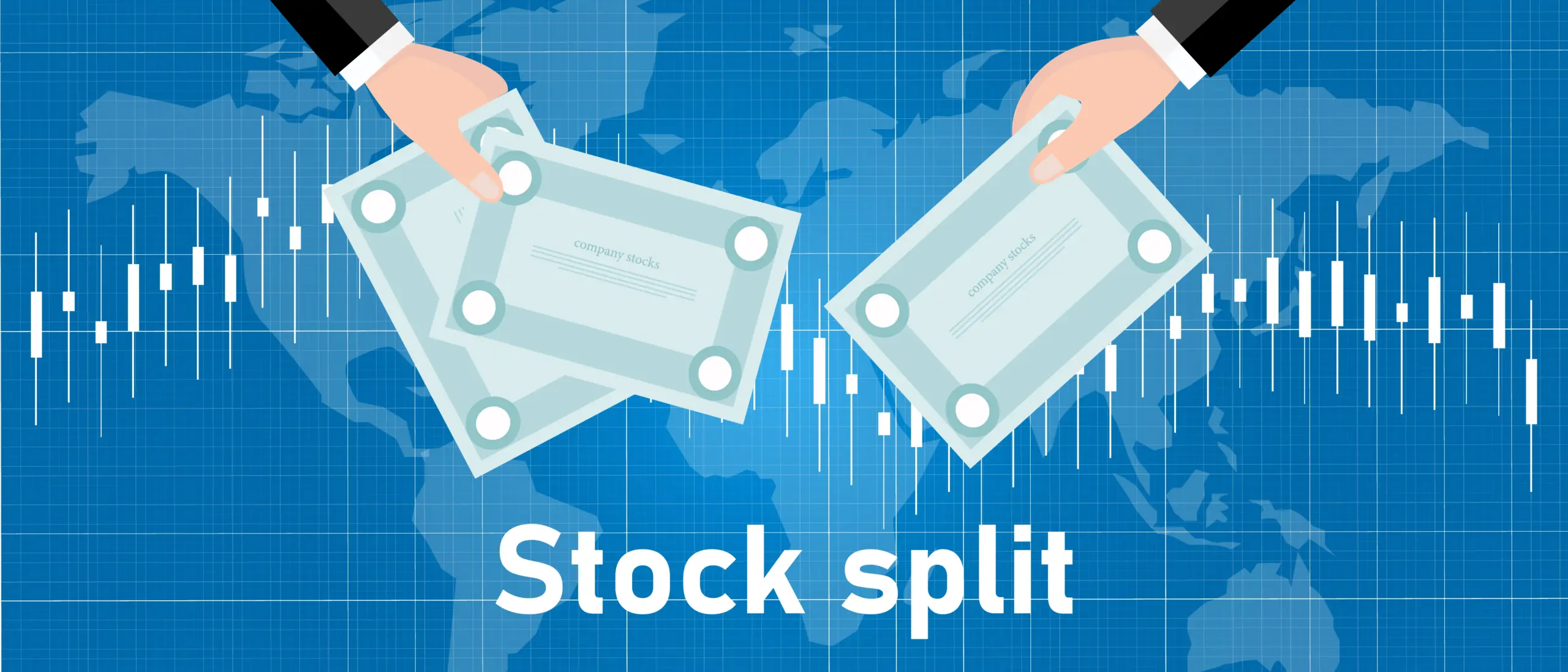
A reverse stock split is a corporate action where a company reduces the total number of its outstanding shares in the market. In this process, existing shares are combined to form a smaller number of higher-priced shares. It is similar to exchanging paper currency.
Suppose you are holding ten ₹10 notes in your wallet. Now, the total value is ₹100. If you exchange those ten notes for one single ₹100 note, the number of paper notes drops from ten to one. However, the total money in your wallet remains exactly ₹100.
In the stock market, a reverse corporate action works on the exact same principle. The company combines multiple small shares into one consolidated share. As a result, the face value and market price increase proportionally. However, your total investment value remains unchanged at the moment of execution.
LG Balakrishnan and Bros is an example of an Indian company that opted for reverse stock split. In March 2010, it went for a reverse stock split to consolidate the face value of its share from Re.1 to Rs.10.
How Does a Reverse Stock Split Work?
To understand the mechanics, let us look at the ratio announced by a company. Ratios are always expressed to show how many old shares combine into new shares. Common ratios include 1:2, 1:5, or 1:10.
Suppose a company listed on the BSE announces a 1:5 reverse ratio. This means for every 5 old shares you own, you will now receive 1 new share.
Here is a step-by-step breakdown using a clear example:
Before the Split
- Shares owned: 500 shares
- Market price per share: ₹10
- Total Investment Value: 500 × ₹10 = ₹5,000
After a 1:5 Split
- New share count: 500 ÷ 5 = 100 shares
- New market price per share: ₹10 × 5 = ₹50
- Total Investment Value: 100 × ₹50 = ₹5,000
As you can see, your overall portfolio value remains ₹5,000. You now hold fewer shares, but each individual share carries a higher market value.
Difference Between Stock Split and Reverse Stock Split
Investors often confuse standard stock splits with reverse actions. While both adjust share counts and share prices, they serve completely opposite purposes in the stock market.
| Feature | Standard Stock Split | Reverse Stock Split |
| Primary Goal | Reduce share price to increase liquidity | Increase share price to improve image or compliance |
| Share Count | Increases | Decreases |
| Per Share Price | Decreases | Increases |
| Target Company | Fast-growing companies with high stock prices | Companies dealing with falling stock prices |
| Market Sentiment | Generally viewed positively | Often viewed with caution |
Why Do Companies Perform a Reverse Stock Split?

Companies do not combine shares randomly. Management usually takes this step due to pressing corporate needs or strategic financial goals.
1. Avoiding Delisting from Stock Exchanges
Stock exchanges enforce strict rules regarding minimum share prices and listing compliance. If a stock trades below a required threshold for a prolonged period, it risks being delisted.
By consolidating shares, the company instantly lifts its stock price back into safe regulatory territory.
2. Attracting Institutional Investors
Mutual funds, foreign portfolio investors (FPIs), and large financial institutions often avoid stocks trading at extremely low prices (penny stocks).
The reason is that low-priced stocks are prone to high volatility and price manipulation. A higher share price makes the stock look respectable and opens doors for institutional buying.
3. Improving Brand Image and Market Perception
In the financial world, perception matters. A stock trading at ₹2 per share is often perceived as a struggling or risky company.
If that same stock is restructured to trade at ₹50 per share, it projects stability and attracts serious retail investors.
4. Preparing for Mergers or Restructuring
When companies undergo corporate restructuring, mergers, or spin-offs, management often needs to align capital structures.
Combining shares simplifies the share capital layout and helps meet valuation requirements during corporate deals.
Stock Market Training Reviewed & Monitored by SEBI Registered Investment Advisor
Trusted, concepts to help you grow with confidence. Enroll now and learn to start investing the right way.
Know moreIs reverse stock split always bad?
Now you might be under the assumption that reverse stock splits are always bad news for the company. However, this is not true in all cases.
A famous example for reverse stock split is that of Citigroup’s. During the 2008 financial crisis, the company’s share price crashed to below $10. Since the price stayed at the same level, Citigroup’s board decided in 2011 to do a reverse stock split of 1-for-10.
As a result of the split, the price shot up from $4.50 per share to $45 per share. Fast forward to 2026 July, Citigroup’s share is currently trading at $132.84.
Impact on Retail Investors in India

If you hold shares of a company undergoing this action, here is how it affects your Demat account, tax calculations, and fractional holdings.
1. Demat Account Adjustment
On the record date announced by the company, trading in the old shares stops temporarily. The old shares are debited from your Demat account, and the consolidated new shares are credited under a new ISIN (International Securities Identification Number). This process usually takes a few business days.
2. Handling Fractional Shares
Let’s go through a scenario where your share count is not cleanly divisible by the split ratio.For example, suppose you own 23 shares, and the company announces a 1:5 reverse ratio:
- 20 shares cleanly convert into 4 new shares.
- 3 shares remain as a fraction (0.6 of a new share).
Companies do not credit fractional shares to Demat accounts. Instead, a designated trustee aggregates all fractional units from all shareholders.
In turn, they sell them in the open market, and distribute the cash proceeds directly to your registered bank account.
3. Income Tax Implications
According to Indian Tax Laws, consolidating shares is not treated as a transfer or sale of assets. Therefore, it does not trigger capital gains tax at the time of consolidation. Your original cost of acquisition simply gets adjusted proportionally:
New Cost per Share = Total Original Purchase Price\New Number of Shares
The original purchase date of your old shares remains valid for calculating long-term or short-term capital gains when you eventually sell the new shares.
Pros and Cons for Investors
Before forming an opinion on a corporate consolidation, evaluate both sides of the coin.
Advantages
- Better Liquidity from Institutions: A higher price point can attract mutual funds, which brings stable liquidity.
- Exchange Compliance: It keeps the company listed on primary stock exchanges, protecting shareholder liquidity.
- Reduced Volatility: Higher-priced shares are generally less susceptible to pump-and-dump schemes by speculative traders.
Disadvantages
- No Change To Underlying Fundamentals: It is a cosmetic change and does not fix poor management, heavy debt, or declining sales.
- Negative Market Sentiment: Retail markets often view this move as a sign of underlying distress or weakness.
- Potential for Further Decline: If the business fundamentals do not improve, the newly elevated share price can start falling again.
Join our Online Course and Learn Stock Marketing the Right Way. Enrol Now!
Top 4 Tips For Indian Investors
When a company in your portfolio announces a share consolidation, never react in haste. Instead, follow this practical checklist:
- Check the Management Rationale: Read the company notification submitted to the BSE or NSE. Understand why management chose to consolidate shares.
- Analyze Business Fundamentals: Look beyond the corporate action. Is the company generating profit? Is debt decreasing? Are sales growing?
- Monitor Fractional Settlements: Keep track of your bank statements around the corporate action date to verify any payout received for fractional units.
- Avoid Unnecessary Panic: Remember that your net invested value does not drop simply because your share count decreased.
Conclusion
A reverse stock split is a corporate restructuring tool used by companies. They opt for reverse stock split to combine existing shares into fewer, higher-valued units. It instantly boosts the per-share price and helps satisfy stock exchange listing norms. However, it does not change the core financial health of the business.
As a smart investor in the Indian stock market, always look beyond surface-level price adjustments. Make sure that you evaluate the underlying business performance, track earnings reports, and make informed decisions based on fundamental strength. It would be a prudent move rather than looking at cosmetic changes happening in share prices.
Stock Market Training Reviewed & Monitored by SEBI Registered Investment Advisor
Trusted, concepts to help you grow with confidence. Enroll now and learn to start investing the right way.
Know moreFrequently Asked Questions
Are GCC internships good for freshers?
Yes. They’re one of the highest-conversion pathways into a full-time GCC role for freshers. Reported conversion rates commonly range from 40–70%, well above typical IT services benchmarks.
Which colleges are eligible for GCC internships?
Large GCCs run structured campus pipelines at IITs, NITs, and BITS, but off-campus and skills-first hiring is rising sharply. A strong coding-test score or project portfolio can outweigh college pedigree at many GCCs.
Can hackathons really help me get an internship?
Yes. Programmes like Walmart Sparkplug and JPMorgan Code for Good are built as internships or hiring pipelines, not just competitions. Even hackathons without a guaranteed internship, like the Goldman Sachs India Hackathon, can lead to pre-placement interviews for strong performers.
How do I convert a GCC internship into a PPO?
Consistently deliver ahead of deadlines, communicate progress proactively, and document the measurable impact of your work. Ask for feedback in your final weeks and clearly express interest in a full-time role.
When should I start applying for GCC internships in 2026?
Campus-linked pipelines can open 12–18 months before actual hiring, so junior-year students should start tracking early. Off-campus and named hackathon windows open on rolling or seasonal schedules, so ongoing tracking matters more than a single date.
Do GCC internships pay well?
Stipends vary by company and function, but competitive technical internship tracks have paid in the ₹1,00,000–1,10,000 per month range. Business and analytics-focused internships may follow different structures.
What skills do GCC recruiters look for in interns?
Demonstrable technical or analytical skill — proven through a coding test or a live project — matters more than branch or college name. Communication, GitHub visibility, and one strong, relevant project consistently stand out.
Are non-engineering students eligible for GCC internships?
Yes, particularly for business, operations, and analytics-adjacent roles, though CSE, IT, ECE, and data backgrounds remain the largest applicant pool. Mechanical and instrumentation graduates are also increasingly considered for ER&D-linked GCC work.
How long do GCC internships typically last?
Most run two to six months, depending on the company and function. Some named coding-challenge pipelines, like Walmart Sparkplug, specifically offer shorter two-month tracks.
What are the biggest mistakes that cost students a PPO?
Staying invisible about your progress and missing deadlines are the two most common conversion killers. Not documenting the measurable impact of your work also makes it harder for managers to justify a full-time offer internally.