
Table of Contents
Key Takeaways:
- The five elements of accounting are assets, liabilities, equity, revenue, and expenses.
- These elements help organize financial transactions clearly.
- Assets show what a business owns.
- Liabilities show what a business owes.
- Equity represents the owner’s share in the business.
- Revenue and expenses show income and costs.
- Together, they help create financial statements and track performance.
The 5 Major Elements of Accounting form the structure of accounting systems. These elements organize financial information within business records. They include assets, liabilities, equity, revenue, and expenses. Businesses use them to prepare financial statements. They also explain financial position and performance.
The 5 Major Elements of Accounting
-
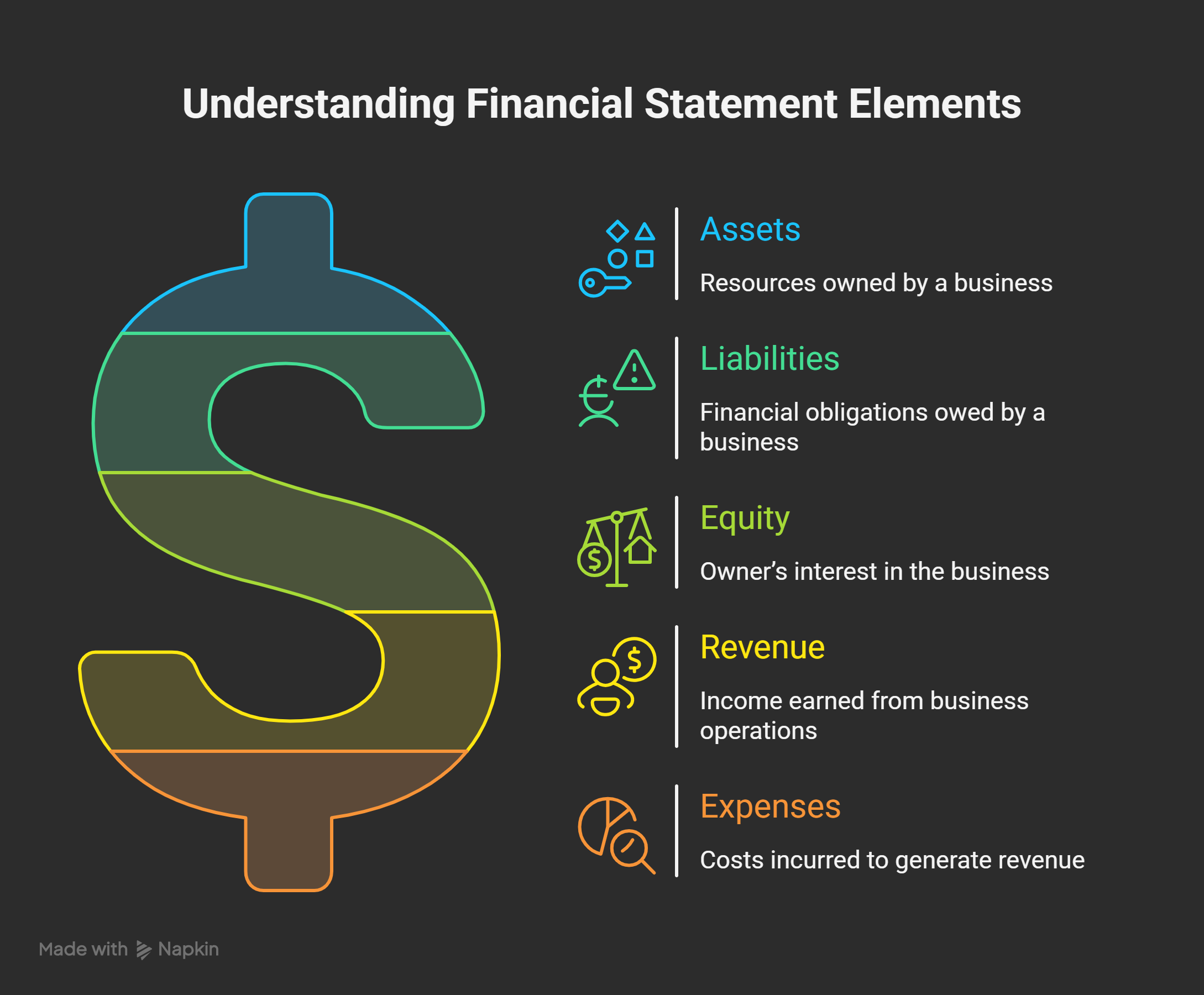
Assets – Resources owned by the business
-
Liabilities – Financial obligations owed to others
-
Equity – Owner’s claim on business assets
-
Revenue – Income earned from business activities
-
Expenses – Costs incurred during business operations
These elements classify financial transactions clearly. They help organize financial information within accounting systems. Financial statements rely on these five accounting elements.
Assets, liabilities, and equity form the accounting equation. The equation states: Assets = Liabilities + Equity.
Revenue and expenses influence equity through profit changes. Revenue increases equity through profits. Expenses reduce equity through costs.

Introduction – Why Understanding Accounting Elements Matters
Financial information guides decisions in every business. Businesses record transactions to track financial activities. Clear records help organizations monitor performance and stability. Accounting systems organize this information into meaningful categories. These categories simplify financial reporting and analysis. They help businesses understand financial activities clearly. Managers rely on structured financial information daily. Investors also examine financial information before decisions.
Understanding accounting elements improves financial awareness. It helps interpret financial information more accurately. Students studying commerce benefit from this knowledge. Business owners also gain clarity about finances. Clear financial structure improves business organization. It also reduces confusion during financial analysis. Accurate information supports responsible financial management.
Understanding accounting elements helps in several ways:
-
Organizing financial information clearly
-
Interpreting financial reports more easily
-
Improving financial awareness for business decisions
-
Supporting better financial management practices
-
Building foundational knowledge in accounting studies
Become an Accounting Pro – Learn from Industry Experts!
Background – Where Do the 5 Major Elements of Accounting Come From?
1: Accounting provides information on
2: To figure out the worth of the end stock during the finish of the monetary year we,
3: Deals invoices are first placed in
4: Entered in the Purchases Journal is
5: Copyrights, Patents, and Trademarks are instances of
Ever wondered how much you really know? It's time to put your brain to the test!
Early Trade Records
Ancient merchants maintained records of trade activities. They tracked goods, money, and outstanding obligations. These records showed business resources and debts. They also revealed profits from trading activities. Costs of trade also appeared in these records.
Early bookkeeping already reflected important financial ideas:
-
Resources owned by traders later became assets
-
Debts to suppliers resembled modern liabilities
-
Remaining wealth reflected early forms of equity
-
Income from trade represented revenue
-
Trade costs represented early expenses
These ideas later shaped modern accounting structure.
Organized Financial Classification
Business activities grew during economic expansion. Companies needed clearer financial organization systems. Accountants began grouping transactions into categories. This classification improved financial clarity and reporting.
-
Resources controlled by businesses became assets.
-
Debts to suppliers resembled modern liabilities
-
Owner investment formed the concept of equity.
-
Income from business operations became revenue.
-
Operational costs became categorized as expenses.
These categories simplified financial record management.
Recognition in Modern Accounting Standards
Modern accounting frameworks formally recognize five elements. Financial reporting standards define these elements clearly. Businesses use them while preparing financial statements. These elements structure balance sheets and income statements.
The five recognized elements include:
-
Assets representing economic resources
-
Liabilities representing financial obligations
-
Equity representing ownership interest
-
Revenue representing income from operations
-
Expenses representing operational costs
These elements now guide global financial reporting practices.
Placement Oriented PWC Business Accounting Course
PWC Certified Business Accounting Course by Entri App: Master in-demand skills, ace interviews, and secure top-tier jobs.
Join Now!Accounting Framework and Financial Reporting Standards
Purpose of Accounting Frameworks
Accounting frameworks guide the preparation of financial statements. They define rules for recording financial information. These rules ensure consistency in financial reporting. Businesses follow frameworks for reliable financial records. Frameworks also improve transparency in financial information.
Key purposes of accounting frameworks include:
-
Providing structure for financial reporting
-
Ensuring consistency in accounting practices
-
Improving reliability of financial statements
-
Supporting transparency for stakeholders
Role of Financial Reporting Standards
Financial reporting standards define accounting principles clearly. They explain how financial transactions should be recorded. Standards also guide presentation of financial statements. Businesses must follow these standards during reporting.
These standards help maintain uniform accounting practices.
Important roles of reporting standards include:
-
Defining recognition of financial elements
-
Standardizing financial statement preparation
-
Improving comparability between businesses
-
Supporting accurate financial disclosure
Connection With Accounting Elements
Financial frameworks recognize five core accounting elements. These elements organize financial information systematically. Each element represents a specific financial category.
The recognized accounting elements include:
-
Assets representing resources owned by businesses
-
Liabilities representing financial obligations
-
Equity represents the owner’s interest in assets
-
Revenue representing income from operations
-
Expenses representing costs of operations
These elements structure financial statements and reporting systems.
The 5 Major Elements of Accounting Comparison
Comparison Table – The 5 Major Elements at a Glance
| Element | Definition | Financial Statement | Example |
|---|---|---|---|
| Assets | Resources owned by a business | Balance Sheet | Cash, equipment, inventory |
| Liabilities | Financial obligations owed by a business | Balance Sheet | Loans, accounts payable |
| Equity | Owner’s interest in the business | Balance Sheet | Owner capital, retained earnings |
| Revenue | Income earned from business operations | Income Statement | Sales revenue, service income |
| Expenses | Costs incurred to generate revenue | Income Statement | Salaries, rent, utilities |
How the 5 Elements Work Together
Financial Structure of a Business
The five elements organize financial information clearly. Each element represents a different financial category. Together they describe financial position and performance. Businesses record transactions using these elements.
These elements structure financial records effectively.
Role of Assets, Liabilities, and Equity
Assets represent resources owned by the business. Liabilities represent obligations owed to other parties. Equity represents the owner’s remaining interest. These three elements describe financial position.
They appear mainly in the balance sheet.
Key roles include:
-
Showing business resources and obligations
-
Explaining ownership interest in assets
-
Describing financial position at specific dates
Role of Revenue and Expenses
Revenue represents income from business operations. Expenses represent costs required for operations. These elements measure financial performance.
They appear mainly in the income statement.
Key roles include:
-
Measuring income earned by the business
-
Tracking operational costs and spending
-
Determining profit or business loss
Interaction Between the Elements
Business transactions often affect multiple elements. Buying equipment increases assets and reduces cash. Taking loans increases liabilities and cash assets. Paying salaries increases expenses and reduces cash.
These interactions maintain accurate financial records. Together the five elements support reliable financial reporting.
Become an Accounting Pro – Learn from Industry Experts!
Placement Oriented PWC Business Accounting Course
PWC Certified Business Accounting Course by Entri App: Master in-demand skills, ace interviews, and secure top-tier jobs.
Join Now!The Accounting Equation Foundation
The accounting equation forms the base of accounting systems. It connects key financial elements in financial reporting.
The accounting equation is:
Assets = Liabilities + Equity
This equation explains business financial structure clearly. It shows how business resources are financed.
Assets represent resources owned by the business. Liabilities represent obligations owed to external parties. Equity represents the owner’s interest in assets.
Revenue and expenses affect equity within this structure. Revenue increases equity through business profits. Expenses reduce equity through business costs.
The equation keeps financial records balanced always. Every transaction maintains balance in financial records.
Relationship with the Accounting Equation
The Accounting Equation
The accounting equation explains balance in financial records. It shows the relationship between three main elements.
The equation appears as:
Assets = Liabilities + Equity
This equation forms the base of accounting systems. Every transaction follows this financial relationship.
Core Elements in the Equation
Assets represent resources controlled by the business. Liabilities represent obligations owed to external parties. Equity represents the owner’s remaining financial interest.
These three elements maintain balance in financial records.
Key components include:
-
Assets showing economic resources owned
-
Liabilities showing financial obligations
-
Equity showing ownership interest in assets
Role of Revenue and Expenses
Revenue and expenses influence the equity component. Revenue increases equity through earned profits. Expenses reduce equity through operational costs. Profit increases the owner’s financial interest. Loss decreases the owner’s financial interest.
Maintaining Financial Balance
Every transaction affects two accounting elements. Changes maintain equality within the accounting equation. Balanced records support accurate financial statements. This structure ensures reliability in financial reporting.
Conclusion
The five elements form the core of accounting systems. They organize financial information into clear categories. Assets, liabilities, and equity describe financial position. Revenue and expenses explain business financial performance. Together they support preparation of financial statements.
Understanding these elements improves financial interpretation. Businesses rely on them for accurate financial reporting. Students also build strong accounting foundations through them. These elements therefore remain essential for financial management.
Placement Oriented PWC Business Accounting Course
PWC Certified Business Accounting Course by Entri App: Master in-demand skills, ace interviews, and secure top-tier jobs.
Join Now!Frequently Asked Questions
What are the five major elements of accounting?
The five elements are assets, liabilities, equity, revenue, and expenses. They classify financial transactions in accounting systems.
Why are accounting elements important?
They organize financial information into clear categories. This structure supports accurate financial reporting and analysis.
Which elements appear in the balance sheet?
Assets, liabilities, and equity appear in the balance sheet. These elements describe a company’s financial position.
Which elements appear in the income statement?
Revenue and expenses appear in the income statement. These elements measure financial performance during a period.
What are assets in accounting?
Assets represent resources owned or controlled by a business. They help generate future economic benefits.
What are liabilities in accounting?
Liabilities represent financial obligations owed to other parties. Businesses must settle them in the future.
What does equity represent in accounting?
Equity represents the owner’s remaining interest in business assets. It equals assets minus liabilities.
How do revenue and expenses affect profit?
Revenue increases business income. Expenses reduce income while generating revenue.
How do the five elements support financial reporting?
They classify financial transactions into structured categories. Financial statements are prepared using these elements.
Do all business transactions affect accounting elements?
Yes. Every transaction changes at least one accounting element. Many transactions affect multiple elements simultaneously.