Table of Contents
The modern world is technologically advanced. There is a need for more professionally qualified DevOps. Software development these days depends on innovation, reliability, flexibility and speed.
The users expect bug fixes, safety updates, and innovative features developed and delivered without any delay.
– CI/CD aids in the automation, testing, integration and deployment of the software applications
-Bugs are detected via continuous testing and monitoring at an early stage
-Manual approval is mandatory for the release of the software
-Code release is done automatically on the CD
-Quality deployment is guaranteed through the use of CI/CD
The application performance, even after the software management or modification, should not affect the overall experience.
The previous methodology of software deployment involved deployment errors, manual testing, frequent errors, slow delivery and unreliability.
Introduction
The CI/CD, or in other words, continuous integration and continuous delivery, comes to aid here. CI/CD is the integration and delivery which makes the overall process automatic.
The automation process helps in the quick testing, building, and deployment of applications for quality outcomes. With the aid of CI/CD, quality software will be released in a more effective way. The core principle of CI/CD provides direct assistance to the software development process.

Human errors will be reduced with the help of CI/CD. The objective of TI/CD is to improve the performance and collaboration of the development and operations team with a focus on human error reduction.
The CI/CD offers various career opportunities that open up new adventures for professionals. Read on to understand the duties and responsibilities of CI/CD, practices, tools and techniques, procedures and so on.
Web Development courses at your fingertips. Join Entri now
What Does CI/CD Stand For?
Understanding CI/CD is an integral part of DevOps engineering. The CI/CD aids in understanding the automated workflow of DevOps in releasing quality deployments.
Continuous Integration (CI)
The shared repository will consist of frequently integrated code changes to ensure the quality and error-free software application.
The bugs will be detected early, and the tests will be automatically run and updated. The codes will be automatically created and tested to ensure the best outcomes. The key features of continuous integration include the following:
- Early bug detection
- Quick developer feedback
- Automated testing
- Frequent code integration
Continuous Delivery (CD)
Continuous delivery makes the code automatically ready for deployment. The validated code changes are automatically executed for the software deployment to save time and speed up the market. The application will be production-ready, but it requires manual approval for market introduction.
The key benefits of continuous deployment include quick software delivery.
- Less deployment risks, readiness in deployment
- Release preparation automation
- Frequent code integration
- Automated testing
- Early bug detection
The successful builds will be automatically directed to production without human intervention. This is done through the continuous deployment process.
Continuous Deployment
The continuous delivery awaits the man’s approval before the deployment to production. On the other hand, the release process is automatically deployed in continuous deployment.
The automatic deployment of the code to the production environment is given approval manually. The final stage of the CI/CD pipeline is known by the name ‘continuous deployment’. The continuous deployment aids in fixing bugs, the new release of the updates and a reliable, quality-based product.
- Fully automated production releases
- Faster software delivery
- Automatic application building
- Frequent quality checks
Web Development courses at your fingertips. Join Entri now
Why CI/CD Matters in Modern Software Development
CI/CD plays a quintessential role in software development. The CI/CD replaced the manual testing, and the time consumption associated with it is reduced. The software release was comparatively slow before the invention of CI/CD.
Back-to-back deployment failures can be reduced if the CI/CD pipeline is introduced to your software development. The CI/CD aids in providing direct and faster developer feedback. Along with this, even the conflicts associated with the code integration can be resolved.
With the invention of CI/CD, the repetitive tasks became automated, and this enhances the collaboration.
The developer feedback at a faster pace helps in the remodification process to ensure quality service. The organisations can release software more frequently and of higher quality with the aid of the CI/CD support.
Challenges Before CI/CD
Here is a list of challenges faced before the invention of the CI/CD in consolidation
- Manual testing
- Slow releases
- Deployment failures
- Integration conflicts
These problems are being solved with the aid of the features of CI/CD, which include
- Automation
- Faster feedback
- Improved collaboration
- Reduced human error
How a CI/CD Pipeline Works
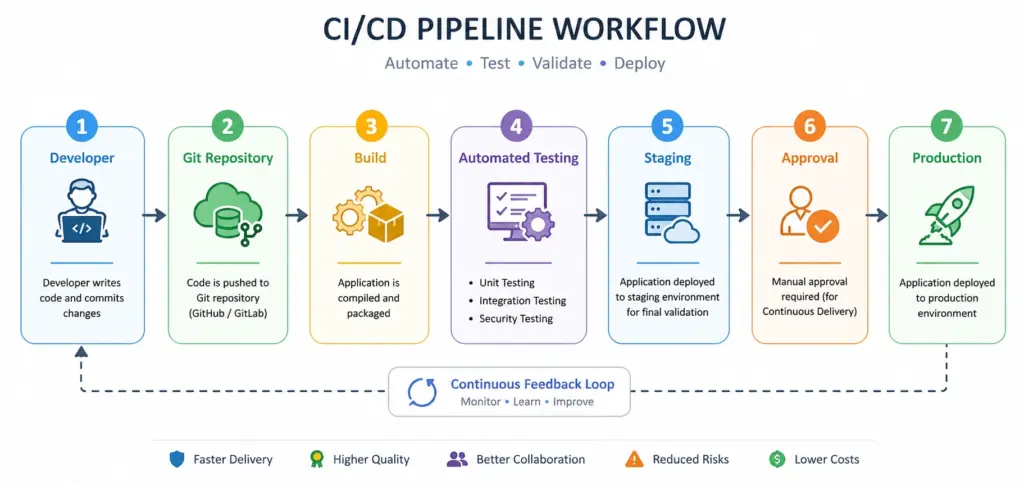
The crucial steps that the CI/CD pipelines follow include the following:
- Step 1: Code Development
Developers write code.
- Step 2: Commit to Repository
Code pushed to Git repositories.
- Step 3: Build Process
The application is compiled and packaged.
- Step 4: Automated Testing
- Unit testing
- Integration testing
- Security testing
- Step 5: Deployment to Staging
Testing environment deployment.
- Step 6: Production Release
Manual approval or automatic deployment.
Web Development courses at your fingertips. Join Entri now
Continuous Integration (CI) Explained
The code automatically triggers the workflow at the time of the initiation of the continuous integration.
- Application-built
- The source code will be managed using GitHub, GitLab, or Git
- Application built in automation
- Automated testing will be done
- Developer feedback will be delivered
Early bug detection is one of the key features of continuous integration. The development cycles will be covered and completed immediately.
The code quality will be updated and improved automatically, and the collaboration will run smoothly. During the continuous integration process, many procedures happen. They are as follows –
- Source Code Management
- Automated Builds
- Automated Testing
- Feedback Loops
Benefits of Continuous Integration
- Early bug detection
- Faster development cycles
- Better code quality
- Improved team collaboration
Continuous Delivery Explained
After the completion of all the tests, the continuous delivery prepares the applications for smooth deployment. The validation will be performed and systematically tested.
The environment will be tested with PreciouS, and the workflows will be approved. The release of the production is faster than before, and this makes the credibility of the software application introduced to the market worth discussing.
With continuous delivery, the release risks are reduced, and the user experience has improved. The software update is paced, and the deployment time has slowly become predictable.
During Continuous Delivery, the following process happens:
- Build Validation
- Environment Testing
- Release Readiness
- Approval Workflows
- Benefits of Continuous Delivery
- Reduced release risks
- Faster updates
- Better user experience
- Predictable deployments
Continuous Deployment Explained
Every successful build to production is automatically triggered with the aid of continuous deployment. The deployment quality and assurance have been boosted with the aid of CD.
Here is the difference between continuous delivery and deployment.
Here is the comparison table to make your understanding even clearer
| Feature | Continuous Delivery | Continuous Deployment |
| Manual Approval | Required | Not Required |
| Production Release | Manual Trigger | Automatic |
| Risk Level | Lower | Higher |
| Deployment Speed | Fast | Very Fast |
CI/CD Pipeline Components
Here are the best CI/CD tools that can help you to improve your application quality
| Components | Examples |
| Source Control | GitHub
GitLab Bitbucket |
| Build Automation | Maven
Gradle npm |
| Deployment Automation | Jenkins
GitHub Actions GitLab CI/CD |
| Testing Frameworks | JUnit
Selenium PyTest |
| Monitoring | Prometheus
Grafana |
Popular CI/CD Tools
Here are the best CI/CD tools that can help you to improve your application quality
| Popular Tools | Benefits and Use Cases |
| Jenkins | Customizable pipeline enterprise
Open source Complex and enterprise level Plugin ecosystem Integration with Gits Complex automation |
| GitHub Actions | Integration of native GitHub
Set up is comparatively easy Workflow purely based on YAML Works on automation Fast automation, testing and deployment |
| GitLab CI/CD | Build an in-platform for DevOps
Pipelines are used as codes Integration of Kubernetes Facilitates container management and deployment |
| CircleCI | Cloud-based platform
Main focus on scalability and speed Integration with Bitbucket is comparatively easy Testing at high speed |
| Azure DevOps | Integration of Microsoft ecosystems
Strong integration Ready for enterprise Deployment of enterprise Cloud Use of the cloud system that is hybrid |
| AWS CodePipeline | AWS cloud deployments
Highly scalable and manageable AWS integration is deep and strong Code building integration Strong code deployment source Use of serverless Applications Smooth automation of infrastructure |
CI/CD Pipeline Example
Here are the steps to follow while you are about to deploy a web application
- Code will be pushed to GitHub by the developer.
- CI/CD pipeline automatically starts the function. The application development process was successful.
- Execution of the automated tests
- Staging of the application
- Approval received
- Deployment of the production is completed
Benefits of CI/CD
Here are the core benefits of CI/CD
- Code quality improvement
- Team collaboration enhancement
- Better user experience
- Quick delivery of software
- Deployment failure reduction
- Low operational costs
Common Challenges in CI/CD
All the innovations come with challenges. The CI/CD development and deployement alonhg withn the management of a pipeline for the smooth launching is not only rewarding but challenging as well. Here is the list of challenges and the corrective measures that can be adopted to make it more effective and quality-oriented. These are the common challenges when CI/CD is integrated into the DevOps workspace.
- Flaky Tests
- Build failures destructively in the workflow
- Coding errors
- complex configuration
- Less pipeline stability
- Pipeline Complexity
- Security Risks
- Delayed feedback due to slow test time
- Inconsistent production environment
- Fluctuating testing environment
- Infrastructure Management
- Tool Integration Issues
- Compliance Risks
- Troubleshooting
- Less visibility
- Less precised monitoring
CI/CD Best Practices
The best practices should be assessed, and further changes should be introduced.
- Every stage witnesses the code testing.
- Codes will be committed frequently
- The pipelines will be kept efficient and quality-oriented. performance can
- Infrastructure as code can be successfully integrated
- Pipeline performance can be monitored strictly
- Regular security checks can be initiated
- Follow version control to derive maximum security
CI/CD is regarded as the most fundamental pillar or cornerstone of DevOps. The collaboration between the development and operation teams is possible with the aid of automated software delivery; this can reduce manual efforts and the risks related to it. The reliability of the release can be achieved with the aid of CI/CD.
- Commit Code Frequently
- Automate Testing
- Keep Pipelines Fast
- Use Infrastructure as Code
- Monitor Pipeline Performance
- Implement Security Checks
- Use Version Control Properly
CI/CD and DevOps
The software development and deployment run smoothly with the aid of DevOps and CI/CD. Both concepts work closely to create a culture that stresses collaboration and teamwork. CI/CD is a set of practices and tools for automation that allows the implementation of DevOps.
The CI/CD focuses more on the automation of the software to make the deployment even faster. DevOps, on the other hand, focuses on the software development cycle.
Communication, teamwork, association, continuous learning and collaboration happen with DevOps, whereas CI/CD focuses on the integration, frequent testing, error checking and release process, ensuring the quality. Quick delivery is the major motive of CI/CD, which is closely aligned with the goal of DevOps.
CI/CD Career Relevance
The modern software industry heavily relies upon CI/CD skills for career balance. To improve the quality, relevance, accuracy and speed of the software applications, automation is the key.
The automation is made possible with the aid of CI/CD. Across the industries, the CI/CD professionals are needed for the smooth working of the organisations. Since organisations across the globe are reaching out for CI/CD experts, they are in high demand.
A strong grip on CI/CD equips you to run the deployment smooth with the aid of automation. Software development pipelines can only be built with the aid of the CI/CD experts.
CI/CD DevOps can gain more experience and expertise only when they have CI/CD skills. You have to upskill yourself in the following:
- Linux
- git
- Jenkins
- Docker
- Kubernetes
- Aws
- Azure
- Gcp
- Cloud Platforms
The CI/CD skills open doors to various career opportunities across the globe. You can work either regionally or globally based on the demands. The professionals with experience, expertise and real-world project exposures can find job opportunities and high salary packages. CI/CD professionals have various career options. This includes,
- Cloud engineer
- Platform engineer, reliability engineer
- Site Reliability Engineeer
- Automation Engineer
- DevOps engineer
- Release Engineer
Conclusion
Modern software development was made easy with the introduction of CI/CD. The faster, safer and more reliable source of the codes can be developed through the automation process. The automation reduces errors and helps in testing, deployment and high-quality delivery.
If you are looking to enhance your software development skills, you can depend on CI/CD skills. The cloud computing, DevOps engineering, and automation sector offers exciting career opportunities to professionals who have a better understanding of CI/CD skills.
| RELATED POSTS | |
| DevOps Engineer Career Path | CI/CD Pipeline Explained: Complete Beginner’s Guide |
| Continuous Integration vs Continuous Delivery: What’s the Difference? | DevOps Engineer Salary in Germany |
Frequently Asked Questions
Define CD/CI?
The CI/CD, or in other words, continuous integration and continuous delivery, comes to aid here. CI/CD is the integration and delivery which makes the overall process automatic.
What is the difference between CI/CD and DevOps?
The CI/CD focuses more on the automation of the software to make the deployment even faster. DevOps, on the other hand, focuses on the software development cycle.
How is CI/CD connected to reliability of the product release?
CI/CD is regarded as the most fundamental pillar or cornerstone of DevOps. The collaboration between the development and operation teams is possible with the aid of automated software delivery; this can reduce manual efforts and the risks related to it. The reliability of the release can be achieved with the aid of CI/CD.
Can CI able to detect bugs early ?
Yes. Early bug detection is one of the key features of continuous integration. The development cycles will be covered and completed immediately.
What is the relevance of CI/CD in modern technological world?
he CI/CD replaced the manual testing, and the time consumption associated with it is reduced. The software release was comparatively slow before the invention of CI/CD.
Back-to-back deployment failures can be reduced if the CI/CD pipeline is introduced to your software development.