Table of Contents
What Is the Career Path at KPMG?
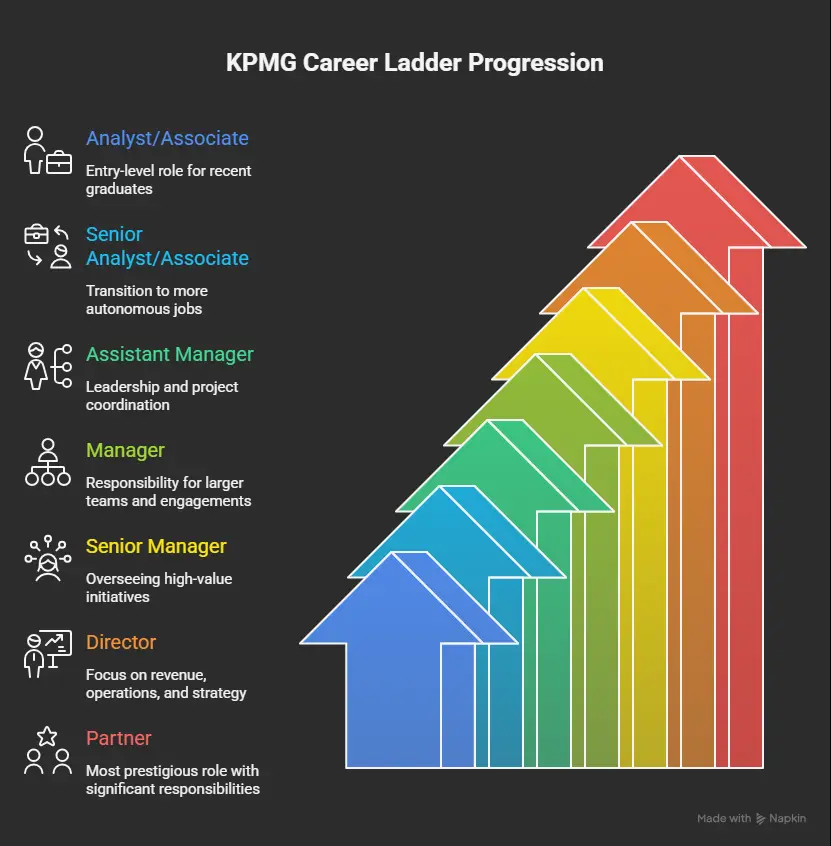
Beginning with entry-level positions such as Analyst or Associate, the career path at KPMG typically proceeds to Senior Associate, Manager, Senior Manager, Director, and Partner positions over the course of one’s career. Employees have the opportunity to work in a wide variety of fields, including auditing, taxation, consultancy, technology, risk advising, and finance, amongst others. KPMG provides its employees with prospects for promotion based on their performance and talents, as well as organised training, worldwide exposure, certifications, and more.
Key Takeaways:
- Big 4 firm offering audit, tax, consultancy, risk, and technology jobs
- Solid professional growth with obvious promotions and global recognition
- High learning exposure with genuine client projects, especially for freshers
- A competitive hiring process including aptitude testing and interviews
- Strong salary growth and exit options into top firms and financial roles
- High-speed workplace where learning and performance matter
Become an Accounting Pro – Learn from Industry Experts!
What Does KPMG Do?
1: Accounting provides information on
KPMG is a member of the “Big 4” accounting firms and is considered to be one of the most successful professional services firms in an international context. It contributes to the enhancement of the financial performance of corporations, governments, startups, and organisations, as well as the management of risks, compliance with rules, and efficient growth.
Principally, KPMG offers its services in the following three broad areas:
1. Audit/Assurance
Company financial records are verified by KPMG for accuracy and legal and accounting compliance. Business transparency and investor and customer trust are improved.
2. Tax Assistance
Tax compliance, risk reduction, and financial planning are the company’s services. Corporate, GST, international, and tax advising services.
3. Consulting/Advisory
Better corporate performance, technological systems, cybersecurity, digital transformation, risk management, and operational efficiency are KPMG’s recommendations.
Placement Oriented PWC Business Accounting Course
PWC Certified Business Accounting Course by Entri App: Master in-demand skills, ace interviews, and secure top-tier jobs.
Join Now!KPMG Career Levels
The career ladder at KPMG is constructed in such a way that it allows people to advance in their careers in a step-by-step manner based on their performance, experience, leadership abilities, and technical expertise.
1. An analyst/ Associate
For recent college graduates and those just starting out, this is the entry-level role.
Duties and obligations:
- Research as well as analysis of data
- Making preparations for reports and presentations
- Being there for senior members of the team
- Mastering the tools and procedures of the company
Who is eligible to apply:
B.Com, BBA, B.Tech, MBA freshmen, CA interns, and grads are all eligible for this position.
2. Senior Analyst or Senior Associate
When employees have gained sufficient experience, they tend to transition into more autonomous jobs.
Aspects of Responsibility:
- Taking care of client responsibilities on one’s own
- Examining the work of junior-level employees
- Resolving issues that arise in business
- Taking care of more straightforward project obligations
Competencies required:
The ability to communicate, think analytically, collaborate with others, and have technical expertise.
3. Assistant Manager
Leadership and project coordination are both required at this level.
Aspects of Responsibility:
- Supervising smaller groups of people
- Dealing with time constraints and responsibilities
- Communication with the client
- Ensuring the quality of the project
When employees reach this level, they begin to build their managerial capacities.
4. Manager
Larger teams and customer engagements are the responsibility of managers.
Duties and obligations:
- Taking charge of many initiatives
- The planning of strategies
- Mentoring for groups
- Management of both the budget and performance
Managers are essential to the success of businesses and the satisfaction of their customers.
5. Senior Manager
Senior Managers are responsible for overseeing high-value initiatives and most important business processes.
Duties and obligations:
- Managing big groups of people
- Cultivating ties with customers
- Development of the business
- The ability to make decisions and to lead
Strong knowledge of the industry and previous experience in leadership are required for this position.
6. Director
The growth of revenue, operations, and strategy are the primary concerns of directors.
Duties and obligations:
- The departments or service lines that are in charge
- Growing the number of customer portfolios
- Contributing to the growth strategies of the company
- Decision-making at the highest levels of the business
Executives and directors collaborate closely with one another.
7. Partner
Partner is one of the most prestigious jobs that can be held at KPMG.
Aspects of Responsibility:
- Dealing with significant customers
- Profitability of the company being driven
- Taking the lead in business expansion
- Taking up the role of executive representative for the company
A significant part of the company’s long-term strategy is played by partners, who frequently receive a portion of the company’s revenues.
Popular Career Tracks at KPMG
KPMG has a variety of professional paths that can be pursued in the areas of finance, consulting, technology, and risk management. The purpose of each track is to provide employees with the opportunity to specialise and advance in their chosen profession by focusing on a particular sort of business expertise.
1. Audit and Assurance
KPMG’s key service lines include this particular service line.
Roles and Duties:
- Examine the income and expenditure statements of the companies.
- Make sure that the accounting requirements are always followed.
- Find any mistakes or potential dangers in the financial reporting.
- Create a sense of trust and openness for your customers.
2. Tax and Regulatory Services
With a primary focus on assisting businesses in managing their tax and legal compliance.
Roles and Duties:
- Tax planning for corporations
- The GST and indirect tax advisory services
- Consulting on international tax matters
- Assistance in complying with regulations
3. Management Consulting
One of the most vibrant and rapidly expanding tracks in the industry.
Roles and Duties:
- Enhance both the performance and strategy of the firm.
- Find solutions to operational problems
- Participate in the digital transition.
- Work on the reorganisation of the company
4. Risk Advisory
Focuses on identifying and removing any potential dangers that may be posed to an organization.
Roles and Duties:
- Audits that are carried out inside
- Risk management by use of cybersecurity
- Investigations into the identification of conformance and the prevention of fraudulent conduct
5. Technology Consulting
An occupation that is in high demand in the present era.
Roles and Duties:
- Solutions for digital transformation should be implemented.
- Utilise cloud computing, artificial intelligence, and data analytics.
- The development of enterprise systems (such as SAP and Oracle)
- Enhance the security and infrastructure of information technology
6. Deal Advisory
Transactions and corporate finance are the primary areas of focus.
Roles and Duties:
- (M&A) stands for mergers and acquisitions.
- Estimation of the value of
- Advisory services for financial reorganisation and investments
7. Data Analytics & Emerging Technologies
A contemporary and rapidly expanding region within KPMG.
Roles and Duties:
- Perform analysis on extensive datasets
- Construct models that are predictive.
- Help in decision-making by utilising various AI techniques
- Build dashboards and gather insights about your company.
How to Start a Career at KPMG
Creating the right educational profile, developing the right skills, and applying through university placements, internships, or online applications are the most crucial steps to a KPMG career. These are the key considerations.
1. Verify your education level
2. Develop essential skills
3. Use proper channels
4. Prepare for selection
5. HR interview
6. Get Certifications (Required, but Optional)
7. Resumes should be solid.
8. Promote Industry Awareness
Placement Oriented PWC Business Accounting Course
PWC Certified Business Accounting Course by Entri App: Master in-demand skills, ace interviews, and secure top-tier jobs.
Join Now!KPMG Salary Structure in India
The wage structure at KPMG India depends on function, experience, and department. Freshers start at moderate salaries as Analysts or Associates, but as they gain experience and advance into managerial and leadership roles, their salaries rise dramatically. In addition to fixed compensation, employees receive bonuses, incentives, health insurance, paid leave, and retirement contributions. Consulting and technology jobs pay more than audit and tax jobs, and promotions drive compensation increases.
| Career Level | Typical Role | Approx. Salary Range (India) |
|---|---|---|
| Entry Level | Analyst / Associate | ₹3 – ₹7 LPA |
| Junior Level | Senior Associate / Consultant | ₹7 – ₹15 LPA |
| Mid Level | Assistant Manager | ₹17 – ₹30 LPA |
| Manager Level | Manager | ₹20 – ₹35 LPA |
| Senior Management | Senior Manager | ₹30 – ₹45+ LPA |
| Leadership | Director | ₹40 – ₹70+ LPA |
| Top Level | Partner | ₹90 LPA – ₹1.5 Cr+ |
What is it Like Working at KPMG?
Fast-paced, structured, and learning-focused describe KPMG’s corporate culture. Early in their careers, individuals are exposed to global clients, commercial issues, and professional skills. The experience might be tiring during busy project seasons.
Learning new things and advancing their careers is the biggest benefit for many KPMG workers. This opportunity offers training, coaching, and complicated projects. Long-term employment in banking, consulting, and business requires communication, teamwork, and analysis abilities.
In high-demand times, auditing, tax, and consultancy jobs are difficult. Demands from clients, tough deadlines, and long hours are frequent under high demand. A medium work-life balance depends on the team and project.
In general, working at KPMG is frequently regarded as a fantastic opportunity to create a career, particularly for recent graduates who are looking to gain significant experience. However, in order to be successful, it is necessary to be flexible, to manage one’s time effectively, and to be able to deal with pressure during times of high demand.
Become an Accounting Pro – Learn from Industry Experts!
KPMG vs Deloitte vs EY vs PwC
Big Four firms are the four multinational corporations that are considered to be the most important on a global scale. The term “Big Four firms” is used in the business sector to refer to these four corporations. Organisations like KPMG, Deloitte, Ernst & Young, and PwC are examples of businesses that fall under this category. These institutions offer employment possibilities in a variety of sectors, including auditing, tax, consulting, risk management, and advisory services, among others. Despite the fact that all four of them offer high earnings, career advancement opportunities, and exposure to the world, there are variances in the work cultures, strengths, and pressures that are associated with each of them. Despite the fact that each of the four is constantly exposed to the outside world. When it comes to each of the four, there is exposure on a global basis.
| Factor | KPMG | Deloitte | EY | PwC |
|---|---|---|---|---|
| Power in the Core | Auditing and Risk Management | Consulting & Technology | Security and the Development of Individuals | Audit and Tax Services |
| Work Culture | Organised and well-balanced | Vibrant and cutthroat competition | Adaptable and friendly to individuals | Instructional and formal in nature |
| The Power of Consulting | Moderate | Strong and powerful (leader) | Powerful | Powerful |
| Strength of the Audit | Strong | Strong | Extremely capable | Extremely capable |
| The Focus on Technology | Developing | Extremely advanced | Powerful | Powerful |
| Work Pressure | Moderate | High | Moderate | Moderate |
| Curve of Learning | Quite high | Extremely high | Quite high | Quite high |
| Work-Life Balance | Moderate | Challenging | Improved equilibrium | Well-aligned |
Exit Opportunities and Long-Term Benefits
Due to the fact that it provides extensive exposure to finance, consulting, auditing, risk management, and client management, experience gained at KPMG is highly regarded in the labour market environment. KPMG serves as a stepping stone for many professionals, allowing them to transition into higher-paying and more specialised employment in other industries.
Opportunities for Exit
The following are some of the job options available to professionals who have worked at KPMG:
Additional Consulting Firms and the Big Four
- PwC, Deloitte, and EY
- Consultants specialising on strategy
- Small, specialised advice firms
The Industry of Investment and Finance
- The banking of investments
- Investments in private equity and venture capital
- The duties of corporate finance
- Investigating equity
Roles within the Corporate Industry
- The Manager or Controller of Finances
- Administration of the internal audit
- Administration of risk and compliance
- Analyst of either business or strategy
The roles that include technology and data
- Analyst of business intelligence programs
- Data analyst and data scientist responsibilities in information technology risk and cybersecurity
- Teams working on digital transformation
New, rapidly expanding businesses and startups
- Positions of leadership in finance
- Positions in both operations and strategy
- Strategic positions in growth and analytics
Long-Term Benefits
- Strong Brand Value on a Global Scale
- Increased Rates of Professional Advancement
- Skills that are highly transferable
- Exposure to the International Community
- Solid and Reliable Professional Network
Things Candidates Should Know Before Joining
- Rapid work with tight deadlines
- The freshman learning curve is steep
- Excellent communication required.
- Increased workload during peak seasons
- Growth is performance-based
- Continuous learning is expected.
- Work-life balance differs by team.
- Responsibility and early client exposure
- Some jobs demand travel.
KPMG Recruitment Process at KPMG
- Apply online via campus drive, referrals, or careers portal.
- Academic and skill-based resume screening
- Reasoning, verbal, and technical online aptitude/assessment test
- Group discussion if held
- Domain knowledge + problem-solving technical interview
- Personality, goals, communication HR interview
- Final choice and offer letter
- Orientation and training
Become an Accounting Pro – Learn from Industry Experts!
Conclusion
KPMG offers an opportunity to grow professionally, study systematically and work throughout the worldwide market in the areas of audits, tax, consulting and advisory services. The employees get training, consumer contact experience and a career track.
The work is difficult, with deadlines and performance expectations, and helps develop skills that are valuable to companies. KPMG is a strong fit for permanent careers in finance, consulting and corporate leadership.
Placement Oriented PWC Business Accounting Course
PWC Certified Business Accounting Course by Entri App: Master in-demand skills, ace interviews, and secure top-tier jobs.
Join Now!Frequently Asked Questions
What qualifications are needed to join KPMG?
B.Com, BBA, MBA, B.Tech, CA, ACCA, CFA, and related degrees are commonly accepted.
Does KPMG offer work-from-home?
Yes, many roles follow a hybrid model depending on team and project requirements.
Is KPMG a stressful company?
It can be during peak project periods, but it also provides strong learning and structured support.
Does KPMG provide international opportunities?
Yes, employees may get global exposure and international assignments depending on performance and role.
Does KPMG hire without experience?
Yes, freshers are regularly hired through campus placements and entry-level programs.
Is coding required to work at KPMG?
Only for technology and data-related roles; audit and tax roles do not require coding.
Can I switch departments in KPMG?
Yes, internal transfers are possible depending on skills and business needs.
Is KPMG suitable for non-commerce students?
Yes, especially in consulting, technology, and data analytics roles.