Table of Contents
Systems Validation Engineers work to make sure products they design, make, and sell work as expected and are safe to use before they ever hit the stores – unlike some products that do not.
They design test plans, implement them, find bugs and work with their design team to get them all fixed so they can ship without a hitch. They must show that the product meets its requirements and can function properly under real-world conditions.
Key Takeaways
- One of the key takeaways from working in system validation is catching problems before a product is ever launched – a vital service especially in industries where safety really matters.
- The job requires a mix of hands on testing skills, and the ability to produce clear, concise reports that tell the story of what you found.
- A lot of people seem to get the terms mixed up – but system validation is NOT just testing. It’s much more than that: its checking to see if the entire system meets the original requirements.
Kickstart your embedded systems career and turn your tech passion into high-demand skills!
Just How Important is System Validation in Modern Industries?

Let’s face it – products are just mind-blowingly complex these days. A modern car has on the order of 100 million lines of code in it. Medical devices are only as good as the first time they work – you can’t have them failing on people. And if an airplane’s flight controls fail – you can guess what the outcome will be.
But system validation acts as the ultimate safeguard. It catches mistakes that would otherwise slip through the net and make it to customers. Companies that try to cut corners on validation end up with recalls, legal battles & customers who are not happy at all. We are literally talking about a situation where a computer bug in a pacemaker can be fatal.
Master Embedded Systems Programming!
Launch your tech career with our Embedded Systems Course, designed for hands-on learning and industry readiness.
Know MoreUnderstanding System Validation
System validation simply checks to see if a product does as the developers originally wanted. In other words, does this product do as it says on the tin? These tests occur at the end of the development process when the product is complete and all pieces are in place. The System Validation Engineer runs the tests to make sure everything works together.
A lot of people confuse verification with validation. Verification just makes sure the product meets the requirements as it was built. Validation makes sure the product does what it was intended to do. Let’s take a car for example. Verification ensures the brake light comes on when the driver presses the brake pedal.
Validation makes sure that brake light actually prevents rear end collisions in heavy rain. Validation is about real-world use. In short – it’s about making sure the product does what it says it does.
Who is a System Validation Engineer?
A System Validation Engineer is someone who tests complete systems to find failures before customers ever see them. This person sits right between the design team and the quality team. They understand how hardware works. They also understand software testing. They write test scripts. They build test benches. They run automated tests overnight while everyone else sleeps. And they write detailed reports about every single bug they discover.
The word “engineer” means something here. This is not a manual testing job. A validation engineer designs the testing process itself. They decide what to test, how to test it, and what equipment to use. They analyze results. They help development teams understand what broke and why. Their recommendations directly change the final product.
Roles and Responsibilities of a System Validation Engineer
A System Validation Engineer handles a wide range of daily tasks. Some happen at a desk. Others happen in a lab surrounded by real hardware.
Role 1: Create Validation Plans
The engineer takes a close look at the system requirements. They figure out what needs testing. Next, they start working on a validation plan – which is a list of every test case.
It outlines what equipment is needed, how long each test is going to take, and what exactly constitutes a pass or a fail. Having a solid plan in place really can save you weeks of fiddling around later down the line.
Role 2: Set Up the Test Environment
Some tests can’t be run on the final product alone. The engineer will build test rigs with power supplies, oscilloscopes, signal generators, and data loggers all neatly set up for them. They also knock up simulated environments.
So for a car sensor, they might try and replicate rain, fog or bright sunlight for example. For a network switch, they’ll maybe simulate thousands of devices all barking away at the same time.
Role 3: Scripting Up Automated Tests
Manual testing just doesn’t cut the mustard anymore, especially when you’re dealing with such complex systems. A validation engineer will write some scripts in Python, C or maybe even a specialized test language.
Then these scripts can run hundreds of tests automatically, swimming through the results and flagging up any failures the moment something goes wrong. And of course, that means you can get the overnight and weekend test runs done without needing to be tied to the bench.
Role 4: Going Hands On & Finding The Root Cause
This is the bit where the engineer puts their hands on the wheel. They run the test plan and just generally keep an eye out for anything unexpected. When something fails, they document exactly what happened.
A good bug report – you know, the ones that are actually useful – will include step-by-step instructions on how to replicate the problem, logs, screenshots and even video if necessary. That way, the devs have got all the information they need to get stuck in and sort the issue out.
Role 5: Wrangling with the Design Teams
The validation engineer will sit down with the hardware and software designers and explain in some detail what failed and how they managed to recreate the problem. They’ll also help prioritise the fixes.
Some bugs are just little niggles, but others can block the whole product launch in its tracks. The validation engineer is the one providing the data to help make these decisions.
Role 6: Writing Validation Reports
At the end of each test cycle they produce a report. This report will break down what passed and what failed and also throw in a few metrics like test coverage and failure rates for good measure. Management use these to figure out whether the product is actually ready for shipping or not.
Now it’s the validation engineer’s job to write up these reports in a clear and honest manner. Because hiding the problems is just going to make them a lot worse later on.
Role 7: Looking After the Test Gear
The test equipment all needs regular calibration and maintenance. And it’s the validation engineer’s job to keep the oscilloscopes, multimeters and power supplies all in good working order.
They’ll keep track of the calibration dates and send the equipment off for servicing when they need to. Because, let’s face it, rubbish test gear is just going to give you rubbish results.
Role 8: Keeping the Processes in Check
After every product launch the team will sit down and review what went wrong. The validation engineer will throw in their two cents by saying ‘would be good to have a new tool’ or ‘maybe the test plan was a bit weak in this area’.
You get the idea. But all of this is about finding a way to do things faster and better next time around.
Master Embedded Systems Programming!
Launch your tech career with our Embedded Systems Course, designed for hands-on learning and industry readiness.
Know MoreKey Skills Required
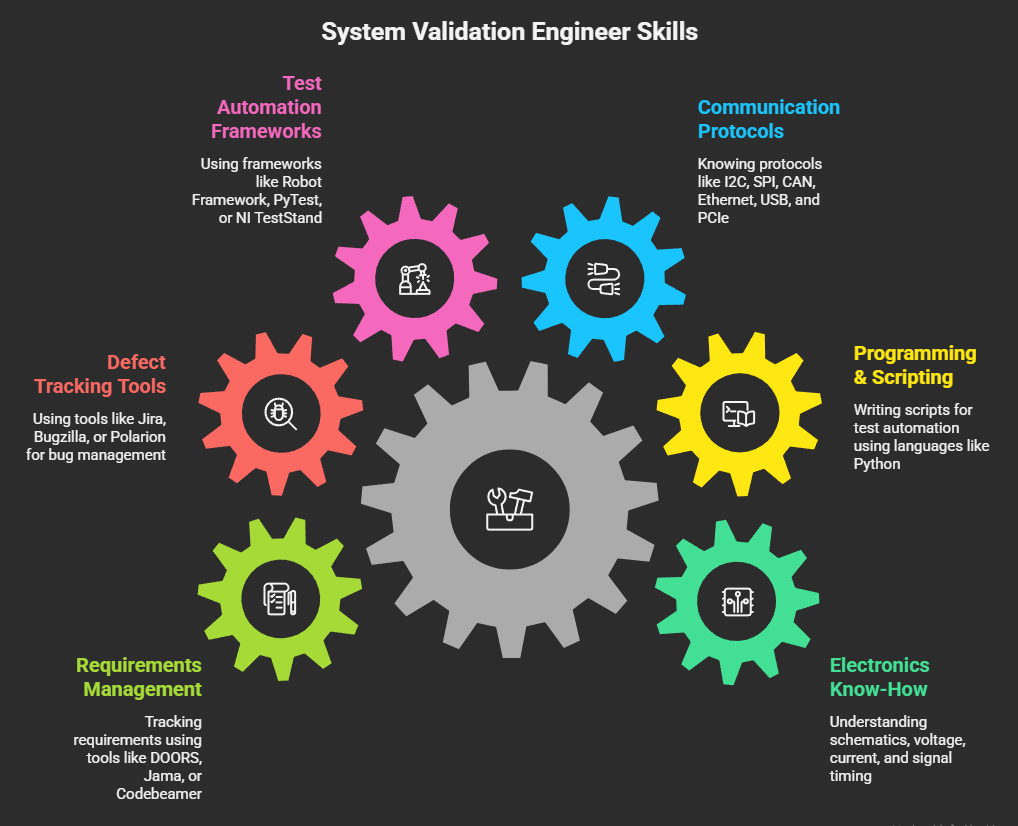
A System Validation Engineer needs a balance of both breadth and depth. Its unlikely that any one person is familiar with every single skill listed but nearly every job description mentions at least a few of the following.
Technical Skill 1: Electronics Know-How
You’re going to need to know how to read schematics and understand the basics of voltage, current and signal timing. Knowing what a pull-up resistor is and being able to use an oscilloscope to measure a clock signal is also a good starting point. Without a solid grounding in electronics, debugging hardware problems is basically impossible.
Technical Skill 2: Programming & Scripting
Python is probably the most commonly used language for validation work – its easy to pick up and has all the libraries you need for test automation. Some roles will require C for testing embedded systems, while others use LabVIEW or MATLAB.
You don’t need to be a full on software engineer to get by, but you will need to be able to write scripts that run without a hitch every single time.
Technical Skill 3: Communication protocols
Modern systems talk to each other all the time, so you need to know your protocols – I2C, SPI, CAN, Ethernet, USB, and PCIe to name a few. These all have timing requirements and error conditions, and as a validation engineer you’ll be writing tests that push these protocols to the limit.
Technical Skill 4: Getting Familiar with Test Automation Frameworks
Writing raw scripts isn’t enough – you need frameworks like Robot Framework, PyTest or NI TestStand to organise your test cases, generate reports and handle the setup and cleanup. Once you’ve got the hang of one, the next one is much easier to learn.
Technical Skill 5: Defect Tracking Tool Knowledge
When bugs come in, you need somewhere to put them – tools like Jira, Bugzilla or Polarion are all used for storing issues. As a validation engineer, you’ll be entering bugs with clear steps, tracking fixes and verifying that the fix actually worked. This verification bit is really important, because if you rush it or do it badly, bugs can come back.
Technical Skill 6: Requirements Management
Validation is all about proving that requirements are being met – so you need tools like DOORS, Jama or Codebeamer to track requirements. Each requirement should link to one or more test cases, and when a test passes, you’re validating that requirement.
This sort of traceability is pretty much essential if you’re working in a regulated industry like medical devices.
Soft Skills

Skills to Succeed as a Validation Engineer – More Than Just Technical Know-How
While having technical skills is a must, it’s not enough on its own to make a great validation engineer. The truth is soft skills are just as important for achieving success in the role.
Paying Attention to Detail
Small differences can have a huge impact – after all a voltage that’s just 0.1V too high can lead to all sorts of intermittent failures and a timing mismatch of 1 microsecond can bring the whole system crashing down. A good validation engineer is that person who spots things that get missed by others.
Staying Patient and Persistent
There’s a good chance you’ll be running the same test for days or even weeks, only to finally get a failure on the 101st try. A good validation engineer doesn’t get discouraged, they just keep digging and trying to figure out what’s going on.
Communicating Effectively
Writing clear and concise bug reports, emails to developers, and presentations to management is key. If your communication is weak, you risk misunderstandings and wasted time – which is the last thing you need.
Thinking Critically
When you encounter a failure, you’ve got to start thinking about what could be causing it. Is it something to do with the hardware or software? Or maybe the test equipment or the test procedure itself. A good validation engineer is always weighing up the possibilities.
Working as a Team
Validation engineers work with a whole range of people – from hardware designers to project managers, and it’s not something you can do on your own. You have to share information freely, ask for help when you need it, and be willing to lend a hand to others when they’re stuck.
Tools Used by System Validation Engineers: The Right Tools for the Job
Having the right tools can make a huge difference in validation, making the whole process faster and more reliable. Here are some common tools across different industries.
Hardware Tools
- An oscilloscope is super useful for measuring electrical signals over time
- A logic analyzer is handy for capturing many digital signals at once
- A multimeter is a must-have for measuring voltage, current and resistance
- A signal generator is great for creating test signals like sine waves or square waves
- A power supply is essential for providing clean power to the device you’re testing
Software Tools
- Python with PyVISA or PySerial is great for controlling instruments and logging data
- Jenkins or GitLab CI is perfect for running automated tests every time your code changes
- Docker is a lifesaver when it comes to creating consistent test environments
- Wireshark is super useful for capturing and analyzing network traffic
- CANalyzer is great for testing automotive CAN bus systems
Documentation Tools
- Jira is the perfect tool for tracking bugs and test tasks
- Confluence is great for storing test plans and validation reports
- Jama or DOORS is handy for managing requirements and traceability
- Git is essential for versions test scripts and configuration files
System Validation Engineer vs Test Engineer
These two job titles have long been a source of endless confusion – and they shouldn’t be. The two aren’t interchangeable – they’re as distinct as night and day. Here’s the lowdown on what sets them apart.
Scope of Work
A Test Engineer tends to focus on just one tiny part of the product – say, only the power supply or just the USB port or just the software API. Its all pretty niche. Meanwhile a System Validation Engineer looks at the whole product as an entire system.
They care about how all the different bits and pieces come together – how the power supply behaves when the USB port is active and the software is being maxed out, for instance.
When Testing Happens
Test engineers usually get to work early on in the development process. They’re out there in the weeds, finding bugs before they become bigger issues. Unit tests and integration tests – that’s what they typically get up to. System validation, on the other hand, happens later on once the product is all complete and ready to ship.
What is Being Proved
What a test engineer is trying to prove is that a component works as advertised. In other words, they’re proving that an individual part of the product does what it’s supposed to do.
A validation engineer, by contrast, is trying to prove that the whole system actually solves the customer’s problem as they experience it. The difference between the two is subtle, but it’s super important to get right.
Failure Consequences
Let’s say a test engineer misses a bug. No big deal – it gets caught later on down the line, possibly when the product is already in the customers hands. But if a validation engineer misses a bug, the consequences are way more severe – we’re talking returns, bad reviews, warranty claims, possible lawsuits and who knows what else.
Mindset
Test engineers are all about trying to break individual pieces of the product. They think like a component, not the whole system. A validation engineer, on the other hand, is looking at the big picture – they think like a customer who is using the product in some weird and wonderful way.
Example
Imagine a smart thermostat. A test engineer might just run some tests to make sure the temperature sensor gives the right reading at 20°C, 25°C and 30°C. Meanwhile a validation engineer would actually install the thermostat in a test house, set the schedule to save some energy at night and then check if the house is actually at a comfortable temperature by the morning.
See the difference? The validation engineer is thinking about the complete user experience – not just one little component.
Why Both Roles Exist
The fact is, companies need both test engineers and validation engineers. Test engineers are super good at sniffing out bugs that are relatively cheap to fix.
Validation engineers however are great at catching the ones that hide out in complete systems until after launch. You cannot cut out validation and get away with it – the cost of fixing bugs later on is way higher.
Career Path & Growth Opportunities

Don’t get it twisted – being a system validation engineer is not a dead end job. In fact, it can actually open a lot of doors for you.
Entry Level
New graduates who are just starting out tend to start as Associate Validation Engineers. Theyre basically just running existing tests, documenting the results and learning the ropes. After a year or two theyll get enough experience to take ownership of smaller subsystems.
Mid Level
With three to five years under their belt, engineers become full blown Validation Engineers. They write validation plans from scratch, design test environments, mentor junior engineers and even lead test execution for one product.
Senior Level
And after five to eight years, Senior Validation Engineers are leading the charge – looking after validation for entire product lines, deciding what to test and how to test it, reviewing other engineers work and even talking to customers to get a better handle on what they want. They also get to hire and train the next generation of engineers.
Staff or Principal Level
The Heavy Hitters – Top 10 Year Veterans in System Validation
We’ve got the crème de la crème here – individuals with over a decade of experience in the field. These are the people you can count on to craft validation strategies that can be applied across a range of products. They’re always on the lookout for new tools and methods to stay ahead of the curve.
And when it comes to sharing their knowledge, they present at industry conferences and write whitepapers that are the real deal. And let’s not forget, when those tough problems come up, they’re the ones everyone turns to for guidance.
The Road to the Top – A Manager’s Path
Some engineers find their way into management roles. As a Validation Manager, you’re leading a team of anywhere from five to twenty engineers. Your main tasks include delegating work, tracking progress, and reporting to the big cheese.
You’ll also be responsible for handling the budget and headcount. It’s not as hands-on as being on the front lines, but you still need to be on top of the technical side of things.
Other Careers to Consider (once you’ve got some Validation Under Your Belt)
- Systems Engineer: You can use your validation expertise to write requirements that are actually useful.
- Quality Manager: You can use testing data to help improve product quality processes.
- Technical Sales: With your deep understanding of the product, you can sell to the tough technical buyers.
- Field Applications Engineer: You get to go out on the road, help customers integrate products, and debug issues in person.
The Money (it’s not too shabby)
Salaries vary depending on the industry and where you are in the US. But here’s what you can expect.
An entry level validation engineer will take home around $70,000 to $90,000. Mid level will get you $90,000 to $120,000.
Senior validation engineers? That can be $120,000 to $160,000.
And if you’re a principal engineer? You can be looking at $160,000 to $200,000 or more.
Just keep in mind that these numbers can be higher in aerospace and medical devices than in consumer electronics.
Some Certifications to Consider (that can help with the next step up the ladder)
- Certified Software Test Engineer (CSTE) – not necessary, but can’t hurt
- ISTQB Advanced Level Test Manager
- ISO 26262 Functional Safety Certification – a must for some roles
- Certified Reliability Engineer (CRE) – another one to add to your belt
Kickstart your embedded systems career and turn your tech passion into high-demand skills!
The Bottom Line
System validation is the last safety check before a complex product hits the market. The System Validation Engineer is the one who owns this responsibility. They design the tests, build the test environments, find those hard to spot bugs, and write the reports that decide whether a product gets shipped out or goes back to the drawing board.
It’s a tough job that requires a rare combination of skills – hardware knowledge, software scripting know-how, and the ability to document your work. And if you think you’ve got what it takes, you’re in for a career that’ll pay off in the end.
Senior validation engineers earn respect, and of course, a pretty penny. Every major industry – automotive, medical, aerospace, and consumer electronics – is competing for top talent in this area.
Master Embedded Systems Programming!
Launch your tech career with our Embedded Systems Course, designed for hands-on learning and industry readiness.
Know MoreFrequently Asked Questions
What does a System Validation Engineer do every day?
A System Validation Engineer writes test plans, runs automated and manual tests, finds bugs, documents failures, and works with designers to fix problems. They spend time in a lab with hardware and at a computer writing scripts.
Do I need a degree to become a System Validation Engineer?
Most employers require a bachelor’s degree in electrical engineering, computer engineering, or a related field. Some companies accept an associate degree plus relevant work experience. Certifications can help but do not replace a degree.
What programming languages should a System Validation Engineer learn?
Python is the most important language for this role. Learn C for embedded systems. Some jobs require LabVIEW or MATLAB. Start with Python because it works for most test automation tasks.
How much money does a System Validation Engineer make?
Entry level salaries range from $70,000 to $90,000 per year in the United States. Mid level engineers earn $90,000 to $120,000. Senior engineers make $120,000 to $160,000. Principal level can exceed $200,000.
Is system validation the same as quality assurance?
No. Quality assurance focuses on processes and preventing defects. System validation focuses on testing the finished product to find defects that already exist. QA sets the rules. Validation checks the result.
What industries hire System Validation Engineers?
Automotive, aerospace, medical devices, consumer electronics, semiconductor, telecommunications, and industrial automation all hire these engineers. Any company that builds complex electronic products needs validation.
Can a Test Engineer become a System Validation Engineer?
Yes. The transition is common. Learn system level thinking beyond component testing. Practice writing test plans for complete products. Understand requirements traceability. Many validation engineers started as test engineers.
What is the hardest part of being a System Validation Engineer?
Finding intermittent bugs that only appear sometimes. These bugs take days or weeks to reproduce. They require patience and creative thinking. Explaining complex technical failures to non technical managers is also difficult.
Does a System Validation Engineer need to know soldering?
Basic soldering skills help but are not always required. Being able to solder a wire to a test point or swap a component on a board saves time. Large companies have technicians for complex soldering work.