Table of Contents
Indian CA students can earn major ACCA exemptions based on qualification. Applied Knowledge papers like Business and Technology, Management Accounting, and Financial Accounting are usually excluded for CA Inter students. Most Applied Knowledge and Applied Skills examinations are exempt for CA Final students, leaving Strategic Professional tests. CAs receive the most exemptions, sometimes 9–10 papers, allowing them to directly take the last ACCA level and Ethics module. Exemptions lower exam burden, save time, and assist CA professionals in shifting faster to global accounting.
Become an Accounting Pro – Learn from Industry Experts!
Key Takeaways:
- ACCA exempts CA Inter, CA Final, and CA-qualified students for syllabus overlap.
- Qualified CAs earn maximum exemptions, whereas CA Inter students get partial exemptions.
- Save time, lessen exam burden, and study less using exemptions.
- ACCA after CA boosts global professional prospects and recognition.
- ACCA emphasises IFRS and worldwide finance, unlike CA India.
- Students must seek and pay for ACCA exemptions.
- CAs typically simply need Strategic Professional papers.
- ACCA helps Big 4 organisations, MNCs, and international financial professions.
Why ACCA Exemptions Matter for Indian CA Students
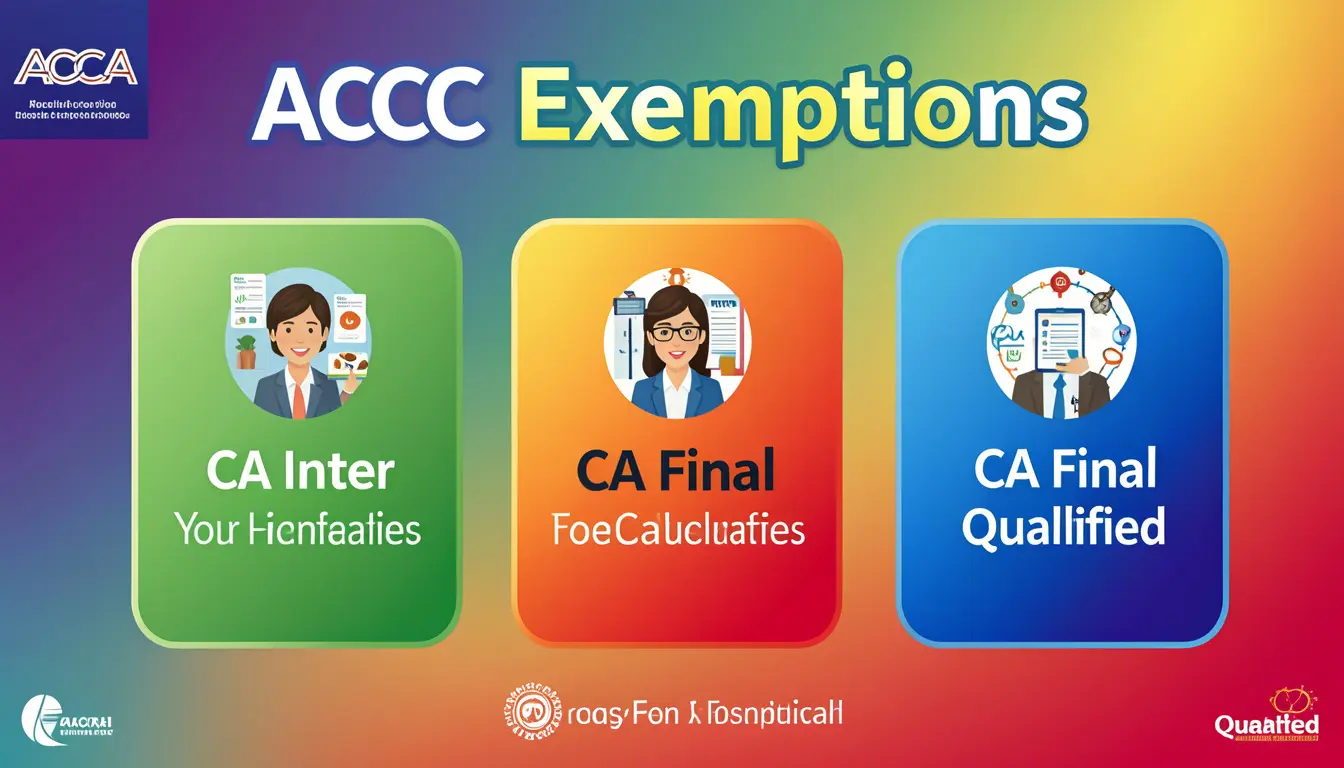
ACCA exemptions recognise CA course topics and prevent students from retaking identical tests. This streamlines and concentrates ACCA training on advanced global accounting issues.
Reasons why exemptions matter:
- Reduces ACCA exams, saving time.
- Reduces exam stress by studying fewer subjects.
- Reduces exam and registration fees
- Avoids repeating CA topics like accounting and auditing
- Accelerates worldwide financial and accounting careers
- Advanced ACCA papers like Strategic Professional are prioritised.
- Enhances worldwide career preparation with IFRS and global standards
Understanding How ACCA Exemptions Work
1: Accounting provides information on
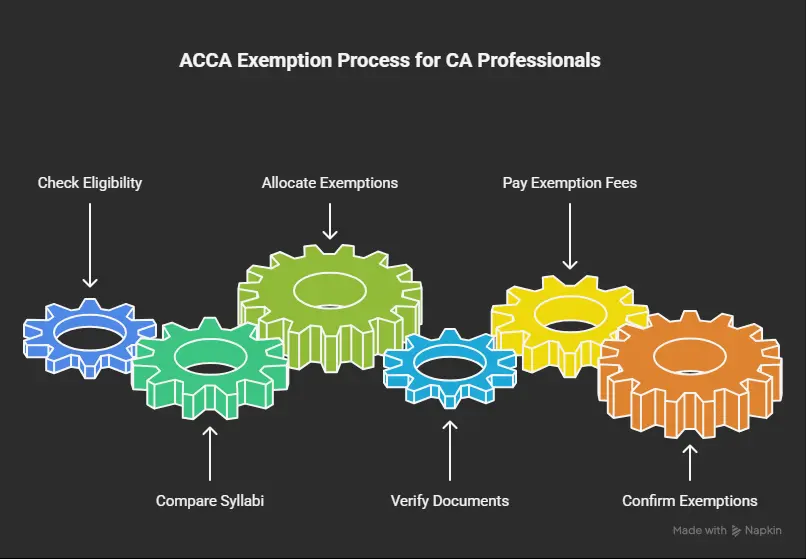
CA Inter, CA Final, or CA membership qualifies you for ACCA exemptions. Many CA subjects overlap with ACCA papers, the ACCA evaluates your academic records and waives exams you’ve already taken.
How ACCA exemptions work:
- ACCA checks your eligibility (CA Inter, CA Final, or CA qualifying).
- Comparing your CA syllabus to ACCA papers
- Allocation of exemption: ACCA exams have matching subject exemptions.
- ACCA approves exemptions following document verification.
- You must pay for each exempted paper.
- Final confirmation: ACCA student accounts show exemptions.
Placement Oriented PWC Business Accounting Course
PWC Certified Business Accounting Course by Entri App: Master in-demand skills, ace interviews, and secure top-tier jobs.
Join Now!ACCA Exemptions for CA Inter Students
CA Inter students gain limited yet valuable ACCA exemptions because they have taken core accounting and finance courses in ICAI.
CA Inter can get ACCA exemptions:
- Business and Technology
- Management Accounting,
- Financial Accounting
Important info:
- Exemptions are based on ICAI syllabus overlap with ACCA Applied Knowledge.
- Students must finish most Applied Skills and Strategic Professional papers.
- Officially apply for exemptions through ACCA with documentation and costs.
- Updated ACCA rules may change the exemption count.
ACCA Exemptions for CA Final Students
Students who are enrolled in the CA Final program are eligible for significant exemptions from the ACCA because their curriculum closely aligns with the majority of the ACCA’s Applied Knowledge and Applied Skills exams. They will be able to proceed directly to the advanced level of ACCA as a result of this.
Exemptions from the ACCA that are typical for CA Final students:
- Applied Knowledge papers (BT, MA, and FA) in their entirety
Almost all of the Applied Skills articles, including:
- Administration of Performance Management (PM)
- Corporate and Business Law (LW)
- Accounting and Auditing (AA)
- Financial Management (FM)
- Taxation (TX)
- Financial Reporting (FR) and
- Financial Management (FM)
ACCA Exemptions for CA Qualified Members
The highest number of exemptions from the ACCA are granted to CA Qualified members, also known as ICAI Chartered Accountants. This is due to the fact that their professional training encompasses a wide variety of ACCA curriculum topics.
Exemptions from the ACCA that are typical for CA Qualified members:
- All of the publications on Applied Knowledge
Papers on many aspects of applied skills, including: - BT stands for business and technology
- MA stands for management accounting.
- FA stands for financial accounting.
- LW stands for corporate and business law.
- PM stands for performance management,
- TX stands for taxation
- FR stands for financial reporting,
- AA is for audit and assurance, and
- FM stands for financial management
Placement Oriented PWC Business Accounting Course
PWC Certified Business Accounting Course by Entri App: Master in-demand skills, ace interviews, and secure top-tier jobs.
Join Now!CA vs. ACCA—Key Differences Students Should Know
The Chartered Accountant (CA) and the Chartered Certified Accountant (ACCA) are both highly regarded accounting qualifications; nevertheless, they differ in terms of their emphasis, recognition, curriculum structure, and career options. CA is mainly focused on India, whereas ACCA is geared for candidates interested in careers in worldwide finance and accounting.
| Basis | CA (India) | ACCA |
|---|---|---|
| Full Form | Chartered Accountant | Association of Chartered Certified Accountants |
| Recognized By | ICAI (India) | ACCA Global Body (UK) |
| Acknowledgement | Primarily centred on India | Acknowledged in more than 180 countries |
| The Primary Emphasis | Taxation, auditing, and legal systems in India | IFRS, international accounting standards, and financial matters |
| Structure of the Course | Levels that are fixed and have a tight progression | The exam structure is flexible and adaptable. |
| The level of difficulty | It is extremely competitive, and the pass rate is lower. | A student-friendly environment that is somewhat adaptable |
| Exam Flexibility | Limited exam flexibility | Multiple exam sessions yearly |
| Training in the Real World | A requirement for articleship | Practical Experience Requirement (PER) |
| Global Opportunities | Powerful in India | Strong potential for a career in international settings |
| Suitable For | Careers in the Indian corporate and taxation sectors | Professions in international accounting and finance |
| The length of time | About four to five years | In most cases, two to three years, depending on exemptions |
| Standardisation of Accounting | Indian Accounting Standards (Ind AS) | International Financial Reporting Standards (IFRS) |
| Prospects for a job | firms that provide audits, taxation, and Indian corporations | International finance responsibilities and multinational corporations (MNCs) |
| Pay Scale and Range | Powerful in India | High potential for earnings on a worldwide scale- |
Benefits of Doing ACCA After CA
When individuals pursue ACCA after obtaining their CA certification, they are able to broaden their job options on a global scale and acquire experience in international accounting standards. The completion of ACCA is made more expedient and effective as a result of the many exemptions that are granted to CAs.
Most important advantages of completing ACCA after CA:
- International recognition in more than 180 countries
- Career options available in multinational corporations and the Big Four firms
- Knowledge of International Financial Reporting Standards (IFRS) and other global financial standards
- A quicker completion of the ACCA as a result of maximum exemptions
- Opportunity for employment in the Middle East, the United Kingdom, Europe, and Singapore
- Greater potential for financial gain in overseas positions
- More impressive professional profile, with dual qualifications on display
- Expanded opportunities for career advancement across business sectors and nations
- Access to global financial markets and positions of leadership
Become an Accounting Pro – Learn from Industry Experts!
Important Things to Know Before Claiming ACCA Exemptions
A student should have a thorough understanding of the qualifying requirements, fees, and the long-term implications on their study and career ambitions before submitting an application for an ACCA exemption. In order to minimise confusion throughout the ACCA registration procedure, proper planning is absolutely necessary.
What you should be aware of is that:
- There is no automatic exemption; you are required to submit an official application through ACCA.
- It is necessary to provide supporting documentation, such as mark sheets and verification of ICAI membership requirements.
- Exemption fees are required to be paid for every document that is exempt.
- How many exemptions you are eligible for is determined by your degree of qualification.
- Because of changes to the syllabus, ACCA exemption policies can be subject to revision.
- After approval, the submission of exempted papers cannot be attempted again.
- It’s possible that with too many exemptions, exposure to some international concepts may be reduced.
- There are still several ACCA papers and ethics module assignments that you need to finish off.
Step-by-Step Process to Apply for ACCA Exemptions
Applying for ACCA exemptions is a simple online process, but students must submit accurate academic documents and complete all verification steps properly.
- Use the ACCA website to register.
- Finish filling out the application form.
- Bring in the necessary documentation.
- Your qualifications are evaluated by ACCA.
- Obtain confirmation of your exemption.
- Make payments for exemption fees.
- Examine the remaining ACCA tests.
Who Should Choose ACCA After CA?
Accountants and students who are interested in pursuing a career in accounting, finance, auditing, or consulting on a global scale will find the ACCA following CA is an excellent choice. It is very helpful for individuals who are interested in working with multinational corporations or in other countries.
ACCA is most appropriate for:
- CA professionals looking for opportunity to advance their careers internationally
- Students who intend to find employment in other countries, such as the United Kingdom, the United Arab Emirates, Canada, or Singapore
- Candidates that are interested in international accounting and an interest in IFRS
- Industry experts who are focusing on the Big Four firms and global corporations
- Experts in finance who are committed to achieving leadership and strategic positions
- Individuals that are interested in obtaining multiple certifications in order to strengthen their professional advancement
- Certified Public Accountants that are interested in increasing their prospects for worldwide salary
Conclusion
CA Inter students, CA Final students, and qualified CAs can achieve a globally recognised accounting certificate through the use of ACCA exemptions, which offer a pathway that is both more expedient and more effective. Exemptions save students time, effort, and money on their studies by minimising the number of tests they have to take. This allows students to concentrate on more sophisticated subjects related to international finance. It is extremely useful for people who are looking for global job prospects, IFRS expertise, and roles in international corporations or Big 4 firms to pursue ACCA after obtaining their CA certification. College of Accountants (CA) students in India have the opportunity to enhance their professional reputation and broaden their job options across the globe by utilising ACCA, provided that they have the appropriate planning and understanding of the exemption procedure.
Placement Oriented PWC Business Accounting Course
PWC Certified Business Accounting Course by Entri App: Master in-demand skills, ace interviews, and secure top-tier jobs.
Join Now!Frequently Asked Questions
Do qualified CAs get maximum ACCA exemptions?
Yes, ICAI-qualified Chartered Accountants can receive up to 9–10 ACCA paper exemptions.
Is ACCA worth pursuing after CA?
Yes, ACCA helps expand global career opportunities and international finance knowledge.
Do I need to pay fees for ACCA exemptions?
Yes, ACCA charges exemption fees for each exempted paper.
Which ACCA papers are usually left after CA qualification?
Most qualified CAs only need to complete Strategic Professional papers and the Ethics module.
Can ACCA exemptions reduce course duration?
Yes, exemptions significantly shorten the ACCA completion time.
Can CA and ACCA be done together?
Yes, many students pursue ACCA alongside CA to improve global career prospects.