Table of Contents
Civil engineers in India need a blend of technical expertise and soft skills to land and grow in today’s competitive job market. While a degree opens the door, the skills you carry through it are what hiring managers actually test for.
India’s National Infrastructure Pipeline has now expanded to ₹185 trillion across 13,000 projects as of 2026. Most importantly, every single one of those projects needs engineers who can do more than calculate loads.
Study Quantity Surveying With Professional Mentors! Join Now!
Key Takeaways
- India’s ₹185 trillion NIP is driving high demand for civil engineers with technical and soft skills.
- Average civil engineering pay in India (2026): ₹4.5 LPA to ₹12 LPA.
- BIM and project management specialists earn a 30% to 40% premium.
- AutoCAD, BIM, and structural analysis are essential for entry-level roles.
- Communication, problem-solving, and leadership determine promotions and senior hires.
- Digital construction skills (BIM, AI-assisted design, GIS) are becoming mandatory.
Why Civil Engineering Skills Matter More than Ever in 2026
1: What is the main purpose of a Bill of Quantities (BoQ)?
India is in the middle of its largest-ever infrastructure push. Roads, metro networks, airports, smart cities, coastal corridors — the construction pipeline is massive and shows no sign of slowing down. With rapid urbanization expected to add 404 million urban residents by 2050, the pressure on civil engineers to deliver faster, smarter, and more sustainably has never been higher.
But here is the catch: the job market is simultaneously more competitive. Engineering colleges produce over 1.5 million graduates annually, yet employers consistently report a skills gap — especially in project execution, digital tools, and communication. A civil engineering degree is the starting point, not the differentiator.
The engineers who grow quickly are the ones who invest in skills beyond the textbook. That is what this guide covers.
Master Quantity Surveying – Build a Rewarding Career Today!
Gain in-demand skills in cost estimation, project budgeting, and contract management with our Quantity Surveying Course. Learn from industry experts and boost your career in construction and infrastructure. Enroll now and take the first step toward success!
Know MoreThe Growing Demand for Civil Engineers in India
India’s infrastructure is on a meteoric rise. With smart cities, Bullet Trains, and coastal roads in the pipeline, civil engineers are in high demand. NASSCOM projects a 12% growth in civil engineering jobs by 2026, with salaries ranging from ₹6–15 LPA, per Glassdoor. But competition is fierce. Indian recruiters, per LinkedIn, prioritize soft skills in 30% of job listings, alongside technical expertise. Why? Because soft skills ensure project success—from managing teams to solving crises. The Entri Quantity Surveying Course bridges this gap, blending cost estimation, project management, and soft skills to boost your employability. Let’s unpack the top six soft skills to become a standout civil engineer.
The Soft Skills that Matter for Civil Engineers
Civil engineers don’t just build structures. They solve real-world challenges. From highways to smart cities, they oversee design, cost, and execution. In India’s 2026 construction surge, soft skills set top engineers apart. Problem-solving tackles site issues, while communication aligns teams. LinkedIn reports 30% of Indian recruiters prioritize soft skills for civil engineering roles. With 15% higher salaries for skilled engineers, per Glassdoor, mastering these skills is key.
1. Sound Technical Knowledge
Civil engineers must have a solid grasp of structural analysis, soil mechanics, hydraulics, transportation engineering, and construction materials. These are the bedrock skills that everything else builds on.
Why it matters: No amount of digital tools or soft skills compensates for shaky technical foundations. Employers – whether L&T, Tata Projects, or a government PWD – expect you to read drawings, interpret specifications, and make engineering judgments on-site.
What to know: Structural behaviour under loads, soil bearing capacity, concrete mix design, and basic surveying are assessed in most entry-level technical interviews and government exams like GATE and SSC JE.
2. Project Management Skills
Civil engineers regularly deal with multiple contractors, subcontractors, material deliveries, and statutory approvals all running simultaneously. The ability to plan and track project schedules using tools like Primavera P6 or MS Project is a significant career advantage.
Why it matters: India’s infrastructure projects routinely face delays. Employers actively seek engineers who understand Critical Path Method (CPM), resource levelling, and Earned Value Management (EVM) to keep timelines on track.
What to know: A working knowledge of contract types (lump-sum, item-rate, EPC), milestone planning, and delay analysis will make you stand out in both private sector and PSU interviews.
3. Problem-Solving Skills

Every construction site is a living, unpredictable environment. Ground conditions shift. Suppliers default. Unexpected structural issues emerge. The ability to analyse a problem quickly, consult the right data, and implement a practical fix is what site engineers are paid for. All this without shutting down the entire project.
In practice: An engineer who can calmly diagnose a foundation settlement issue and propose temporary shoring while waiting for geotechnical advice is infinitely more valuable than one who escalates everything upward. Employers look for evidence of this in technical interviews through situational questions and case-based problem sets.
4. AutoCAD and Digital Design Tools
AutoCAD remains the industry standard for 2D drafting in India. Beyond that, proficiency in software like STAAD Pro, ETABS, and REVIT is increasingly expected, especially for structural and MEP design roles.
Why it matters: Manual drafting is largely obsolete. Firms expect freshers to be job-ready on CAD tools from day one.
What to focus on: 2D and 3D drafting, drawing annotations, and working with architectural drawings. Government exam syllabi for technical roles like KPSC AE and SSC JE explicitly include knowledge of drafting and design tools.
5. Building Information Modelling (BIM)
BIM is transforming how infrastructure is designed, built, and maintained. Engineers who can work in BIM environments — creating digital twins of structures before the first brick is laid — command a 30–40% salary premium over general site engineers in 2026.
Why it matters: India’s Ministry of Housing and Urban Affairs has mandated BIM for government construction projects above a certain scale. Private firms are adopting it even faster, especially for high-rise residential and commercial projects.
What to know: Autodesk Revit and Navisworks are the most commonly used BIM platforms. Understanding the concept of LOD (Level of Development) and how BIM integrates across design, structural, and MEP disciplines is increasingly assessed in technical interviews.
6. Quantity Surveying and Cost Estimation
Understanding how to measure quantities from drawings, prepare Bills of Quantities (BoQ), and estimate project costs is a critical technical skill. This is especially for roles in contract management, project planning, and site engineering.
Why it matters: Cost overruns are one of the most common causes of project failure in India. Engineers who can read and control project finances are invaluable to employers.
Tools and methods: PlanSwift, CostX, and Excel-based estimation are standard. Knowledge of IS codes for measurement, market rate analysis, and BOQ preparation separates competent site engineers from those who just supervise.
7. Communication and Report Writing
Civil engineers communicate upward to clients and management, sideways to consultants and contractors, and downward to site supervisors and labour. Clarity in all three directions is essential.
Why it matters: Miscommunication on site leads to rework, which leads to cost and time overruns. A well-written daily progress report, an accurate site instruction, or a clear variation order can prevent disputes worth lakhs of rupees.
What to develop: Report writing, technical correspondence, presentation skills, and the ability to explain complex engineering decisions in plain language. For engineers eyeing international roles in the Gulf or Southeast Asia, strong written and spoken English is increasingly non-negotiable.
8. Leadership and Team Management
Most civil engineers become team leaders within three to five years of starting out. Managing a diverse workforce requires leadership skills that no engineering college teaches formally. This includes site supervisors, masons, electricians, and subcontractors.
Why it matters: Project execution ultimately depends on how well a team functions. Leaders who earn trust through technical competence and fair dealing, rather than authority alone, consistently deliver better results.
What to build: Delegation, conflict resolution, motivating diverse teams, and giving constructive feedback. Engineers who move into project management or senior site roles are almost always those who demonstrate early leadership instincts.
9. Attention to Detail and Quality Management
Construction errors discovered late are exponentially more expensive than those caught early. Civil engineers must develop the discipline to check drawings against site conditions, verify material specifications, and ensure that work-in-progress meets IS code requirements before moving to the next stage.
In practice: Knowledge of quality control systems is expected of engineers on infrastructure projects and is tested in PSU recruitment exams. This includes third-party inspection, concrete cube testing, soil compaction testing (Proctor test), and non-destructive testing (NDT).
10. Creative and Adaptive Thinking
Not every engineering problem has a textbook solution. Site constraints, budget pressures, and client requirements often demand creative thinking — finding cost-effective alternatives without compromising structural integrity or safety.
What this looks like: Proposing a precast solution instead of cast-in-situ concrete to save time. Redesigning a drainage layout to avoid an unforeseen utility conflict. Adapting a foundation design to accommodate unexpected soil variability. Engineers with this mindset move into design and planning roles much faster.
Emerging Skills Civil Engineers Should Start Building Now
GIS and Remote Sensing:
Geographic Information Systems are increasingly used for site analysis, flood zone mapping, and infrastructure planning. Government agencies and consultancies are actively hiring engineers with GIS proficiency.
Sustainable Construction and Green Building:
With GRIHA and IGBC green building certifications gaining ground in India, engineers who understand passive design, energy efficiency, and sustainable materials are in high demand from premium developers.
AI-Assisted Design:
Tools that use machine learning to optimise structural designs or predict project risks are entering mainstream use at large firms. Engineers who can work alongside these tools, even if they cannot build them, will have a significant edge within the next five years.
Contract and Legal Awareness:
Understanding FIDIC conditions, Indian Arbitration law basics, and contract clauses related to delays, variations, and disputes protects both the engineer and the employer.
Master Quantity Surveying – Build a Rewarding Career Today!
Gain in-demand skills in cost estimation, project budgeting, and contract management with our Quantity Surveying Course. Learn from industry experts and boost your career in construction and infrastructure. Enroll now and take the first step toward success!
Know MoreHow to Develop these Skills
Building soft skills requires practice and training:
-
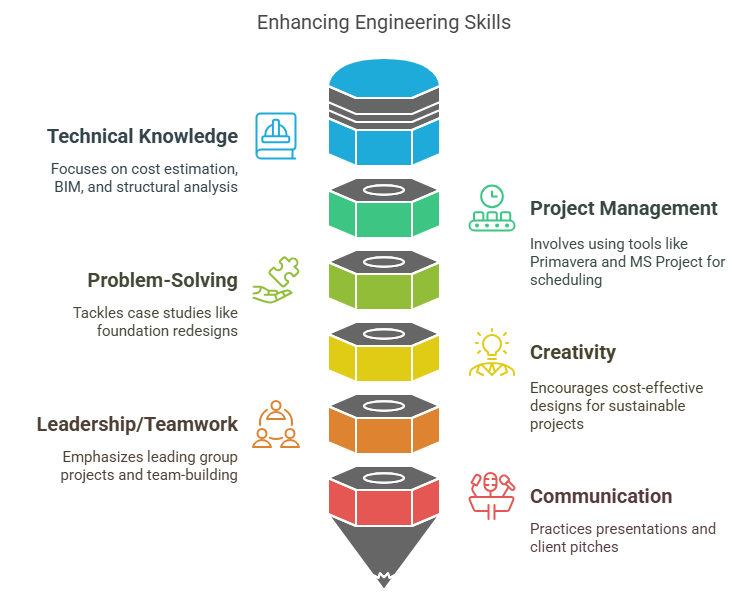
Technical Knowledge: Study cost estimation, BIM, and structural analysis via Entri’s Quantity Surveying Course.
-
Project Management: Use Primavera or MS Project; practice scheduling on mock projects.
-
Problem-Solving: Tackle case studies, like foundation redesigns, in Entri’s training.
-
Creativity: Experiment with cost-effective designs for sustainable projects.
-
Leadership/Teamwork: Lead group projects or join team-building workshops.
-
Communication: Practice presentations and client pitches in Entri’s sessions.
Upskilling is key—40% of Indian engineers plan to upskill in 2026, per TeamLease. Entri’s Quantity Surveying Course offers multilingual training to fast-track your growth.
Building civil engineering skills is not a one-time event — it is a continuous process. Here is a practical approach:
For freshers (0–2 years): Focus on consolidating AutoCAD, learning one structural analysis software (STAAD Pro or ETABS), and getting real exposure to site documentation. Pursue GATE preparation in parallel if a PSU career interests you.
For mid-level engineers (3–7 years): Invest in a BIM certification (Autodesk or Bentley), a quantity surveying programme, or a PMP/CAPM credential. These have a direct impact on salary negotiations and promotion readiness.
For senior engineers (8+ years): Leadership training, contract management knowledge, and stakeholder communication skills become the primary differentiators. Engineers targeting director or project head roles should look at MBA programmes or executive leadership courses.
Reading IS codes, following industry journals, attending site visits with senior engineers, and joining professional bodies like the Institution of Engineers (India) all compound over time into a formidable skill profile.
Study Quantity Surveying With Professional Mentors! Join Now!
Conclusion
Civil engineering in India has never offered more opportunity or demanded more from its practitioners. The ₹185 trillion National Infrastructure Pipeline guarantees a long runway of projects, but the engineers who will land the best roles and grow fastest are not just technically sound. They combine solid engineering fundamentals with digital fluency, project management discipline, and the interpersonal skills that make complex projects work in the real world.
Whether you are a fresher stepping into your first site role or an experienced engineer eyeing a promotion, the message is the same: skills compound. Every certification, every tool you master, every project report you write with clarity adds to a professional profile that employers cannot ignore.
Start with the skills most relevant to the role you want next and build from there.
Master Quantity Surveying – Build a Rewarding Career Today!
Gain in-demand skills in cost estimation, project budgeting, and contract management with our Quantity Surveying Course. Learn from industry experts and boost your career in construction and infrastructure. Enroll now and take the first step toward success!
Know MoreFrequently Asked Questions
What are the most important skills for a civil engineering job in India?
The most important skills are sound technical knowledge (structural analysis, AutoCAD, BIM), project management, quantity surveying, and soft skills like communication, problem-solving, and leadership. In 2026, BIM and digital construction tools are increasingly mandatory for private sector roles.
Does soft skills training help civil engineers get better jobs?
Yes. LinkedIn’s Indian hiring data shows that soft skills appear in approximately 30% of civil engineering job listings as explicit requirements. Engineers with strong communication, leadership, and problem-solving skills advance faster into project management and senior site roles.
What is the average salary of a civil engineer in India in 2026?
The average civil engineering salary in India ranges from ₹4.5 LPA to ₹12 LPA, depending on experience, sector, and specialisation. Specialists in BIM, structural design, or green building can earn ₹15 LPA to ₹25 LPA at mid-level. Senior professionals with 15+ years of experience and specialised skills can command ₹25 LPA to ₹50 LPA.
What project management skills do civil engineers need?
Project management skills ensure civil engineers deliver projects on time and within budget. Coordinating teams, managing resources, and using tools like Primavera are key. Naukri notes 12% cost savings by skilled managers in 2026.
How do problem-solving skills help civil engineers?
Problem-solving skills enable civil engineers to fix site issues, like soil instability or budget overruns. Quick solutions, such as redesigning foundations, save 15% in costs. LinkedIn shows 28% of 2026 job listings seek this skill. Entri’s Quantity Surveying Course sharpens problem-solving through MEP scenarios, making you a top candidate for civil engineering jobs.
Why is creativity important for civil engineers?
Creativity lets civil engineers design sustainable structures, like solar-powered buildings. India’s green building trend boosts creative engineer demand by 18%, per Indeed. Innovative designs enhance aesthetics and efficiency.
What leadership skills are needed for civil engineering jobs?
Leadership skills empower civil engineers to guide teams and motivate workers. Leading a bridge project requires decision-making and empathy. SHRM notes 22% of Indian recruiters value leadership in 2026.
Is BIM important for civil engineering jobs in 2026?
Yes. BIM proficiency commands a 30% to 40% salary premium over general site engineers. The Government of India has mandated BIM for large-scale public construction projects, making it a future-proof skill investment.
Which software skills are most valued by civil engineering employers?
AutoCAD, STAAD Pro or ETABS (structural analysis), Primavera P6 or MS Project (scheduling), and Autodesk Revit or Navisworks (BIM) are the most commonly required software tools in Indian civil engineering job descriptions.
How does Entri’s Quantity Surveying Course help civil engineers?
Entri’s Quantity Surveying Course offers NSDC-certified training in Revit MEP, BIM, and soft skills like leadership and communication. Multilingual (English, Hindi, Tamil), it boosts employability by 20% in 2026. Learn project management and problem-solving for MEP projects. Join a free demo at entri.app to excel in civil engineering jobs.