Table of Contents
Answer First – What Is Changing with the EA Exam in 2026?
The Internal Revenue Service (IRS) completely overhauled the administrative framework of the Enrolled Agent Special Enrollment Examination (EA-SEE). The core structure and topics of the three exam parts remain consistent, but how you book, sit for, and experience the test changed fundamentally.
- New Testing Partner: Effective March 1, 2026, the IRS cut ties with Prometric and transitioned the development and proctoring of the exam to PSI Services, LLC.
- Remote Proctored Option: Candidates in the United States can now choose between testing at a physical PSI center or taking an online proctored exam from home. International candidates (including those in India) will test exclusively through the remote platform.
- Deadlines Shifted & Rates Increased: In accordance with the new announcement, the May 1 date of the exam rollout was moved to July 1, 2026, for domestic candidates and to September 1, 2026, for international candidates. Meanwhile, candidates are now required to pay a more expensive exam booking fee of $317 instead of the previous fee of $267.
Key Takeaways
- Curriculum Framework: The basic areas of taxation covered in Parts 1, 2, and 3 were also unchanged.
- Novel Scoring System: The examination results would now be calculated on a fresh scaling scale from 200 to 800 points with the minimum pass score being 500 points.
- Credit Security: Any exam parts successfully cleared before the vendor transition remain safe and fully valid under the standard three-year carryover window.
Introduction
1: Accounting provides information on
In case you are preparing for the Enrolled Agent (EA) qualification, it is now the right time to discard your conventional exam day checklist. For several years, the IRS Special Enrollment Examination (SEE) utilized the same exam taking approach as before. However, many changes have taken place behind the curtains that altered the entire process related to EA credentialing.
The transition to a brand-new testing vendor isn’t just a corporate name swap; it alters when you take your tests, how much your credit card is charged, the structure of your exam breaks, and whether you even need to leave your house to earn your credentials. Navigating this shift smoothly requires a clear look at the operational realities of the new system so you don’t run into registration barriers or surprises on exam day.
Become an Accounting Pro – Learn from Industry Experts!
Placement Oriented PWC Business Accounting Course
PWC Certified Business Accounting Course by Entri App: Master in-demand skills, ace interviews, and secure top-tier jobs.
Join Now!Why the EA Exam Is Changing in 2026
The primary driver behind the sudden shakeup is the expiration of the long-term contract between the IRS and Prometric. Rather than renewing the old framework, the IRS opted for a complete technological modernizing of the candidate platform by selecting PSI Services.
PSI stepped in to write and administer this year’s testing engine from the ground up. The goal of the shift is straightforward: expanding global accessibility by integrating remote proctoring options, while stepping up digital identity security to keep pace with modern technical certification standards.
What Are the Major EA Exam Changes in 2026?
The changes for this cycle alter the logistics and actual execution of your testing session.
1. Expansion of Remote Online Proctoring
You no longer have to commute to a high-security physical center if you prefer not to. U.S. domestic candidates can now choose between physical test centers or online proctoring. For international test-takers, the choice is entirely made for you, you will test 100% remotely using secure lock-down browser software and automated webcam feeds.
2. Re-engineered Exam Blocks and Break Patterns
The format of exam day itself has a completely different pace. Under the old system, candidates faced a two-part layout broken up by a single 15-minute break. PSI has restructured the 3.5-hour testing timeline into three distinct question blocks, giving you two scheduled 10-minute breaks to step away from your workstation.
3. Redefined Scale for Passing Scores
When you complete a section, your diagnostic results will read differently. The old passing metric of 105 has been archived. The exam is now measured on a broader 200-to-800 point scale. If your scaled score hits 500 or higher, you secure a pass.
EA Exam 2026 vs Previous EA Exam
Key Differences at a Glance
| Feature Category | Legacy Prometric Framework | Modern 2026 PSI Framework |
| Exam Fee Per Part | $267 | $317 |
| Testing Venues | Physical centers only | Center-based or Remote Online Proctoring |
| Break Policy | One 15-minute scheduled break | Two 10-minute scheduled breaks |
| Exam Layout | Two structural sections | Three self-contained question blocks |
| Passing Benchmark | 105 (on a 40–130 scale) | 500 (on a 200–800 scale) |
| Scratch Space (Remote) | Not Applicable | On-screen digital whiteboard only |
Placement Oriented PWC Business Accounting Course
PWC Certified Business Accounting Course by Entri App: Master in-demand skills, ace interviews, and secure top-tier jobs.
Join Now!How the Changes Affect Current Candidates
If you already cleared one or two parts of the EA-SEE under the old vendor, do not panic. You will not lose your hard-earned progress. The IRS explicitly states that all passing scores retain their standard three-year carryover validity from the original date of completion.
However, the real operational bottleneck centers on your calendar planning. Because of the system-wide data migration, the traditional May 1 testing kickoff was entirely paused. For domestic candidates, testing resumed on July 1, 2026. International candidates face a longer delay, with their registration and testing windows locked to a September 1, 2026, through February 28, 2027 timeline.
How to Prepare for the New EA Exam Pattern
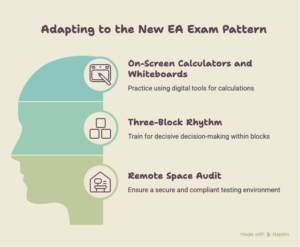
Since the core syllabus covering U.S. tax codes, business entities, and circular 230 representation regulations hasn’t changed, you do not need to throw out your core study texts. You do, however, need to change your practical review strategies to match the new system mechanics:
- Train with On-Screen Calculators and Whiteboards: Handheld calculators and physical scratch paper are barred if you choose the remote testing path. Practice managing tax math and calculation structures using a digital on-screen notepad and electronic whiteboard.
- Practice the Three-Block Rhythm: When you complete a block and submit it for a break, you cannot go back to those questions. Train your brain to be decisive; review your flags within each block before committing to your scheduled breaks.
- Audit Your Remote Space Early: If testing from home, ensure you have a private room completely free of clutter, loose notes, extra devices, or exposed bookshelves. The remote proctors utilize a mandatory 360-degree room scan and will cancel your session instantly if security violations are detected.
Potential Challenges Candidates May Face
The primary hurdle during this transition cycle will be navigating system logistics rather than the tax laws themselves.
- The Remote Tracking Rules: If you test from home, the environmental rules are incredibly strict. You are required to keep your hands fully visible to the camera at all times, and you are barred from mouthing words or whispering while reading questions.
- The Forex Price Hit: With the exam fee moving to $317 per part, candidates booking from international regions must factor in significant currency translation expenses and credit card processing markups.
- The Compressed Testing Cycle: International candidates lose four months of the standard testing calendar due to the September rollout. This creates higher competition for optimal remote proctor time slots as deadlines approach.
Become an Accounting Pro – Learn from Industry Experts!
Final Thoughts on EA Exam Changes 2026
The structural changes introduced by the IRS and PSI for this cycle can feel intimidating at first look, but the core objective remains entirely within your control. The tax concepts, depreciation formulas, and compliance rules haven’t changed. Once you understand the higher pricing thresholds, adjust your timeline to account for the modified testing windows, and practice using the digital workspace tools, you can approach your next testing slot with complete confidence.
Placement Oriented PWC Business Accounting Course
PWC Certified Business Accounting Course by Entri App: Master in-demand skills, ace interviews, and secure top-tier jobs.
Join Now!Frequently Asked Questions
Can I take the three parts of the EA exam in any order under the new system?
Yes. PSI maintains the same structural flexibility as before. You can book and sit for Part 1, Part 2, or Part 3 in whichever sequence aligns best with your professional tax background.
What happens if I fail an exam part under the new proctoring rules?
If you fail a specific part, you must wait a mandatory 24 hours before you are permitted to book a retake appointment for that same section. You are allowed a maximum of four testing attempts per individual exam part within a single testing cycle.
Do I need a new PTIN because the exam vendor switched to PSI?
No. Your Preparer Tax Identification Number (PTIN) is issued directly by the IRS, not the testing vendor. You will use your existing, active PTIN to create your new user profile on the PSI portal.