Table of Contents
PTIN Number Explained
A Preparer Tax Identification Number (PTIN) is an exclusive eight-digit number that the Internal Revenue Service (IRS) issues which starts with the letter “P”.
- The Main Rule: All individuals preparing or assisting in the preparation of tax returns or claims for refunds must have a PTIN.
- The Status Requirement: Those who are compensated for their service in preparing returns must include their PTIN in the signature block of their tax returns.
- The Basic Standard: Those who are federal return filers have to keep their PTIN active in order to avoid losing their credentials.
Key Takeaways
- Annual Renewal Matrix: A PTIN is not a one-time credential. Every number expires on December 31st of the calendar year for which it was issued, requiring an annual renewal sprint.
- The Cost in 2026: The official IRS processing fee to obtain or renew a PTIN for the 2026 tax cycle is $18.75, which is non-refundable.
- Security Standards: As of the current 2026 filing season, the IRS Tax Professional PTIN System requires a secure identity verification check through ID.me to protect data pipelines and stop fraudulent account creations.
Understanding PTIN in the US Tax System
1: Accounting provides information on
Before the IRS standardized the preparer tracking framework, paid tax professionals were forced to sign client tax returns using their personal Social Security Numbers (SSNs). This outdated mechanism posed a massive risk to consumer privacy and exposed preparers directly to identity theft.
The introduction of the PTIN completely transformed the consumer privacy landscape by shielding the preparer’s private identifying numbers from public view while maintaining strict corporate accountability. Within the broader U.S. tax framework, the PTIN acts as an operational fingerprint, allowing the IRS Return Preparer Office to easily track filing accuracy, monitor high-volume submission anomalies, and audit signature patterns across the tax software landscape.
Become an Accounting Pro – Learn from Industry Experts!
Placement Oriented PWC Business Accounting Course
PWC Certified Business Accounting Course by Entri App: Master in-demand skills, ace interviews, and secure top-tier jobs.
Join Now!Who Needs a PTIN Number?
The legal threshold for requiring a PTIN comes down to a single question: Are you receiving compensation for assisting with a U.S. federal tax return?
- Paid Tax Preparers: Any accountant, independent bookkeeping professional, or tax software operator charging a commercial fee to complete an individual, corporate, or partnership return.
- Support Staff and Interns: If a junior accountant or administrative intern helps calculate line items or inputs client data into professional tax software, they generally must hold a PTIN if they assist with substantial portions of the final return.
- Credentialed Practitioners: All Enrolled Agents (EAs) must hold a valid PTIN to maintain their professional active status with the IRS, regardless of whether they actively sign client papers or work strictly in a tax advisory capacity.
How Does a PTIN Number Work?
When a tax return is finalized inside a firm’s tax software suite, it requires two distinct signature blocks before transmission: the taxpayer’s authorization and the paid preparer’s verification profile.
[Client Tax Data Input] ➔ [Preparer Signs with 8-Digit PTIN] ➔ [E-Filing Transmission] ➔ [IRS Matches PTIN to EFIN Ledger]
The PTIN works side-by-side with your firm’s Electronic Filing Identification Number (EFIN). While the EFIN authorizes the specific office location or software system to e-file a return batch, your personal PTIN anchors the legal responsibility for the tax logic directly to you as an individual professional. If systemic technical errors or fraudulent patterns appear on multiple returns across a specific region, the IRS queries its national data ledger to identify every return flagged with that specific individual PTIN number.
How to Apply for a PTIN Number
The registration engine is highly optimized for digital applications. While a manual, paper-based path using Form W-12 remains active, the IRS strongly encourages the online portal path to bypass long administrative hold periods.
The Step-by-Step Online Route (~15 Minutes)
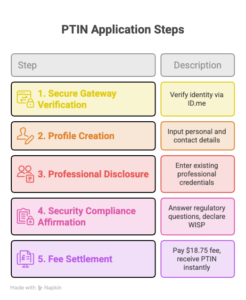
- The Secure Gateway Verification: Navigate directly to the IRS Tax Pros workspace (IRS.gov/taxpros) and launch the registration portal. You will immediately be routed through ID.me to verify your identity using a valid state passport, national ID card, or biometric scan.
- Profile Creation: Once authenticated, input your core personal details, including your business contact address, primary mobile metrics, and date of birth.
- Professional Disclosure: Enter your existing professional credentials if applicable (e.g., your active CPA registry or Enrolled Agent license details).
- The Security Compliance Affirmation: You must answer specific regulatory questions, including a mandatory declaration that your firm maintains a formal, written information security plan (WISP).
- Fee Settlement: Pay the fixed $18.75 non-refundable processing fee via credit card or digital routing. Your 8-digit identification number is issued on-screen instantly.
Placement Oriented PWC Business Accounting Course
PWC Certified Business Accounting Course by Entri App: Master in-demand skills, ace interviews, and secure top-tier jobs.
Join Now!PTIN vs Other Tax Identification Numbers
It is incredibly common for new practitioners to mix up the acronyms used throughout the tax filing ecosystem. Each number serves a distinct, independent compliance purpose:
| Number Acronym | Full Name Title | Who Issues It | Core Operational Purpose |
| PTIN | Preparer Tax Identification Number | IRS Return Preparer Office | Identifies the specific individual signing a paid return. |
| EFIN | Electronic Filing Identification Number | IRS e-file Provider Desk | Authorizes an entity or firm location to transmit returns to the IRS. |
| EIN | Employer Identification Number | IRS Business Services Division | Functions as a corporate tax ID for a business entity or employer. |
| ITIN | Individual Taxpayer Identification Number | IRS W-7 Operations Branch | Allows foreign individuals without an SSN to file tax returns. |
Benefits of Having a PTIN Number
Beyond simply fulfilling a mandatory legal requirement, securing your individual number unlocks core components of the professional tax ecosystem:
💡 Professional Growth Tip:
Holding a valid PTIN allows you to log into the backend tracking system to review exactly how many Form 1040 returns have been transmitted using your signature fingerprint across a calendar year. This serves as an unalterable metric of your professional output and client management volume when negotiating corporate compensation terms.
- Free Access to the IRS Study Archives: An active account allows you to seamlessly track your completed Continuing Education (CE) credits and monitor communications from the Return Preparer Office.
- Eligibility for the Annual Filing Season Program (AFSP): Uncredentialed preparers can participate in this structured training initiative via their account dashboard, earning an official IRS Record of Completion and gaining limited representation rights before audit boards.
Common PTIN Renewal and Compliance Requirements
To avoid disruption to your practice during peak filing windows, you must follow strict maintenance rules:
- The October Window Rollout: The annual system renewal engine traditionally opens every year on October 16th. It is a critical best practice to renew your credentials during October or November before the system becomes bottlenecked by last-minute filings in December.
- The Continuing Education Mandate: If you hold an Enrolled Agent license, your PTIN maintenance goes hand-in-hand with your educational updates. EAs must track at least 72 hours of CE every 3 years, including a mandatory minimum of 16 hours per individual year and 2 hours focused completely on ethics.
Common Mistakes to Avoid When Applying for a PTIN
- Opting for the Paper-Based Form W-12: Filing a physical paper application takes 4 to 6 weeks to route through the mail systems, leaving you completely blocked from signing client files during peak season. Stick entirely to the online portal, which yields instant confirmation.
- Failing to Create a Written Information Security Plan (WISP): During the online registration steps, checking the confirmation box affirming you protect client data without actually having a written data security plan in your office violates IRS Publication 5708 standards and can trigger heavy penalties.
- Mismatched Firm Names on EFIN Records: Ensure the legal spelling of your personal name and corporate entity details exactly matches your business filing data to prevent processing locks on electronic submissions.
Advantages and Limitations of PTIN
The Operational Advantages
- Protects Personal Data: Keeps your social security number completely invisible to clients and third-party processing units.
- Enables Scalable Auditing: Allows tax business owners to monitor individual performance metrics across multiple remote accounting pods.
The Core Limitations
- Without the automatic representation entitlements: The possession of a PTIN authorizes one to prepare tax returns, but it does not give an individual the right to represent clients before the IRS in any IRS proceedings. This authority requires the status of either enrolled agent, CPA, or attorney.
- Strict Expiration Schedule: Numbers cannot be extended; missing the December 31st cutoff deadline pauses your legal right to generate income from tax filings on January 1st.
Become an Accounting Pro – Learn from Industry Experts!
Conclusion
The PTIN is much more than a routine sequence of characters; it functions as your official license to operate within the global U.S. tax consulting landscape. By prioritizing your annual renewal sprints early in October, keeping your contact details verified through the ID.me portal, and pairing your software logic with a structured data security plan, you can easily protect your career momentum and avoid disruptive compliance holdups during the peak filing seasons.
Placement Oriented PWC Business Accounting Course
PWC Certified Business Accounting Course by Entri App: Master in-demand skills, ace interviews, and secure top-tier jobs.
Join Now!Frequently Asked Questions
Is the annual PTIN fee refundable if my career plans shift mid-year?
No. The $18.75 registration fee covers the administrative and technical verification costs processed by the IRS and its technology contractors, making it entirely non-refundable under all circumstances.
What penalties apply if a paid professional prepares a return without a valid PTIN?
Filing returns for compensation without an active number violates Internal Revenue Code Section 6695. The IRS can hit the individual with financial fines per un-signed return and, in severe cases, revoke their Enrolled Agent or practice credentials completely.
Can multiple accountants inside the same consulting firm share a single PTIN?
No. Sharing a number is entirely illegal. Because a PTIN represents an individual’s personal signature verification, every single paid preparer must register for their own unique identification number and complete independent identity screening via ID.me.