Table of Contents
Introduction
The students who pursue accounting study are preparing themselves regularly for the ACCA examinations. They procure the most sizable study text, underline every second page of the book, view online lectures at fast speed, and engage in continuous practice questions. However, the results reveal many students being labelled with 44, 47, or 49, which may leave them helpless.
It is a classic corporate education trap assuming that brute-force memorization translates directly to points on a computer-based exam screen. The missing link here isn’t your technical understanding of consolidated financial statements or deferred tax rules. It’s a complete disconnect between what you think looks good on a script and what the marking team is actually hunting for under intense marking deadlines.
That is where the official examiners’ reports come into play. These aren’t dry, bureaucratic reference summaries to be filed away under “optional reading.” They are a direct, post-exam diagnostic breakdown from the people who hold the keys to your pass or fail score. If you know how to deconstruct them, these documents will completely shift your preparation from blind syllabus memorization to highly precise exam execution.
Become an Accounting Pro – Learn from Industry Experts!
Understanding ACCA Examiners’ Reports
1: Accounting provides information on
What Are ACCA Examiners’ Reports?
Think of an ACCA examiner’s report as a forensic post-mortem of the most recent exam window. Published shortly after the results are released for each sitting, these documents lay out exactly how the global candidate pool handled the pressure. It isn’t just a compilation of statistics; it is a candid critique detailing where real students under pressure picked up easy marks and exactly where they ran their scripts directly off a cliff.
Who Writes These Reports?
These overviews are written directly by the ACCA examining team, the actual subject-matter experts who spend months designing the case studies, mapping out the grading metrics, and supervising the assessment pools for each module. When you read these pages, you are hearing from the head judge, not an external academic guessing at the guidelines from a distance.
What Information Is Included?
The structure of each report balances macro trends with highly granular technical breakdowns:
- Global Performance Temperature Check: First impressions on how well the candidates fared in this first batch of testing, what challenges they faced with the new layout of the exam, and what happened in those few areas where things went horribly wrong.
- Question-by-Question Technical Autopsy: Close examination of questions asked in the exam, understanding exactly which ones proved problematic and how exactly they caused cases of mass failure.
- Performance Gap Blueprint: Concrete remarks distinguishing between a potential 48-mark attempt and a well-developed 65-mark attempt.
Placement Oriented PWC Business Accounting Course
PWC Certified Business Accounting Course by Entri App: Master in-demand skills, ace interviews, and secure top-tier jobs.
Join Now!Why ACCA Examiners’ Reports Matter
There is a major danger in relying purely on model answers during your revision phase. Model answers are beautiful, pristine, and entirely unrealistic documents. They are constructed by panels of experts with unlimited time, total access to textbook resources, and zero exam-hall panic. They show you a flawless final product, but they completely fail to show you how a regular human being can secure a clean 53-mark pass within a tight three-hour window.
The examiner’s report bridges this gap by highlighting the exact delta between a textbook ideal and the messy realities of a timed exam script. It shows you the psychological traps where candidates wasted twenty minutes over-explaining a simple definition, where they misread a critical verb in a requirement, and where they left easy professional presentation marks sitting on the table. Reading these reports helps ensure you don’t repeat the mistakes of thousands of candidates who went before you.
Step-by-Step Guide to Using ACCA Examiners’ Reports
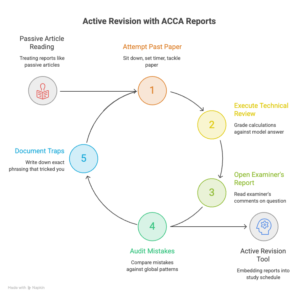
To stop treating these documents like passive articles and start using them as active revision tools, you need to embed them into your weekly study schedule using a systematic loop:
- Attempt a Past Paper Completely Blind: Sit down on the official Practice Platform, set a timer, and tackle a past paper under strict, uninterrupted exam conditions. No peeking at notes when you hit a wall.
- Execute the Technical Review: Grade your calculations and narrative points against the standard model answer. Fix your math, verify your accounting standards, and adjust your core formulas.
- Open the Corresponding Examiner’s Report: This is where the real work begins. Find the exact question you just struggled through and read what the examining team wrote about how the rest of the world handled it.
- Audit Your Mistakes Against Global Patterns: Did you miss a key variable in a cash-flow forecast because you rushed the reading? Look at the report if the examiner notes that “most weak candidates failed to adjust for inflation,” you know you’re falling into common, systemic traps.
- Document Your Traps in a Master Error Log: Do not just say “I’ll remember that next time.” Write down the exact phrasing or system step that tricked you. Review this log every single Sunday morning before your next mock exam sprint.
How to Read Different Sections of an Examiner’s Report
The General Comments Section
Do not skip the opening pages. This is where the examiner reveals structural observations about student behavior and exam-tech navigation. If the report highlights that candidates universally struggled to format their spreadsheets properly or that time management collapsed on Section C, it is a clear warning to change how you practice using your software tools at home.
Section A and B Feedback (Objective Test Questions)
For Applied Skills papers, this section identifies the exact corners of the syllabus where students tried to cut corners during revision. The examiner routinely calls out the technical topics that candidates skipped, reinforcing the reality that ACCA papers are designed to test the breadth of the entire syllabus, leaving no room for selective cramming.
Section C Feedback (Constructive Response Questions)
This is where you should focus most of your energy. The examining team takes each case study requirement apart line by line, explaining exactly how markers awarded points for calculation layouts and narrative analysis. It makes it clear whether students failed because they didn’t know the theory, or because they failed to explain how that theory applied to the company in the scenario.
Placement Oriented PWC Business Accounting Course
PWC Certified Business Accounting Course by Entri App: Master in-demand skills, ace interviews, and secure top-tier jobs.
Join Now!Common Student Mistakes Highlighted in ACCA Examiners’ Reports
If you spend an afternoon reading through five or six consecutive reports across any module, you will start to notice a striking pattern. The same four or five fundamental mistakes cost students their passing scores exam window after exam window:
- Treating Every Verb Like it Means “Define”: When a question requirement uses verbs like “evaluate,” “justify,” or “criticize,” students often write two pages of textbook definitions. The marker doesn’t want a definition; they want an analysis of the specific corporate problem.
- Reworking Data Already Provided in the Case: Examiners frequently express frustration over students spending fifteen minutes recalculating financial ratios or matrix variables that were already explicitly given to them in the exhibit attachments. It is a total waste of irreplaceable exam time.
- Relying on Fragmented, One-Word Bullet Points: In advanced professional papers, dropping a list of isolated bullet points with no context will not earn you full marks. If your sentence doesn’t explain the underlying “why” or connect back to the company’s financial risk, the marker will skip right past it.
- The Generic, Copy-Paste Answer: Memorizing a standard answer from a revision kit and forcing it onto a completely different case study scenario. If your answer could apply to any random business on Earth instead of the specific enterprise described in the exam paper, you will lose the points.
When Should ACCA Students Use Examiners’ Reports?
Timing your engagement with these resources is just as important as how you read them. You want to scatter them strategically across your entire study timeline:
- At the Very Start of the Semester: Before you even open chapter one of your study text, read through the latest examiner’s report. Spend twenty minutes understanding how the testing team approaches the syllabus so you know what to focus on during your reading.
- During the Mid-Term Question Practice Phase: Treat the report as a mandatory part of your post-question review. Every single time you finish a past paper question from your revision kit, checking the examiner’s commentary should be an automatic step.
- The Final Two-Week Sprint: In the fourteen days leading up to your actual exam date, stop loading your brain with new technical theories. Instead, sit down and read the last four examiner’s reports back-to-back to sharpen your exam technique and remind yourself of the common traps to avoid.
Benefits of Using ACCA Examiners’ Reports
💡 Pro Tip for Strategic Revision:
The internal statistics are incredibly clear on this: candidates who treat the examiner’s reports as core study material, rather than optional footnotes, see a significant shift in their mock pass rates. Analyzing these patterns teaches you to think like a marker, which completely changes how you structure your answers under pressure.
- Trims the Waste From Your Scripts: You learn exactly how much depth is required to secure a point, helping you write concise answers and save valuable exam time.
- Secures Crucial Professional Marks: By understanding the presentation layouts preferred by the examining team, you can structure your spreadsheets and word processor text to match their expectations perfectly.
- Removes Revision Guesswork: Seeing exactly which topics are regularly tested and how they are evaluated clears up the confusion around your revision strategy.
Become an Accounting Pro – Learn from Industry Experts!
Conclusion
To successfully navigate the ACCA experience, you will need more than technical knowledge; you also need to learn how to apply that knowledge on exam papers. The examiner’s reports give you an idea about the marking process. It shows the exact criteria that determine what is required in order to pass the examinations and what mistakes make you fail. By making use of the examiner’s reports on a regular basis, you can widely improve your examination technique and keep away from the common mistakes.
Placement Oriented PWC Business Accounting Course
PWC Certified Business Accounting Course by Entri App: Master in-demand skills, ace interviews, and secure top-tier jobs.
Join Now!Frequently Asked Questions
Where can I download official ACCA examiners' reports?
Reports for all papers are provided entirely for free on the official study support platform. You can find them directly by navigating to the ACCA Professional Exams Study Resources Hub.
How many past examiner's reports should I read before my exam?
You should focus on reading the reports from at least the last four exam sittings. This window is wide enough to help you spot recurring testing patterns, seasonal syllabus focuses, and common student errors.
Should I bother reading the report if I scored a pass on a mock question?
Absolutely. Scoring a passing grade on a practice question just means your answer was good enough to get by. Reading the report helps you see if you could have secured those same marks much faster or using a much cleaner layout.