Table of Contents
Key Answer
Relative grading and absolute grading are different evaluation methods. Relative grading compares student performance within the class. Absolute grading uses fixed score ranges for every student. Both systems influence final grades differently. Understanding these methods helps VIT students plan studies, set realistic goals, and improve academic performance.
Check out Entri’s free coding courses now!
Introduction
Many students focus only on marks. However, grading methods also matter. Relative and absolute grading work differently. Each system follows separate evaluation principles. Understanding both methods reduces confusion. It also helps students prepare more effectively. Better planning often leads to stronger academic performance.

What Is Relative Grading?
Quick Answer
Relative grading assigns grades based on class performance. Students are evaluated against their peers instead of fixed marks.
Relative grading compares students within the same class. Everyone writes the same examination. However, final grades depend upon overall class performance. Therefore, identical marks may receive different grades across semesters.
This system focuses on relative performance. Students compete within their batch. Strong performance above the class average usually improves grade outcomes. Competition therefore becomes an important factor.
Grade boundaries remain flexible. They may change every semester. They may also differ between courses. Overall class performance influences final grade distribution.
How Does Relative Grading Work?
The university reviews class performance first. Student scores are then compared collectively. Grade boundaries are determined afterwards. Better relative performance receives higher grades.
Students should understand one important point. Scoring well alone may not guarantee the highest grade. Class performance also influences final results.
Why Do Universities Use Relative Grading?
Relative grading creates balanced evaluation. It also considers examination difficulty. Difficult papers affect the entire class. Therefore, grade boundaries may adjust accordingly.
This approach also rewards stronger academic performance. Students performing above classmates receive better grades. High consistency becomes especially valuable.
Key Features of Relative Grading
Important characteristics include:
- Grades depend on class performance.
- Grade cutoffs may change.
- Students compete with peers.
- Examination difficulty receives consideration.
- Consistent performance remains important.
Students should avoid comparing marks alone. Relative ranking often matters more.
What Is Absolute Grading?
Absolute grading follows fixed score ranges. Every student receives grades according to marks earned. Other students’ scores never affect individual results.
This system remains straightforward. Students know target scores beforehand. Meeting fixed score ranges determines final grades.
The table below shows a common example.
| Marks | Grade |
|---|---|
| 90–100 | S |
| 80–89 | A |
| 70–79 | B |
| 60–69 | C |
| 50–59 | D |
| 40–49 | E |
| Below 40 | F |
These ranges represent a general example. Actual grade cutoffs may vary according to university regulations.
How Does Absolute Grading Work?
Every student follows identical score ranges. Marks alone determine final grades. Class performance creates no influence. Evaluation therefore remains predictable.
Students understand academic targets clearly. Reaching required marks secures desired grades. Preparation becomes easier because expectations remain stable.
Why Do Students Prefer Absolute Grading?
Many students appreciate transparency. Fixed score ranges reduce uncertainty. Students know exactly what to achieve.
Performance depends upon individual effort. Classmates’ marks never reduce another student’s grade. This creates predictable academic planning.
Key Features of Absolute Grading
Absolute grading offers several advantages.
- Fixed score ranges.
- Predictable grade targets.
- Individual performance matters.
- Peer scores create no impact.
- Easier academic planning.
Students can create study plans earlier. Clear targets improve preparation confidence.
Relative Grading vs Absolute Grading
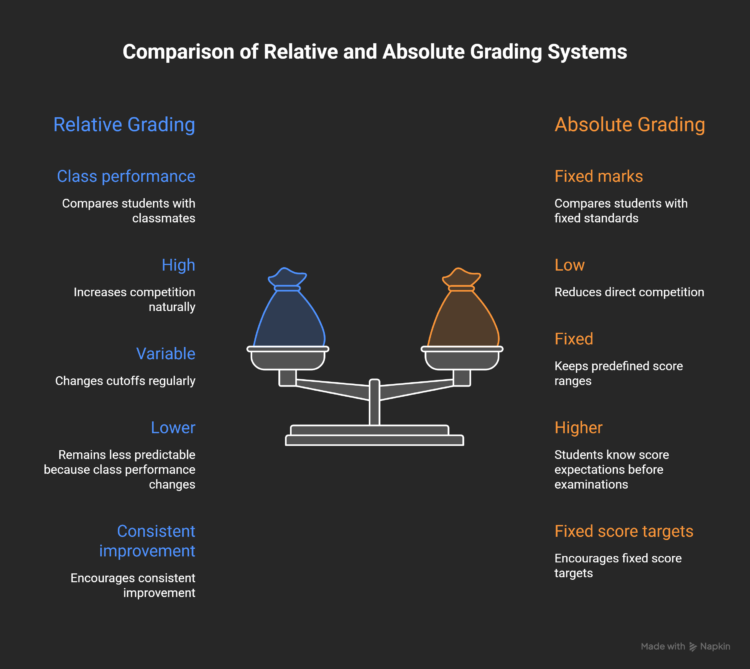
Both grading systems measure academic performance. However, they evaluate students differently. Understanding these differences helps students prepare better.
| Feature | Relative Grading | Absolute Grading |
|---|---|---|
| Based On | Class performance | Fixed marks |
| Competition | High | Low |
| Grade Boundaries | Variable | Fixed |
| Peer Performance Matters | Yes | No |
| Predictability | Lower | Higher |
| Difficulty Level | Depends on batch | More consistent |
Evaluation Method
Relative grading compares students with classmates. Absolute grading compares students with fixed standards. This remains the biggest difference.
Grade Boundaries
Relative grading changes cutoffs regularly. Absolute grading keeps predefined score ranges. Students therefore experience different expectations.
Competition Level
Relative grading increases competition naturally. Every student’s performance influences overall distribution. Absolute grading reduces direct competition.
Planning Strategy
Relative grading encourages consistent improvement. Absolute grading encourages fixed score targets. Study methods may therefore differ.
Which System Feels More Predictable?
Absolute grading usually feels predictable. Students know score expectations before examinations. Relative grading remains less predictable because class performance changes.
Understanding these differences supports smarter preparation. Students should adjust study strategies accordingly.
Which Grading System Does VIT Use?
Many students ask this question. The answer depends on the course. Evaluation methods may vary across subjects. University regulations also influence grading policies.
Some courses may follow relative grading principles. Others may use absolute grading policies. Faculty evaluation methods may also differ. Therefore, students should avoid making assumptions.
Students should always refer to current academic regulations. Official university guidelines provide the most accurate information. Faculty members also explain course evaluation methods during the semester.
Why Can Grading Methods Differ?
Different subjects require different evaluations. Laboratory courses differ from theory courses. Project-based courses also follow separate assessment methods.
Course objectives influence evaluation approaches. Assessment methods therefore remain flexible.
What Should Students Do?
Instead of guessing, students should:
- Read official course handbooks.
- Review current academic regulations.
- Clarify doubts with faculty.
- Understand assessment patterns early.
- Plan studies accordingly.
Understanding the grading method early helps students prepare effectively. It also reduces unnecessary confusion throughout the semester.
Students can also track academic performance using the Entri’s CGPA Calculator:
Monitoring academic progress helps students set realistic semester goals.
How Do Relative and Absolute Grading Affect SGPA and CGPA?
Relative and absolute grading influence academic results differently. However, both eventually affect SGPA and CGPA. The grading method determines final grades first. Those grades later contribute to cumulative performance.
Students should understand the evaluation method early. This helps set realistic academic goals. Better planning also reduces examination stress. Preparation becomes more focused throughout the semester.
Relative Grading and SGPA
Relative grading depends upon class performance. Small mark differences sometimes change final grades. Therefore, every assessment becomes important. Consistency matters throughout the semester.
Consider two students scoring similar marks. One student performs above class average. Another remains near average. Their final grades may differ because overall class performance influences grade boundaries.
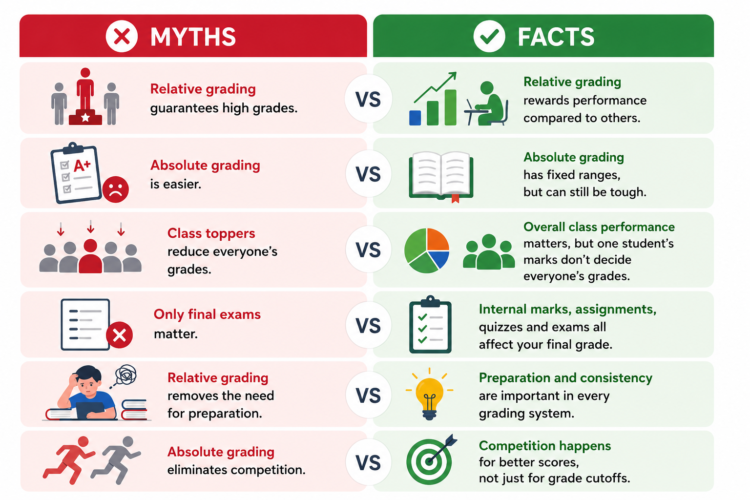
Students should avoid depending only on final examinations. Strong internal scores create valuable advantages. Every assessment contributes to overall performance.
Students should focus on:
- Performing above the class average.
- Scoring well in internals.
- Maintaining steady performance.
- Improving weaker subjects quickly.
- Avoiding careless examination mistakes.
Absolute Grading and SGPA
Absolute grading follows fixed score ranges. Students know grade targets beforehand. Classmates never influence final grades. Individual performance becomes the deciding factor.
This system encourages goal-based preparation. Students can plan score targets early. Tracking marks also becomes much easier.
Students should:
- Set subject-wise score targets.
- Monitor every assessment carefully.
- Improve low-scoring subjects.
- Protect internal assessment marks.
- Review progress after every CAT.
How Does CGPA Change?
CGPA combines grades from every semester. Strong semester performance improves overall results. Weak semesters reduce cumulative averages. Therefore, consistency always remains important.
Relative grading may create unexpected grade changes. Absolute grading usually provides predictable outcomes. Students should adjust preparation accordingly.
Practical Example
Imagine two difficult examinations. One follows relative grading. The other follows absolute grading.
Under relative grading, lower class performance may reduce grade cutoffs. Students still receive competitive grades despite difficult papers.
Under absolute grading, score ranges remain unchanged. Students must achieve required marks regardless of paper difficulty.
This difference influences preparation strategy. Students should understand course evaluation before examinations.
Student Planning Tips
Keep these points in mind.
- Understand grading methods early.
- Track internal assessment scores.
- Monitor semester progress regularly.
- Prioritize high-weight assessments.
- Ask faculty about evaluation patterns.
Planning early reduces unnecessary pressure. It also improves academic confidence.
Get Free Career Guidance with Entri. Click here!
Which System Is Better?
Students often compare both systems. However, neither remains universally better. Each system offers different advantages. Success depends upon preparation and consistency.
Some students prefer fixed targets. Others benefit from flexible grade boundaries. The better system depends upon individual strengths.
Advantages of Relative Grading
Relative grading benefits difficult examinations. Lower overall class scores may reduce grade cutoffs. Strong performers continue receiving higher grades.
Additional advantages include:
- Difficult papers receive balanced evaluation.
- Flexible grade boundaries.
- Strong relative performance earns rewards.
- Consistency receives greater importance.
- Exceptional effort remains recognized.
Challenges of Relative Grading
Students should also understand limitations.
Common challenges include:
- Higher academic competition.
- Unpredictable grade cutoffs.
- Class performance influences grades.
- Small mark differences matter.
Students cannot predict exact grade boundaries. Therefore, consistent preparation becomes essential.
Advantages of Absolute Grading
Absolute grading offers greater clarity. Students understand score expectations early. Preparation therefore becomes more structured.
Important advantages include:
- Fixed score targets.
- Transparent evaluation.
- Predictable grading process.
- Independent performance.
- Easier semester planning.
Students always know required marks. Progress becomes easier to measure throughout the semester.
Challenges of Absolute Grading
Absolute grading also presents challenges.
Students should remember:
- Difficult papers affect everyone equally.
- Grade cutoffs remain fixed.
- Missing target scores reduces grades.
- Recovery depends completely on marks.
Students cannot depend upon lower grade boundaries. Every mark therefore becomes valuable.
Which Students Benefit Most?
Relative grading may benefit students during difficult examinations. Strong performers also benefit from flexible grade boundaries.
Absolute grading suits students preferring fixed academic goals. Predictable targets simplify long-term preparation.
Neither system guarantees better grades. Preparation remains the deciding factor. Students should understand evaluation methods before every semester. Smart planning always produces stronger academic outcomes.
Frequently Asked Questions
Does VIT use relative grading?
Yes, VIT may use relative grading for some courses. The grading method depends on the subject and university regulations.
Is relative grading harder than absolute grading?
Not always. The difficulty depends on the class performance and examination level.
Can classmates affect my grades in relative grading?
Yes. Your grade may depend on how you perform compared to your classmates.
Which grading system is better for CGPA?
Neither is better for everyone. Consistent performance helps maintain a good CGPA under both systems.
Is 80 marks enough for an A grade?
It may be under absolute grading. Under relative grading, the final grade depends on class performance.
Do all subjects follow the same grading system at VIT?
No. The grading method may vary depending on the course and university regulations.
Why do grade cutoffs change in relative grading?
Grade cutoffs depend on the overall class performance. They may vary from one semester to another.
How can I score well under relative grading?
Maintain strong internals, revise regularly, and stay above the class average whenever possible.
Does absolute grading depend on classmates' marks?
No. Your grade depends only on your own marks and the fixed score range.
Which grading system is more predictable?
Absolute grading is generally more predictable because it follows fixed mark ranges.