Table of Contents
Key Answer
VIT measures semester performance using SGPA. SGPA means Semester Grade Point Average. Every subject has assigned credits. Every grade has assigned points. Better grades earn higher points. Higher-credit subjects affect results more. Multiply credits by grade points. Add all weighted scores together. Divide by total registered credits. The result becomes the semester SGPA.
Check out Entri’s free coding courses now!
Introduction
VIT, or Vellore Institute of Technology, ranks among India’s leading universities. Thousands study engineering, management, science, and other programs. VIT follows a credit-based academic system. Every semester includes several registered courses. Every course carries assigned academic credits.
SGPA means Semester Grade Point Average. It measures one semester’s academic performance. VIT calculates SGPA using credits and grade points. Both values influence the final result. Better grades produce higher grade points. Higher-credit courses carry greater importance.
Every VIT student should understand SGPA calculations. Clear knowledge improves academic planning. Students can estimate semester performance confidently. They can also identify improvement opportunities early. This guide explains every calculation step clearly.

What Is SGPA in VIT?
SGPA stands for Semester Grade Point Average. It measures academic performance during one semester. VIT calculates SGPA after every semester. The calculation uses credits and grade points.
Unlike simple averages, SGPA follows weighted calculations. Every subject contributes differently. Course credits determine each subject’s importance. Therefore, high-credit subjects influence results more.
Students receive one SGPA every semester. Later, all semester results contribute towards CGPA. Therefore, every semester remains equally important.
Why Does VIT Use SGPA?
VIT offers different course types. Every course requires different learning efforts. Some courses include laboratories. Others include projects. Some carry higher academic weight.
Credits represent these differences. SGPA reflects those credit values fairly. Therefore, the calculation remains balanced.
Why Should Students Understand SGPA?
Understanding SGPA offers several benefits.
- Tracks semester performance.
- Supports academic goal setting.
- Identifies weaker subjects.
- Highlights stronger subjects.
- Helps scholarship preparation.
- Supports placement readiness.
Students also avoid calculation mistakes. Better understanding improves future planning.
Key Points
- SGPA measures one semester.
- Credits affect final calculations.
- Grade points determine scores.
- Higher grades improve SGPA.
- Every registered subject contributes.
- Laboratory credits also count.
Before learning calculations, understand important terms.
| Term | Meaning |
|---|---|
| SGPA | Semester Grade Point Average |
| Credit | Academic weight assigned to a course |
| Grade Point | Numerical value assigned to grades |
These terms appear throughout semester calculations. Understanding them prevents confusion later.
VIT Grading System Explained
VIT assigns letter grades after every semester. Every grade represents academic performance. Every grade also carries numerical points. These values determine SGPA calculations.
Students should know every grade point. Incorrect values produce incorrect SGPA.
| Grade | Grade Point |
|---|---|
| S | 10 |
| A | 9 |
| B | 8 |
| C | 7 |
| D | 6 |
| E | 5 |
| F | 0 |
| N | 0 |
The table shows official grade values. Higher grades receive higher points. Lower grades reduce semester performance.
S Grade
S represents outstanding academic performance. It carries ten grade points. This remains the highest possible score. Multiple S grades improve SGPA significantly.
A Grade
A indicates excellent academic performance. It carries nine grade points. Strong semester performance often includes several A grades.
B Grade
B represents very good performance. It carries eight grade points. Students still maintain competitive academic records.
C Grade
C indicates good academic performance. It carries seven grade points. However, SGPA becomes slightly lower.
D Grade
D represents satisfactory performance. It carries six grade points. Students still complete course requirements successfully.
E Grade
E remains the minimum passing grade. It carries five grade points. Although passing, SGPA reduces noticeably.
F Grade
F means course failure. It carries zero grade points. Failed courses reduce semester performance significantly.
N Grade
N also carries zero points. Attendance shortages often cause N grades. Academic requirements may also affect results.
Why Grade Points Matter
Grade points determine weighted scores. Credits multiply these values. Therefore, every grade affects semester performance differently.
For example, an A grade earns nine points. An S grade earns ten points. Even one-point differences matter greatly. High-credit courses amplify these differences further.
❓ What does S grade mean in VIT?
An S grade represents outstanding academic performance. It carries the highest grade point, ten. Students earning multiple S grades usually achieve stronger semester results. High-credit S grades improve SGPA considerably.
❓ What happens if I get an F grade?
An F grade carries zero grade points. Therefore, semester SGPA decreases significantly. Students usually re-register failed courses later. Successful completion restores earned academic credits.
Formula Used to Calculate SGPA in VIT
Understanding the formula simplifies calculations. Fortunately, VIT follows one standard method. Every semester uses the same formula.

SGPA = Σ(Credit × Grade Point) ÷ Σ Credits
The formula calculates weighted academic performance. Credits determine subject importance. Grade points measure subject performance.
Understanding the Numerator
The numerator includes weighted grade points. Every subject contributes separately.
Calculate each subject using:
Credit × Grade Point
For example:
- Credits = 4
- Grade Point = 9
Calculation becomes:
4 × 9 = 36
Repeat this process for every subject. Finally, add every weighted value.
The result becomes total weighted points.
Understanding the Denominator
The denominator includes registered semester credits.
Include:
- Theory courses.
- Laboratory courses.
- Elective courses.
- Project courses.
Add every registered credit together.
The total becomes semester credits.
Why Credits Matter
Many students ignore credits. This creates incorrect calculations.
Consider two subjects.
Subject One
- Credits = 4
- Grade Point = 10
Weighted score becomes:
4 × 10 = 40
Subject Two
- Credits = 2
- Grade Point = 10
Weighted score becomes:
2 × 10 = 20
Both earned identical grades. However, contributions differ greatly.
Therefore, high-credit subjects deserve greater attention.
Common Formula Mistakes
Students often make simple mistakes.
Avoid these errors.
- Averaging grades directly.
- Ignoring subject credits.
- Using incorrect grade points.
- Excluding laboratory credits.
- Forgetting registered electives.
Correct calculations always include every registered course.
Step-by-Step SGPA Calculation Example
Learning becomes easier through examples. Consider a realistic VIT semester below.
| Subject | Credits | Grade | Grade Point | Credit × GP |
|---|---|---|---|---|
| Mathematics | 4 | S | 10 | 40 |
| Physics | 3 | A | 9 | 27 |
| Chemistry | 3 | B | 8 | 24 |
| Programming | 4 | A | 9 | 36 |
| English | 2 | S | 10 | 20 |
Total Credits = 16
Total Weighted Points = 147
SGPA = 147 ÷ 16 = 9.19
Follow these simple steps.
Step 1
List every registered subject.
Step 2
Write corresponding course credits.
Step 3
Record obtained grades.
Step 4
Convert grades into grade points.
Step 5
Multiply credits by grade points.
Step 6
Add every weighted score.
Step 7
Add total semester credits.
Step 8
Divide weighted points by credits.
The final answer becomes 9.19.
Students can repeat these steps every semester. Manual calculations become easier with practice. Online calculators also verify calculated results quickly.
Get Free Career Guidance with Entri. Click here!
How Failed Subjects Affect SGPA
Failed subjects can reduce SGPA significantly. Both grades and credits matter. Therefore, failures affect overall semester performance. Understanding this impact helps students plan better.
VIT mainly uses F and N grades. Both carry zero grade points. However, their registered credits still count. This lowers the final weighted average.
What Does an F Grade Mean?
An F grade indicates course failure. Required learning outcomes remain incomplete. Students do not earn course credits. The course usually requires another attempt.
What Does an N Grade Mean?
An N grade also indicates failure. Low attendance commonly causes this grade. Missing academic requirements also contribute. It also carries zero grade points.
Why Does SGPA Reduce?
Many students misunderstand failed subjects. They expect failed courses ignored completely. However, VIT still counts course credits. Zero grade points reduce overall performance.
Consider a four-credit course. Suppose the student earns an F grade. The grade point becomes zero. The weighted score also becomes zero. Those credits remain included. Therefore, the semester average falls noticeably.
Now consider another situation. The same course receives an A grade. The grade point becomes nine. The weighted score becomes thirty-six. The semester SGPA improves immediately.
This comparison shows credit importance. High-credit failures cause larger reductions. High-credit successes create greater improvements.
How Can Students Recover?
One failed semester never ends progress. Students can improve future performance. Re-registering failed courses helps recovery. Better grades strengthen future academic records. Consistent effort also improves CGPA gradually.
Tips to Avoid Failed Subjects
Regular preparation prevents unnecessary failures.
- Attend classes consistently.
- Complete assignments before deadlines.
- Revise topics every week.
- Prepare well before examinations.
- Ask faculty doubts early.
- Practice laboratory sessions seriously.
Good study habits improve results consistently. Small improvements create better semester outcomes.
Difference Between SGPA and CGPA
Students often confuse SGPA and CGPA. Both measure academic performance. However, their purposes differ completely. Understanding both helps academic planning.
SGPA measures one semester’s performance. CGPA measures performance across all semesters. Every semester receives one SGPA. Later, those values contribute towards CGPA.
Many students search VIT SGPA vs CGPA. The comparison becomes simple. SGPA reflects short-term performance. CGPA reflects long-term consistency.
| SGPA | CGPA |
|---|---|
| Semester performance | Overall performance |
| One semester only | All semesters |
| Changes every semester | Cumulative score |
When Does SGPA Matter?
SGPA helps students evaluate current performance. It reflects recent academic achievements. Students identify weaker subjects quickly. Future semester planning becomes easier.
Many internships also consider recent performance. Therefore, maintaining strong SGPA remains beneficial.
When Does CGPA Matter?
CGPA reflects complete academic progress. Recruiters frequently review this score. Higher education institutions also consider CGPA. Consistent performance improves future opportunities.
Which Score Deserves Greater Attention?
Both scores remain equally important. Strong SGPA supports better CGPA. Every semester contributes future success. Therefore, consistent performance always matters.
How to Convert SGPA Into Percentage at VIT
Many students require percentage values. Employers sometimes request percentages. Universities may request percentages too. However, VIT mainly reports GPA scores.
Official transcripts usually display GPA values. Percentage conversion may become necessary later. However, no universal conversion formula exists. Different organizations follow different methods.
Some recruiters accept GPA directly. Others request converted percentages. Requirements differ between organizations. Therefore, students should verify official instructions first.
Using unofficial formulas creates confusion. Incorrect conversions may produce inaccurate results. Always follow employer requirements carefully.
When Might Percentage Be Required?
Percentage values become useful during several situations.
- Job applications.
- Higher education admissions.
- Scholarship applications.
- Government recruitment.
- International university applications.
Checking requirements first prevents unnecessary mistakes. It also improves application accuracy.
Important Things to Remember
Keep these points in mind.
- VIT mainly reports GPA.
- Conversion methods differ.
- Recruiters follow different requirements.
- Universities follow separate guidelines.
- Official instructions always matter.
Common Mistakes Students Make While Calculating SGPA
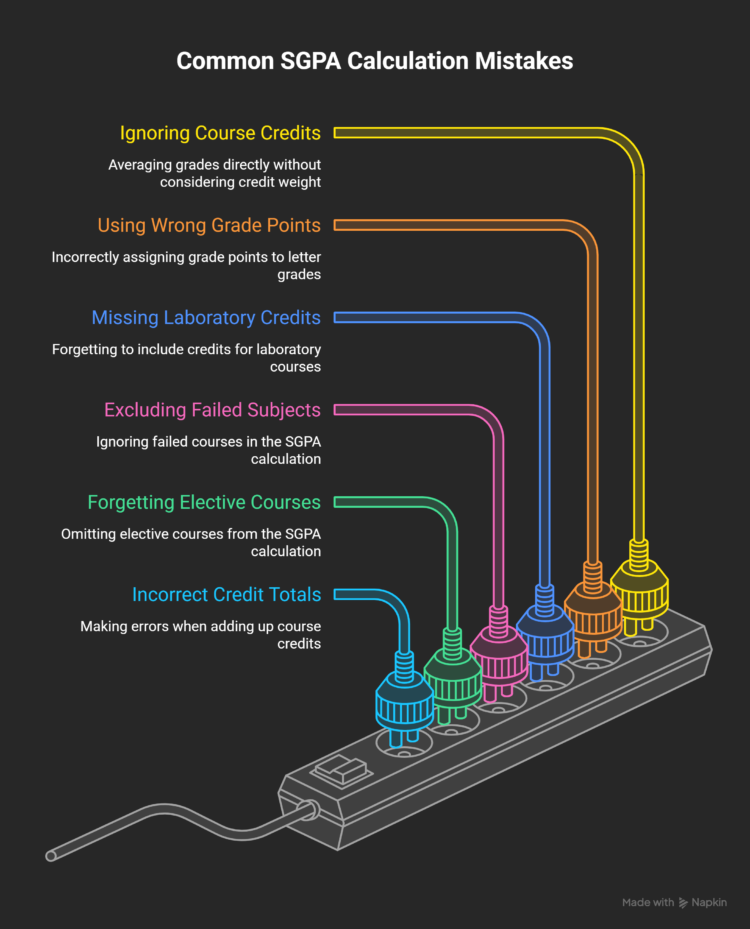
Manual calculations often create mistakes. Small errors change final results. Understanding common mistakes improves calculation accuracy.
Ignoring Course Credits
Many students average grades directly. This method remains incorrect. Credits determine every subject’s importance. Always include credit values first.
Using Wrong Grade Points
Every letter grade carries fixed points. Incorrect values produce incorrect SGPA. Always verify official grading tables. Double-check calculations before finishing.
Missing Laboratory Credits
Laboratory subjects also carry credits. These credits affect final calculations. Missing laboratory credits lowers accuracy. Include every registered laboratory course.
Excluding Failed Subjects
Some students ignore failed courses. However, failed subjects still count. Zero grade points affect SGPA. Never exclude registered failures.
Forgetting Elective Courses
Elective subjects also contribute credits. Their grades affect semester performance. Include every registered elective. Missing electives creates incorrect calculations.
Incorrect Credit Totals
Adding credits incorrectly creates errors. Always verify semester registrations carefully. Check totals before calculating SGPA.
Quick Checklist
Review these points before calculating.
- Include every registered subject.
- Verify all course credits.
- Check every grade point.
- Include laboratory courses.
- Include elective courses.
- Include failed subjects.
- Verify total credits.
- Check calculations again.
Careful checking prevents avoidable mistakes. Accurate calculations improve academic planning.
Secure a high-paying career with Entri’s AI-powered Python course!
Online VIT SGPA Calculator
Manual calculations require patience. They also consume valuable time. Online calculators simplify the entire process. Students receive results within seconds.
These calculators reduce manual errors. They also improve calculation accuracy. Students can verify expected SGPA quickly. Semester planning becomes much easier.
Most calculators require simple inputs. Enter course credits correctly. Select obtained grades carefully. The calculator automatically displays SGPA.
Benefits of Using a Calculator
Online calculators offer several advantages.
- Calculate results instantly.
- Reduce manual mistakes.
- Support all VIT branches.
- Verify manual calculations.
- Save valuable time.
- Simple and convenient.
Reliable calculators improve confidence. They also simplify semester planning.
Useful Entri Tools
Students can use these helpful calculators.
- VIT CGPA Calculator: Click Here
- VIT GPA Calculator: Click Here
- VIT Percentage Calculator: Click Here
These tools support faster calculations. They also reduce unnecessary errors.
Conclusion
Understanding SGPA helps students make better academic decisions. Every subject contributes differently. Credits and grades work together. Strong grades improve semester performance. High-credit courses deserve additional attention. Failed subjects reduce weighted averages. Regular tracking encourages continuous improvement. Online calculators simplify every calculation. Consistent effort builds stronger academic success.
|
Coding Courses Offered |
|||||
| Full-Stack Web Developer | Data Science | Python Programming | |||
| Software Testing | DevOps | Data Analytics | |||
| Cyber Security | UI/UX Design | ||||
Frequently Asked Questions
How is SGPA calculated in VIT?
VIT calculates SGPA by multiplying each course’s credits with its grade point. The total weighted points are then divided by the total registered credits for that semester.
What is the formula for SGPA in VIT?
The formula is SGPA = Σ(Credit × Grade Point) ÷ Σ Credits. This method ensures every subject contributes according to its assigned credit value.
Is an 8.5 SGPA considered good in VIT?
Yes, an 8.5 SGPA is generally considered a strong academic score. It reflects consistent performance and can strengthen internship, placement, and higher education opportunities.
Does failing a subject affect SGPA?
Yes, failed subjects directly reduce SGPA because they receive zero grade points. Since the course credits are still included, the overall weighted average decreases.
What is the highest SGPA possible in VIT?
The highest possible SGPA at VIT is 10.0. Students can achieve this by earning the highest grade points across all registered courses.
Do laboratory courses count while calculating SGPA?
Yes, laboratory courses carry academic credits and contribute to SGPA calculations. Their grade points are included just like theory subjects.
Are elective subjects included in SGPA calculation?
Yes, all registered elective courses are included in SGPA calculation. Their credits and grade points contribute to the final semester average.
Can SGPA improve after revaluation?
Yes, SGPA can change if the revaluation results in higher grades. Once the updated grade is published, the university recalculates the semester performance accordingly.
What is the difference between SGPA and CGPA?
SGPA measures academic performance for a single semester, while CGPA represents cumulative performance across all completed semesters. CGPA is calculated using the SGPAs earned throughout the entire program.