Table of Contents
Key Answer
A low CGPA in VIT can improve over time. Every semester contributes to the final CGPA. Strong SGPA in future semesters raises the overall average. High-credit subjects create greater improvement. Clearing backlogs also supports recovery. Consistent preparation delivers better results than one exceptional semester.
Check out Entri’s free coding courses now!
Introduction
A poor semester feels disappointing. However, recovery remains possible. CGPA never becomes permanently fixed. Every future semester creates improvement opportunities. Strong academic habits produce gradual progress. Smart planning also strengthens results. Students should focus upon steady improvement. Small gains eventually create meaningful academic success.

Can You Improve Your CGPA in VIT?
Quick Answer
Yes. A low CGPA can improve through consistent future performance. Higher SGPA raises the overall average. Recovery becomes easier with remaining credits. Early improvement produces better long-term results.
Many students lose confidence early. However, one poor semester changes nothing permanently. Every completed semester updates the cumulative average. Better future performance gradually raises CGPA.
Recovery depends upon remaining semesters. Students with many pending credits recover faster. Final-year students require greater effort. Therefore, starting early always provides advantages.
Improvement rarely happens instantly. Every semester contributes small gains. Those improvements accumulate gradually. Consistency produces stronger long-term outcomes.
Students should monitor progress regularly. Tracking every semester improves motivation. Small improvements encourage continued effort. Academic confidence also increases steadily.
Understand How CGPA Works in VIT
CGPA combines performance across completed semesters. Every subject contributes according to credits. Higher-credit courses influence results more. Therefore, understanding credit distribution becomes important.
CGPA uses weighted calculations instead of simple averages. Strong grades alone remain insufficient. Course credits also determine academic impact. Better planning requires understanding this difference.
Students often improve one semester dramatically. However, CGPA changes gradually. Earlier semester results continue contributing. Therefore, patience remains equally important.
Why Do High-Credit Subjects Matter?
Every course carries different credits. Core subjects usually carry higher values. Better grades create larger improvements. Poor grades reduce overall progress significantly.
Students should identify high-credit courses first. These subjects deserve additional preparation. Better performance creates stronger academic returns.
Why Does Recovery Slow Later?
Early semesters contain many remaining credits. Later semesters contain fewer opportunities. Therefore, final-year recovery becomes slower.
Students should avoid delaying improvement. Early action provides greater flexibility. Waiting increases academic pressure unnecessarily.
Why Does Consistency Matter?
One excellent semester feels encouraging. However, long-term performance matters more. Consistent SGPA produces stable CGPA growth. Regular improvement creates lasting academic benefits.
Students should avoid unrealistic expectations. Steady progress remains more sustainable. Long-term discipline produces stronger results.
To understand calculations better, read How SGPA Is Calculated at VIT. Understanding SGPA simplifies future academic planning.
Find Out Why Your CGPA Dropped
Recovery begins with honest evaluation. Students should identify underlying problems first. Correcting weaknesses improves future performance. Guessing rarely produces lasting improvement.
Many students experience similar difficulties. However, reasons differ considerably. Understanding personal challenges simplifies recovery planning.
Poor Time Management
Many students underestimate semester workload. Assignments accumulate unexpectedly. Revision receives limited attention. Examination pressure increases quickly.
Planning every week prevents unnecessary stress. Organized schedules improve academic consistency.
Lack of Revision
Reading once rarely becomes sufficient. Concepts fade gradually without revision. Regular review strengthens long-term understanding. Better retention improves examination performance.
Students should revise throughout semesters. Continuous learning reduces last-minute pressure.
Backlogs
Backlogs increase academic workload. Future semesters become more demanding. Additional pressure affects current subjects. Recovery becomes slower over time.
Clearing failed subjects early prevents complications. Academic planning also becomes easier.
Attendance Problems
Attendance affects internal assessment opportunities. Missing classes creates learning gaps. Practical sessions also become difficult.
Regular attendance improves classroom understanding. Faculty interactions also become stronger.
Faculty Selection Challenges
Teaching styles differ considerably. Some approaches suit certain learners better. Students should seek reliable guidance. Senior recommendations often prove valuable.
Thoughtful choices improve learning experiences. Better understanding improves examination performance.
Too Many Activities
Clubs provide valuable experiences. Leadership also develops important skills. However, excessive commitments reduce study time.
Students should balance responsibilities carefully. Academics deserve consistent attention.
Last-Minute Preparation
Many students postpone preparation. Learning becomes rushed before examinations. Important concepts remain incomplete.
Early preparation reduces examination stress. Daily progress creates stronger confidence.
Self-Assessment Checklist
Review these questions honestly.
- Are assignments completed regularly?
- Are weekly revisions happening?
- Are attendance requirements maintained?
- Are backlogs affecting progress?
- Are high-credit subjects prioritized?
- Are distractions reducing study time?
- Are doubts clarified quickly?
Answering honestly reveals improvement areas. Recovery plans become much more effective.
Semester Recovery Strategies
Improving CGPA requires practical strategies. Random effort rarely produces consistent results. Students should focus upon measurable improvements. Small changes create significant long-term benefits.
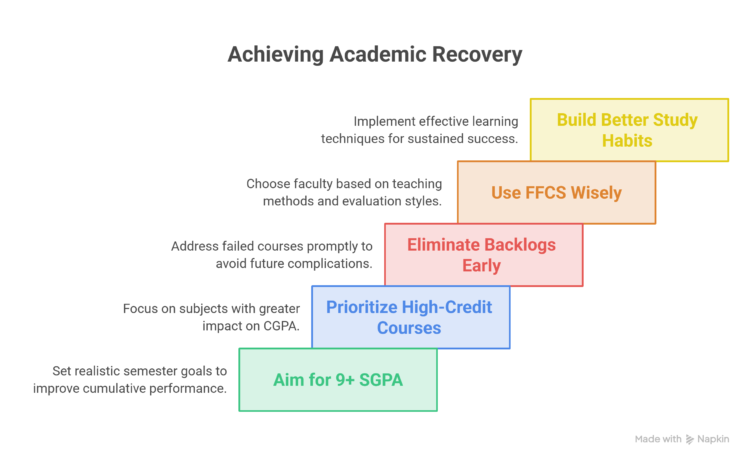
Strategy 1: Aim for 9+ SGPA Every Semester
Higher SGPA improves cumulative performance gradually. Every strong semester raises overall CGPA. Small improvements compound over time. Consistency matters more than perfection.
Students should set realistic semester goals. Tracking progress improves motivation. Strong habits produce repeatable success.
Strategy 2: Prioritize High-Credit Courses
Not every subject influences CGPA equally. High-credit courses create greater impact. Strong performance delivers larger improvements. Therefore, preparation should reflect course importance.
| Course Type | Credits | CGPA Impact |
|---|---|---|
| Core Courses | 4 | High |
| Theory Subjects | 3 | Medium |
| Labs | 1–2 | Lower |
Students should allocate study time wisely. High-impact subjects deserve additional attention. Balanced preparation prevents unnecessary score losses.
Strategy 3: Eliminate Backlogs Early
Backlogs reduce academic flexibility. They also increase future workload. Delaying recovery creates additional pressure. Clearing subjects early simplifies future semesters.
Failed courses often affect confidence. They also influence placement eligibility. Prompt action prevents unnecessary complications.
Students should schedule re-registrations carefully. Completing pending subjects restores academic momentum.
Strategy 4: Use FFCS Wisely
Faculty selection influences classroom experiences. Teaching methods differ considerably. Evaluation styles also vary.
Students should discuss options with seniors. Genuine feedback improves decision-making. Balanced choices support learning and scoring.
Choosing easier faculty alone remains insufficient. Good teaching improves concept clarity. Strong understanding benefits future semesters.
Strategy 5: Build Better Study Habits
Recovery depends upon daily routines. Effective learning methods improve retention. Smart preparation saves valuable time.
Helpful techniques include:
- Active recall.
- Spaced repetition.
- Weekly revision.
- Previous-year questions.
- Group discussions.
Students should follow consistent routines. Small habits create lasting improvement. Strong foundations support every future semester.
How Much Can CGPA Increase?
Many students expect quick improvement. However, recovery takes consistent effort. The remaining credits decide recovery speed. Earlier recovery usually produces better results.
The table below shows realistic examples. These are general academic scenarios. Actual improvement depends on future performance.
| Current CGPA | Target CGPA | Effort Required |
|---|---|---|
| 6.5 | 7.5 | Moderate |
| 7.0 | 8.0 | High |
| 8.0 | 9.0 | Very High |
Students with many semesters remaining recover faster. More pending credits provide greater improvement opportunities. Every high SGPA increases the cumulative average. Small gains gradually become meaningful improvements.
Students near graduation face different challenges. Most credits are already completed. Therefore, every remaining subject becomes more important. Strong performance still improves final CGPA.
Students should avoid unrealistic expectations. Recovery rarely happens after one semester. Consistent academic performance creates lasting improvement. Patience remains equally important.
Get Free Career Guidance with Entri. Click here!
How to Recover From Backlogs in VIT
Quick Answer
Backlogs never permanently ruin CGPA. However, delaying them creates academic difficulties. Clearing failed subjects early supports better recovery. It also improves placement readiness.
Backlogs affect more than grades. They increase future academic pressure. Multiple pending subjects reduce preparation time. Managing them early simplifies future semesters.
Re-register Courses Quickly
Students should avoid postponing failed courses. Early re-registration reduces future workload. It also prevents overlapping academic pressure. Planning becomes much easier afterwards.
Use Summer Semester Opportunities
Summer semesters provide valuable recovery opportunities. Students clear pending subjects earlier. Regular semesters remain less crowded. Academic planning also becomes smoother.
Availability may vary between semesters. Students should verify official announcements.
Prioritize Failed Subjects
Many students delay difficult subjects. This decision increases future pressure. Difficult courses deserve immediate attention. Early success restores academic confidence.
Preparing gradually improves understanding. Continuous practice reduces examination stress.
Avoid Multiple Backlogs
One backlog creates additional workload. Several backlogs create academic pressure. Time management becomes increasingly difficult. Future semester performance may also suffer.
Students should solve problems immediately. Delaying recovery rarely produces benefits.
Study Plan for CGPA Recovery
A structured routine improves consistency. Daily planning prevents unnecessary stress. Regular revision strengthens long-term memory. Small routines create lasting improvement.

Students should follow achievable schedules. Unrealistic plans reduce motivation. Flexible routines remain easier to maintain.
Suggested Daily Study Plan
| Time | Activity |
|---|---|
| Morning | Review notes and difficult concepts. |
| Afternoon | Attend classes and clarify doubts. |
| Evening | Solve problems and revise topics. |
| Weekend | Previous-year questions and mock tests. |
Morning study improves concentration. Reviewing notes strengthens understanding. Difficult concepts become easier gradually.
Classroom learning remains important. Students should ask questions immediately. Doubts become harder later. Active participation improves retention.
Evening revision reinforces learning. Solving problems builds confidence. Practical practice strengthens examination preparation.
Weekends support deeper revision. Mock tests identify weak areas. Previous-year questions improve familiarity. Students also practise time management.
Students should review progress weekly. Small corrections improve consistency. Continuous improvement builds stronger academic performance.
Best Tools to Track CGPA Improvement
Tracking academic progress prevents surprises. Students understand improvement patterns better. Regular monitoring supports better planning. It also improves academic discipline.
VIT CGPA Calculator
- Students should estimate future performance regularly.
- Calculators simplify semester planning.
- They also reduce manual calculation mistakes.
Use the VIT CGPA Calculator here:
VIT SGPA Calculator
- SGPA predicts semester performance.
- Students estimate expected outcomes early.
- Semester planning becomes more accurate.
Attendance Tracker
- Attendance influences internal marks.
- Missing classes creates avoidable risks.
- Regular tracking prevents shortages.
Grade Predictor
- Grade prediction supports realistic expectations.
- Students identify improvement areas earlier.
- Better planning follows naturally.
Semester Planner
- Semester planners organize important deadlines.
- Assignment schedules become easier.
- Students manage workload more effectively.
Students should combine these tools wisely. Regular monitoring encourages consistent academic improvement.
Common Mistakes Students Make
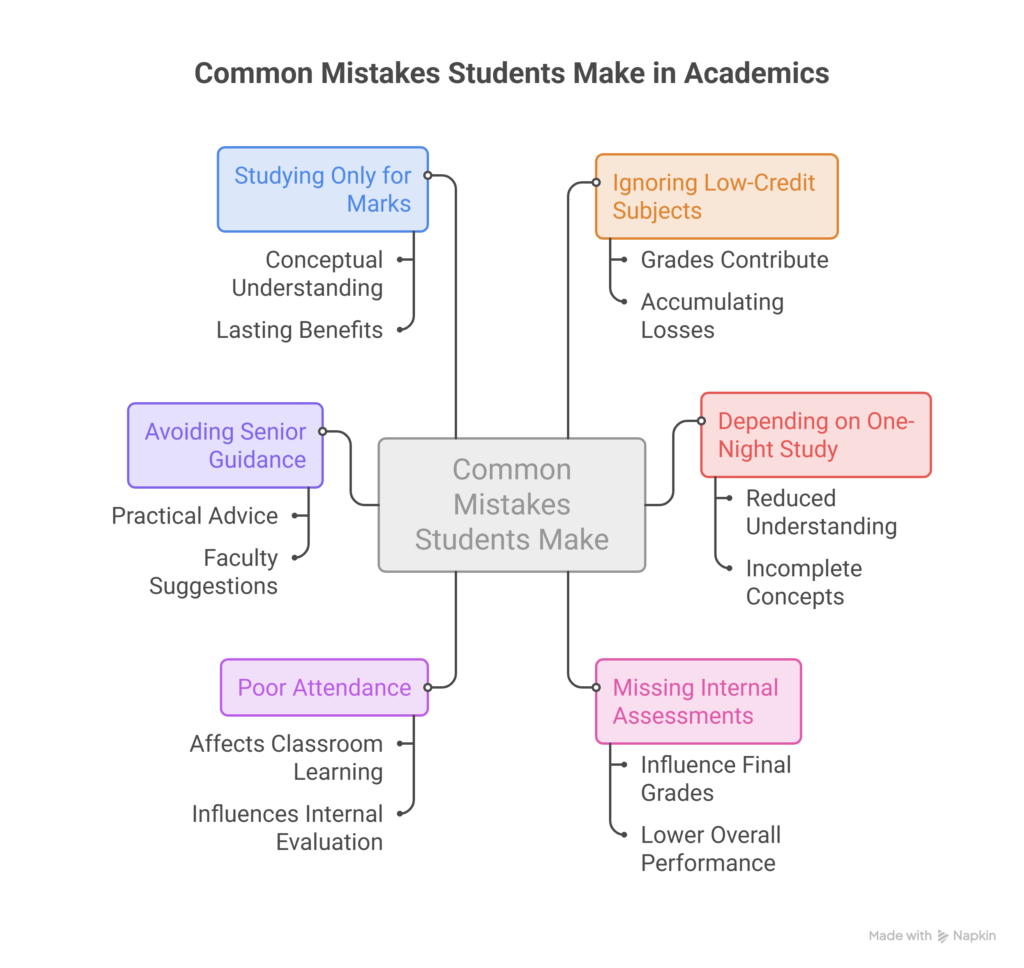
Many students repeat avoidable mistakes. These habits reduce academic performance. Recognizing them prevents future problems.
Ignoring Low-Credit Subjects
- Low-credit subjects still contribute grades.
- Small losses accumulate gradually.
- Every registered subject deserves attention.
Depending on One-Night Study
- Last-minute preparation reduces understanding.
- Important concepts remain incomplete.
- Regular revision produces better retention.
Missing Internal Assessments
- Internal marks influence final grades.
- Missing assessments lowers overall performance.
- Every evaluation deserves equal importance.
Poor Attendance
- Attendance affects classroom learning.
- It also influences internal evaluation.
- Consistent attendance supports stronger performance.
Avoiding Senior Guidance
- Experienced seniors provide practical advice.
- Faculty suggestions also help.
- Learning from others prevents common mistakes.
Studying Only for Marks
- Conceptual understanding creates lasting benefits.
- Memorization alone fades quickly.
- Practical knowledge improves future learning.
Students should correct these habits early. Better decisions produce stronger academic outcomes.
Realistic CGPA Targets
Students often chase unrealistic goals. Practical targets improve motivation. They also simplify academic planning.
| Goal | Recommended CGPA |
|---|---|
| Placement Eligibility | 7+ |
| Good Placement Opportunities | 8+ |
| Dream Companies | 8.5+ |
| Product Companies | 9+ |
| Higher Studies Abroad | 8.5–9+ |
These values provide general guidance. Individual recruiters may follow different requirements. Universities also apply separate admission standards.
Students should improve gradually. Consistent progress remains more achievable. Every semester creates fresh opportunities.
Does CGPA Matter More Than Skills?
Students often compare academics and skills. Both remain important for career success. However, each serves different purposes.
CGPA helps during initial shortlisting. Many recruiters apply eligibility criteria. Strong academic performance increases interview opportunities.
Skills determine interview performance afterwards. Recruiters assess practical knowledge carefully. Communication also influences hiring decisions.
Students should strengthen important abilities.
- Data Structures and Algorithms.
- Practical projects.
- Internship experience.
- Open-source contributions.
- Communication skills.
Balanced preparation creates stronger profiles. Academic performance opens opportunities first. Practical skills convert opportunities into successful careers.
Conclusion
CGPA improvement requires patience and consistency. Every semester creates new opportunities. Strong SGPA gradually raises overall performance. High-credit subjects deserve additional attention. Backlogs require immediate action. Smart planning improves academic confidence. Regular progress tracking supports better decisions. Practical skills strengthen career opportunities. Consistent effort always delivers better long-term results.
|
Coding Courses Offered |
|||||
| Full-Stack Web Developer | Data Science | Python Programming | |||
| Software Testing | DevOps | Data Analytics | |||
| Cyber Security | UI/UX Design | ||||
Frequently Asked Questions
Can I improve my CGPA after 5th semester in VIT?
Yes, improving your CGPA after the 5th semester is possible. Maintaining a high SGPA in the remaining semesters and performing well in high-credit courses can gradually increase your overall CGPA.
Is it possible to reach a 9 CGPA from a 7 CGPA?
Yes, but it depends on the number of remaining semesters and credits. Achieving a 9 CGPA from 7 requires consistently high SGPAs and excellent performance in upcoming semesters.
Do backlogs permanently affect CGPA?
No, backlogs do not permanently prevent CGPA improvement. However, delaying failed subjects can slow recovery and may affect placement or internship eligibility.
Can I recover from one bad semester?
Yes, one poor semester does not determine your final CGPA. Consistent improvement in future semesters can gradually offset the impact of lower grades.
Which semester affects CGPA the most?
Every semester contributes to the final CGPA based on the credits earned. Semesters with more high-credit courses usually have a greater influence on the cumulative average.
Is 8 CGPA enough for placements?
Yes, an 8 CGPA is generally considered good for many campus placements. Several recruiters accept students with this score, although eligibility requirements differ between companies.
Can I improve my CGPA in the final year?
Yes, CGPA can still improve during the final year if credits remain. However, improvement is usually slower because most program credits have already been completed.
How many SGPA points are needed to improve CGPA?
There is no fixed SGPA requirement because improvement depends on your current CGPA and remaining credits. Consistently earning higher SGPAs over multiple semesters usually produces better results.
Should I focus more on high-credit subjects?
Yes, high-credit subjects have a greater impact on your CGPA than low-credit courses. Scoring well in these subjects can improve your cumulative average more effectively.
What is the fastest way to improve CGPA in VIT?
There is no instant method to increase CGPA. The most effective approach is maintaining a high SGPA, avoiding backlogs, prioritizing high-credit courses, and following a consistent study plan every semester.