Table of Contents
Cracking the Enrolled Agent (EA) Exam is a vital step if you want to create a successful career in taxation. The EA certification is the highest accreditation from the IRS, which shows your understanding of U.S. tax laws and ability to represent taxpayers before the IRS. The exam is vast; it covers tax-related topics; however, a good study plan can make the preparation much easier. In this guide, you’ll learn how to ace the Enrolled Agent Exam with proven study techniques, useful tools, and practical strategies to help you prepare confidently and boost your chances of success.
How to Crack the Enrolled Agent Exam?
An intelligent study strategy, materials from the Internal Revenue Service, and consistent practice tests are more important than simply reading theory in order to pass the Enrolled Agent Exam.
The following is the quickest way to get it crack:
Make sure you have a solid understanding of the exam format. Individuals, businesses, and representation and procedures are the three components that make up the EA examination. Due to the fact that each section assesses actual IRS tax knowledge, memorisation alone will not be sufficient; you will need to understand ideas.
How can I answer the EA test questions quickly?
Organise your study time, focus on IRS tools, and do multiple-choice questions every day.
How difficult is the test for Enrolled Agents?
Although there are some mild problems, they are definitely doable with regular practice.
How many hours a week exactly should you spend studying?
Each component should take between 150 and 200 hours.
First, what part of the test should you focus on?
Applicants usually start with Part 1 (Individuals) because it makes more sense.
What are the best study materials?
These include tax guides, study tools, and question banks (like Gleim and Surgent).
Become an Accounting Pro – Learn from Industry Experts!
Key Takeaways:
U.S. tax professionals can demonstrate their competence by passing the Enrolled Agent (EA) Exam, which is run by the IRS. A qualified tax professional can represent clients before the Internal Revenue Service (IRS) thanks to this program.
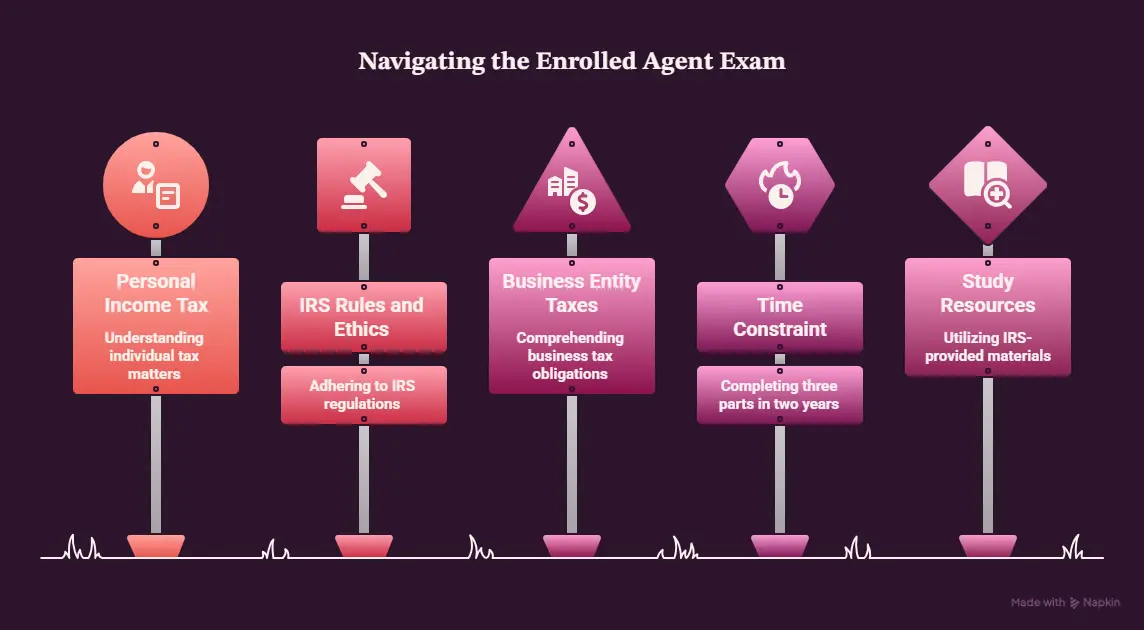
All three of these things are necessary:
- Individuals’ personal income tax-related topics
- Rules, ethics, and processes pertaining to the Internal Revenue Service
- Taxes on entities dealing with businesses
You have two years to complete the three parts of the exam, which is a multiple-choice test administered on a computer.
The majority of applicants can succeed on this exam—which mostly covers US federal tax law—by consistently studying and using resources provided by the IRS.U.S. tax professionals can demonstrate their competence by passing the Enrolled Agent (EA) Exam, which the IRS runs. A qualified tax professional can represent clients before the Internal Revenue Service (IRS) thanks to this program.
How Difficult Is the Enrolled Agent Exam?
1: Accounting provides information on
Although the EA Exam is relatively challenging, it is entirely doable with adequate study.
This is not a test of memorisation but of your ability to comprehend and apply the tax laws of the United States in practical contexts.
Reasons for the difficulty:
- Comprehensive course outline for individuals, companies, and IRS processes
- Questions utilising multiple-choice scenarios
- Has to be well-versed in tax regulations, not merely in their definitions
This is why it is possible:
- No complex calculations needed
- Completely focused on federal tax issues; study sections are modular.
- The IRS provides a straightforward curriculum.
Placement Oriented PWC Business Accounting Course
PWC Certified Business Accounting Course by Entri App: Master in-demand skills, ace interviews, and secure top-tier jobs.
Join Now!10 Proven Tips to Crack the Enrolled Agent Exam

1. Become Familiar with the structure of the examination first.
Before beginning your studies, it is important to have a solid understanding of the sections on individuals, businesses, and representation.
2. Obtain Direct Access to the Contents of the IRS
To avoid relying just on notes or summaries, it is recommended to consult the official publications of the Internal Revenue Service.
3. Do not deviate from a predetermined study schedule.
A consistent timetable should be developed, and your preparation should be broken up into chunks of eight to twelve weeks.
4. Focus on ideas rather than memorisation
What the exam is measuring is not memorisation of tax legislation but rather the ability to apply them.
5. Every day, you should practice problems with multiple-choice answers.
By working through a large number of multiple-choice questions, you can learn the patterns of questions.
6. Get some experience with full-length examinations.
It is important to familiarise yourself with the test setting in order to improve your confidence and speed.
7. Analyse each and every mistake
Not only should you practise, but you should also investigate the reasons why you were wrong.
8. Circular 230 of the Internal Revenue Service and Ethics: Become an Expert
Specifically with regard to Section 3 (Representation), this is of very high importance.
9. Make Alterations on a Regular Basis
Keep going over the fundamentals by reviewing the content that has been covered in the past.
10. Maintain a Consistent Approach While Steering Clear of Interruptions
The most effective method of learning is to engage in short, consistent study periods rather than sporadic, lengthier ones.
Best Study Resources for EA Exam Preparation
In order to aid in your preparation for the Enrolled Agent (EA) Exam, the following are some of the most dependable and efficient resources:
1. IRS Official Materials (Most Important)
Start with the official source: Internal Revenue Service
- IRS Publications (like Pub 17, 334, 542)
- Circular 230 (for Part 3)
These form the core of the exam syllabus.
2. EA Review Courses (Structured Learning)
These give full video lessons, notes, and practice questions:
- Gleim EA Review
- Hock International EA Review
- Surgent EA Review
- Fast Forward Academy
3. Practice Question Banks (Very Important)
- Gleim Test Bank
- Mock Multiple-Choice Questions
- Wiley EA practice questions
Educates you about the timing and questions that are similar to those on exams.
4. Mock Exams
- Comprehensive timed examinations from the producers of reviews
- Enables the development of speed and confidence under pressure
5. IRS Special Enrollment Exam (SEE) Candidate Bulletin
- Clearly explains the rules, format, and structure of the examination
6. YouTube & Free Learning Videos
- Beneficial for the speedy reworking of concepts
- Beneficial for those who learn best through visuals
Recommended Study Plan Based on Your Background
For novices, the overall preparation time is between four and six months.
Background in accounting: two to three months
Working professionals: three to five months with daily study sessions lasting two to three hours
It is suggested that:
- Months 1 and 2: Developing the Concept
- Practice questions for the third month
- Revision and practice exams for the fourth month
Placement Oriented PWC Business Accounting Course
PWC Certified Business Accounting Course by Entri App: Master in-demand skills, ace interviews, and secure top-tier jobs.
Join Now!EA Exam Part-Wise Preparation Strategy
Part 1 (Individuals):
- Pay attention to deductions, credits, and the filing status.
Part 2 (Businesses):
- Learn about the taxation of businesses, entities, and depreciation.
Part 3 (Representation):
- Pay attention to compliance, ethics, and IRS procedures.
Common Mistakes to Avoid During Preparation
- Ignoring articles from the Internal Revenue Service
- Neglecting to take practice tests
- In the eleventh hour, preparations were made.
- An act of memorisation that is performed without comprehension
- An absence of consistent changes
Exam-Day Tips for Higher Scores
- Carefully read over the questions.
- Start by removing the incorrect choices.
- Use your time effectively.
- Be careful not to overthink challenging questions.
- Try your hand at the simpler problems first. Read the questions carefully.
- Start by removing the incorrect choices.
- Use your time effectively.
- Be careful not to overthink challenging questions.
- Prioritise questions that are simple.
Benefits of Following a Structured EA Study Strategy
- A higher percentage of students passing
- Better management of one’s time
- A decrease in stress
- Clear and concise conceptualisation
- Process of revision that is effective
Challenges Candidates May Face While Preparing
1. Large Syllabus
It is possible that the exam will initially feel daunting due to the fact that it covers a wide range of topics related to individuals, businesses, and IRS regulations.
2. Comprehending the Rules of Taxation
The ideas of taxes might be difficult to understand, particularly if you are new to accounting or the taxation system in the United States.
3. Comprehending an Excessive Amount of Particulars
A significant number of candidates struggle because they focus on memorisation rather than trying to comprehend the topics.
4. Difficulty of Examples of Practice Questions
Due to the fact that EA questions are scenario-based, basic reading is not sufficient; an application of information is required.
5. Managing one’s time effectively
Trying to find a balance between studying and working or going to school can be difficult.
6. Keeping a Consistent Opinion
A prolonged period of preparation (weeks or months) can result in a loss of concentration if it is not maintained consistently.
Enrolled Agent vs Other Tax and Accounting Certifications
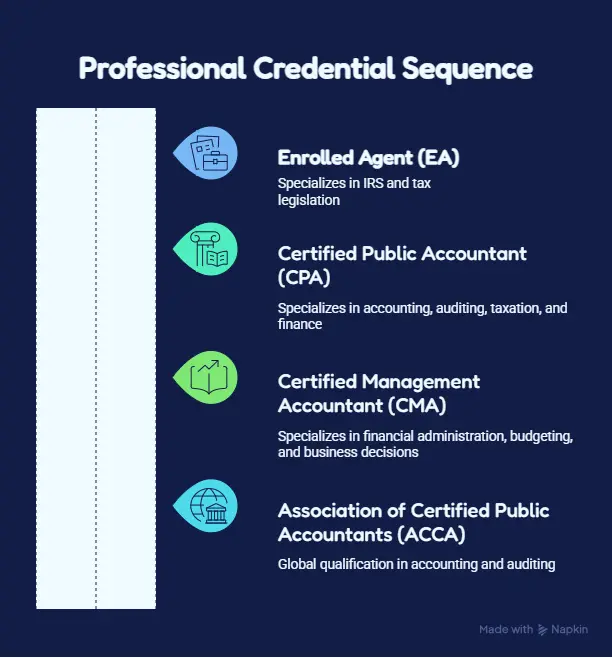
The Enrolled Agent (EA) credential is primarily concerned with issues pertaining to the United States Internal Revenue Service (IRS) and tax legislation. People who are interested in specialising in taxation should do well to consider this option.
Accounting, auditing, taxation, and finance are just some of the areas that are covered by a Certified Public Accountant (CPA), who is a professional who specialises in accounting. In most cases, it is both more challenging and more time-consuming to finish.
Certified administration Accountants (CMAs) are professionals who specialise in the administration of finances, the creation of budgets, and the making of business decisions. Those who are interested in positions in corporate finance are the greatest candidates for this.
The Association of Certified Public Accountants (ACCA) is a qualification that is recognised in many countries throughout the world and gives expertise in accounting and auditing.
Become an Accounting Pro – Learn from Industry Experts!
Final Thoughts
It is very possible to pass the EA exam if you employ the appropriate method. Focus on the materials provided by the IRS, practise on a regular basis, and adhere to an organised study plan. Having the dedication and the ability to revise makes it extremely likely that you will pass all three portions.
Placement Oriented PWC Business Accounting Course
PWC Certified Business Accounting Course by Entri App: Master in-demand skills, ace interviews, and secure top-tier jobs.
Join Now!Frequently Asked Questions
How can I crack the Enrolled Agent Exam on my first attempt?
To crack the Enrolled Agent Exam on your first attempt, follow a structured study plan, use IRS materials, practice MCQs regularly, and take mock exams.
What is the best way to prepare for the Enrolled Agent Exam?
The best way to prepare is to study the exam syllabus thoroughly, use a reputable EA review course, and practice with exam-style questions.
How difficult is the Enrolled Agent Exam?
The EA Exam is considered moderately difficult because it covers a wide range of tax topics and requires the application of tax laws to real-world scenarios.
How long does it take to study for the Enrolled Agent Exam?
Most candidates spend between 8 and 12 weeks preparing for each part of the EA Exam, depending on their experience and available study time.
What are the best study resources for EA Exam preparation?
Popular resources include IRS publications, Circular 230, EA review courses, practice question banks, and full-length mock tests.
Can beginners pass the Enrolled Agent Exam?
Yes, beginners can pass the EA Exam with consistent study, a structured preparation strategy, and regular practice.
Is the Enrolled Agent certification worth it?
Yes, the EA certification is highly valued for tax professionals because it demonstrates expertise in U.S. taxation and allows representation before the IRS.