
Table of Contents
Key Answer
Both F grade and N grade indicate unsuccessful course completion in VIT. An F grade usually means academic failure. An N grade usually means grading ineligibility because of attendance shortage or related academic regulations. F grade as well as N grade receive zero grade points. Both affect SGPA and CGPA. Both require course re-registration for successful completion.
Check out Entri’s free coding courses now!
Introduction
Receiving an F or N grade worries many students. However, both grades have different meanings. Understanding these differences prevents unnecessary confusion. An F grade reflects academic failure. An N grade usually reflects grading ineligibility. Both affect semester performance. Both also influence overall CGPA. Knowing their impact helps students recover quickly.

What Is an F Grade in VIT?
Quick Answer
An F grade means the student failed the course academically. The required passing criteria were not achieved. The course must usually be registered again.
An F grade reflects academic performance only. Students receive this grade after failing course requirements. Poor internal marks may contribute. Low end-semester examination marks may also contribute.
Passing requires satisfying university evaluation rules. Students who fail these requirements receive an F grade. The subject remains incomplete until cleared successfully.
An F grade carries zero grade points. Therefore, it immediately lowers semester performance. High-credit subjects create greater academic impact. Core subjects often influence SGPA more strongly.
Students cannot ignore an F grade. The course normally requires re-registration. Future semesters include another attempt. Better performance improves academic progress.
Why Do Students Receive an F Grade?
Several reasons commonly lead to failure.
- Low internal assessment marks.
- Poor end-semester examination performance.
- Weak subject understanding.
- Insufficient preparation.
- Missing important assessments.
Different students experience different challenges. Identifying the real reason supports better recovery.
What Happens After Receiving an F Grade?
Receiving an F grade creates a backlog. Students usually register the course again. They attend classes again. They complete assessments again.
The previous performance highlights improvement areas. Students should strengthen weaker concepts. Better preparation increases passing chances.
What Is an N Grade in VIT?
Quick Answer
An N grade usually means regular grading was not awarded. Attendance shortage or related academic regulations commonly cause this grade. Students normally need course re-registration.
Many students confuse F and N grades. However, their causes differ completely. Academic performance usually causes F grades. Eligibility issues generally cause N grades.
Attendance plays an important role. Falling below required attendance limits may result in an N grade. Students then become ineligible for normal evaluation.
Certain academic or disciplinary situations may also result in an N grade, depending on university regulations. Students should always follow official academic policies.
Like an F grade, an N grade carries zero grade points. Therefore, it also reduces SGPA and CGPA.
Why Do Students Receive an N Grade?
Common reasons include:
- Attendance shortage.
- Academic ineligibility.
- Regulation-related grading restrictions.
- Other university-approved disciplinary situations.
Students should verify official regulations. Exact situations may differ under university policies.
How Can Students Avoid an N Grade?
Maintaining attendance remains the simplest solution. Students should monitor attendance regularly. Missing too many classes creates unnecessary risks.
Good attendance also improves classroom understanding. Better participation supports stronger academic performance.
F Grade vs N Grade in VIT
Although both grades receive zero points, their causes remain different. Understanding these differences helps students respond appropriately.
| Feature | F Grade | N Grade |
|---|---|---|
| Reason | Failed academically | Attendance shortage or other ineligibility |
| Grade Point | 0 | 0 |
| Affects SGPA | Yes | Yes |
| Affects CGPA | Yes | Yes |
| Requires Re-registration | Yes | Yes |
| Considered Backlog | Yes | Yes |
Academic Reason
An F grade results from academic failure. Students do not satisfy passing requirements. An N grade usually results from grading ineligibility. Attendance commonly becomes the deciding factor.
Grade Points
Both grades receive zero grade points. Therefore, neither contributes positive academic value. Both reduce the semester average immediately.
Academic Progress
Both grades create backlogs. Students normally complete the course again. Clearing subjects quickly prevents future complications.
Future Planning
Students should understand the actual cause. Academic weaknesses require better preparation. Attendance problems require improved discipline. Different problems need different solutions.
Which Is Worse – F Grade or N Grade?

Many students ask this question. The answer depends upon the situation. Academically, both grades receive zero grade points. Therefore, both reduce SGPA similarly.
Both grades also create backlogs. Students must usually register those courses again. Graduation planning may become more difficult. Academic workload also increases.
However, an N grade often highlights attendance problems. This may indicate poor academic discipline. Repeated attendance shortages create unnecessary risks throughout college.
An F grade usually reflects learning difficulties. Students can improve through better preparation. Extra practice often solves academic weaknesses.
Employers generally review overall academic records. Final CGPA receives greater attention. Successfully cleared backlogs also demonstrate improvement.
Students should avoid comparing grades unnecessarily. The real priority involves recovery. Clearing pending courses early produces better long-term outcomes.
How Do F Grade and N Grade Affect SGPA?
SGPA depends upon credits and grade points. Every registered course contributes. Zero grade points reduce the weighted average immediately.
Consider the following example.
| Subject | Credits | Grade |
|---|---|---|
| Mathematics | 4 | A |
| Physics | 3 | B |
| Programming | 4 | F |
| English | 2 | S |
Programming carries four credits. However, the F grade contributes zero points. Those credits receive no positive academic value. Therefore, overall SGPA decreases noticeably.
The same principle applies to N grades. Zero grade points reduce weighted scores. High-credit subjects produce greater reductions.
Students often focus only on grades. Credits matter equally. Strong performance in high-credit courses supports faster recovery.
How Do F Grade and N Grade Affect CGPA?
CGPA combines results from every completed semester. Therefore, every failed course influences future performance. An F or N grade contributes zero grade points. This lowers the cumulative academic average.
Recovery depends upon remaining semesters. Students with many pending credits recover faster. Final-year students have fewer recovery opportunities. Early action always provides greater flexibility.
One failed subject creates limited impact. Multiple failed subjects create greater challenges. High-credit backlogs reduce CGPA more noticeably. Therefore, clearing important subjects should become the first priority.
Why Does Recovery Become Harder Later?
Recovery slows during final years. Most credits remain already completed. Every remaining course carries greater pressure. Students have fewer chances for improvement.
Students should avoid delaying recovery because:
- Remaining credits become fewer.
- CGPA changes more slowly.
- Placement season approaches.
- Academic pressure increases.
- Backlogs become harder to manage.
How Do High-Credit Courses Affect CGPA?
Not every subject carries equal weight. Core courses usually have higher credits. Better grades improve CGPA faster. Poor grades create greater reductions.
For example:
- Core course (4 credits): Larger CGPA impact.
- Theory course (3 credits): Moderate impact.
- Lab course (1–2 credits): Smaller impact.
Students should identify these subjects early. Extra preparation creates better academic returns.
Practical Recovery Tips
Students should recover systematically.
- Clear backlogs immediately.
- Target higher SGPA every semester.
- Prioritize high-credit courses.
- Track CGPA after every result.
- Avoid repeating failed subjects.
Small improvements accumulate steadily. Consistent progress produces stronger final CGPA.
Get Free Career Guidance with Entri. Click here!
Do F Grade and N Grade Affect Placements?
Many students fear losing placement opportunities. However, one backlog rarely ends careers. Most companies evaluate complete candidate profiles. Eligibility rules also differ considerably.
Some recruiters allow cleared backlogs. Others require zero active backlogs. Competitive companies often apply stricter academic filters. Therefore, students should verify company requirements carefully.
Placement Eligibility
Campus recruiters commonly announce eligibility criteria.
These may include:
- Minimum CGPA requirement.
- Maximum active backlogs.
- Cleared backlog conditions.
- Academic consistency.
- Graduation eligibility.
Requirements vary between recruiters. Students should never assume identical policies.
Internship Opportunities
Internship eligibility also differs.
Some companies accept backlog history. Others require stronger academic records. Practical projects improve applications further.
Students should strengthen their resumes through:
- Technical projects.
- Internship experience.
- Open-source contributions.
- Hackathons.
- Industry certifications.
Dream and Product Companies
Product companies often receive many applications. Academic filtering becomes more common. Strong CGPA improves shortlisting chances. Cleared backlogs strengthen student profiles.
However, technical interviews remain equally important. Coding ability often determines final selection.
Off-Campus Opportunities
Off-campus hiring follows different rules. Many startups focus upon practical skills. Several companies ignore previous backlog history. Strong portfolios create competitive advantages.
Students should continue applying confidently. One academic setback never defines future success.
Can F Grade Be Removed?
An F grade does not remain permanent academically. Students usually receive another opportunity. Re-registering the course allows fresh evaluation. Better performance completes graduation requirements.
Students should avoid delaying re-registration. Early completion reduces future workload. It also improves academic confidence. Waiting usually increases semester pressure.
Steps to Recover From an F Grade
Follow a structured approach.
- Identify previous mistakes.
- Re-register the failed course.
- Attend every class regularly.
- Complete every internal assessment.
- Revise topics every week.
- Practice previous-year questions.
- Prepare early for examinations.
How Does Re-registration Help?
Re-registration provides another chance. Students understand difficult topics better. Previous mistakes become learning opportunities. Better preparation improves final grades.
Clearing failed subjects also offers several benefits.
- Reduces backlog pressure.
- Improves future SGPA.
- Supports gradual CGPA recovery.
- Strengthens placement eligibility.
- Builds academic confidence.
Students should remain patient throughout recovery. Strong academic habits produce lasting improvement.
Can N Grade Be Removed?
An N grade also requires immediate attention. Students should never ignore attendance-related problems. Early action prevents additional academic pressure. Recovery becomes easier with proper planning.
Students usually recover through course re-registration. Completing every course requirement successfully helps continue academic progress. However, preventing another N grade remains equally important.
Why Do Students Receive Repeated N Grades?
Many students overlook attendance regularly. Others misunderstand attendance calculations. Some depend upon medical leave approvals. These situations create avoidable academic problems.
Students should avoid these habits.
- Missing consecutive classes.
- Ignoring attendance warnings.
- Depending upon attendance condonation.
- Skipping laboratory sessions.
- Assuming attendance improves automatically.
Build Better Attendance Habits
Simple habits prevent unnecessary problems.
- Check attendance every week.
- Attend important practical sessions.
- Inform faculty during genuine emergencies.
- Track attendance before examinations.
- Maintain attendance above required limits.
Regular attendance offers additional benefits. Classroom participation improves concept clarity. Continuous learning reduces examination stress. Students also perform better during internal assessments.
How to Recover From F or N Grade
Recovering requires a structured plan. Random effort rarely produces consistent improvement. Every semester should have clear academic goals. Small improvements gradually rebuild confidence.
Students should focus upon solving one problem first. Managing everything together creates unnecessary pressure. A step-by-step approach produces better results.
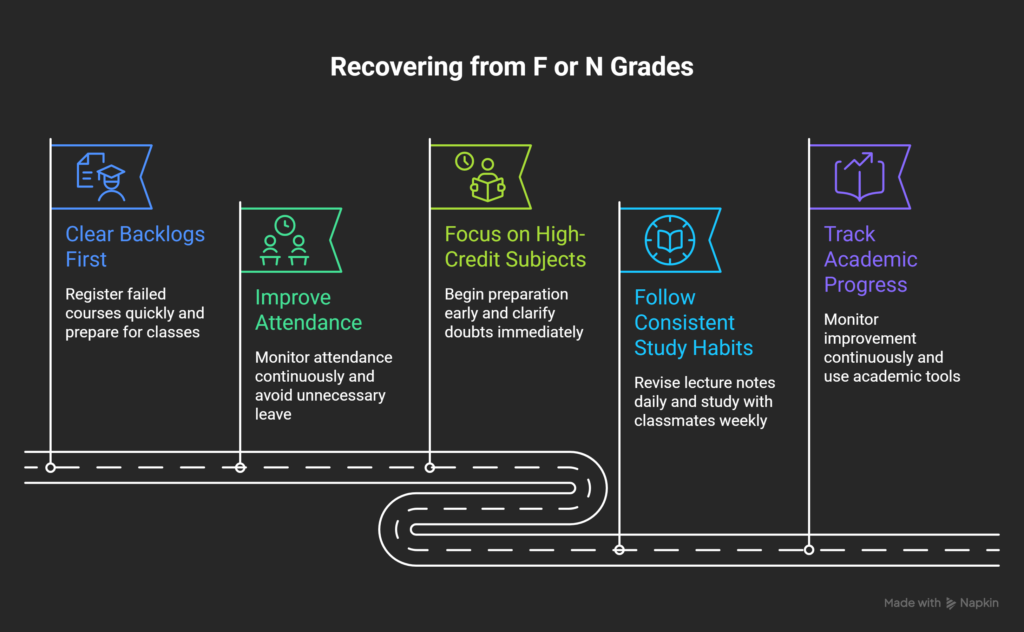
Strategy 1: Clear Backlogs First
Pending subjects deserve immediate attention. Delaying them increases future workload. Clearing backlogs early simplifies later semesters.
Students should:
- Register failed courses quickly.
- Prepare before classes begin.
- Revise difficult topics weekly.
- Complete every assessment seriously.
Strategy 2: Improve Attendance
Attendance remains completely controllable. Students should monitor it continuously. Weekly tracking prevents unexpected shortages.
Helpful habits include:
- Review attendance every Friday.
- Avoid unnecessary leave.
- Attend laboratory sessions.
- Complete attendance requirements early.
Strategy 3: Focus on High-Credit Subjects
Core subjects influence CGPA significantly. Better performance creates larger improvements. Additional preparation produces better academic returns.
Students should:
- Begin preparation early.
- Practise numerical problems regularly.
- Revise difficult units repeatedly.
- Clarify doubts immediately.
Strategy 4: Follow Consistent Study Habits
Recovery depends upon discipline. Last-minute preparation rarely succeeds. Small daily efforts produce stronger understanding.
Build simple routines.
- Revise lecture notes daily.
- Solve previous-year questions.
- Study with classmates weekly.
- Create monthly revision goals.
Strategy 5: Track Academic Progress
Students should monitor improvement continuously. Tracking motivates consistent performance. Small improvements become visible quickly.
Useful tools include:
- VIT CGPA Calculator.
- SGPA Calculator.
- Semester Planner.
- Attendance Tracker.
- Grade Predictor.
Students can estimate future performance using the Entri’s VIT CGPA Calculator.
Tracking progress improves planning. It also helps students set realistic semester goals.
Common Mistakes Students Make
Many students repeat similar mistakes. Avoiding these habits supports faster recovery. Better decisions create stronger academic outcomes.
Ignoring Attendance
Students often monitor attendance too late. Recovery then becomes difficult. Weekly tracking prevents unnecessary N grades.
Delaying Re-registration
Some students postpone failed subjects. Future semesters become more demanding. Early completion reduces academic pressure.
Accumulating Multiple Backlogs
One backlog remains manageable. Several backlogs increase workload significantly. Time management becomes much harder.
Studying Only Before Exams
Last-minute preparation weakens understanding. Important concepts remain incomplete. Regular revision produces better results.
Ignoring Internal Assessments
Internal marks contribute significantly. Missing assignments reduces final grades. Every assessment deserves equal attention.
Avoiding Faculty Guidance
Many students hesitate asking questions. Faculty guidance improves understanding quickly. Senior advice also supports better planning.
Neglecting Laboratory Courses
Laboratory credits also matter academically. Practical performance affects semester grades. Regular practice improves confidence.
Depending Only on Memory
Memorization alone creates short-term learning. Conceptual understanding improves long-term performance. Practical application strengthens retention.
Quick Recovery Checklist
Students should review these points regularly.
- Clear backlogs immediately.
- Monitor attendance weekly.
- Prioritize high-credit subjects.
- Complete internal assessments.
- Revise every week.
- Track CGPA after results.
- Seek guidance whenever required.
Following this checklist builds consistency. Consistency creates stronger academic recovery.
Conclusion
F and N grades have different causes. However, both affect academic progress similarly. Both reduce SGPA and CGPA. Both usually require course re-registration. Early recovery produces better results. Strong attendance prevents unnecessary N grades. Better preparation reduces F grades. Consistent effort improves future performance. Smart planning supports long-term academic success.
|
Coding Courses Offered |
|||||
| Full-Stack Web Developer | Data Science | Python Programming | |||
| Software Testing | DevOps | Data Analytics | |||
| Cyber Security | UI/UX Design | ||||
Frequently Asked Questions
Is N grade worse than F grade in VIT?
No. Both carry zero grade points and affect SGPA and CGPA. An N grade usually results from attendance shortage, while an F grade indicates academic failure.
Does F grade permanently affect CGPA?
No. Re-registering the course and performing well later can gradually improve your overall CGPA.
Can I sit for placements with backlog history?
Yes. Many companies accept students with cleared backlogs. However, some recruiters do not allow active backlogs.
Does N grade mean attendance shortage?
Usually, yes. It commonly indicates attendance shortage or another academic ineligibility under university regulations.
Can re-registration improve CGPA?
Yes. Completing the course successfully after re-registration can improve your future CGPA.
Are F and N grades shown on transcripts?
Academic records follow VIT regulations. Refer to the latest university guidelines for transcript-related information.
How many backlogs are allowed in VIT?
The limit depends on university and company policies. Always check the latest official guidelines.
Can I recover from multiple F or N grades?
Yes. Clearing backlogs early and maintaining higher SGPAs can improve your academic record over time.
Do F and N grades affect internship opportunities?
Some companies consider active backlogs. Others focus more on skills and overall academic performance.
How can I avoid getting F or N grades in VIT?
Maintain good attendance, study regularly, and complete all assessments on time.