Table of Contents
Search has swung away from relying on exact keywords towards a focus on meaning and intent. Modern algorithms now give more weight to semantic clarity, depth of topic knowledge, the scope of information covered, whether the content delivers what the user is looking for rather than just counting how many times the right keywords get mentioned.
Learn the fundamentals of digital marketing! Join the Course today!
Key Takeaways
- From keywords to meaning: Rank by intent, not exact words.
- Embeddings power meaning: Text → vectors.
- Cosine similarity explains matching: Compare vector directions.
- Vector databases are essential: Store embeddings for fast search.
- Content strategy shifts: Prioritize topics and entities.
- Practical impact: Answer intent, cover related subtopics.
- Future-facing SEO: Learn embeddings and RAG.
The Context
1: What is the primary goal of SEO (Search Engine Optimization)?
Text is now fed into some super clever maths to turn it into numerical vector embeddings. The upshot of this is that words or phrases that mean the same thing are actually represented on a kind of invisible graph as being more or less next door to each other. When looking for similar meanings, you can then do a comparison with something called cosine similarity to find the closest match.
These vector embeddings are indexed in special databases that let you do very speedy lookups, and models like BERT and GPT are being used to create them in the first place for all sorts of applications including search, recommendations and chat.
So, with the old ways of ‘stuffing’ pages with keywords well and truly out the window – it’s all now about creating clusters of content around topics and making sure you cover all the key entities as well as linking and ‘labelling’ the content so search engines know what’s what
Become an AI-powered Digital Marketing Expert
Master AI-Driven Digital Marketing: Learn Core Skills and Tools to Lead the Industry!
Explore CourseThe Shift from Keywords to Meaning

Search engines no longer depend only on exact keyword matching. Modern search systems increasingly understand meaning, intent, entities, and contextual relationships between words.
Earlier search algorithms focused mainly on lexical relevance. Pages ranked based on keyword repetition, exact phrases, and traditional matching signals. While effective for direct queries, these systems struggled to understand the user intent behind different search variations.
As search behaviour evolved, users began searching in natural language rather than predictable keyword patterns. This pushed search engines toward semantic understanding.Modern retrieval systems now attempt to identify:
- User intent
- Contextual meaning
- Entity relationships
- Semantic similarity between queries
This evolution introduced semantic retrieval into modern search. Technologies like knowledge graphs, language models and AI driven contextual systems have really accelerated this shift and given us a whole new set of tools to work with.
Nowadays, visibility in search isn’t just about chucking in the right keywords any more. It’s also about clarity of meaning, the depth of what you’re offering and the relationships between different pieces of content. Also, getting that all right means making sure you’re using all the right tools for the job.
What are Vector Embeddings
Search engines and AI just don’t understand words in the same way that humans do. To make them do some kind of intelligence with it, they have to be converted into numerical values. It’s basically a numerical representation of words, entities, phrases and documents which we call vector embeddings.
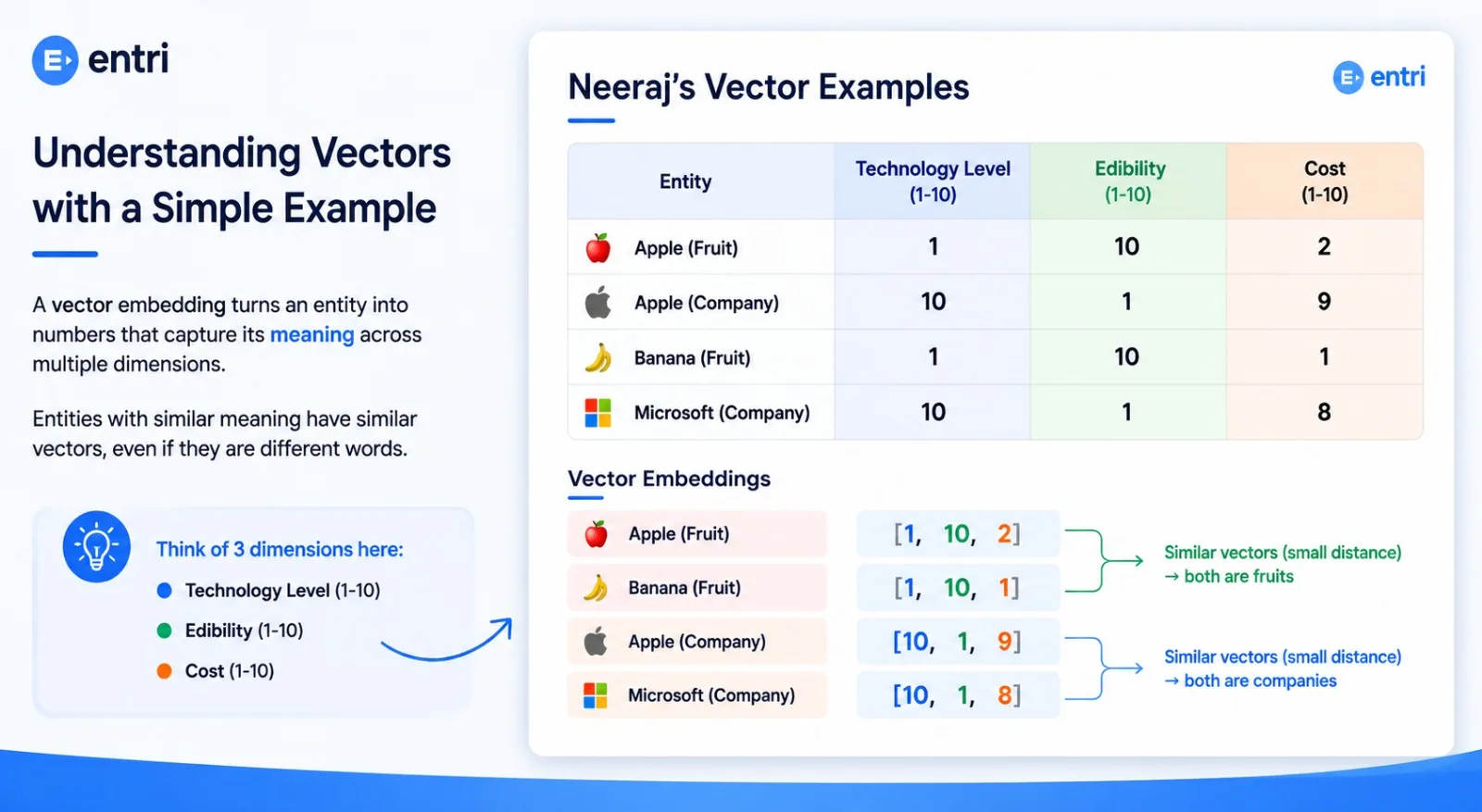
As shown in the example above, each entity is represented using multiple dimensions or attributes. Here, attributes like technology level, edibility, and cost are converted into numerical values.
or example:
- Apple (Fruit) → [1,10,2]
- Banana (Fruit) → [1,10,1]
- Apple (Company) → [10,1,9]
- Microsoft (Company) → [10,1,8]
These numbers form vectors.
When entities share similar characteristics, their vectors stay closer together in vector space. That is why Apple (Fruit) and Banana (Fruit) appear semantically closer, while Apple (Company) and Microsoft (Company) form another related cluster.
The same concept applies in semantic search.For example:
- Government job openings for graduates
- Public sector vacancies after a degree
Use different wording but carry similar intent. Semantic retrieval systems identify this similarity through vector embeddings rather than exact keyword matching.
Modern language models like BERT and GPT generate these embeddings by analyzing contextual relationships between words, entities, and phrases. This allows search systems to retrieve content based on meaning, semantic relevance, and user intent instead of relying only on exact keywords.
What is a Vector Database?
A vector database is a system designed to store and retrieve vector embeddings efficiently.
In traditional databases, information is usually retrieved through exact values, tags, or keyword-based matching. Vector databases work differently. They retrieve information based on similarity between vectors.
Using the previous example:
- Apple (Fruit) → [1,10,2]
- Banana (Fruit) → [1,10,1]
Both vectors stay close because their attributes are semantically similar. In contrast:
- Apple (Company) → [10,1,9]
- Microsoft (Company) → [10,1,8]
form another related cluster.
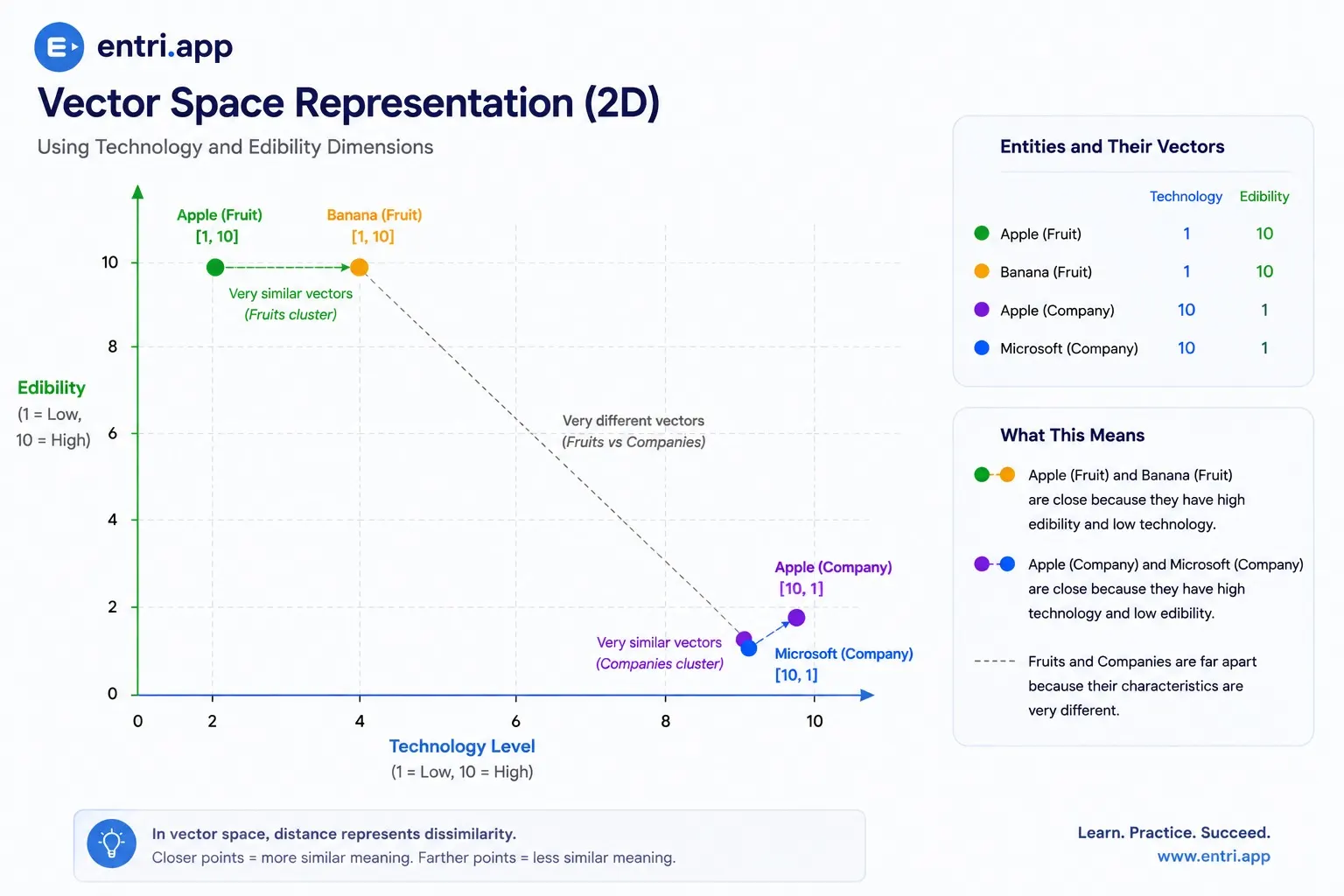
A vector database identifies these relationships by measuring the distance between vectors inside a multi-dimensional space. Similar vectors stay closer, while unrelated vectors stay farther apart.
This becomes important in semantic search because search systems no longer retrieve information only through exact keyword matching. Instead, they retrieve semantically related content based on contextual similarity and intent.
Become an AI-powered Digital Marketing Expert
Master AI-Driven Digital Marketing: Learn Core Skills and Tools to Lead the Industry!
Explore CourseUnderstanding Cosine Similarity
Cosine similarity measures how closely two vectors point in the same direction in vector space.
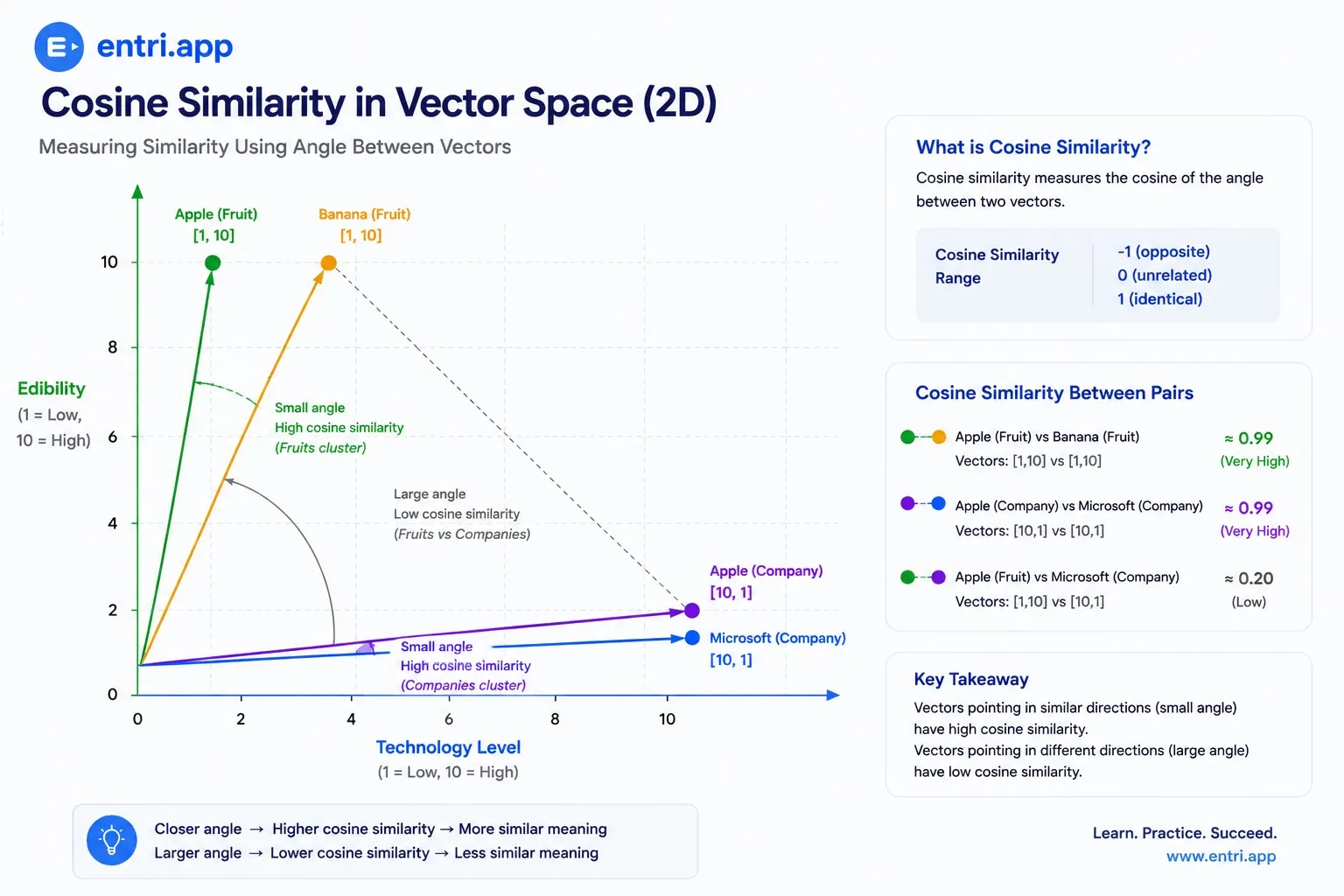
In the graph above, each entity is represented as a vector starting from the origin point (0,0).
- Apple (Fruit) and Banana (Fruit) point in nearly the same direction because both have high edibility and low technology values. The angle between them is very small, resulting in high cosine similarity.
- Apple (Company) and Microsoft (Company) also point in a similar direction because both have high technology relevance and low edibility. This forms another high-similarity cluster.
- However, fruit vectors and company vectors point in very different directions. The angle between them becomes much larger, resulting in lower cosine similarity.
This is the core idea behind semantic retrieval systems.
Cosine similarity does not focus on exact words. Instead, it measures directional similarity between vectors to identify entities, queries, or documents that carry related meaning. Because of this, modern AI retrieval systems can understand that differently written
What is Semantic Search?
Semantic search is a search approach that retrieves information based on meaning, contextual relevance, and intent rather than relying only on exact keyword matching.
Traditional search systems mainly depended on lexical matching, where pages ranked based on repeated keywords or exact phrases. Semantic search works differently. It attempts to understand how closely queries, entities, and documents relate inside vector space.
For example:
- Government job openings for graduates
- Public sector vacancies after a degree
Use completely different wording but represent similar intent.
In semantic systems, both queries are converted into vector embeddings. Since their vectors point in similar directions inside vector space, cosine similarity between them becomes higher. This allows the system to cluster both queries under similar contextual meaning.
Because of this, semantic search systems understand that both searches relate to:
- government jobs
- graduate-level opportunities
- public sector recruitment
even without exact keyword matches.
How Semantic Search Works
Semantic search systems first convert queries and documents into vector embeddings.
When a user searches, the query itself becomes a vector. The system then compares this vector with stored content vectors inside vector space using cosine similarity.
Content with vectors pointing in similar directions gets identified as semantically relevant. This allows modern search engines and AI retrieval systems to retrieve results based on:
- semantic similarity
- contextual meaning
- entity relationships
- user intent
instead of depending only on repeated keywords or exact phrase matching.
Vector Databases and AI Retrieval Systems
Vector databases became important as search systems shifted toward semantic retrieval and AI-driven responses.
Traditional databases retrieve information through exact values or keyword-based matching. Vector databases work differently. They retrieve content based on semantic similarity between embeddings.
When a query enters the system, it is converted into a vector embedding. The vector database then identifies nearby vectors with higher cosine similarity and retrieves contextually related content.For example, if a user searches:
- Government job openings for graduates
The system can also retrieve content related to:
- Public sector vacancies after a degree
because both queries remain semantically closer in the vector space.
This retrieval approach is now widely used in:
- AI search systems
- recommendation engines
- Retrieval Augmented Generation (RAG)
- conversational AI platforms
- semantic document retrieval
For SEO professionals, this evolution changes how content gets discovered. Modern retrieval systems increasingly prioritize semantic relationships, contextual relevance, and topical understanding rather than relying only on repeated keyword patterns.
Understanding these concepts is becoming increasingly important in modern SEO education and advanced SEO courses, especially as AI-driven retrieval systems continue influencing search visibility and content discovery.
Learn the fundamentals of digital marketing! Join the Course today!
How Semantic Search Changes Content Strategy
Semantic search has significantly changed how SEO content should be planned, structured, and optimized.
Earlier content strategies mainly focused on inserting exact keywords across headings, paragraphs, and anchor texts. Modern semantic systems evaluate whether the content fully covers the topic contextually.
For example, content targeting:
- Government job openings for graduates
may also need contextual coverage around:
- public sector recruitment
- graduate eligibility
- competitive exams
- government career opportunities
- PSC hiring
This helps search systems understand topical relationships and semantic completeness.
As semantic retrieval evolves, content optimization increasingly depends on:
- entity coverage
- topical clustering
- contextual internal linking
- semantic relevance
- intent satisfaction
rather than isolated keyword repetition.
This is one reason modern SEO strategies increasingly focus on topical authority and semantic depth instead of single-keyword optimization.
Conclusion
What we now know as semantic search has dramatically changed the way people find stuff.
With vector embeddings, cosine similarity and vector databases on board, search engines (and AI systems in general) can now match what the user is looking for with what’s being offered by meaning rather than just relying on exact keywords. That’s meant that SEO has to adapt so it’s now about getting the underlying meaning of your content right, rather than just playing keyword tricks.
As AI retrieval evolves, optimization moves from keyword tricks to building semantic knowledge. So, SEO practitioners should learn embeddings, vector search, and RAG-ready content design to stay competitive.
Frequently Asked Questions
What is the difference between keyword-based search and semantic search?
Keyword search matches exact words. Semantic search understands intent and meaning so different wording can return the same results.
Why are exact keywords no longer enough to rank in search?
Search now evaluates semantic clarity, topic depth, and whether content satisfies intent. Keyword stuffing no longer guarantees visibility.
What are vector embeddings and why do they matter for SEO?
Embeddings are numeric representations of text that capture meaning. They let search systems find contextually related content instead of relying on exact words.
How does cosine similarity work in semantic search?
Cosine similarity measures how closely two vectors point in the same direction. Higher alignment means higher semantic relevance.
How do models like BERT and GPT contribute to modern search?
They generate contextual embeddings by analysing word relationships. Those embeddings help match varied queries with the same intent.
How should content strategy change in response to semantic search?
Build topic clusters, cover related entities, and use contextual internal links. Focus on satisfying intent rather than repeating phrases.
Can two pieces of content with different wording rank for the same query?
Yes. If their embeddings are semantically close and they satisfy the same intent, both can rank.
What role does user intent play in modern search ranking?
Intent is a primary ranking signal. Content that matches user intent is favoured over content that only contains keywords.
How do recommendation engines and conversational AI relate to semantic search?
They use embeddings and similarity metrics like search does. All three match meaning, enabling cross-surface content reuse.
What skills should SEO professionals develop to stay competitive in an AI-driven search landscape?
Learn embeddings, vector search basics, topical modelling, and RAG-friendly content design. These skills help create content that ranks in semantic systems.