Table of Contents
Automation Engineers design and maintain automated systems. They improve efficiency, quality, and productivity. Their work combines hardware, software, and control systems. Many industries depend on automation today. This makes Automation Engineering a valuable career choice.
Key Takeaways:
- Automation Improves Industrial Efficiency:
- Automation reduces repetitive manual work.
- Production processes become faster and more consistent.
- Technical Skills Drive Career Growth:
- PLC and SCADA skills remain important.
- Strong fundamentals support long-term career success.
- Multiple Industries Hire Automation Engineers:
- Many sectors use automated systems today.
- Career opportunities remain widely available.
- Industry 4.0 Creates New Opportunities:
- Smart factories continue expanding globally.
- Advanced automation skills are increasingly valuable.
- Continuous Learning Supports Career Progression:
- Technology changes rapidly across industries.
- Updated skills improve future opportunities.
- Automation Remains a Growing Field:
- Businesses continue investing in automation.
- Demand for professionals remains strong.
🚀 Why Automation Engineering is Becoming a High-Demand Career
Automation plays a larger role today. Industries seek greater efficiency and accuracy. Automated systems help achieve these goals. This drives demand for skilled professionals.
Organizations now automate many operations. Production, logistics, and monitoring are examples. Automation Engineers help implement these solutions.
New to Robotics? Start from the Basics. Join Now!
Growing Need for Automation Across Industries
Automation adoption continues increasing worldwide. Businesses seek faster and safer operations. Automated systems improve productivity significantly. They also reduce operational costs.
Common applications include:
- Manufacturing automation.
- Warehouse automation.
- Process automation.
- Industrial robotics.
- Smart production systems.
Growing adoption creates new opportunities.

Industry 4.0 and Digital Transformation
Industry 4.0 combines automation with technology. Connected devices share information continuously. Data helps improve decision-making processes.
Important technologies include:
- Industrial IoT.
- Artificial Intelligence.
- Robotics.
- Cloud platforms.
- Smart sensors.
Automation Engineers support these transformations.
How Businesses Benefit from Automation
Automation delivers several business advantages. Operations become more efficient and reliable. Quality also improves significantly.
Benefits include:
- Increased productivity.
- Reduced human errors.
- Better product quality.
- Faster production cycles.
- Lower operating costs.
Industry Trends
- Smart factories continue expanding globally.
- Industrial robot adoption keeps increasing.
- IoT devices become more common.
- Logistics automation grows rapidly.
- Digital transformation investments remain strong.
👨💻 Who is an Automation Engineer?
Automation Engineers develop automated solutions. Their work reduces manual intervention. Businesses use automation to improve performance.
These professionals combine engineering and technology. They work with machines, software, and control systems. Their expertise supports efficient operations.
Definition and Core Role
An Automation Engineer designs automated systems. They also configure and maintain equipment. Their goal is improving efficiency and reliability.
Core responsibilities include:
- System design.
- PLC programming.
- Process automation.
- System monitoring.
- Equipment maintenance.
- Troubleshooting.
Automation Engineers improve operational performance.
Where Automation Engineers Work
Automation Engineers work in many environments. Opportunities exist across different industries.
Common workplaces include:
- Manufacturing facilities.
- Industrial plants.
- Engineering firms.
- Technology companies.
- Energy facilities.
- Research centers.
Many roles involve field work.
Industries that Hire Automation Engineers
Automation technologies support many industries. Demand remains strong across multiple sectors.
Manufacturing
Examples include:
- Assembly lines.
- Packaging systems.
- Production facilities.
- Quality control systems.
Oil & Gas
Examples include:
- Refineries.
- Pipeline operations.
- Process control systems.
- Safety monitoring systems.
Pharmaceuticals
Examples include:
- Drug manufacturing.
- Packaging operations.
- Quality monitoring.
- Production automation.
Automotive
Examples include:
- Vehicle assembly.
- Robotic welding.
- Testing systems.
- Production automation.
Power Plants
Examples include:
- Energy generation.
- Process monitoring.
- Safety systems.
- Equipment control.
IT & Software
Examples include:
- Workflow automation.
- Infrastructure monitoring.
- Process optimization.
- System management.
Logistics
Examples include:
- Automated warehouses.
- Sorting systems.
- Conveyor operations.
- Inventory management.
Master Robotics and AI!
Ready to build the future? Join our comprehensive robotics course to bridge the gap between complex code and physical motion. You’ll gain hands-on experience giving you the technical edge needed to lead in the age of automation.
Know More✅ Key Responsibilities of an Automation Engineer
Automation Engineers perform many important tasks. Their work keeps systems efficient and reliable.
Designing Automation Systems
Every project begins with planning. System requirements must be understood first. Appropriate solutions are then designed.
Responsibility Checklist
☐ Analyze operational requirements.
☐ Design automation architectures.
☐ Select suitable technologies.
☐ Plan system implementation.
Good design improves system performance.
Programming and Configuring Controllers
Controllers manage automated operations. Proper programming ensures smooth functionality.
Responsibility Checklist
☐ Program PLC systems.
☐ Configure control devices.
☐ Integrate system components.
☐ Verify controller performance.
Programming remains a core responsibility.
Testing and Troubleshooting Automated Processes
Testing ensures reliable operation. Problems must be identified quickly.
Responsibility Checklist
☐ Execute testing procedures.
☐ Detect system faults.
☐ Resolve technical issues.
☐ Validate performance standards.
Effective troubleshooting improves reliability.
Monitoring System Performance
Performance monitoring supports optimization efforts. Data helps identify improvement areas.
Responsibility Checklist
☐ Monitor operational data.
☐ Track system efficiency.
☐ Identify performance issues.
☐ Recommend improvements.
Continuous monitoring prevents future problems.
Maintaining Automation Equipment
Maintenance keeps systems operating efficiently. Preventive actions reduce unexpected failures.
Responsibility Checklist
☐ Inspect equipment regularly.
☐ Perform preventive maintenance.
☐ Replace faulty components.
☐ Maintain service records.
Proper maintenance reduces downtime.
Improving Production Efficiency
Efficiency remains a key objective. Small improvements create major benefits.
Responsibility Checklist
☐ Analyze workflows.
☐ Remove process bottlenecks.
☐ Improve productivity.
☐ Optimize system performance.
Efficient operations improve business outcomes.
Ensuring Safety and Compliance
Safety remains a top priority. Compliance requirements must always be met.
Responsibility Checklist
☐ Follow safety standards.
☐ Conduct risk assessments.
☐ Maintain compliance records.
☐ Support safe operations.
Safe systems protect people and equipment.
💡 Essential Skills Every Automation Engineer Needs
Automation Engineers require diverse skills. Technical and professional abilities both matter.
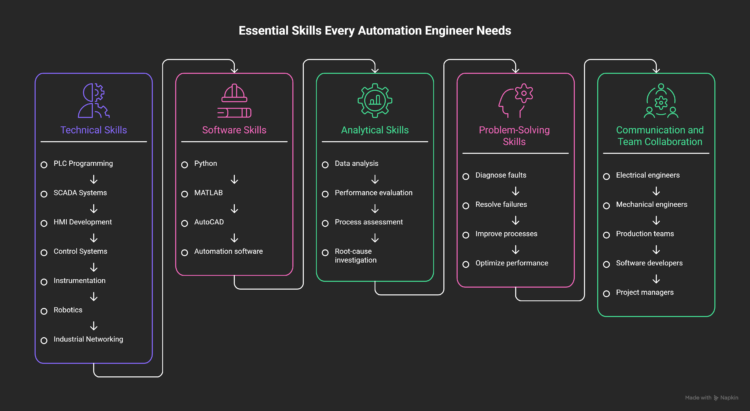
Technical Skills
Strong technical knowledge supports success.
PLC Programming
PLCs control industrial automation systems. Programming skills remain highly valuable.
SCADA Systems
SCADA systems monitor industrial operations. Engineers use them extensively.
HMI Development
HMIs improve operator interactions. Clear interfaces enhance productivity.
Control Systems
Control systems regulate industrial processes. Understanding them remains essential.
Instrumentation
Sensors provide critical process information. Accurate measurements support reliable operations.
Robotics
Robotics adoption continues increasing. Many engineers work with robotic systems.
Industrial Networking
Devices must communicate effectively. Networking knowledge supports integration projects.
Software Skills
Software tools improve engineering efficiency.
Important skills include:
- Python.
- MATLAB.
- AutoCAD.
- Automation software.
These tools support daily activities.
Analytical Skills
Automation projects generate large datasets. Engineers must interpret information correctly.
Important abilities include:
- Data analysis.
- Performance evaluation.
- Process assessment.
- Root-cause investigation.
Problem-Solving Skills
Technical issues occur regularly. Strong problem-solving improves system reliability.
Engineers often:
- Diagnose faults.
- Resolve failures.
- Improve processes.
- Optimize performance.
Communication and Team Collaboration
Automation projects involve many stakeholders. Effective communication supports project success.
Engineers work closely with:
- Electrical engineers.
- Mechanical engineers.
- Production teams.
- Software developers.
- Project managers.
Strong teamwork improves project outcomes.
🛠️ Tools and Technologies Used by Automation Engineers
Automation Engineers use several technologies daily. These tools support monitoring, control, and optimization.
PLC Platforms
PLCs control industrial machines and processes. They remain essential in automation projects.
Common PLC platforms include:
- Siemens S7.
- Allen-Bradley PLC.
- Mitsubishi PLC.
- Schneider Electric PLC.
- Omron PLC.
SCADA Software
SCADA systems monitor industrial operations. They provide real-time system visibility.
Common SCADA platforms include:
- WinCC.
- Ignition SCADA.
- Wonderware.
- FactoryTalk View.
- Citect SCADA.
HMI Tools
HMIs connect operators with machines. User-friendly interfaces improve productivity.
Popular HMI tools include:
- WinCC HMI.
- FactoryTalk View.
- Wonderware InTouch.
- Pro-face.
Industrial IoT Solutions
Industrial IoT improves connectivity and monitoring. Connected systems support smarter decisions.
Examples include:
- AWS IoT.
- Azure IoT.
- Siemens MindSphere.
- PTC ThingWorx.
Robotics and Automation Equipment
Many industries use robotic systems. Robotics improves precision and efficiency.
Common platforms include:
- ABB Robots.
- FANUC Robots.
- KUKA Robots.
- Yaskawa Robots.
Common Automation Tools
| Category | Common Tools |
|---|---|
| PLC | Siemens, Allen-Bradley, Mitsubishi |
| SCADA | WinCC, Ignition, Wonderware |
| HMI | WinCC, FactoryTalk, Pro-face |
| Robotics | ABB, FANUC, KUKA |
| Industrial IoT | AWS IoT, Azure IoT, MindSphere |
Master Robotics and AI!
Ready to build the future? Join our comprehensive robotics course to bridge the gap between complex code and physical motion. You’ll gain hands-on experience giving you the technical edge needed to lead in the age of automation.
Know More⚖️ Automation Engineer vs Other Engineering Roles
Automation Engineers work with many technologies. However, their focus differs from other roles.
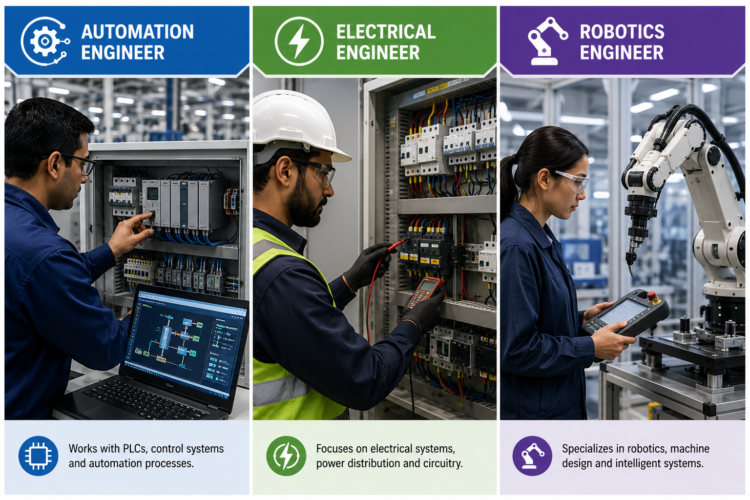
Automation Engineer vs Electrical Engineer
Electrical Engineers design electrical systems and equipment. Power distribution remains a major focus.
Automation Engineers focus on automated operations. Control systems and efficiency improvements remain priorities.
Automation Engineer vs Control Engineer
Control Engineers specialize in system behavior. They develop control strategies and models.
Automation Engineers implement complete solutions. Their work includes programming and integration.
Automation Engineer vs Robotics Engineer
Robotics Engineers develop robotic machines and systems. Robot design remains a primary responsibility.
Automation Engineers work across broader operations. Robotics forms only one area.
Comparison Table
| Aspect | Automation Engineer | Electrical Engineer | Robotics Engineer |
|---|---|---|---|
| Primary Focus | Automation systems | Electrical systems | Robotic systems |
| Programming | Extensive | Limited | Extensive |
| Control Systems | Core responsibility | Moderate | Moderate |
| Industrial Processes | Extensive | Limited | Moderate |
| Robotics Work | Moderate | Limited | Core responsibility |
| Typical Projects | Automation solutions | Power systems | Robot applications |
🎓 Educational Qualifications and Certifications
Education provides technical foundations. Practical experience strengthens these foundations.
Relevant Degree Programmes
Common degree options include:
- Electrical Engineering.
- Electronics Engineering.
- Instrumentation Engineering.
- Mechatronics Engineering.
- Automation Engineering.
These programs support automation careers.
Certifications that Add Value
Certifications strengthen technical knowledge. They also improve employability.
Useful certifications include:
- Siemens PLC Certification.
- SCADA Training.
- Industrial Automation Certification.
- Robotics Certification.
- Industrial IoT Certification.
Importance of Practical Training
Practical training builds confidence quickly. Real equipment improves understanding.
Benefits include:
- Industry exposure.
- Equipment familiarity.
- Better troubleshooting skills.
- Improved job readiness.
📈 Career Path and Growth Opportunities
Automation Engineering offers strong career growth. Experience opens new opportunities.
Entry-Level Roles
Most professionals begin with:
- Automation Engineer Trainee.
- PLC Programmer.
- Automation Technician.
- Junior Control Engineer.
These roles build practical skills.
Mid-Level Career Progression
Experience brings greater responsibilities. Technical expertise becomes increasingly important.
Common positions include:
- Automation Engineer.
- SCADA Engineer.
- Control Systems Engineer.
- Robotics Engineer.
Senior and Leadership Positions
Leadership opportunities increase with experience. Senior roles involve strategic decisions.
Examples include:
- Senior Automation Engineer.
- Automation Lead.
- Engineering Manager.
- Automation Consultant.
Emerging Opportunities in Industry 4.0
Industry 4.0 creates specialized careers. New technologies drive demand.
Examples include:
- Industrial IoT Engineer.
- Smart Factory Specialist.
- Digital Transformation Engineer.
- Industrial Data Analyst.
Career Progression Roadmap
Automation Trainee
⬇
Automation Engineer
⬇
Senior Automation Engineer
⬇
Automation Lead
⬇
Engineering Manager
🌟 Benefits of Choosing Automation Engineering as a Career
Automation Engineering offers several advantages. The field continues growing rapidly.
High Industry Demand
Industries increasingly adopt automated solutions. Skilled professionals remain highly valuable. Growing automation investments create new opportunities. Demand remains strong across sectors.
Competitive Salary Potential
Automation Engineers often earn attractive salaries. Specialized skills increase earning potential. Experience supports salary growth over time. Leadership roles offer higher compensation.
Global Career Opportunities
Automation technologies are used worldwide. Opportunities exist across many countries. Multinational companies hire automation professionals. International career growth remains possible.
Continuous Technological Growth
Technology evolves rapidly in this field. New systems appear regularly. Engineers continuously learn new skills. This keeps careers dynamic and engaging.
Benefits List
✔ Strong demand across industries.
✔ Diverse career opportunities available.
✔ Global employment possibilities remain strong.
✔ Competitive salaries reward expertise.
✔ Continuous innovation supports learning.
✔ Long-term career growth remains promising.
⚠️ Challenges Faced by Automation Engineers
The profession remains rewarding and demanding. Engineers face technical and operational challenges.
Pros vs Challenges
| Pros | Challenges |
|---|---|
| High demand | Rapid technology changes |
| Strong salaries | Continuous learning required |
| Diverse industries | Troubleshooting pressure |
| Career growth | System downtime responsibility |
| Global opportunities | Cybersecurity concerns |
Rapidly Evolving Technologies
Automation technology changes very quickly. New tools appear every year. Engineers must keep learning regularly. Updated skills improve career growth.
System Downtime and Troubleshooting Pressure
Unexpected failures can stop production processes. Downtime affects productivity and revenue. Engineers must respond quickly to issues. Fast troubleshooting restores operations faster.
Cybersecurity Risks in Automated Systems
Modern systems are increasingly connected. Connected systems face growing security threats. Security awareness becomes increasingly important. Safe systems protect critical operations.
Need for Continuous Skill Upgradation
New technologies emerge across industries. Existing tools evolve frequently. Engineers must update knowledge regularly. Continuous learning supports long-term success.
New to Robotics? Start from the Basics. Join Now!
🔮 Future of Automation Engineering
Automation will continue shaping industries worldwide. Emerging technologies will create new opportunities.
AI-Powered Automation
Artificial Intelligence enhances automation systems. Faster decisions improve operational efficiency. Smart technologies continue expanding rapidly. AI skills are becoming highly valuable.
Smart Factories
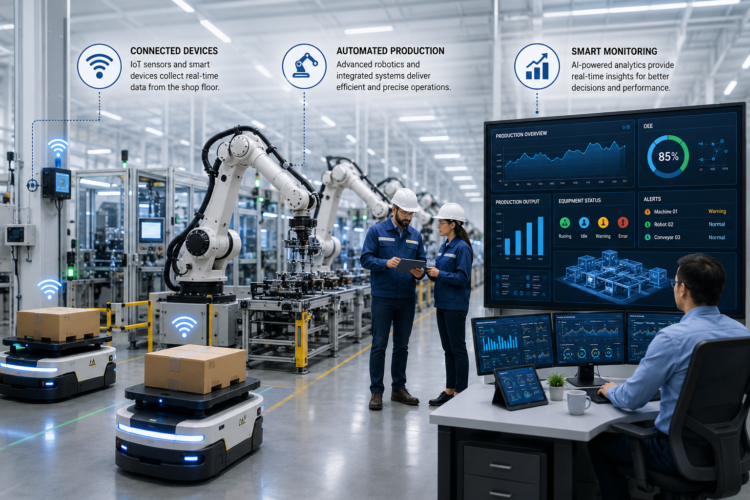
Smart factories use connected technologies extensively. Real-time data improves production efficiency. Automation Engineers support these transformations. Their expertise enables successful implementation.
Industrial IoT Expansion
Industrial IoT adoption continues growing rapidly. Connected equipment improves monitoring capabilities. Organizations gain better operational visibility. Efficient operations become easier to achieve.
Robotics and Autonomous Systems
Advanced robotics transform industrial operations. Robots perform repetitive tasks efficiently. Autonomous systems improve accuracy significantly. Robotics opportunities continue increasing steadily.
Future Skills Employers Will Look For
Employers increasingly seek advanced capabilities. Future professionals must adapt continuously.
Important skills include:
- AI fundamentals.
- Industrial IoT knowledge.
- Robotics expertise.
- Data analytics.
- Cybersecurity awareness.
These skills improve future employability.
🏁 Conclusion
Automation Engineering remains a fast-growing profession. Modern industries depend heavily on automation. Skilled professionals help improve productivity and quality. Opportunities exist across many sectors worldwide.
Knowledge of PLCs, SCADA, robotics, and IoT remains valuable. As Industry 4.0 expands further, demand for Automation Engineers is expected to remain strong.
Master Robotics and AI!
Ready to build the future? Join our comprehensive robotics course to bridge the gap between complex code and physical motion. You’ll gain hands-on experience giving you the technical edge needed to lead in the age of automation.
Know MoreFrequently Asked Questions
What does an Automation Engineer do daily?
Automation Engineers design, monitor, and maintain automated systems used in industrial operations. They also troubleshoot technical issues, optimize system performance, and ensure equipment operates safely and efficiently.
Is Automation Engineering a good career?
Yes, Automation Engineering is a promising career because industries increasingly rely on automation technologies. The field offers strong job demand, competitive salaries, and excellent long-term growth opportunities.
What qualifications are needed to become an Automation Engineer?
Most employers prefer candidates with degrees in Electrical, Electronics, Instrumentation, Mechatronics, or Automation Engineering. Industry certifications and hands-on training can further strengthen technical skills and employability.
What is the salary of an Automation Engineer?
Freshers typically earn between ₹3 LPA and ₹6 LPA, while experienced professionals can earn ₹8 LPA to ₹20+ LPA depending on expertise. Factors such as industry, location, certifications, and technical skills can significantly influence salary growth.
Which industries hire Automation Engineers?
Automation Engineers are hired across manufacturing, oil and gas, pharmaceuticals, automotive, logistics, power generation, and IT sectors. Any industry using automated equipment or processes can create opportunities for automation professionals.
Is coding required for Automation Engineering?
Basic coding knowledge is beneficial because many automation systems require programming and configuration. Skills in PLC programming, Python, and scripting can help engineers automate tasks and improve system functionality.
What are the most important automation tools to learn?
PLC platforms, SCADA software, HMI tools, and Industrial IoT technologies are among the most widely used automation tools. Learning these technologies can improve practical knowledge and increase job opportunities.
What is the difference between PLC and SCADA?
A PLC controls machines and industrial processes by executing programmed instructions. SCADA provides a centralized platform for monitoring, visualizing, and managing those processes in real time.
Can freshers become Automation Engineers?
Yes, freshers can enter the field by building strong fundamentals in automation, control systems, and industrial technologies. Practical projects, internships, and automation training programs can significantly improve career prospects.
What is the future scope of automation careers?
The future of automation remains strong due to advancements in Industry 4.0, robotics, Industrial IoT, and Artificial Intelligence. As organizations continue adopting smart technologies, demand for Automation Engineers is expected to grow steadily.