Table of Contents
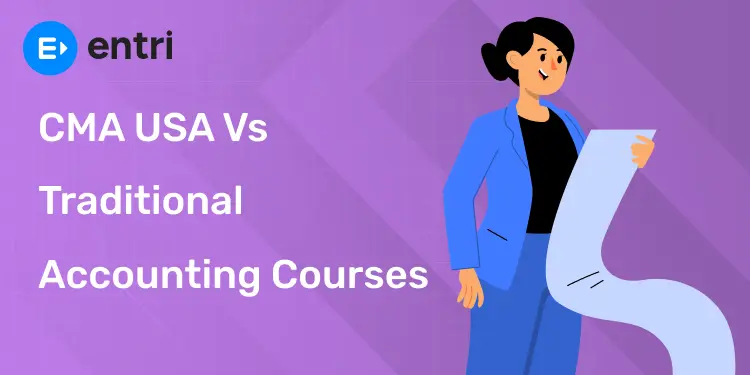
CMA USA is a global credential in management accounting. Traditional accounting courses, like B.Com, M.Com and CA, focus more on bookkeeping, tax, audit and law. The main difference is the focus. CMA USA teaches you to plan, analyse and guide business decisions. Traditional courses teach you to record, report and check the numbers.
CMA USA suits people who want corporate finance and management roles. Traditional courses suit people who want audit, tax or practice. For management accounting and corporate finance roles, CMA USA lines up better.
| Point | CMA USA | Traditional Accounting Courses |
|---|---|---|
| Focus | Costing, planning, analysis, strategy | Accounting, tax, audit, law |
| Duration | Often 6 to 12 months of study, flexible | 3 to 5 years or more, based on the course |
| Qualification type | Professional certification | Degree or professional qualification |
| Career orientation | Business decisions and finance roles | Compliance, reporting, audit and practice |
| Global relevance | High, awarded by a US body | Strong in India, varies abroad |
| Typical roles | Financial analyst, cost accountant, finance manager | Accountant, auditor, tax consultant, practising CA |
Want a career in management accounting? Enrol now for our CMA USA course!
CMA USA and Traditional Accounting: Understanding the Difference
Both paths lead to finance jobs. But they train you in different ways. Let us start with what each one is.
What Is CMA USA?
CMA stands for Certified Management Accountant. It is given by the Institute of Management Accountants, or IMA. IMA is based in the USA.
The exam has two parts:
- Part 1: Financial Planning, Performance and Analytics
- Part 2: Strategic Financial Management
Each part has 100 multiple-choice questions. It also has case-based questions. The passing score is 360 out of 500 for each part.
In 2026, IMA is moving away from essay questions. It is bringing in case-based questions instead. Please check the IMA website for the latest format before you register.
What Do You Need for CMA USA?
You need three things:
- A bachelor’s degree
- Active IMA membership
- Two years of work experience in management accounting or financial management
You can sit the exam first. You can finish the degree and experience later. But you must do it within seven years of passing.
Also, you have three years to pass both parts. This runs from the date you pay the entrance fee.
What Are Traditional Accounting Courses?
These are the courses most people think of first. They have been around for a long time.
Common ones:
- B.Com and M.Com
- Chartered Accountancy (CA)
- CMA from the Indian institute (ICMAI)
- Other commerce and accounting degrees
They teach you how books are kept. They also cover tax, audit, company law and reporting.
What Traditional Courses Focus On
Traditional courses go deep on rules. You learn:
- How to record entries
- How to prepare financial statements
- How tax works
- How audits are done
- How company law applies
This is the base of finance. Every business needs it.
What CMA USA Focuses On
CMA USA looks ahead. It asks, “What should the business do next?”
You learn:
- Budgeting and forecasting
- Cost management
- Performance checks
- Risk and internal controls
- Investment decisions
- Business strategy
Think of it like this. A traditional accountant tells you what happened. A management accountant helps you decide what to do next.
A Simple Way to See It
Say a company has a bad quarter.
A traditional accountant may:
- Check the books
- Make sure the numbers are right
- File the reports
A management accountant may:
- Find out why costs went up
- Plan a cheaper way to work
- Suggest which products to push
Both jobs matter. They are just different.
CMA USA vs Traditional Accounting Courses: Key Differences
Now let us go through the main differences.
1. Focus
CMA USA:
- Management accounting
- Corporate finance
- Costing and planning
- Decision-making
Traditional courses:
- Financial accounting
- Tax and audit
- Law and compliance
- Reporting
2. Duration
CMA USA:
- Two exam parts
- Most people finish study in 6 to 12 months
- You can take the parts in any order
- You can study while working
Traditional courses:
- B.Com takes about 3 years
- M.Com takes about 2 more years
- CA often takes 4 to 5 years or more
- Most need full-time attention
The time for CMA USA depends on how much you study each week. Some people take longer.
3. Qualification Type
CMA USA:
- A professional certification
- Given by IMA
- Needs exams, experience and membership
Traditional courses:
- B.Com and M.Com are degrees
- CA is a professional qualification
- Each has its own rules
Note that CMA USA is not a degree. You need a bachelor’s degree to get it. So many people do B.Com first, and then CMA USA.
4. Eligibility
CMA USA:
- Needs a bachelor’s degree
- Any field works
- You can sit the exam before you finish the degree
- Needs IMA membership
Traditional courses:
- B.Com needs class 12
- CA has its own entry steps
- Rules differ by course
5. Exam Style
CMA USA:
- Multiple-choice questions
- Case-based questions
- Taken at test centres
- Two parts, each 4 hours long
Traditional courses:
- Mostly written papers
- Long answers
- Many subjects
- Exams are set by the college or institute
6. Work Experience
CMA USA:
- Two years of related work
- Can be before or up to seven years after passing
Traditional courses:
- CA needs practical training, called articleship
- B.Com and M.Com do not need work experience
- It depends on the course
7. Global Relevance
CMA USA:
- Awarded by a US body
- Seen as a global credential
- Useful for MNCs and Gulf jobs
- Good if you want to work abroad
Traditional courses:
- Very strong in India
- CA is well known in India
- Value abroad can vary
- Some countries have their own rules
8. Cost
CMA USA fees are paid to IMA. They cover membership, an entrance fee and an exam fee for each part. Fees are in US dollars. They change with exchange rates and your membership type. You also pay for coaching if you take it.
Traditional courses have their own fees. A government college B.Com may cost less. Private colleges and CA coaching may cost more.
Please check the official websites for current fees before you plan.
Quick Comparison
| Point | CMA USA | Traditional Courses |
|---|---|---|
| Learning style | Practical and business-led | Rule-led and detailed |
| Study time | Shorter and flexible | Longer |
| Exam | MCQs and case-based questions | Mostly written |
| Work experience | 2 years | Depends on the course |
| Strength | Finance and strategy | Audit, tax and law |
Career Opportunities After CMA USA vs Traditional Accounting
Your course shapes your first job. Let us look at both.
Careers After CMA USA
CMA USA opens doors in corporate finance. Many roles sit inside companies.
Common roles:
- Financial analyst
- Management accountant
- Cost accountant
- Budget analyst
- Finance manager
- Business analyst
- Internal auditor
- Risk analyst
- Finance controller
With time, some people move into senior roles like:
- Finance head
- Financial controller
- Chief Financial Officer (CFO)
That depends on your skills, results and the company.
Where CMA USA Holders Work
- Large companies and MNCs
- Banks and financial firms
- IT and consulting firms
- Manufacturing firms
- Retail and e-commerce firms
- Startups with finance teams
Careers After Traditional Accounting Courses
Traditional courses lead to a wide set of jobs. Some are in firms. Some are in practice.
Common roles:
- Accountant
- Accounts executive
- Tax consultant
- Auditor
- GST and compliance executive
- Bank clerk or officer
- Practising chartered accountant (after CA)
Where Traditional Course Holders Work
- Accounting and audit firms
- Tax firms
- Banks
- Government departments
- Small and mid-size businesses
- Their own practice
Overlap Between the Two
The paths are not walls. Many roles take both kinds of people.
For example:
- A B.Com graduate can add CMA USA and move into corporate finance
- A CA can add CMA USA to widen their profile
- A CMA USA holder can learn tax later
A good mix is common. Many finance people have a degree and a certification.
What Employers Look For
Most employers care about:
- Your skills
- Your work results
- Your Excel and data skills
- How well you explain numbers
- Your communication
A credential helps you get noticed. Your work helps you grow.
Which Course Fits Different Career Goals?
It depends on what you want. Here are some common goals.
If You Want Corporate Finance Roles
- CMA USA is a strong fit
- It trains you in planning and analysis
- It matches what finance teams do
- It helps in MNCs
If You Want Management Accounting Roles
- CMA USA fits well
- The course is built around this work
- You learn costing and performance tools
If You Want to Work in Audit
- A traditional path often fits better
- CA is the classic route in India
- It goes deep into audit and law
If You Want to Work in Tax
- Traditional courses are usually better
- You learn tax rules in detail
- CA and commerce degrees both help
If You Want Your Own Practice
- CA is the common route in India
- It gives you the right to practise in certain areas
- CMA USA does not replace this
If You Want to Work Abroad
- CMA USA may help
- It is a global credential
- It is useful for Gulf and US jobs
- Check the rules of the country you want
If You Are a Fresher
- Finish your degree first
- Then think about CMA USA
- You can sit the exam before you finish your degree
- Pick based on the job you want
If You Are Already Working
- CMA USA suits working people
- It is flexible
- You can study in the evenings and on weekends
- Your work years can count as experience
If You Want a Short Path
- CMA USA is shorter
- But it still needs hard work
- Many people find the syllabus heavy
- Plan your study time well
If You Want a Mix
- Do a degree and a certification
- For example, B.Com plus CMA USA
- This gives you both base and focus
Advantages and Limitations of Each Path
Each path has good and hard sides.
CMA USA: Advantages
1. Focus on business
You learn how finance helps a company grow.
2. Global name
IMA is based in the USA. The credential is known in many countries.
3. Flexible timing
You can take the parts in any order. You can study while you work.
4. Shorter study time
Many people finish study in under a year or two.
5. Open to many degrees
A bachelor’s degree in any field works.
6. Work experience can come later
You can sit the exam first.
7. Fits corporate roles
It matches finance and management jobs.
CMA USA: Limitations
1. Not a degree
You still need a bachelor’s degree.
2. Work experience is needed
You must complete two years to earn the title.
3. Fees are in dollars
Costs can rise when the rupee falls.
4. Not for practice
It does not let you sign audits in India.
5. Heavy syllabus
There are many topics in a short time.
6. Yearly membership
You need to keep your IMA membership active.
7. Time limits
You have three years to pass both parts. You have seven years to finish the other requirements.
Traditional Courses: Advantages
1. Strong base
You learn how accounting really works.
2. Wide job choice
Jobs exist in firms, banks, government and business.
3. Well known in India
Employers know B.Com and CA well.
4. Right to practise
CA lets you work in audit and tax practice.
5. Deep tax and law skills
These are in high demand.
6. Many entry points
You can start after class 12.
Traditional Courses: Limitations
1. Longer time
CA can take years.
2. Hard exams
CA exams are known to be tough.
3. Less focus on strategy
Some courses are light on business planning.
4. Narrow global use
Value abroad can vary.
5. Rule-heavy
You may spend more time on rules than on decisions.
6. Varies by college
B.Com quality differs from place to place.
A Fair Way to See It
Neither path is weak. They do different jobs. One builds the base. The other builds a business view.
CMA USA vs Traditional Accounting: What Should You Choose?
Take some time before you decide. Think about these things.
1. Your Goal
Where do you want to be in five years?
- In a company finance team? Look at CMA USA.
- In audit or tax? Look at traditional courses.
- Abroad? Check CMA USA and local rules.
Write it down. Then see which path gets you closer.
2. Your Current Stage
- In class 12? Start with a degree.
- A final-year student? You can plan CMA USA.
- A graduate? You can start CMA USA now.
- Working? Check if your job counts as experience.
3. Your Time
- Can you study full time?
- Can you study 10 to 15 hours a week?
- Do you need to work while you study?
CMA USA suits busy people. But you still need to put in the hours.
4. Your Money
- How much can you spend?
- Can you pay in dollars?
- Do you need coaching?
Check the costs on the official sites.
5. Your Interest
Ask yourself:
- Do you like planning and numbers?
- Do you like rules and law?
- Do you like working with business teams?
- Do you like checking and reviewing?
Choose what you enjoy. You will do it for years.
6. The Job Market
Look at real job posts.
- What do companies ask for?
- Do they name CMA USA?
- Do they ask for CA or B.Com?
This tells you what works in your city and field.
7. Your Backup Plan
- Can you add a second course later?
- Can you switch roles?
Many people do both. They begin with a degree. They add CMA USA after.
Questions to Ask Before You Enrol
- What jobs do people get after this course?
- What is the total cost?
- How long will it really take?
- What support do I get?
- What is the pass rate?
- Does it match my goal?
A Simple Way to Decide
Make two lists. On one, write the jobs you want. On the other, write what each course gives you. See which one matches more. That is a good place to start.
Final Takeaway
CMA USA is not better than traditional accounting. Traditional accounting is not better than CMA USA. They are built for different goals.
If you want a career in management accounting or corporate finance, CMA USA is a strong fit. If you want audit, tax, law or your own practice, traditional courses may suit you more.
Many people do both. A degree gives you the base. CMA USA gives you the business view.
Think about your goal first. Then check the rules, the cost and the time. Rules and fees can change, so please check the IMA website before you register.
Whichever path you take, keep learning. Build real skills, like Excel and clear communication. That will help your career as much as the name of the course.