Table of Contents
There are numerous opportunities for children to enhance their language skills, including eating together, reading aloud, singing songs, naming objects, and playing with their friends. By participating in these activities, children will have many opportunities to practice their listening and language skills.
It is not necessary to use expensive resources or challenging instructional methods in order to improve their capacity to communicate. Toddlers should be taught to listen, understand, imitate, and utilize language through small conversations that take place on a daily basis. This is the most effective method.
Register for the Entri Elevate Montessori Teacher Training Program! Join Now!
Key Takeaways:
- Keep your communication with your child simple, clear and regular.
- Reading picture books aloud helps your child develop language and listening abilities.
- Get kids talking with singing, games and pretend play.
- Let your child answer without pressure.
- Repeat what your kid says, and then build upon it. Add to what they’ve said.
- If you notice signs of delayed speech development in a child, consult a doctor.
When does Speech Development Begin in Toddlers?

Speech and language development begin at birth, when the first steps are taken toward communication. A youngster is already familiar with the fundamentals of communication abilities before they even utter their first word if they are a child.
The important activities to achieve the goal includes:
- Hearing voices
- Observing facial expressions
- Reacting to sounds
- Observing conversations
When a child is in their toddler years, it is likely that their vocabulary as well as their capacity to communicate will grow at a quick pace. The fact that youngsters can display a great deal of variation is something that should be kept in mind, however.
Approximately 12–18 months
The majority of children start using their first words that have any real meaning during this time period. They might be able to:
- Recite well-known phrases like “mama,” “dada,” or the names of objects that are particularly dear to you.
- Point to the things that people desire.
- Obey straightforward directions.
- Recognize individuals and things that are known to you.
- Along with noises or words, you should also use gestures.
- Listen to adults and imitate the sounds they hear.
- Understand more words than they are able to articulate.
Approximately 18–24 months
Children will start mixing words and expanding their vocabulary.
It’s possible that they:
- On a regular basis, learn new terms.
- Name some things that are commonplace.
- Use straightforward combinations of two words.
- Use language to make requests for things.
- Observe the straightforward command.
- Find photographs in books that you are familiar with.
- Start using words to describe the things you own or the behaviors you take.
Approximately from2-3 years
There is a tendency for language to become more complicated throughout this era. Kids are able to:
- Make use of a few sentences.
- Ask a great deal of questions.
- People, animals, foods, and objects should all be named.
- Discuss what they are doing at the moment.
- Simple inquiries should be understood.
- Maintain compliance with instructions that involve more than one step.
- Involve yourself in straightforward interactions.
It is more accurate to refer to these as general developmental patterns than to specific dates. There are varying rates at which children can acquire new skills.
Simple Ways to Encourage Toddler Speech Development
1: What is the primary focus of the first plane of development in the Montessori method?
It is not necessary for parents to transform their homes into classrooms. It is possible to foster speech development in a natural way by engaging in activities and conversations associated with daily life.
1. Maintain a chat with your little child throughout the day.
What are you doing while you go about your everyday routine? Describe what you are doing.
Just one example:
- “We are washing your hands.”
- “Mommy is cutting the banana.”
- “Let’s put the shoes on.”
- “The water is warm.”
- “Look, the car is moving.”
Toddlers receive regular exposure to words and sentence patterns as a result of these activities.
2. Give Names to Commonplace Items
Through repeated exposure, toddlers acquire language skills. Name some of the things that your child frequently interacts with and sees.
Just one example:
Cup, Spoon, Ball, Chair, Shoes, Book, Cup, Apple, Cat, and Car
The following descriptions can be added in stages:
“This is a red ball.”
Extend it even farther by saying:
“The red ball is rolling.”
Consequently, youngsters are better able to connect individual words with sentences that are more comprehensive.
3. Offer Your Child a Variety of Options
In place of asking questions that can only be answered with “yes” or “no,” you should provide options that are really straightforward.
Just one example:
- “Do you want an apple or a banana?” “Would you like the red cup or the blue cup?”
- “Do you want to read the animal book or the car book?”
Ensure that your youngster has sufficient time to answer. On the initial attempt, they might respond with a word, a gesture, or a point.
4. Complement what your child has to say.
If your child uses a phrase that is only a few words long, you should repeat it and add a little bit additional information.
Just one example:
- Little one: “Dog.”
- “Yes, a big dog!” the parent exclaimed.
If not:
- A child said, “Car go.”
- The parent responded, “Yes, the car is going.”
In this way, a natural language model is provided without the need to explicitly correct the youngster each and every time.
5. Make use of repetition
In order for toddlers to begin utilizing words on their own, it is typically necessary for them to hear them multiple times.
For example, while you are playing with a ball, you might say:
- “Ball.” “Red ball.”
- “Throw the ball.”
- “The ball is rolling.”
- “Catch the ball!”
Get Certified & Start Your Montessori Career
Montessori Teacher Training Course by Entri App: Gain expert skills, earn certification, and kickstart your teaching career.
Join Now!Speech Development Activities for Toddlers
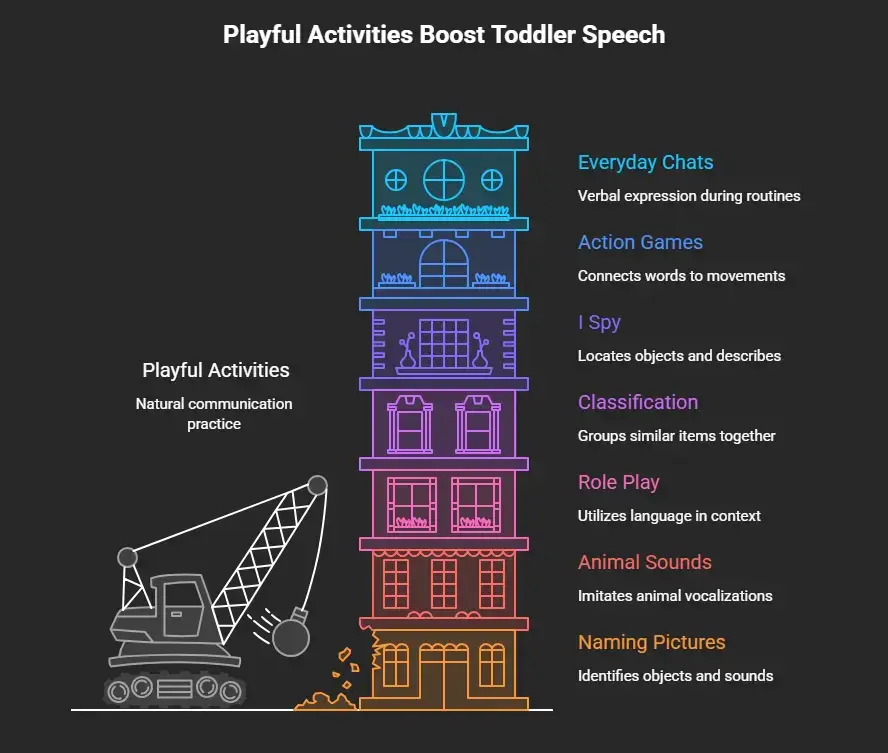
Playing is one of the most natural methods for children to practice communicating, and it is also one of some of the most effective ones. It is not necessary for all activities to be difficult.
1. The Naming of Pictures
You can utilize picture books, flashcards, magazines, or even objects from around the house.
Display a picture to your young child and inquire:
“What is this?” “What sound does the cow make?”
“Where is the ball?”
“What color is this?”
You need only supply the word in the event that your child does not respond.
Just one example:
There is a cat here. The meow of the cat!
2. Animal Sound Games
For toddlers, imitating animal sounds is not only enjoyable but also simple.
You are free to ask:
- “What does a dog say?” “What does a cow say?” “What does a duck say?”
Make the sounds along with your child and encourage them to copy what you are doing.
3. Acting Out a Role
When youngsters engage in pretend play, they are given opportunities to utilize language in a natural way.
It is possible to play:
- Doctor and patient
- Shopkeeper and customer
- Cooking
- Tea party
- Feeding a doll
- Toy school
- Toy restaurant
When playing make-believe, it is important to teach valuable terms and phrases:
- “The baby is hungry.” “Let’s cook dinner.”
- “The doctor will help.”
- “Here is your medicine.”
- “The doll is sleeping.”
4. Games of Classification and Naming
Provide your toddler with toys or household items that are considered safe, and encourage them to group them together.
Just one example:
- Together, the animals
- Vehicles in tandem
- Collectively, fruits
- Together, the blocks
While you are playing, let’s talk about the objects:
- “This in fact is an apple. It must be a fruit. It is likewise a fruit that the banana is.
5. Games on the “I Spy”
The game should be kept very simple for toddlers that are younger.
Assume:
- “Do you see a ball? Is the ball somewhere else?
You should encourage your toddler to point to it or speak the word “ball.”
You are able to introduce descriptions as their language grows, beginning with:
- “I see something red.”
6. Video Games That Involve Action
Utilize straightforward directions that involve movement.
Try this:
- “Jump!”
- “Clap your hands.”
- “Touch your nose.”
- “Sit down.”
- “Stand up.”
- “Turn around.”
- “Kick the ball.”
These activities assist children in making the connection between words and actions.
7. Everyday Conversations
Everyday activities offer a plethora of options for verbal expression.
At the time of the bath:
- “Wash your hands.” “Wash your feet.”
- “The water is warm.”
- “Where is the soap?”
When eating meals:
- “This is rice.” “The spoon is here.”
- “Do you want water?” “The banana is sweet.”
While getting dressed:
- “Here is your shirt.”
- “Put on your socks.”
- “Where are your shoes?”
How Reading Helps Toddler Language Development
Reading aloud is one of the easiest methods to provide a language-rich environment. You don’t need to read the whole book every time. Even a few minutes of interactive reading is useful.
Reading benefits toddlers:
- Build your vocabulary.
- Study sentence constructions.
- Listen to practice.
- Understand sequences and storylines.
- Identify common objects and characters.
- Practice sounds and words.
- Know how discussions function.
- Improve attention and comprehension.
Make Reading Active
Instead of just reading each phrase, comment about the photos.
Question:
- “Where’s the dog?” “What do you see?”
- “What is the boy doing?” “What color is the car?”
- “Where’s the bird?
Allow your youngster to turn pages, point to pictures, make sounds, and talk about the story.
Reread your favorite books
If your youngster requests the same book every night, don’t worry. Repetition can help toddlers get familiar with terminology, story patterns, and phrases.
You can promote involvement by stopping before a recognized word or phrase and letting your youngster to fill it in if he or she wants to.
Talk, Sing, and Play with Your Toddler
Communication is more than questions. The child learns language through active social engagement.
Talk
Talk naturally about what your child’s interested in.
- If your kid is playing with a car, you can say:
Wow, the car is going quickly! - If they’re playing with blocks:
“You have a tall tower.”
Don’t continuously change activities; follow your child’s interests.
Sing
Songs and nursery rhymes help language to stick because of rhythm, repetition and predictable vocabulary.
This is how:
- Songs with action
- Children’s Rhymes
- Songs on the count
- Songs for animals
- Simple tunes about regular life
Add actions wherever you can. Singing and clapping, waving, jumping or pointing.
Play
Play allows toddlers to practice communicating without feeling they are being instructed.
On the field:
- Go with your kid.
- What’s going on? Tell us.
- Add new words.
- Alternate.
- Promote imitation.
Respond to your child’s attempts to communicate.
Minimize Background Distractions
Toddlers may have difficulty focusing on interactions if there is background television or other distractions. When you spend time playing and talking with your child, they have more opportunity to listen and respond.
Get Certified & Start Your Montessori Career
Montessori Teacher Training Course by Entri App: Gain expert skills, earn certification, and kickstart your teaching career.
Join Now!Common Mistakes to Avoid During Speech Development
1. Avoid Repeating Words with Your Child
Repeating “Say this” or “Say that” can hinder communication. Instead, repeat the term naturally.
Instead of asking constantly,
Say ball.
Try:
“See! A ball. The ball bounces.
2. Avoid Comparing Your Child to Others
Children develop differently. Comparisons of children’s speech can be unwarranted.
Customize for your child’s growth.
3. Leave Some Errors
Toddlers are learning sentences and sounds.
Instead of constantly correcting your youngster, demonstrate proper pronunciation.
4. Do not Always Speak for Your Child
Give your child communication opportunities.
Example: If your child is asked:
“Want some juice?”
Allow your youngster to respond before responding.
5. Limit Baby Talk
Although a warm, cheerful voice is fantastic, newborns need clear, conversational language.
Simple but proper sentences.
6.Don’t teach from every activity
Natural partnerships teach toddlers. Games, dinners, treks, stories, and routines can teach languages.
Signs of Delayed Speech Development
Parents should monitor their child’s communication development. Children learn to talk and use language at different rates.
Signs that may require professional treatment are
- Very minimal word use relative to projected developmental trends.
- No adding progressive words.
- Difficulty with simple directions.
- Not often expressing needs or interests.
- Not much pointing and waving.
- Not responding well to well-known speakers.
- Loss of ability to speak or communicate.
- Increasing difficulty in understanding as they become older.
- “Little interest in social affairs.
One sign doesn’t mean a child has a problem with speech or language. Parents who are worried should talk to the child’s pediatrician or speech-language pathologist. The doctor may order a hearing test because hearing might impair speech and language development.
When Should Parents Seek Help?
Parents don’t have to wait until their child reaches a particular age to discuss their concerns. It may be good to hear from a speech-language pathologist or a doctor to see whether or not the child’s development is progressing appropriately.
With early support, specialists are able to identify the kid’s skills and the areas in which the child needs help and provide activities that parents may do at home. That can be a good thing.”
Register for the Entri Elevate Montessori Teacher Training Program! Join Now!
Conclusion
Helping children with their speech development may be easy and joyful when it is included into everyday living. Talking, reading, singing and playing with your kid daily to let them hear new words and practice communicating. Instead of pressuring, parents should be patient and cherish every step of communication.
A warm, pleasant environment and early expert supervision when required can help children steadily expand their vocabulary, confidence and communication skills.
Get Certified & Start Your Montessori Career
Montessori Teacher Training Course by Entri App: Gain expert skills, earn certification, and kickstart your teaching career.
Join Now!Frequently Asked Questions
When does speech development begin?
Speech and language development begins from birth and continues rapidly during the toddler years.
How can I help my toddler speak more?
Talk to your toddler often and describe everyday activities, objects, and actions.
Does reading help speech development?
Yes. Reading helps toddlers learn new words, improve listening, and understand sentences.
Are songs useful for speech development?
Yes. Songs and nursery rhymes help children learn words through repetition and rhythm.
What are good speech activities for toddlers?
Picture naming, pretend play, animal sounds, action games, and simple conversations are useful activities.
Should I correct my toddler's pronunciation?
Avoid correcting every mistake. Instead, repeat the word correctly in a natural way.
Should I make my toddler repeat words?
It is better not to pressure your child. Model the word naturally and give them time to try.
Should I compare my toddler's speech with other children?
No. Children develop language at different rates, so focus on your child’s progress.
How long should I practise speech activities?
Short, enjoyable activities throughout the day are usually better than long teaching sessions.
When should I be concerned about delayed speech?
If your child has very limited communication, stops using skills they previously had, or you have ongoing concerns, speak with a pediatrician or speech-language professional.