Table of Contents
An entity is a uniquely identifiable person, place, organization, product, event, or concept that search engines can recognize and understand independently of keywords.
Unlike keywords, which are simply strings of text, entities carry meaning and exist within a network of relationships. For example, Mohanlal is not just a name. Google understands Mohanlal as an Indian actor associated with Malayalam cinema, Kerala, specific movies, awards, and other people in the film industry.
Similarly, Kerala is recognized as a geographic entity connected to people, culture, tourism, organizations, and countless other subjects
Join Our Online Digital Marketing Course & Learn the Fundamentals!
Key Takeaways
- Entity-first mindset: Focus on meaning, not matching keywords.
- Entities vs keywords: Keywords are signals; entities provide stable context.
- Knowledge graphs: Connect entities, attributes, and relationships.
- Structured data: Use schema to clarify entities for search engines.
- Search evolution: Hummingbird, RankBrain, BERT moved search to semantics.
- Entity mapping: Identify the main entity and its related entities.
- Topical authority: Consistent coverage of entities builds long-term authority.
- Practical vs technical: Combine editorial mapping with schema and metadata.
- Future-proofing: Entity focus aligns with AI-driven search.
- Priorities: Start with mapping, add schema, cluster content, link internally, earn citations.
Understanding the Entity-First Approach
Entity SEO focuses on meaning rather than matching keywords. Traditional SEO often attempts to rank pages by targeting specific search terms.
Entity SEO focuses on helping search engines understand the subject, context, and relationships behind the content. Consider the entities Mohanlal, Mammootty, and Kerala. A keyword-focused approach may optimize a page for terms such as “Mohanlal movies” or “Mammootty films.”
An entity-focused approach goes deeper by explaining how these entities connect through Malayalam cinema, the film industry, awards, directors, and cultural influence.
This shift from keywords to meaning aligns with how modern search engines process information. Instead of asking whether a page contains certain words, Google increasingly evaluates whether the page demonstrates a complete understanding of the topic and the entities associated with it.
Benefits of Entity-Based SEO
Entity-Based SEO helps search engines understand content at a deeper level. Instead of relying on exact keyword matches, search engines can evaluate topics through entities, attributes, and relationships.
This allows content to rank for a broader range of relevant searches while maintaining strong topical relevance. Entity-Based SEO also strengthens topical authority.
When a website consistently covers related entities and their relationships, search engines gain confidence in the site’s expertise within that subject area. This deeper understanding supports modern search experiences, including AI-generated answers, conversational search, and semantic retrieval systems.
Knowledge Graphs
A knowledge graph is a structured network of entities, attributes, and relationships. Search engines use knowledge graphs to organize information in a way that mirrors how concepts connect in the real world. Rather than treating words as isolated keywords, they connect entities to build a deeper understanding of meaning and context.
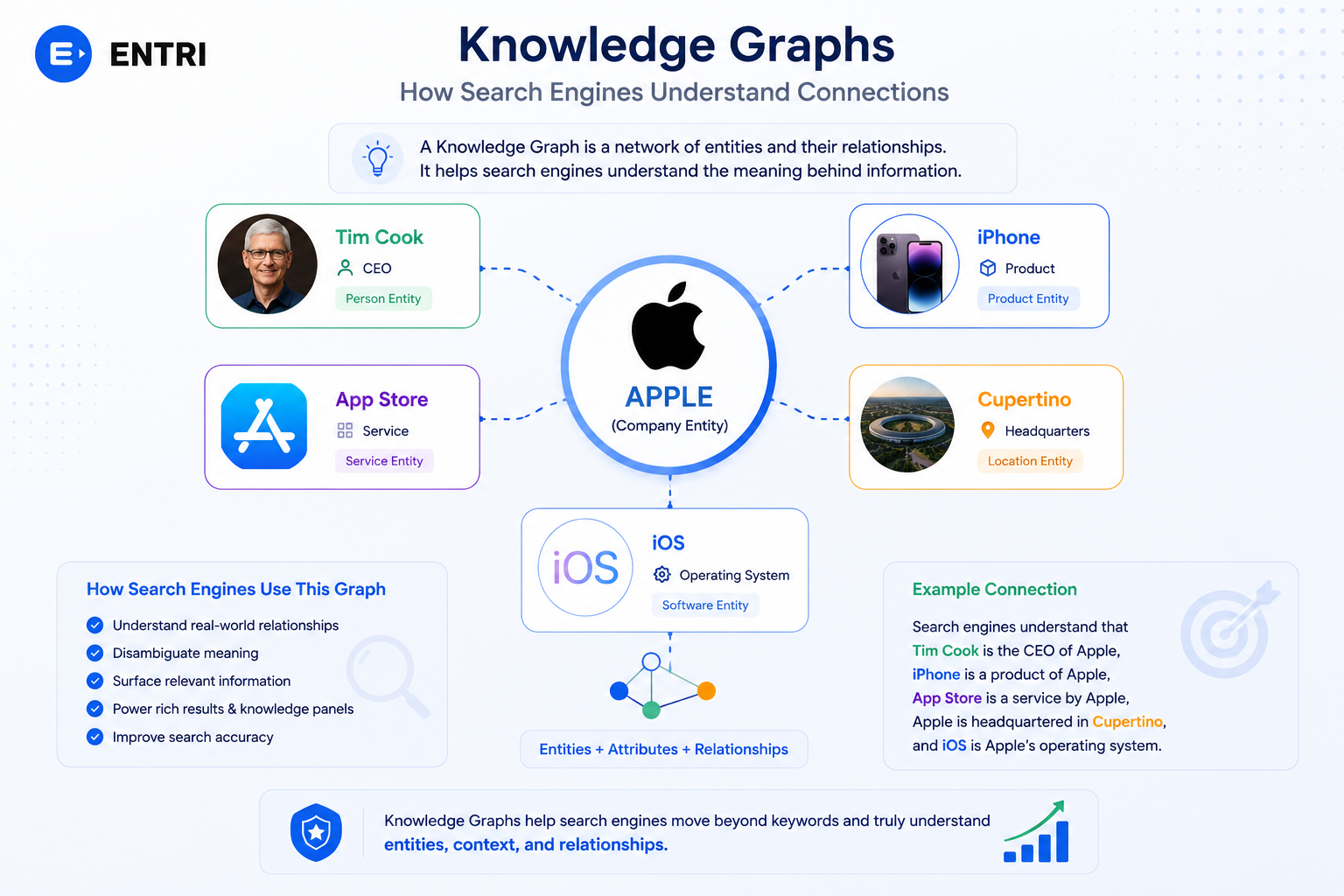
In the example above, Apple serves as the central entity. Search engines understand Tim Cook as Apple’s CEO, iPhone as one of its products, App Store as one of its services, Cupertino as its headquarters, and iOS as its operating system. Each entity contributes additional context that helps define Apple’s identity within the knowledge graph.
These relationships allow search engines to answer complex queries more accurately. For example, when a user searches for Apple’s CEO, flagship products, or operating system, Google can retrieve information directly from the relationships stored within its knowledge graph. This ability to connect entities enables features such as knowledge panels, AI-generated answers, semantic search, and entity-based retrieval.
Knowledge graphs play a critical role in Entity-Based SEO because they help search engines understand topics rather than simply matching keywords. The stronger and more comprehensive the relationships between entities, the easier it becomes for search engines to evaluate relevance, expertise, and topical authority.
Structured Data and Schema Markup
Structured data helps search engines identify entities more accurately. It provides additional information about people, organizations, products, events, courses, and other entities in a machine-readable format. While search engines can extract entities from content, structured data removes ambiguity and improves understanding.
Schema.org provides a standardized vocabulary for implementing structured data. Website owners can use schema types such as Organization, Person, Product, Course, Article, and FAQ to describe entities and their attributes. Search engines use this information to enhance search results and strengthen their understanding of the relationships between entities.
Structured data does not directly improve rankings. However, it improves entity recognition, content understanding, and eligibility for rich search features. As Entity-Based SEO continues to evolve, structured data remains one of the most effective ways to communicate entity information to search engines.
Google’s Evolution Toward Entity Understanding

Hummingbird
Before Hummingbird, Google mainly relied on keyword matching to determine relevance. This approach often struggled to understand the meaning behind complex or conversational searches.
Introduced in 2013, Hummingbird shifted Google’s focus toward semantic search. Instead of analyzing individual keywords, Google began evaluating the overall meaning and intent of a query.
For example, a search such as “best smartphone for photography” does not specify a product. Hummingbird helps Google understand concepts such as smartphones, cameras, reviews, and photography performance to deliver more relevant results.
This update laid the foundation for Entity-Based SEO by moving search beyond keywords and toward concepts, context, and entity relationships.
RankBrain
Introduced in 2015, RankBrain enhanced Google’s ability to interpret unfamiliar and ambiguous search queries. It uses machine learning to identify patterns and understand how words, topics, and concepts relate to one another.
Instead of relying only on exact keyword matches, RankBrain helps Google connect searches with relevant entities and topics. This allows the search engine to deliver useful results even when a query contains new terms or uncommon phrasing.
RankBrain strengthened Google’s move toward semantic understanding by helping search engines evaluate context, relevance, and relationships rather than keywords alone.
BERT
Introduced in 2019, BERT improved Google’s ability to understand the context of words within a sentence. Rather than analyzing terms individually, BERT evaluates how words relate to one another and contribute to the overall meaning of a query.
This advancement helped Google interpret natural language more accurately, especially for conversational and long-tail searches. By understanding context, BERT enables search engines to identify entities, relationships, and intent with greater precision.
BERT further strengthened Google’s shift from keyword matching to meaning-based search, making Entity-Based SEO more important than ever.
Knowledge Panels
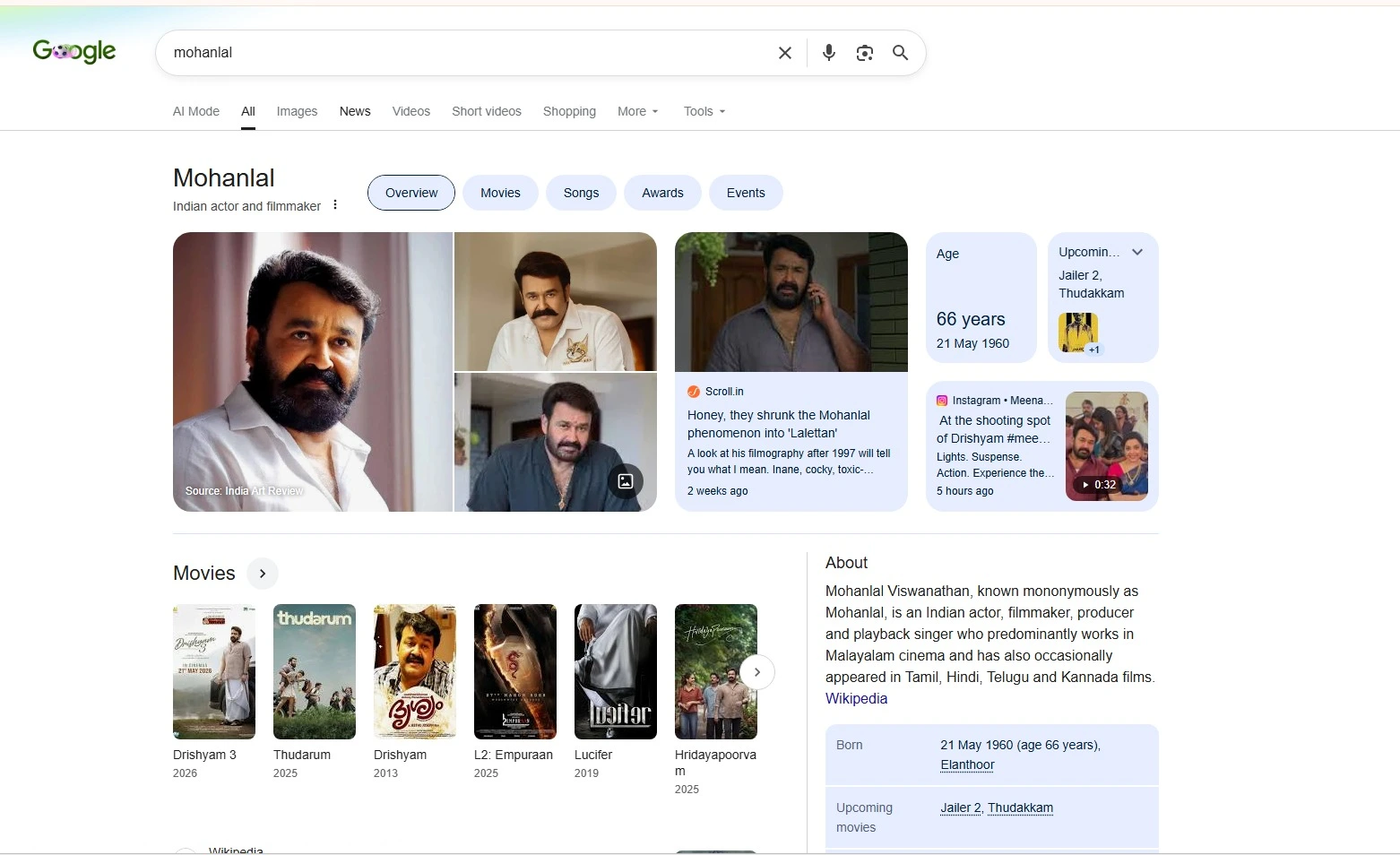 Knowledge Panels are one of the most visible outcomes of Google’s entity understanding. They appear in search results when Google has sufficient confidence in an entity and its associated information.
Unlike traditional search snippets, Knowledge Panels pull information from Google’s Knowledge Graph. They consolidate important attributes such as descriptions, images, locations, founders, products, social profiles, and related entities into a single view.
For brands, organizations, and public figures, Knowledge Panels demonstrate how Google understands and connects entity information across the web. The more consistent and authoritative the entity signals, the easier it becomes for Google to establish confidence in the entity and its relationships.
Knowledge Panels illustrate the practical impact of Entity-Based SEO. They show how structured entity information can improve visibility, reinforce authority, and help search engines present information more effectively to users.
Implementing Entity-Based SEO

Entity Mapping
Entity mapping is the process of identifying the primary entity of a page and the related entities that help search engines understand the topic. It provides a structured approach to content creation by ensuring that important concepts, attributes, and relationships are covered naturally.
Effective entity mapping improves topical coverage and reduces content gaps. Instead of focusing on a single keyword, content creators can build pages around a network of related entities and their relationships. This approach aligns with how modern search engines evaluate relevance, expertise, and topical authority.
Content Clusters
Content clusters organize related topics around a central entity or subject. Instead of publishing isolated articles, websites create interconnected content that covers a topic from multiple angles.
For example, a website targeting Entity-Based SEO may create supporting content around Semantic SEO, Knowledge Graphs, Structured Data, Schema Markup, Vector embedding, Topical Authority, and Search Entities. Each article strengthens the understanding of the central topic while adding context and depth.
Content clusters help search engines discover relationships among entities across a website. As coverage expands, search engines gain greater confidence in the site’s expertise and understanding of the subject.
This approach strengthens topical authority and improves the website’s ability to rank for a broader range of related searches.
Internal Linking
Internal linking helps search engines understand the relationships between entities across a website. Every internal link provides additional context by connecting related topics, concepts, and supporting information.
Effective internal linking strengthens entity relationships and improves content discoverability. As search engines crawl these connections, they gain a clearer understanding of the website’s expertise, topic coverage, and overall authority.
External Authority Signals
Search engines do not evaluate entities using on-page content alone. They also analyze signals from external sources to verify the credibility, popularity, and authority of an entity. These signals can include backlinks, brand mentions, author profiles, citations, reviews, social profiles, and references from trusted websites.
When multiple authoritative sources consistently reference the same entity, search engines gain greater confidence in its legitimacy and expertise. External authority signals help search engines validate relationships between entities across the web.
Combined with strong content and internal entity relationships, these signals contribute to greater visibility, trust, and authority in search results.
Entities vs Keywords

Understanding Keywords
Keywords are the words and phrases users enter into search engines. Traditional SEO relies on identifying these terms and optimizing content around them to improve visibility in search results.
For many years, keyword optimization formed the foundation of SEO. Search engines primarily evaluated whether content contained the words used in a search query and how frequently those words appeared on a page.
Although keywords remain important, modern search engines use them as signals rather than the primary method of understanding content. They now evaluate the meaning behind the keywords and the entities associated with them to determine relevance.
Understanding Entities
Entities are uniquely identifiable people, places, organizations, products, concepts, or events that search engines can understand independently of keywords. Unlike keywords, entities carry meaning and exist within a network of relationships.
Modern search engines rely on entities to understand topics more accurately. By connecting entities through attributes and relationships, they can evaluate content based on meaning rather than exact keyword matches. This enables more relevant search results and a deeper understanding of complex topics.
Why Entities Build Long-Term Authority
Keywords can help a page rank for specific searches, but entities help search engines understand expertise across an entire topic. As websites publish content around related entities and their relationships, they build a stronger knowledge ecosystem that demonstrates depth and relevance.
As search continues to evolve toward semantic understanding and AI-driven retrieval, entities provide a more sustainable foundation than keywords alone.
Websites that organize content around entities, relationships, and context are better positioned to build long-term visibility, authority, and trust in search results.
Join Our Online Digital Marketing Course & Learn the Fundamentals!
The Future of SEO is Entity-Driven
Search engines have evolved beyond simple keyword matching. Updates such as Hummingbird, RankBrain, and BERT have improved Google’s ability to understand entities, relationships, context, and intent.
Entity-Based SEO aligns with how modern search engines organize and retrieve information. By focusing on entities, knowledge graphs, structured data, and topical coverage, websites can create content that search engines understand more effectively.
As AI-powered search continues to grow, entities will become even more important. Websites that build content around entities and meaningful relationships will be better positioned to earn visibility, authority, and long-term search success.
|
RELATED POSTS |
|
| Vector Databases and the Evolution of Semantic SEO | |
| What are AEO Tools? A Beginner’s Guide to Answer Engine Optimization | |
| Why Every Entrepreneur Needs Digital Marketing Skills in 2026 | |
Frequently Asked Questions
How is entity-based SEO different from traditional SEO?
Traditional SEO focuses on optimizing for specific keywords. Entity-based SEO focuses on representing meaning — identifying entities, their attributes, and relationships — so search engines understand the topic contextually.
Do I stop using keywords if I adopt entity SEO?
No. Keywords remain useful signals for intent and queries. Use keywords alongside entity-focused content to satisfy both searcher phrasing and machine understanding.
Does structured data (schema) improve rankings?
Structured data doesn’t directly raise rankings but reduces ambiguity, helps entity recognition, and increases eligibility for rich results and enhanced SERP features.
Which schema types are most useful for entity SEO?
Common and useful types include Organization, Person, Product, Course, Event, Article, FAQ, and LocalBusiness. Choose the schema that matches the entity being represented.
How do content clusters help entity SEO?
Clusters create a network of pages around a central entity, each covering a distinct related entity or subtopic. This demonstrates topic depth and helps crawlers see relationships across your site.
How should I use internal links for entity SEO?
Link supporting pages to the central entity page using descriptive anchor text, and ensure links denote relationships (e.g., “Mohanlal filmography” linking to film pages) to strengthen entity context.
How can I earn external authority signals for entities?
Publish authoritative content, earn backlinks from reputable sites, get mentions in trusted publications, maintain consistent social and knowledge panel profiles, and gather reviews and citations.
How do I measure success for entity-based SEO?
Track entity-relevant metrics: presence in knowledge panels, visibility in SERP features, traffic from concept-driven queries, backlink mentions for entities, and topical coverage depth.
How technical is entity SEO implementation?
It requires both editorial strategy (mapping entities, building clusters) and technical tasks (JSON-LD schema, canonical tags, structured metadata). Teams often split these responsibilities.
Can small sites benefit from entity SEO?
Yes. Even small sites can map core entities, use schema for clarity, publish focused clusters, and pursue targeted authoritative citations to build niche topical authority.