Table of Contents
Topical authority is basically a gauge of how deep your website’s pockets are in terms of a specific subject area. The way to build that authority is by creating a bunch of comprehensive content that covers all the subtopics related to that subject, and also makes sure to catch the different ways that people are looking for information on that topic.
For instance, a website that puts out articles on SEO, covering things like careers, salaries, skills, jobs and tools, has a lot more expertise than some other website that maybe just has a single article on SEO.
Search engines can tell when a website knows the relevant details. As search engines get better at figuring out what topics really mean, who and what is involved in those topics, and what people are actually searching for, websites with strong topical authority tend to rise to the top and end up getting a lot more visibility, all while building trust and long-term organic growth.
Join Our Online Next Gen AI Digital Marketing Course & Learn the Fundamentals!
Key Takeaways
- Topical authority – demonstrated expertise across a subject, not single keywords.
- Search engines judge coverage, entities, intent, links, quality, and freshness.
- Authority layers: author, website, and brand.
- Start with a focused pillar that matches your business goal.
- Build supporting articles that map to user intent stages.
- Find topics via autocomplete, PAA, GSC, competitor analysis, and forums.
- Link pillar ↔ supporting pages with clear internal links.
- Measure via rankings for related keywords, traffic, impressions, and engagement.
- Avoid isolated posts, early competition on broad topics, weak linking, and content for bots.
Why Topical Authority Matters
1: What is the primary goal of SEO (Search Engine Optimization)?

Topical authority lets search engines know when they can trust a website to give them some decent, reliable information on a subject. When a website consistently puts out related topics and content, search engines get more and more confident that that website is an expert on the subject.
As a result of that confidence, websites with strong topical authority often end up ranking better on a whole bunch of related search terms, not just one or two keywords. They end up showing up in lots of different search results rather than just one.
Let’s not forget that topical authority is also good for the user. People love being able to find all the answers to their questions on one website, without having to keep searching elsewhere for more information.
But topical authority has become even more important since search engines started using AI to help with their search results. Now search engines like to pick sources that can give them a really in-depth look at a subject, and websites that build that topical authority are that much more likely to end up in those search results and become one of the go-to sources of information on the subject.
Become an AI-powered Digital Marketing Expert
Master AI-Driven Digital Marketing: Learn Core Skills and Tools to Lead the Industry!
Explore CourseHow Search Engines Determine Topical Authority
Search engines decide how much topical authority a website has by looking at how thoroughly it covers a subject. They don’t just look at keywords no more, instead they try to figure out the relationships between all the different topics, entities and search intents involved.
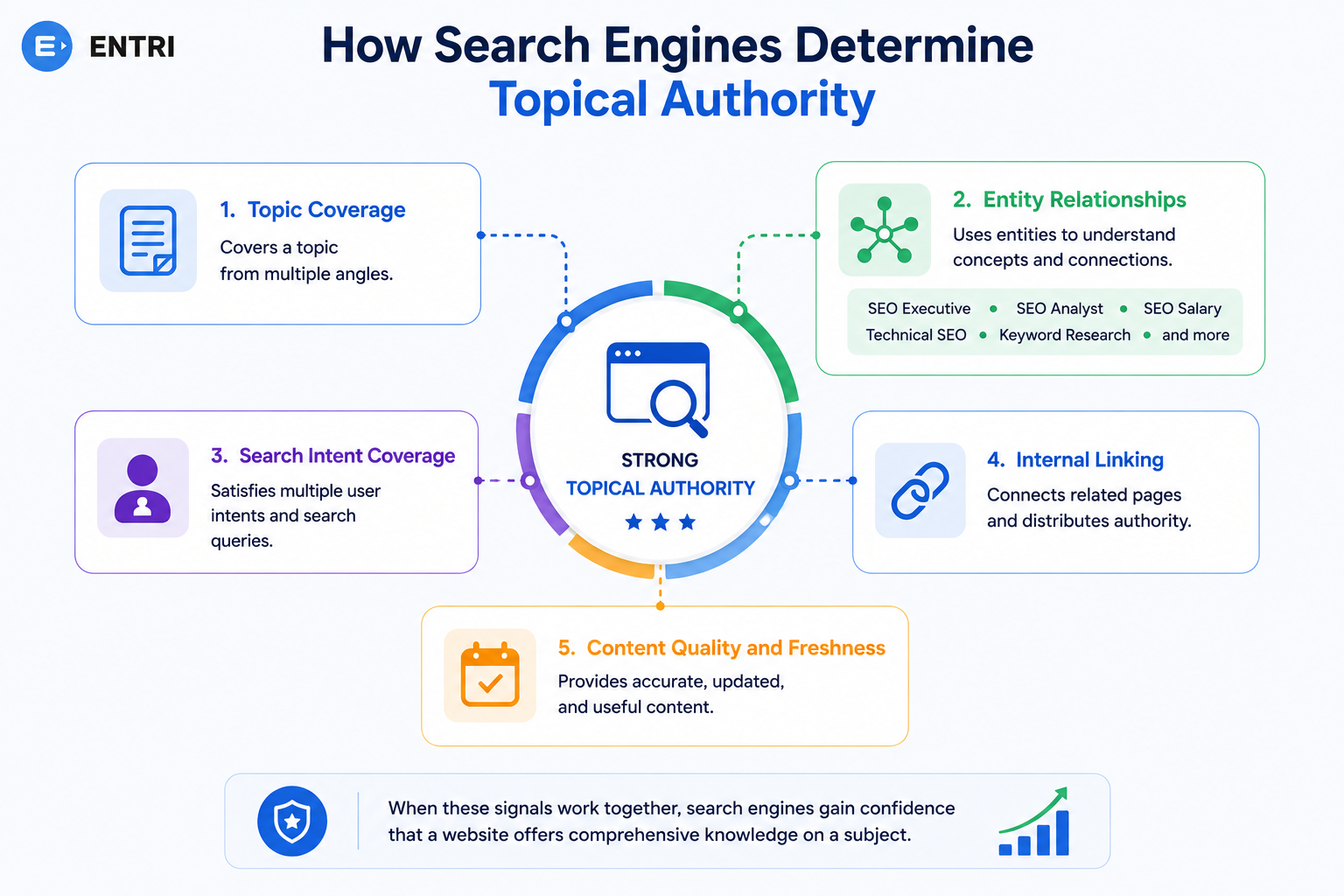
Several factors influence topical authority.
Topic Coverage
Websites that cover a topic from multiple angles demonstrate stronger expertise. Comprehensive coverage helps search engines understand that the website can answer a wide range of user questions.
Entity Relationships
Search engines use entities to understand concepts and their connections. For example, the topic “SEO Career” connects with entities such as SEO Executive, SEO Analyst, Search Engine Optimization, Keyword Research, Technical SEO, SEO Salary, and Digital Marketing. When content covers these related entities, search engines gain a clearer understanding of the website’s expertise.
Modern search engines use semantic technologies such as vector embeddings to understand the relationship between topics, entities, and user queries. Instead of matching exact keywords, search engines compare the contextual meaning of content. This allows them to recognize that topics such as SEO careers, SEO salaries, SEO skills, and SEO jobs belong to the same knowledge area, helping them evaluate topical authority more accurately.
Search Intent Coverage
Users rarely search for a topic in a single way. Some users seek definitions, while others seek salaries, jobs, skills, courses, or career opportunities. Websites that satisfy multiple search intents build stronger topical authority.
Internal Linking
Internal links help search engines discover relationships between pages. A well-structured internal linking system connects supporting articles to the main topic and helps distribute authority throughout the website.
Content Quality and Freshness
Accurate, updated, and useful content strengthens trust. Websites that regularly improve and expand their content often maintain stronger topical authority over time.
When these signals work together, search engines gain confidence that a website offers comprehensive knowledge on a subject rather than isolated information.
Authority Distribution in Modern Search

Topical authority is not limited to content alone. Search engines evaluate authority across multiple layers, including the author, website, and brand behind the content.
User Authority (Author Authority)
Author authority refers to the expertise and credibility of the individual creating the content.
For example, an SEO article written by an experienced SEO professional with a strong author profile carries stronger authority than one written by someone with no expertise. Search engines assess signals such as experience, qualifications, published work, industry recognition, and topic consistency.
The more expertise an author demonstrates within a specific subject, the stronger their authority becomes.
Website Authority
Website authority refers to the overall trust and expertise of a website within a topic area.
Content depth, topical coverage, internal linking, backlinks, and user engagement all contribute to website authority.
Brand Authority
Brand authority refers to the trust and recognition associated with a brand.
For example, if Tata launches a new website about electric vehicles, users and search engines may trust the content more quickly because the Tata brand already possesses authority and credibility in related industries.
Strong brands benefit from existing trust signals, brand searches, mentions, media coverage, and reputation. These signals can accelerate the growth of topical authority for new content and websites.
When author authority, website authority, and brand authority work together, search engines gain stronger confidence in the expertise and reliability of the information being published.
Building Topical Authority Starts With Topic Selection
Many websites fail to build topical authority because they start with highly competitive topics.
Suppose you want to sell an SEO course. Your first instinct might be to create a pillar page targeting “What is SEO”. While the topic attracts significant search volume, it also faces intense competition from established websites, SEO tools, blogs, and educational platforms.
Instead of competing directly on a broad topic, you can focus on a topic that aligns more closely with your business goal.For example, SEO Careers in Kerala can become the pillar topic.People searching for SEO careers often want to know:
- SEO salary in Kerala
- Companies hiring SEO professionals in Kerala
- SEO skills required for jobs
- SEO interview questions
- SEO internships in Kerala
- SEO certifications
- SEO career growth opportunities
These topics create natural supporting articles around the pillar page.
As you start publishing and connecting these articles, search engines start to get the picture – your website’s got comprehensive info on SEO careers. At the same time, you’re attracting users who are just starting to explore an SEO course, because they’re actively looking into it.
This approach works a couple of ways – it reduces competition and gets your business moving in the right direction, all while laying out a clear path to building up your authority in your field.
Instead of trying to rank for every possible SEO keyword out there, you’re establishing your expertise in a particular area and then gradually expanding your authority.
Become an AI-powered Digital Marketing Expert
Master AI-Driven Digital Marketing: Learn Core Skills and Tools to Lead the Industry!
Explore CourseHow to Find Supporting Topics for Your Pillar Page
The goal of a content cluster is not to create random articles. Each supporting topic should help users move closer to their objective while strengthening the pillar topic.
Start by identifying the questions users ask at different stages of their journey.
Using SEO Career in Kerala as an example, a beginner may first ask whether SEO is a good career choice. Once interested, they may search for salaries, required skills, job opportunities, certifications, internships, and career growth.
This journey naturally reveals supporting topics such as:
- Is SEO a Good Career in Kerala?
- SEO Salary in Kerala
- SEO Skills Required for Freshers
- SEO Internship Opportunities in Kerala
- SEO Jobs in Kochi
- SEO Interview Questions
- SEO Certifications for Beginners
- Future Scope of SEO Careers
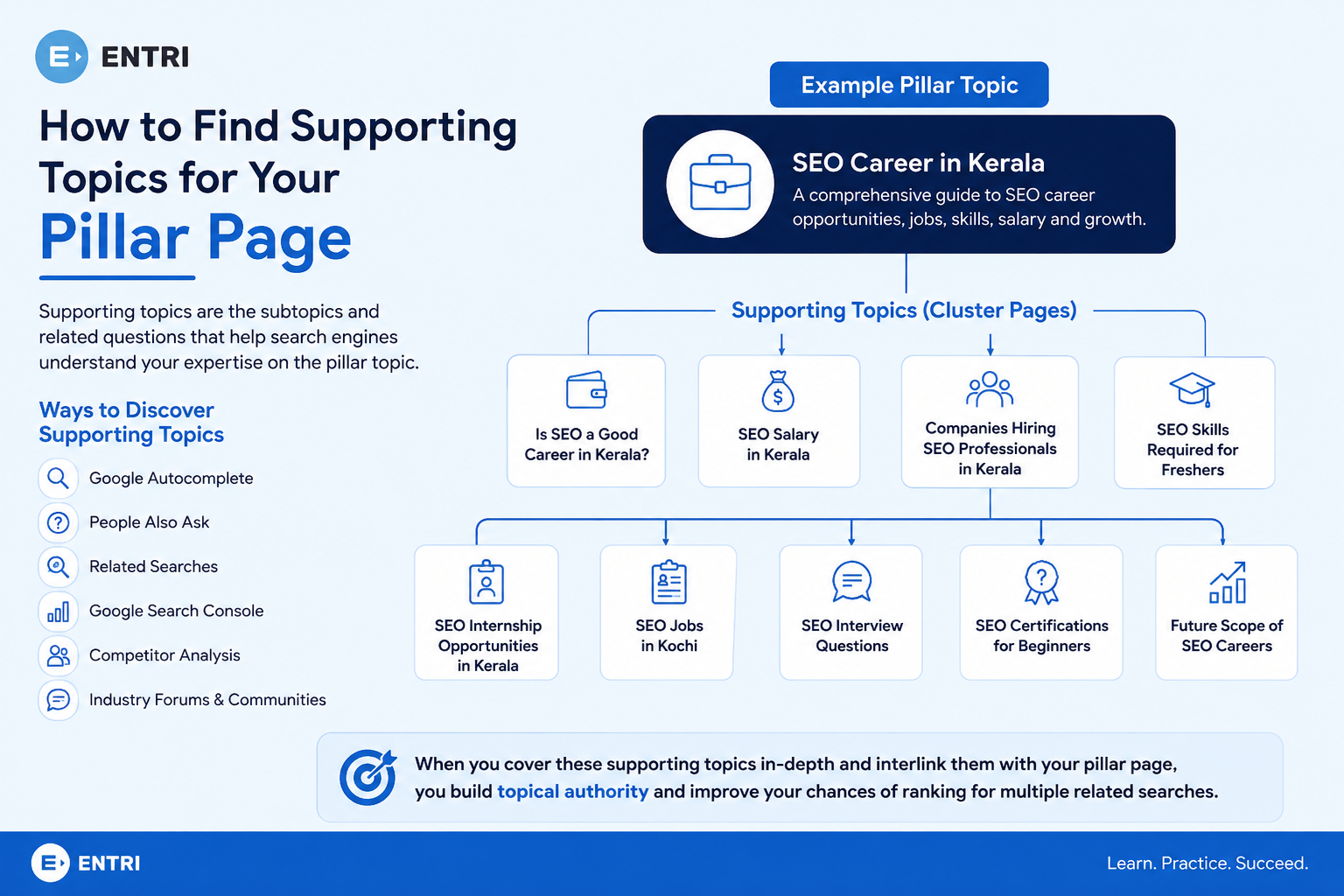
You can discover these topics through:
- Google Autocomplete
- People Also Ask results
- Related Searches
- Google Search Console
- Competitor content analysis
- Industry forums and communities
As you collect topics, organize them around the pillar page instead of treating them as independent articles.
A good content cluster answers the majority of questions a user may have about a topic. When search engines observe this comprehensive coverage, they gain greater confidence in the website’s expertise and topical authority.
How Internal Linking Strengthens Topical Authority
Internal links help search engines understand what’s going on between pages on your website.
A solid internal linking structure connects the pillar page with all its supporting articles. For example, SEO Career in Kerala can link to articles about SEO salaries, skills, internships, certifications, and job opportunities.
Supporting articles should also link back to the pillar page when relevant.
This structure helps search engines understand the topic more clearly and strengthens the connection between related content.
Internal links also improve the user experience by helping visitors discover additional information without leaving the website.
When content clusters, entity coverage, and internal linking work together, they create a strong foundation for topical authority.
How Topical Authority Improves Rankings
With topical authority, websites don’t just get to rank for their primary target keyword – they can also start ranking for other searches related to the topic.
For example, a website targeting SEO Career in Kerala might also start showing up for searches on SEO salaries, SEO jobs, SEO internships, SEO skills, and SEO certifications.
This happens because search engines get that the website’s an authority in the whole topic area, not just a single page. Topical authority has pretty much become one of the top SEO strategies for getting more visibility across related keyword clusters and building up some long-term organic growth.
As you start covering more and more of the topic, your website becomes eligible to rank for a whole bunch of other related searches. This increases organic visibility and attracts users at all stages of their journey. It gives you a bunch of new opportunities to get traffic from the same topic ecosystem, rather than relying on just one keyword.
Common Mistakes that Prevent Topical Authority
Many websites struggle to build topical authority because they focus on keywords instead of topics.
Some of the most common mistakes include:
- Publishing isolated articles without a content cluster
- Targeting highly competitive topics too early
- Ignoring related entities and supporting topics
- Weak or missing internal linking
- Creating content for search engines instead of users
- Leaving important user questions unanswered
For example, a website targeting SEO Career in Kerala with a single article will struggle to demonstrate expertise. Supporting content about salaries, skills, jobs, certifications, and internships provides the depth needed to build authority.
Topical authority grows when websites cover a topic comprehensively rather than chasing individual keywords.
How to Measure Topical Authority

Topical authority does not have a direct score. Instead, you can measure it through the visibility and growth of your content cluster.
Some key indicators include:
- Rankings for multiple related keywords
- Growth in organic traffic
- Increased impressions in Google Search Console
- Higher visibility across topic-related searches
- Better engagement with supporting articles
As more supporting pages begin to rank, search engines gain greater confidence in the website’s expertise. This growth often indicates that topical authority is increasing.
Topical Authority is a Long-Term Strategy
Building topical authority takes time. Search engines need consistent signals before they recognize a website as an expert source on a topic.
Instead of publishing random articles, focus on creating a structured content ecosystem around a specific subject. Start with a focused pillar topic, identify supporting topics, cover important entities, and connect everything through internal links.
Topical authority is not just about trying to rank one or two pages. It’s about becoming the go-to resource for that whole topic – a trusted authority that folk turn to when they’re looking for reliable information. Websites that keep investing in that sort of topic-coverage just seem to get seen more often, get more trust, and grow their organic traffic over time.
Kickstart your Dream Career with Online Performance Marketing Course in Kerala. Enrol Now
Conclusion
Topical authority flips the script on SEO. It is not about optimising one page at a time, it is about building a network of connected knowledge. Find a pillar topic that resonates with your audience and your business goals, mapping supporting topics to actual user needs, producing high-quality and up-to-date content, and deliberately linking your pages together. By doing these you create what the search engines and AI driven experiences love to reward.
Think of topical authority as an investment strategy: start small by building around a niche with a focused pillar topic, build out your coverage little by little, keep an eye on that multi-keyword visibility, and use that user behaviour and search data to keep tweaking and improving.
Over time this approach should get you more long term rankings, a better user experience, and a whole lot more trust. That means that when people search for a topic, your site is the one they come to – the go to resource that you’re all about.
Frequently Asked Questions
Why does topical authority matter for SEO?
Search engines reward sites with strong topical authority by ranking them for many related queries, not just one keyword. This leads to better visibility, trust, and long-term organic growth.
How do search engines measure topical authority?
They evaluate topic coverage, entity relationships, search-intent variety, internal linking, content quality, and freshness. There’s no single public score, but growth in rankings and traffic across a topic cluster signals rising authority.
How do I choose a pillar topic?
Pick a focused topic that aligns with your business goal and isn’t overly competitive (e.g., “SEO Career in Kerala” instead of “What is SEO”). It should naturally lead to many supporting questions users ask.
How do I find supporting topics for my pillar page?
Use Google Autocomplete, People Also Ask, Related Searches, Google Search Console, competitor analysis, and community forums. Organize results by user-journey stages (awareness → consideration → decision).
Why is internal linking critical for topical authority?
Internal links show search engines how pages relate and help distribute authority across the cluster. They also guide users to related answers without leaving your site.
What common mistakes kill topical authority?
Publishing isolated posts, targeting ultra-broad topics too early, ignoring related entities, weak internal linking, and writing for bots instead of users. These prevent search engines from seeing your site as a true expert.
How long does it take to build topical authority?
It’s a long-term strategy; search engines need consistent, high-quality signals over months. Focus on steadily expanding your cluster and refining content rather than expecting quick wins.
How can I measure progress in topical authority?
Track rankings for multiple related keywords, organic traffic growth, impressions in Search Console, and engagement with supporting articles. Rising performance across the cluster indicates growing authority.