Table of Contents
Have you seen a child sitting with the legs out on both sides? The knees are bent, and the feet stay near the hips. From the front, the legs look a little like the letter W. This sitting style is called W-sitting.
You may see it during floor play. A child may sit like this while playing with toys, looking at a book, or drawing. Some children stay this way for quite a while.
W-sitting is not a problem every time. What matters is how often the child sits this way and whether there are other problems, such as pain, frequent falls, or trouble walking.
Register for the Entri Elevate Montessori Teacher Training Program! Join Now!
Key Takeaways:
- Some children sit in a W shape while playing.
- They may like this way because it feels comfortable.
- Try other sitting ways during floor play.
- Look out for pain or frequent falls.
- Get medical advice if the child has any trouble for walking or moving.
What is W-Sitting?
You may see some children sit on the floor with both knees bent. Their feet stay beside their body. The legs point out to the sides. From the front, the legs look like a W. So, this way of sitting is called W-sitting.
How does W-Sitting Look?
In this position:
- The child sits on the floor.
- Both knees are bent.
- The feet stay beside the hips.
- The legs look like a W.
A child may sit this way while playing with toys, drawing, or looking at a book.
Why do Children Sit This Way?
W-sitting may feel easy and steady for some children. It lets them sit without using their hands to support their body.
Children may choose this position while:
- Playing with blocks.
- Drawing or colouring.
- Looking at books.
- Playing with toys.
Is W-Sitting Common?
Yes, some young children W-sit while playing. They may move into this position without thinking about it.
A child may also change between W-sitting and other ways of sitting. W-sitting for a short time does not always mean there is a problem.
Should Parents Stop W-Sitting?
Some children like to sit this way when they play. They may sit like this for some time and then change.
Parents can show them another way. The child can sit with the legs in front or on one side. Sitting with crossed legs is also okay. Do not keep telling the child to change. Just let them try other ways of sitting during play.
Why do Children Sit in the W Position?
1: What is the primary focus of the first plane of development in the Montessori method?
Some children like W-sitting because it feels easy and steady. They may choose it while playing on the floor. There can be a few simple reasons for this.
It Feels Comfortable
W-sitting can feel comfortable for some children. Their legs stay on the floor, which helps them feel steady.
It Gives Good Support
The legs stay on both sides of the body. This gives the child a wide base to sit on. So, they can sit and play without using their hands to support themselves.
It Makes Playing Easy
The child can keep their body steady while using their hands.
They can:
- Play with toys.
- Build blocks.
- Draw.
- Read books.
- Do puzzles.
It Helps Them Reach Toys
Children may choose W-sitting when toys are in front of them. They can reach the toys without moving their legs much.
They May Choose It Naturally
Young children often change their sitting positions during play. They may move into W-sitting without thinking about it. Later, they may crawl, stand, walk, or sit in another way.
They May Like It During Floor Play
W-sitting may be seen during activities such as:
- Playing with blocks.
- Colouring.
- Looking at books.
- Playing with cars or dolls.
- Doing puzzles.
Let Children Try Other Positions
Children can also sit in other ways during play.
They can try:
- Sitting with legs straight.
- Sitting cross-legged.
- Side sitting.
- Kneeling.
- Sitting on a small chair.
Is W-Sitting Bad for Children?
You may see your child sit like this while playing on the floor. They may sit this way with toys, books, or while drawing.
Sitting like this sometimes is usually okay. If they sit this way a lot, show them another way to sit. They can keep their legs in front, sit with crossed legs, or put their legs to one side.
W-Sitting is not Always a Problem
A child may sit in the W position for a short time. They may then change their position or get up and play. This is common during floor play. Parents do not need to worry every time they see their child sitting this way.
Why Should Children Change Positions?
Children need to move their bodies in different ways. Changing the sitting position gives them more chances to move.
They can:
- Sit with their legs in front.
- Sit cross-legged.
- Sit on a small chair.
- Kneel for a short time.
- Stand up and move around.
These simple changes can be part of normal play.
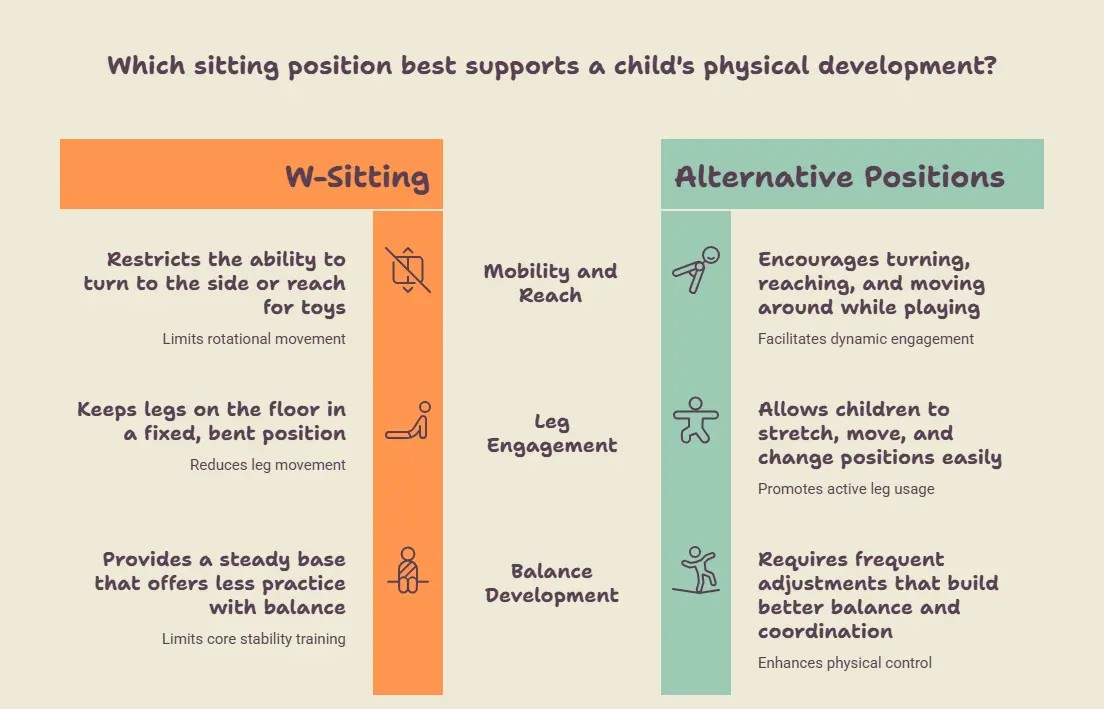
W-Sitting can Limit Some Movements
When a child sits in the W position, both legs stay on the floor. The child may not move their legs much. This can make some movements harder.
For example, the child may find it harder to:
- Turn to the side.
- Reach behind them.
- Move from one side to another.
- Change to another sitting position.
Giving the child other ways to sit can help them practise these movements.
Give Children More Chances to Move
Children can change their position while playing. They can sit, stand, crawl, walk, and reach for toys. You can place toys in different places. This can make the child turn and move while playing.
For example, place a toy:
- In front of the child.
- Beside the child.
- A little away from the child.
This makes play more active.
When Should Parents Get Help?
W-sitting may not be a problem on its own. Look at how the child moves at other times too. Is walking easy for them? Can they get up, run, and move around without pain?
If these things seem difficult, it is worth getting the child checked by a doctor.
It is good to ask for help if the child:
- Has pain.
- Falls often.
- Has trouble walking.
- Has trouble running.
- Finds it hard to change positions.
- Uses one side of the body much more than the other.
A doctor can check the child and guide the parents.
What Should Parents Remember?
Parents do not need to stop the child every time they W-sit. Instead, give the child other ways to sit and play. The main aim is simple. Let the child move, change positions, and play comfortably.
Potential Risks of W-Sitting
W-sitting may feel easy and steady for some children. But sitting this way for a long time may give the child less chance to move and turn their body. This is why it is good to let children try other sitting positions too.
May Make Turning Harder
In a W-position, the legs stay on the floor. This may make it harder for the child to turn and reach.
They may find it harder to:
- Turn to the side.
- Reach for a toy.
- Move around while sitting.
Less Practice With Balance
A child may not stay in one place while playing. They may turn, reach for a toy, get up, and sit again.
Less Leg Movement
In a W-position, the legs stay bent and turned out.
Other positions let children:
- Stretch their legs.
- Move their legs.
- Change position.
- Stand up.
Not a Problem for Every Child
W-sitting does not mean that every child will have a problem. Each child is different. The main thing is to give children chances to sit and move in different ways.
When Should Parents Get Help?
Talk to a doctor or physiotherapist if the child also has:
- Pain.
- Trouble walking or running.
- Frequent falls.
- Trouble getting up.
- Trouble moving one side of the body.
W-sitting by itself does not mean that a child has a health problem.
How Can Parents Help?
Parents do not need to stop the child every time they W-sit. Instead, gently offer another position.
The child can try:
- Sitting cross-legged.
- Sitting with legs straight.
- Side sitting.
- Kneeling.
- Sitting on a small chair.
- Standing and playing.
Let the child change positions during play. The simple goal is to give them more chances to move their body in different ways.
Get Certified & Start Your Montessori Career
Montessori Teacher Training Course by Entri App: Gain expert skills, earn certification, and kickstart your teaching career.
Join Now! Alternatives to W-Sitting for Children
A child does not have to sit in one way during floor play. They can stretch their legs out, sit with their legs crossed, or turn both legs to one side. A small chair is another option.
Cross-Legged Sitting
This is the sitting position many children use during floor play. They can sit this way for a book, a puzzle, or some drawing. It also makes it easy to reach the toys in front of them.
Legs Straight
Children can also sit with both legs straight in front of them. They can use this position while playing on the floor.
They can:
- Look at books.
- Play with toys.
- Build blocks.
- Roll a ball.
Let the child change position when they want.
Side Sitting
In side sitting, the child sits with both legs on one side. This can be used during simple floor play. Place a toy in front of the child and let them play. Do not move the child’s legs into this position. Let them sit in a way that feels comfortable.
Kneeling
Children can kneel while playing with toys. They can also move from kneeling to standing.
For example, place a toy on a low table. Let the child kneel and play with it.
Sitting on a Small Chair
A small, strong chair can be useful for drawing, reading, or puzzles.
Make sure:
- The chair is stable.
- It is the right size.
- The child’s feet can touch the floor.
Stay close while the child uses the chair.
Squatting and Standing
Children can squat to pick up toys from the floor. They can then stand up again. This can be part of a simple game.
For example, ask the child to pick up a toy and put it in a box.
Let the Child Change Positions
Children do not need to stay in one position while playing.
They may:
- Sit.
- Kneel.
- Crawl.
- Stand.
- Walk.
- Sit again.
Let them move when they want to.
Use Play to Encourage Movement
Keep a toy a little away from the child. They may turn or reach for it. They may also crawl or stand to get the toy. Let them play without forcing them to move.
Give Children Safe Floor Space
Give the child some clear space to play. Look around before play time. Move away wires, sharp things, small toys, and mats that slip.
Do not Force a Sitting Position
If the child sits in a W shape, do not pull their legs. Let them sit and move as they like. They may change their position while playing.
Watch how the child moves at other times. Pain or lots of falls may need a check. If walking or balance is hard, talk to the child’s doctor.
How Parents Can Encourage Better Sitting Positions
During play, children sit in many ways. They may stretch their legs, cross them, or move them to one side. If your child keeps sitting in a W shape, show them another way to sit. You do not have to correct them each time.
Offer Other Sitting Positions
If the child is W-sitting, gently show another position.
They can try:
- Sitting cross-legged.
- Sitting with legs straight.
- Side sitting.
- Kneeling.
- Sitting on a small chair.
Do not force the child to change.
Use Toys to Encourage Movement
Place toys in different places. This can encourage the child to turn, reach, or move.
For example, place a toy:
- In front of the child.
- A little to the side.
- On a low table.
This makes movement part of play.
Change Activities
Different activities can lead to different sitting positions.
For example:
- Read a book while sitting.
- Build blocks while kneeling.
- Draw at a small table.
- Play with a ball while standing.
This helps the child move more during the day.
Let the Child Move Often
Children do not need to stay in one position for a long time.
They can:
- Sit.
- Kneel.
- Crawl.
- Stand.
- Walk.
They may sit in another way later.
Keep the Play Area Safe
The child needs a safe place to play. Look around the floor before they start. Wires, sharp things, and small objects should be out of the way. Also check that the floor is not slippery.
Do not Force the Child
If your child sits in a W shape, leave the legs alone. Do not pull them into another position. They may change their sitting position on their own while playing.
When Should Parents Consult a Professional?
W-sitting alone does not always mean there is a problem. Many children sit this way while playing. But some signs may need more attention.
When to Talk to a Doctor
Parents can talk to a doctor if the child often has:
- Pain in the legs, hips, or back
- Trouble walking or running
- Frequent falls
- Trouble getting up from the floor
- Trouble moving one leg
- Trouble keeping balance
When to See a Physiotherapist
A physiotherapist can check how the child sits, walks, and moves. They can also suggest simple exercises or other ways to sit and play. It is helpful to get advice if the child has ongoing movement problems.
Do not Worry About W-Sitting Alone
A child may W-sit sometimes without having any health problem. Parents do not need to panic or force the child to change every time.
If there are other concerns about walking, movement, or pain, it is better to ask a health professional.
Register for the Entri Elevate Montessori Teacher Training Program! Join Now!
Conclusion
W-sitting is common in young children. They may sit like this when they play on the floor.
A child can also sit with the legs straight, cross the legs, or sit on one side. Parents can show these ways during play. There is no need to change the child’s sitting way every time. Let the child move and sit in different ways.
If the child has pain or falls a lot, talk to a doctor. The same is true if walking seems hard. Children may sit in many ways when they play. Let them sit, get up, and move around during play.
Get Certified & Start Your Montessori Career
Montessori Teacher Training Course by Entri App: Gain expert skills, earn certification, and kickstart your teaching career.
Join Now!Frequently Asked Questions
What is W-sitting in children?
W-sitting is a way of sitting on the floor. The child sits on their bottom with both knees bent. The feet stay on the sides of the body. When seen from the front, the legs look like the letter W.
Why do children sit in a W position?
Some children find this position easy and steady. It can help them sit without using their hands for support. They may choose it while playing with toys, drawing, reading, or doing puzzles on the floor.
Is W-sitting bad for children?
W-sitting does not always mean there is a problem. Some children sit this way for a short time during play. It is worth paying more attention if the child sits this way very often or also has pain, frequent falls, or trouble with movement.
Should parents stop a child from W-sitting?
Parents do not have to correct the child every time they W-sit. They can show other sitting positions during play. Sitting with the legs straight, crossed, or to one side are some simple choices.
Can W-sitting affect a child's walking?
W-sitting by itself does not mean that a child will have trouble walking. If the child already has problems with walking, balance, running, or getting up from the floor, it is better to speak with a doctor or physiotherapist.
What are some alternatives to W-sitting?
Children can try several other ways to sit. They can sit with their legs in front, sit cross-legged, or keep both legs to one side. A small chair can also be used for some floor activities.
Is side sitting good for children?
Side sitting is one option during floor play. The child sits with both legs on one side of the body. They can use this position while playing with a toy, looking at a book, or doing a simple activity.
Can children kneel instead of W-sitting?
Yes. Kneeling can be used during some play activities. A child may kneel near a low table while playing with a toy. They may also move from kneeling to standing during play.
When should parents talk to a doctor about W-sitting?
W-sitting alone is not usually enough to show that something is wrong. Parents should get advice if the child has pain, falls often, has trouble walking or running, or has difficulty with balance or movement.
How can parents help a child who often W-sits?
There is no need to keep correcting the child. During play, parents can show another way to sit. They can also give the child enough open space to move, change positions, and play comfortably.