Table of Contents
Assessment is collecting information about how a child learns. Evaluation is judging that information to decide how well the learning went and what to do next.
Assessment asks, “Where is this child right now?” Evaluation asks, “How well did it go, and what should we decide?”
Many teachers mix the two up. That is natural. Both use the same tools, like notes, checklists and tests. Both happen in the same room. People also use the words as if they mean one thing, and many school forms do the same. But they do different jobs.
Key Takeaways
- Assessment gathers information about learning.
- Evaluation judges the quality of that learning.
- Assessment is ongoing. Evaluation comes at set points.
- Assessment helps the child grow. Evaluation helps adults decide.
- There are three common kinds: diagnostic, formative and summative.
- Young children are best assessed through watching and play.
- Teachers need both to teach well.
Register for the Entri Elevate Montessori Teacher Training Program! Join Now!
What is Assessment?
1: What is the primary focus of the first plane of development in the Montessori method?
Assessment means gathering information about what a child knows, can do and needs. The teacher watches, listens, asks and collects work. The goal is to get to know each child well.
Assessment is finding out where a learner stands today. Think of it as a daily health check for learning.
Purpose of Assessment
It helps the teacher answer simple questions.
- What does this child already know?
- What is the child ready to learn next?
- Where is the child stuck?
- Is my teaching working?
Key Features of Assessment
It is Ongoing
It does not wait for the end. This happens every day in small ways. A teacher notices how a child holds a pencil or how long a child stays with a task.
It Looks at the Process
It cares about how a child learns, not only the final answer. How did the child try? What did the child do when it got hard?
It is Mostly Descriptive
Teachers often write short notes, not marks. For example: “Counts to ten with help. Skips seven.”
It Guides the Next Step
The results shape the next lesson. If many children struggle, the teacher changes the plan.
It Feels Safe
Good assessment does not scare children. It feels like part of the day.
Common Assessment Tools
- Observation notes
- Checklists
- Work samples
- Photos and short videos
- Talks and questions
- Short quizzes
- Portfolios
- Self-checks by the child
Get Certified & Start Your Montessori Career
Montessori Teacher Training Course by Entri App: Gain expert skills, earn certification, and kickstart your teaching career.
Join Now!What is Evaluation?
Evaluation means looking at the information gathered and making a judgment. It asks how well something worked. It often leads to a decision.
Evaluation means judging how good the learning, the lesson or the program was. It uses facts from assessment and gives them meaning.
Purpose of Evaluation
It helps adults make clear choices.
- Did the child reach the goal?
- Did the lesson work?
- Is the program doing its job?
- Does the child need extra support or a new level?
- What should change next year?
Key Features of Evaluation
It Happens at Set Points
This often comes at the end of a unit, term or year.
It Looks at the Result
Did the child meet the goal or standard?
It May Use Marks or Ratings
This can give a grade, a score, a rating or a written report.
It Involves Judgment
Someone decides what is strong, average or weak, based on a clear goal.
It Leads to Decisions
A child may move up a level. A child may get extra help. A school may change its plan.
It Can Look Beyond the Child
Evaluation can also review a lesson, a method or a whole program.
Common Evaluation Tools
- End-of-term tests
- Report cards
- Progress reports
- Rating scales
- Program reviews
- Parent feedback forms
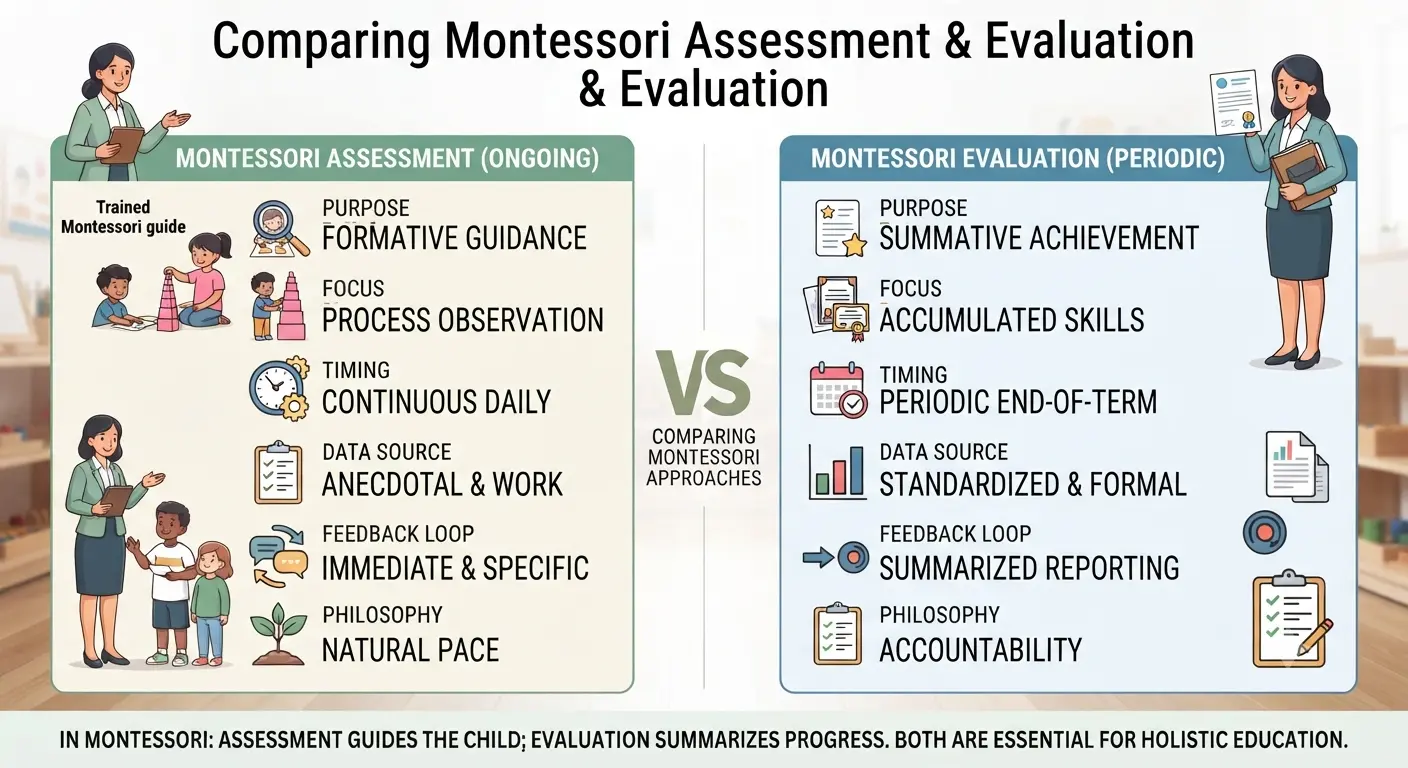
Difference between Assessment and Evaluation
Both are about learning. But their aims, timing and results are not the same.
Comparison Table
| Point | Assessment | Evaluation |
|---|---|---|
| Meaning | Collecting information on learning | Judging the value of learning |
| Main question | Where is the child now? | How well did it go? |
| Purpose | To guide and improve learning | To decide and measure results |
| Timing | Ongoing, every day | At set points, often the end |
| Focus | The process | The result |
| Feedback | Quick, in words | Later, often as marks |
| Outcome | Next steps for teaching | A grade, decision or report |
| Tone | Supportive | Judging |
Purpose
Assessment aims to help. It tells the teacher how to support the child. Evaluation aims to decide. It tells adults how well the goal was met.
For example, a teacher watches a child try to tie shoelaces. The child gets the first loop but not the second. That is assessment. At the end of the term, the teacher writes whether the child can tie shoes alone. That is evaluation.
Timing
Assessment runs from the first day to the last. Evaluation comes at planned moments.
Think of cooking. Tasting the soup as it simmers is assessment. Asking guests how it was after dinner is evaluation.
Process
In assessment, the teacher gathers many small bits of information. In evaluation, she puts those bits together, compares them with a goal and forms a judgment.
Feedback
Assessment feedback is quick and friendly. “You counted well. Let us try the next number.” Evaluation feedback comes later, such as a report. It tells the child and parents how things went overall.
Outcome
The outcome of assessment is a better plan. The outcome of evaluation is a decision.
Types of Assessment and Evaluation
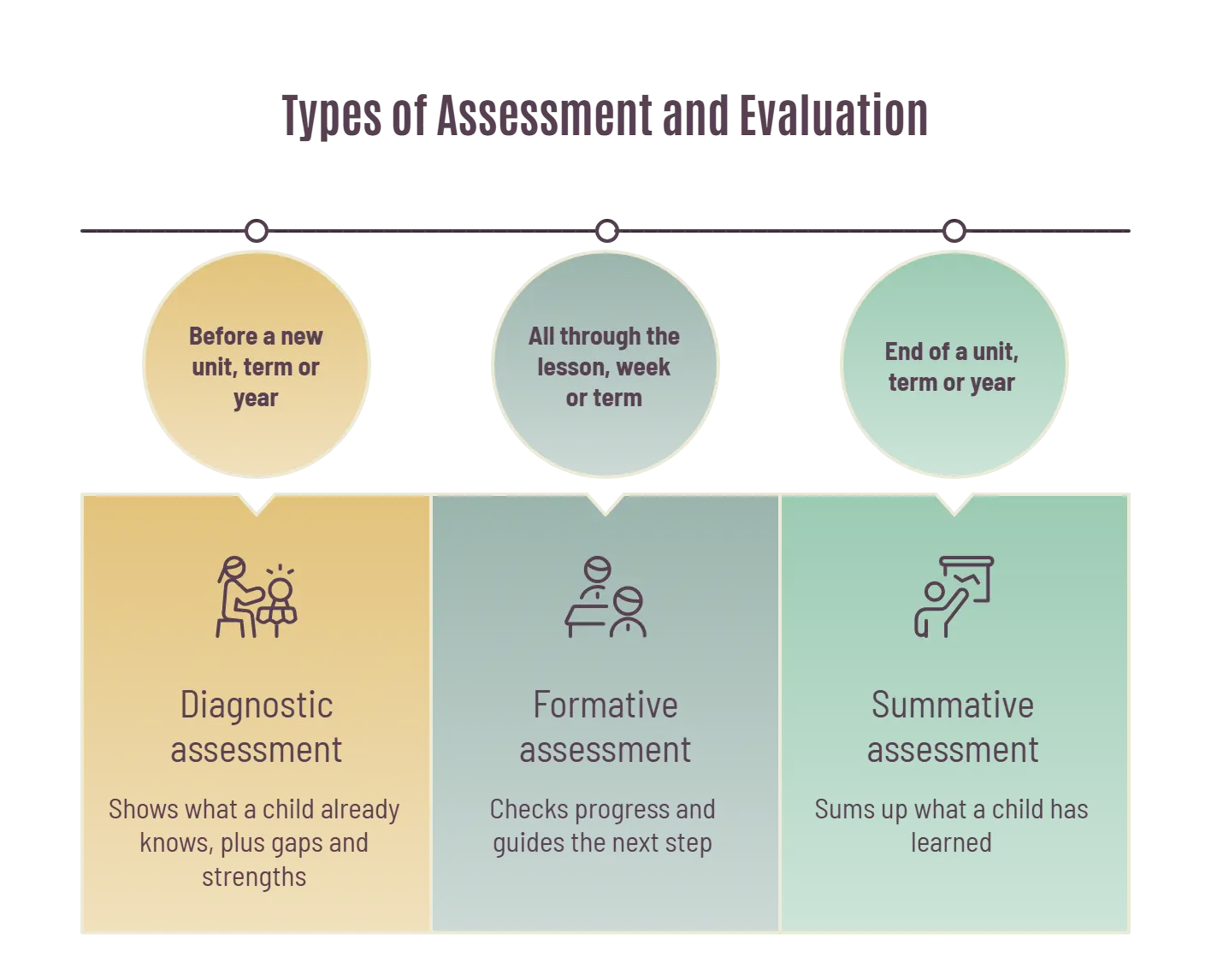
Teachers use three main types. Each has its own time and use.
Diagnostic
This happens at the start. It shows what a child already knows, plus gaps and strengths.
When: Before a new unit, term or year.
Examples:
- A friendly chat to see which letters a child knows
- A pre-unit quiz
- A skills checklist at admission
- A story-telling activity to check language
Why it helps:
- It shows where to begin.
- It spots children who need support.
- It avoids teaching what children already know.
Formative
This happens during learning. It checks progress and guides the next step. It is low pressure and often has no marks.
When: All through the lesson, week or term.
Examples:
- Watching a child work with materials
- Asking questions during a lesson
- A quick thumbs-up check
- Looking at a drawing or writing sample
- Feedback during an activity
Why it helps:
- It gives quick feedback.
- It lets the teacher change the lesson right away.
- It helps children see their own growth.
Summative
This happens at the end. It sums up what a child has learned. It is usually graded or rated.
When: End of a unit, term or year.
Examples:
- End-of-term exams
- A final project
- A year-end report
- A skills demonstration
Why it helps:
- It shows whether goals were met.
- It gives parents a clear record.
- It guides decisions on levels and programs.
Quick Comparison of the Three Types
| Type | When | Main Goal | Marks? |
|---|---|---|---|
| Diagnostic | Before learning | Find the starting point | Usually no |
| Formative | During learning | Guide and improve | Usually no |
| Summative | After learning | Judge the result | Often yes |
Get Certified & Start Your Montessori Career
Montessori Teacher Training Course by Entri App: Gain expert skills, earn certification, and kickstart your teaching career.
Join Now!Real Classroom and Montessori Examples
Real examples make the idea clear. Here are some from everyday settings.
Example 1: Watching a Child at Work
In a Montessori classroom, children choose their own activity. A teacher sits quietly and watches a four-year-old build the pink tower.
Assessment:
She notes that the child stacks the blocks in the right order but stops when they get small. She also notes how long the child stays focused.
Next Step:
She offers a short demo and a similar task with smaller pieces.
Example 2: The Three-Period Lesson
This is a classic Montessori method.
- Naming: “This is a triangle.”
- Recognition: “Show me the triangle.”
- Recall: “What is this?”
Assessment:
The third step shows whether the word truly stuck. If the child answers, the teacher knows. If not, she tries again another day.
Example 3: A Morning Goodbye
Think of a child who cries at drop-off in the first weeks of preschool.
Assessment:
The teacher notes how long the crying lasts and what calms the child. Maybe a soft toy helps. Maybe pouring water from a jug helps.
Next Step:
She plans a short, warm goodbye routine and a calming task at the start of the day. She shares a short note with the parent.
Example 4: Watching Brain and Body Skills Grow
A teacher keeps notes on how children move, speak and solve problems. One child can now thread beads. Another can follow a two-step request.
Assessment:
These notes show each child’s growth in small steps. They also show who may need a closer look.
Example 5: Work Samples and Portfolios
A teacher keeps a folder for each child. It holds drawings, early writing, photos and notes.
Assessment:
Over time, she sees growth in handwriting and drawing.
Evaluation:
At term end, she reviews the folder, decides whether the child met the goals and writes a progress report.
Example 6: A Checklist for Daily Skills
A teacher tracks practical life skills like these.
- Pours water without spilling
- Buttons a coat
- Washes hands properly
- Puts materials back
Assessment:
She ticks off what each child can do during the term.
Evaluation:
At the end, she reviews the lists and reports which skills are strong and which need support.
Example 7: A Parent Meeting
The teacher shares a child’s work and notes.
Evaluation:
She sums up how the child is doing, what is going well and what needs support. Together, they agree on a plan.
Example 8: Reviewing a Program
A school wants to know if its new reading program works.
Evaluation:
It looks at progress data for all children, plus feedback from teachers and parents. Then it decides whether to keep, change or stop the program.
Why Both Matter in Early Childhood Education
Young children learn differently from older students. So the way we check their learning must also be different.
Children Grow at Different Speeds
Two children of the same age can be at very different points. Assessment shows each child’s own path. It helps teachers avoid comparing children.
The Early Years are a Time of Fast Brain Growth
The brain builds new links quickly in the first five years. What a child lives through each day builds those links. Talking, playing and feeling safe all help.
When teachers watch closely, they can see how each child is growing. They notice words, movement, memory and feelings.
Early Support Makes a Difference
If a child struggles with speech, movement or social skills, an early start on support helps. Assessment spots the signs. Evaluation helps decide what support to offer.
It Guides Daily Teaching
Assessment shows what to teach next. A teacher who watches closely can match each activity to the child’s level. This keeps children interested and not stressed.
It Supports Feelings and Settling in
School can feel scary at first. Some children cry. Some hold on to mum. A teacher who watches can see who needs more time.
A soft toy helps one child. Another child wants to sit close to the teacher. This helps them feel safe.
It Builds Confidence
Kind words help a child. Say, “Good try. Let’s do it again.” Do not say, “That is wrong.” A kind word helps a child try again.
It Keeps Parents Informed
Parents like small stories. “He poured water by himself today.” That makes them happy. The term report shows the big picture. The daily notes show small moments.
Quick Look: Why Each Matters
| Need | Assessment Helps | Evaluation Helps |
|---|---|---|
| Daily teaching | Yes | Sometimes |
| Spotting early gaps | Yes | Yes |
| Telling parents | Gives stories | Gives a summary |
| Improving the program | Gives data | Gives judgment |
| Planning next steps | Yes | Yes |
How Teachers Use Assessment & Evaluation Together
The two work best as a cycle. Assessment feeds evaluation. Evaluation shapes the next round of assessment.
A Simple Cycle
- Set a goal. Decide what children should learn.
- Start with a diagnostic check. Find out what they already know.
- Teach and assess through the unit. Watch, ask and collect work.
- Adjust the plan. Change the lesson based on what you see.
- Evaluate at the end. Look at the evidence and judge the results.
- Reflect and plan. Use what you learned for the next unit.
Tips for Using Both Well
1. Use Many Sources
Do not rely on one test. Mix observation, work samples and talks with the child.
2. Keep Records Simple
Short notes and checklists are enough. Write what you see, not what you guess.
3. Share Feedback Quickly
Tell children what went well and what to try next. Do it soon, not weeks later.
4. Be Fair and Clear
Judge each child against the goal, not against other children.
5. Let Children Join In
Ask what they enjoyed and what felt hard.
6. Keep Parents in the Loop
Share short notes and photos. Explain reports in plain words. A simple line like “She cried for five minutes, then joined the puzzle” can reassure a parent.
Common Mistakes to Avoid
- Using the two words as if they are the same
- Waiting until the end to check learning
- Giving marks without feedback
- Using only tests
- Not sharing results with parents
- Doing the paperwork but not changing the teaching
A Quick Checklist for Teachers
- Do I know the goal?
- Did I check where children started?
- Am I watching and noting during the unit?
- Do I give quick, kind feedback?
- Do I judge fairly at the end?
- Do I use results to plan the next step?
Register for the Entri Elevate Montessori Teacher Training Program! Join Now!
Conclusion
Assessment and evaluation are close partners, but they are not the same. Assessment gathers information. It is ongoing, gentle and focused on helping the child grow. Evaluation judges the results. It happens at set points and guides decisions.
The three types show how they fit together. Diagnostic and formative work help you teach well along the way. Summative work shows where children ended up.
In early childhood, both matter a lot. When you watch a child closely, you see how they are growing, in how they think and how they feel. When you judge fairly, you can fix your own teaching and write honest, kind reports. Use both, and children feel safe. They learn better too.
Next time you watch a child at work, that is assessment. Next time you write a progress report, that is evaluation. Do both with care and kindness, and every child gains.
Get Certified & Start Your Montessori Career
Montessori Teacher Training Course by Entri App: Gain expert skills, earn certification, and kickstart your teaching career.
Join Now!Frequently Asked Questions
Is evaluation part of assessment?
Yes. Evaluation is an important part of the learning process. Assessment collects information about a student’s learning and progress. Evaluation uses this information to judge performance and decide whether learning goals have been achieved.
Which comes first, assessment or evaluation?
Assessment comes first, followed by evaluation. First, teachers collect information about students’ knowledge and skills through tests, assignments and classroom activities. Then, they evaluate the results to understand overall performance.
Is a test an assessment or evaluation?
A test is mainly a form of assessment. It helps teachers understand how much students have learned. The results of the test can later be used for evaluation and grading.
What is the difference between formative and summative assessment?
Formative assessment takes place during the learning process. It helps teachers identify learning difficulties and improve teaching methods. Summative assessment takes place at the end of a lesson, course or term to measure overall learning outcomes.
Can assessment exist without evaluation?
Yes. Assessment can take place without a final evaluation. Teachers can collect information through classroom activities, observations and assignments to understand student progress. However, evaluation uses this information to make judgments about learning outcomes.
What is the main purpose of assessment?
The main purpose of assessment is to understand students’ learning progress. It helps teachers identify strengths, find learning gaps and provide the right support to students.
What is the main purpose of evaluation?
Evaluation helps teachers judge how well students have achieved their learning goals. It also helps schools make decisions about grades, academic progress and teaching methods.
What are some examples of assessment and evaluation?
Classroom quizzes, homework, projects, oral questions and teacher observations are examples of assessment. Giving grades, preparing report cards and deciding whether students have achieved learning goals are examples of evaluation.