
Table of Contents
Young children ask many questions because their brains are growing fast and they want to understand the world. Questions help them learn new words, connect ideas and feel close to you. It shows your child is eager to learn. Most children go through this phase between ages 2 and 5.
It can feel tiring. “Why is the sky blue?” “Why do I have to sleep?” “Why, why, why?” But behind each question is a small mind at work.
Key Takeaways
- Questions are how young children learn.
- Most children start asking “why” around age 2 or 3.
- The phase is strongest between ages 3 and 5.
- Different questions show different kinds of thinking.
- Do not brush questions off. Ask the child back.
- You can say, “I’m not sure. Let’s look it up.”
- Very few questions, or no speech, may need a doctor’s advice.
Register for the Entri Elevate Montessori Teacher Training Program! Join Now!
Why Curiosity Drives Learning in Early Childhood
Curiosity means wanting to learn more about something. Young children have lots of it. Everything is new to them, so everything is interesting.
The Brain is Busy
A child’s brain grows quickly in the first five years. It builds new links all the time. Each new answer adds to those links. Questions feed the brain.
Questions are a Learning Tool
A child cannot read a book to find out how rain works. So the child asks. Asking is the quickest way a young child can get facts.
Children Want to Make Sense of Things
Children see many new things each day. They like to see how things connect. A question fills the gap in what they know.
It Builds Language
Every question uses words. Every answer adds new ones. A child who asks and listens learns to talk better.
It Builds Thinking Skills
Asking “why” and “how” teaches a child to look for reasons. This is the start of problem-solving.
It Builds Trust
When you answer, the child learns that you are there to help. The child feels safe, so they keep asking.
It is not Always about the Answer
Sometimes a child asks because they want to talk with you. The question is a way to connect. Giving your full attention is just as important as the answer.
What Curiosity Does for a Child
| Benefit | How It Helps |
|---|---|
| Better language | New words and longer sentences |
| Better thinking | Looking for reasons and causes |
| Better memory | Linking new facts to old ones |
| More confidence | Feeling safe to ask |
| Love of learning | Wanting to find out more |
At What Age Do Children Start Asking Questions?
1: What is the primary focus of the first plane of development in the Montessori method?
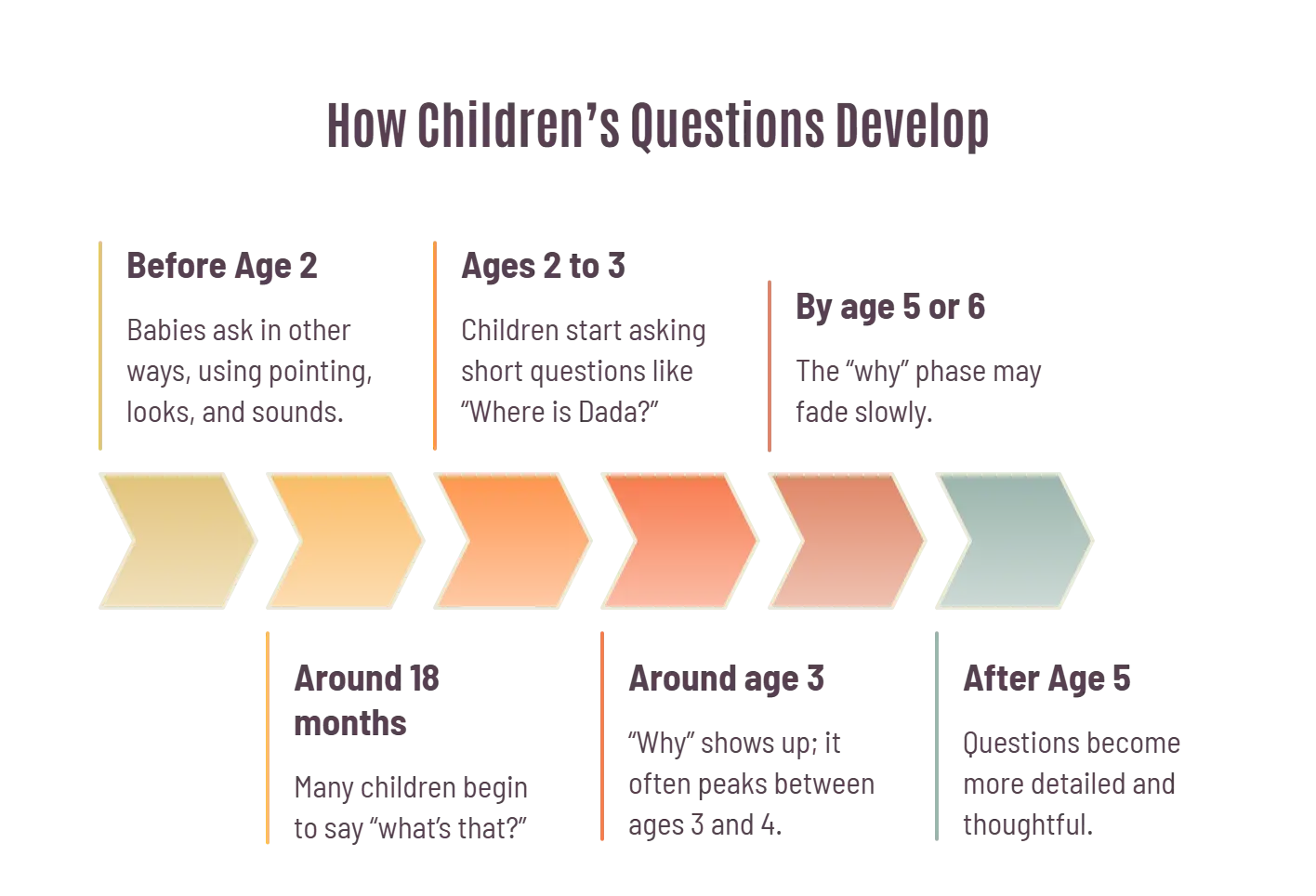
Children start asking questions before they can say “why.” It happens in steps.
Before Age 2
Babies do not ask in words. But they ask in other ways.
- They point to things.
- They look at you and make a sound.
- They raise their voice at the end, as if asking.
- They hold up an object and look at you.
Around 18 months, many children begin to say “what’s that?” They want you to name things.
Ages 2 to 3
Children start asking short questions.
- “What’s that?”
- “Where is Dada?”
- “Mine?”
Their words are few, so questions are simple.
The ‘Why’ Phase (Roughly Ages 2 to 5)
This is the stage that surprises parents. Around age 3, “why” shows up. It often peaks between ages 3 and 4. It may fade slowly by age 5 or 6.
What Happens in this Phase
- The child asks “why” many times a day.
- The child may ask the same thing again and again.
- The child may ask “why” about your answer too.
- Questions come at odd times, like bedtime or in a car.
Why it Starts Now
At this age, language grows quickly. Children can form longer sentences. They also start to think about cause and effect. They want to know why things happen.
How Long Does it Last?
It varies. Some children go through it in a few months. Others stay curious for years. As children grow, their questions get deeper and more thoughtful.
After Age 5
Questions become more detailed. A child may ask, “How does a plane stay up?” or “What happens when we die?” Their thinking is more advanced, so their questions are too.
Quick Look: Age and Questions
| Age | Typical Questions |
|---|---|
| Under 2 | Pointing, sounds, looks |
| 18 to 24 months | “What’s that?” |
| 2 to 3 years | Short “what” and “where” questions |
| 3 to 5 years | Many “why” and “how” questions |
| 5 and up | Longer, deeper questions |
Get Certified & Start Your Montessori Career
Montessori Teacher Training Course by Entri App: Gain expert skills, earn certification, and kickstart your teaching career.
Join Now!Types of Questions Young Children Ask
Not all questions are the same. Each kind shows a different type of thinking.
1. “What” Questions
These are about names and things.
- “What is that?”
- “What are you doing?”
The child is learning labels for the world.
2. “Where” Questions
These are about places and people.
- “Where is Grandma?”
- “Where does the sun go?”
The child is learning how space works.
3. “Who” Questions
These are about people.
- “Who is that man?”
- “Who made this?”
The child is learning about people and roles.
4. “Why” Questions
These are about reasons.
- “Why is it dark?”
- “Why do I need to wear shoes?”
The child is learning that things have causes.
5. “How” Questions
These are about how things work.
- “How does a bird fly?”
- “How did you make this?”
The child is learning about steps and processes.
6. “When” Questions
These are about time.
- “When are we going?”
- “When will it be morning?”
Time is hard for young children. They ask to get a feel for it.
7. “What If” Questions
These come with a growing imagination.
- “What if I could fly?”
- “What if the moon fell?”
The child is playing with ideas.
8. Feelings and People Questions
- “Why is she crying?”
- “Are you angry?”
The child is learning about feelings and others.
9. Rule Questions
- “Why can’t I stay up?”
- “Why do I have to share?”
The child is testing rules and learning limits.
10. Big Life Questions
- “Where do babies come from?”
- “Will you die?”
- “Why do people get old?”
These can feel hard. But they are normal. The child is trying to understand life.
11. Testing Questions
Sometimes a child asks something they already know. They want to see what you say. Or they want to keep you talking.
Question Types
| Type | Example | What It Shows |
|---|---|---|
| What | “What is that?” | Learning names |
| Where | “Where is Mum?” | Understanding place |
| Why | “Why is it cold?” | Looking for reasons |
| How | “How does it work?” | Understanding steps |
| What if | “What if I could fly?” | Imagination |
| Feelings | “Why is he sad?” | Social learning |
| Big | “Will you die?” | Making sense of life |
What Children’s Questions Tell Us About Their Development
A child’s questions are a window into their mind. If we listen, we can learn a lot.
Language Growth
Questions show how well a child can use words. A child who moves from “What’s that?” to “Why is that red?” is building longer sentences and a bigger vocabulary.
Thinking and Reasoning
“Why” questions show that a child understands cause and effect. They know that things happen for a reason and want to find it.
Memory
A child who asks about something from last week is using memory. This is a good sign.
Attention
When a child asks a follow-up question, they are listening and thinking about the answer. This shows growing focus.
Imagination
“What if” questions show creative thinking. The child can picture things that are not real.
Social and Emotional Skills
Questions about feelings show that a child is learning to understand others. They are building empathy.
Independence
A child who asks, “Can I do it?” or “How do I do this?” is moving toward doing things alone.
Fears and Worries
Sometimes questions hint at worry. A child who keeps asking, “Will you come back?” may feel unsure. This is common when starting school. A calm, clear answer helps.
How to Respond to Endless Questions (Parent and Teacher Tips)
Answering the 50th “why” of the day is not easy. Here are simple ways to cope and make the most of it.
Don’t Dismiss
It is easy to say, “Because I said so,” or “Stop asking.” But this can make a child stop wondering.
Why Not to Brush Them Off
- The child may feel their question does not matter.
- They may stop asking.
- They may feel less safe to try things.
What to Do Instead
- Stop for a moment and look at the child.
- Say, “Good question.”
- Give a short, simple answer.
- If you are very busy, say, “Great question. Ask me again after lunch.” Then follow up.
Keep Answers Short
Young children do not need long talks. One or two simple sentences are enough. If they want more, they will ask.
Ask Them Back
Turning the question around is a strong tool. It helps the child think.
How to Do it
- “What do you think?”
- “Hmm, why do you think the leaf is yellow?”
- “What do you notice?”
Why it Works
- The child practices thinking.
- You see what they already know.
- They feel proud of their ideas.
A Small Example
Child: “Why does the moon follow us?”
Parent: “That is a good one. What do you think?”
Child: “Maybe it likes us.”
Parent: “That is a lovely idea. It looks like it follows because it is very far away.”
Say ‘Let’s Find Out’
You do not need to know everything. Saying “I don’t know” is fine. It shows that learning never stops.
How to Do it
- “I don’t know. Let’s find out.”
- Look in a book together.
- Watch a short video together.
- Ask someone who may know.
- Try a small experiment.
Why it Works
- It shows your child how to look for answers.
- It makes learning a team effort.
- It builds trust.
A Small Example
Child: “Why do worms come out when it rains?”
Parent: “I’m not sure. Let’s look it up.”
Get Certified & Start Your Montessori Career
Montessori Teacher Training Course by Entri App: Gain expert skills, earn certification, and kickstart your teaching career.
Join Now!How Montessori Encourages Curiosity and Independent Learning
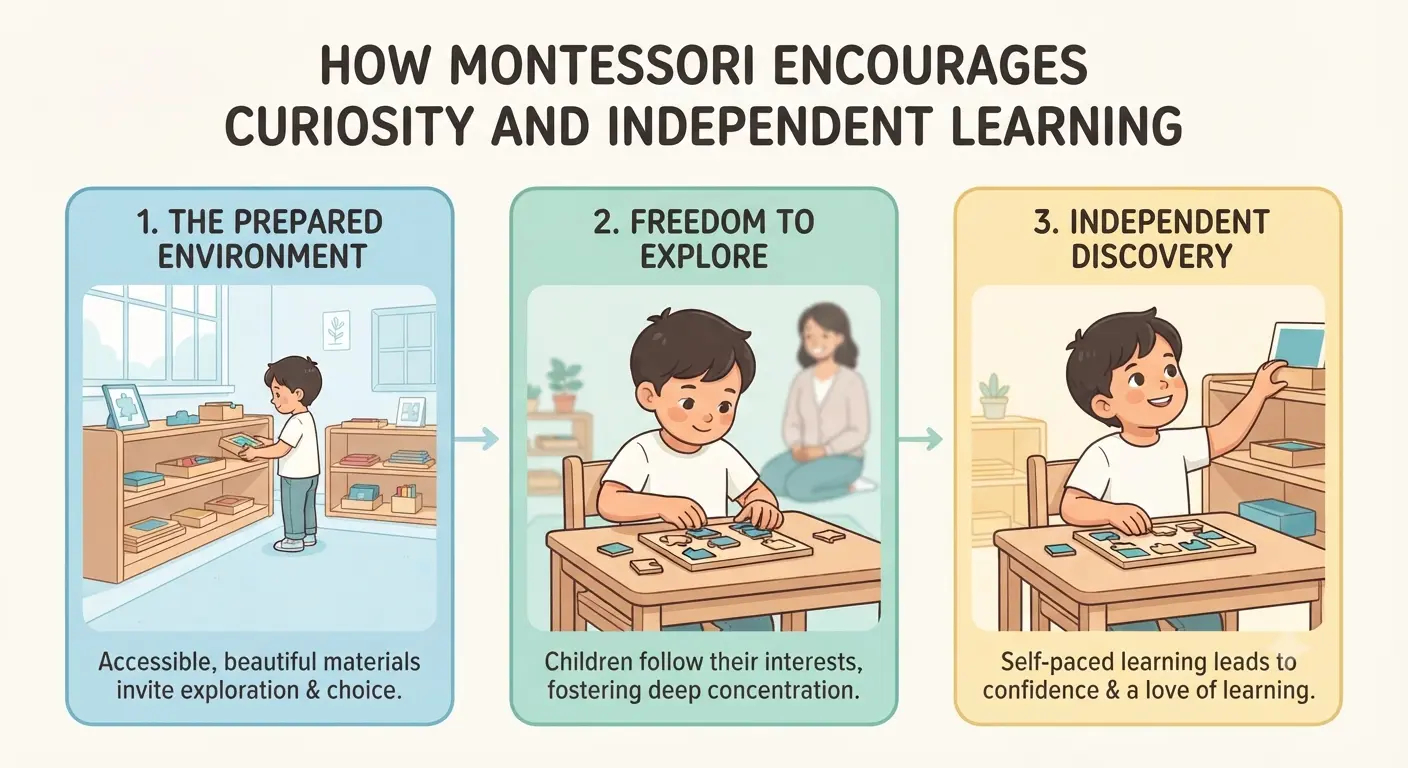
Montessori education is built around a child’s natural wish to learn. It gives children space and time to explore and ask.
Follow the Child
Montessori teachers watch what each child is interested in. They let the child’s curiosity lead the way. This keeps the wish to learn alive.
A Prepared Environment
The classroom is calm, neat and simple. Materials sit on low shelves. Children can reach them without help. This invites them to explore and wonder.
Hands-On Materials
Children learn by touching, moving and trying. A child who builds the pink tower may ask, “Why does the big one go at the bottom?” The material itself sparks the question.
Freedom of Choice
Children choose their own work. When a child picks something because they are interested, they stay longer and ask more.
Long Work Time
Children get long, calm blocks of time. This gives them room to think, try and ask without being rushed.
The Teacher as a Guide
The teacher does not give all the answers. She asks questions back, shows how to look something up and lets the child find out. She might say:
- “What do you notice?”
- “What do you think will happen?”
- “How could we find out?”
Self-Correcting Materials
Many materials show the child when something is wrong. The child sees the mistake and fixes it. This helps children think and try again. They do not need to ask an adult every time.
Help Me Do it Myself
Dr. Maria Montessori taught that children want to do things on their own. When a child can pour water or button a coat alone, they feel proud. This builds confidence and a love of learning.
Real Life and Nature
Children care for plants, wash tables and walk outdoors. These real tasks bring up questions about the world.
Mixed Ages
Younger children watch and ask older ones. Older children learn by explaining. Everyone gains.
Montessori vs Rushing through Answers
| Point | Montessori Approach | Quick Answer Approach |
|---|---|---|
| Role of adult | Guide | Answer giver |
| Child’s role | Explorer | Listener |
| Learning | Hands-on | Mostly told |
| Questions | Welcomed and explored | Answered fast |
| Result | Deeper thinking | Short-term facts |
When to Talk to a Professional
Most children who ask many questions are developing well. A few signs are worth a chat with a doctor. Trust your gut as a parent.
Very Few Questions or None
Some children are quiet. That is okay. But talk to a doctor if your child:
- Rarely uses words to ask for things by age 2 or 3.
- Does not ask any questions by age 3 to 4, and does not seem interested in the world.
- Does not show or point to things they want.
- Does not use gestures like waving or pointing.
Speech Delay
A speech delay means a child’s talking is behind for their age. These are general guides. Children vary. If you see these signs, speak to your child’s doctor:
- Few or no words by 16 to 18 months
- No two-word phrases by around age 2
- Hard to understand by age 3
- Not following simple instructions
- Losing words or skills they once had
Other Signs to Watch for
- Does not respond to their name
- Little eye contact
- Does not seem to hear well
- Does not play with others
- Repeats words without meaning, all the time
- Seems very frustrated when trying to speak
Questions that Cause Worry
Speak to a professional if:
- Questions seem very stuck or repeat in a way that upsets the child.
- The child shows strong fear or anxiety with many questions.
- Questions about death or harm come with deep sadness or fear that lasts.
Who to Talk to
- Your child’s pediatrician or family doctor
- A speech and language therapist
- A child development specialist
- Your child’s teacher, who may share what they see
A Hearing Check
Hearing problems can slow speech. A simple hearing test is often a good first step.
Early Help Works
Early support can make a big difference. Do not wait and worry. A quick check can give you peace of mind or a plan.
Register for the Entri Elevate Montessori Teacher Training Program! Join Now!
Conclusion
Young children ask so many questions because they are learning fast. Each question builds language, thinking and trust. The “why” phase can be tiring, but it is a gift.
Listen with care. Do not brush questions off. Ask your child what they think. When you do not know, say, “Let’s find out.” Give them time and space to explore, like in a Montessori setting.
If your child asks very few questions, or has trouble with speech, talk to a doctor. Early help can make a real difference.
Next time your child asks “why” for the tenth time, take a deep breath. Smile. Enjoy the wonder. These years go by quickly.
Get Certified & Start Your Montessori Career
Montessori Teacher Training Course by Entri App: Gain expert skills, earn certification, and kickstart your teaching career.
Join Now!Frequently Asked Questions
Is it normal for a child to ask 'why' all day?
Yes. It is normal for young children to ask ‘why’ many times a day. They are curious about the world around them. Asking questions helps them understand new things, learn words and develop their thinking skills.
Why do toddlers repeat the same question?
Toddlers often repeat questions because they want to understand the answer better. Sometimes, they may not understand the first explanation. They may also enjoy hearing familiar answers and getting attention from parents.
How many questions do kids ask a day?
There is no fixed number of questions children ask every day. It depends on their age, interests and surroundings. Some studies suggest that young children can ask hundreds of questions in a day, especially during their curious preschool years.
Should I answer every question my child asks?
You can try to answer your child’s questions in simple words. If you are busy, let them know that you will answer later. Encourage them to ask questions because it helps develop curiosity and learning.
How do I handle questions I can't answer?
It is okay if you do not know every answer. You can tell your child that you are not sure. Try finding the answer together using a book or another learning resource. This also teaches children that learning is a continuous process.
At what age do children start asking many questions?
Children may start asking simple questions around the age of two. Their questions often increase between three and five years as their language and thinking skills develop.
Do children's questions help improve their language skills?
Yes. Asking and answering questions helps children learn new words and understand how sentences are formed. It also improves their listening, speaking and communication skills.
How can parents encourage children to ask more questions?
Parents can encourage questions by listening patiently and giving simple answers. Read storybooks, explore nature and talk about everyday activities together. Avoid making children feel bad for asking too many questions.