Table of Contents
Aviation abbreviations are short forms used in airports and airlines. They save time. A long phrase like “Estimated Time of Departure” becomes just “ETD.”
Which ones matter most for ground staff?
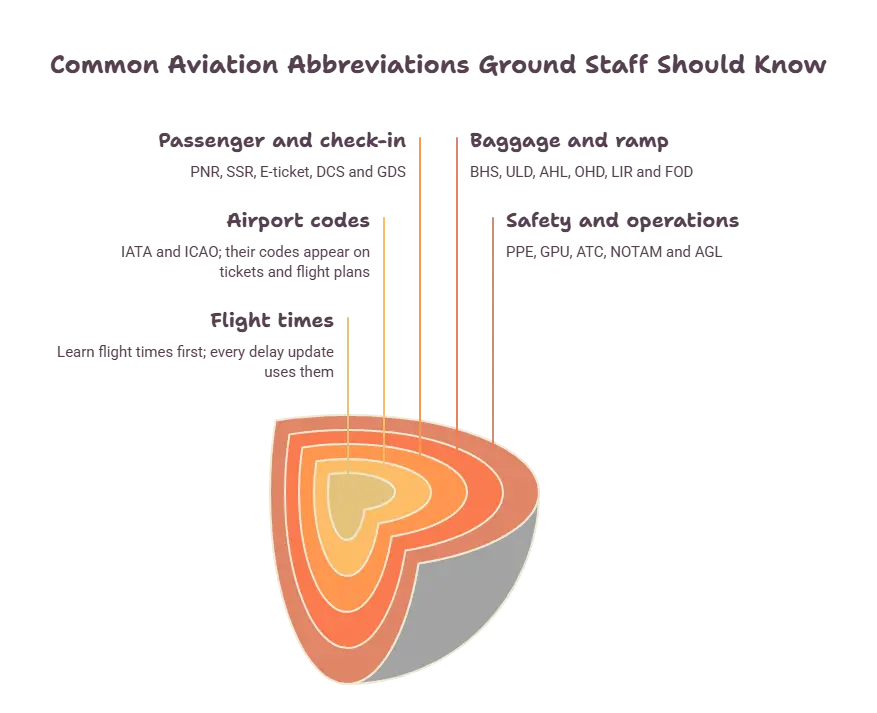
Ground staff use these every day: ETA, ETD, STA, STD, PNR, SSR, DCS, ULD, AHL, OHD and FOD. They also use airport codes like DEL, BOM and BLR.
What do the common ones mean?
- Airport and flight: IATA, ICAO, ETA, ETD, ATA, ATD, STA, STD
- Passenger: PNR, SSR, DCS, GDS, E-ticket
- Baggage and ramp: BHS, ULD, AHL, OHD, LIR, FOD
- Safety and operations: PPE, NOTAM, ATC, AGL, GPU
Which should beginners learn first?
Start with flight times (STA, STD, ETA, ETD), then PNR and DCS. After that, learn baggage terms like ULD and AHL. Then learn airport codes.
Key Takeaways:
- Airports use short forms to save time, so ground staff need to know them.
- Flight time terms come first. STA and STD are the plan. ETA and ETD are the new guess.
- PNR and DCS are the two you will use most at the counter.
- Three letters like BLR are IATA codes. Four letters like VOBL are ICAO codes.
- ETA and ETD, or AHL and OHD, look alike. New staff mix them up often.
Join Entri Airport Management Course in Kerala
Why Aviation Abbreviations Matter for Ground Staff
Airports run on short forms. A check-in agent has only a few minutes for each passenger. A ramp team has a short time to load a plane. So no one uses long phrases.
If you are new, the terms can feel confusing. You may hear “ETD moved to 09:45” and not know what it means. Learning them early helps you in three ways.
- You understand what your team says
- You can read screens, bag tags and forms quickly
- You make fewer mistakes, like mixing up ETA and ETD
For example, a flight is delayed and the screen shows a new ETD. The gate agent tells the passengers. The baggage team sees the same update and waits to load.
Common Aviation Abbreviations Ground Staff Should Know
Ground staff do not need hundreds of short forms. A small set covers most of the daily work.
Airport and Flight-Related Abbreviations
Learn flight times first. Every delay update uses them. IATA and ICAO are also here, because their codes appear on tickets and flight plans.
| Abbreviation | Full form | Meaning |
|---|---|---|
| IATA | International Air Transport Association | Airlines’ group. Its codes are on tickets and bag tags |
| ICAO | International Civil Aviation Organization | UN body. Its codes are used in flight plans |
| STA | Scheduled Time of Arrival | Landing time in the timetable |
| STD | Scheduled Time of Departure | Leaving time in the timetable |
| ETA | Estimated Time of Arrival | New landing time after a change |
| ETD | Estimated Time of Departure | New leaving time after a delay |
| ATA | Actual Time of Arrival | Time the flight really landed |
| ATD | Actual Time of Departure | Time the flight really left |
- S means scheduled. It is the plan.
- E means estimated. It is the updated guess.
- A means actual. It is what really happened.
A flight may be scheduled to leave at 10:00. That is the STD. Because of a delay, the airline now expects 10:40. That is the ETD. The plane finally leaves at 10:45. That is the ATD.
Passenger and Check-in Abbreviations
| Abbreviation | Full form | Meaning |
|---|---|---|
| PNR | Passenger Name Record | The booking, with name, flight, seat and contact details |
| SSR | Special Service Request | A note for extra help, like a wheelchair or a special meal |
| E-ticket | Electronic ticket | A ticket kept in the airline system, with no paper copy |
| DCS | Departure Control System | The system used to check in and board passengers |
| GDS | Global Distribution System | The booking network used by airlines and travel agents |
A passenger comes to the counter. The agent types the PNR into the DCS. The system shows the booking. If the passenger asked for a wheelchair, the SSR shows up on screen. The agent then arranges the help.
Baggage and Ramp Operations Abbreviations
Baggage work happens in two places. One is the baggage hall. The other is the ramp, where bags are loaded into the plane.
The BHS (Baggage Handling System) is a set of belts. A bag you check in moves on it until it reaches the loading area.
At the ramp, bags go into a ULD (Unit Load Device). It is a metal box or a flat pallet. Staff fill it and then load it into the plane.
Sometimes a bag does not reach the passenger. These terms cover that.
- AHL: a report for a delayed bag
- OHD (On-Hand): a bag found at the airport with no owner
- LIR: a report for a lost item. Some airlines use a different name, so check your airline’s manual.
Think of it this way. One passenger is waiting for a bag. One bag is waiting for a passenger. The team matches them.
FOD (Foreign Object Debris) is about safety. A loose bolt or a stone on the ramp can damage a plane. So staff pick up anything loose, even if it is small.
Safety and Airport Operations Abbreviations
Some terms are about staying safe at work. Others are about how the airport is controlled.
PPE (Personal Protective Equipment) is the gear you wear on the ramp. It includes a safety vest, safety shoes, gloves and ear protection.
GPU (Ground Power Unit) is a machine that gives power to a parked plane. The engines are off, so the plane needs power from outside.
You will also hear these terms.
- ATC (Air Traffic Control): the team that guides planes
- NOTAM (Notice to Airmen): a notice about a danger or change, like a closed runway
- AGL (Above Ground Level): height measured from the ground
Ground staff usually hear about a NOTAM from the duty manager. If a runway closes, the plan for the day changes.
✈️ Start Your Aviation Career Today
Explore career-focused insights on airport jobs, ground staff roles, and aviation training. Learn about salaries, skills, certifications, and hiring trends to start and grow your career in the aviation industry.
Join NowAirport Codes Ground Staff Need to Understand
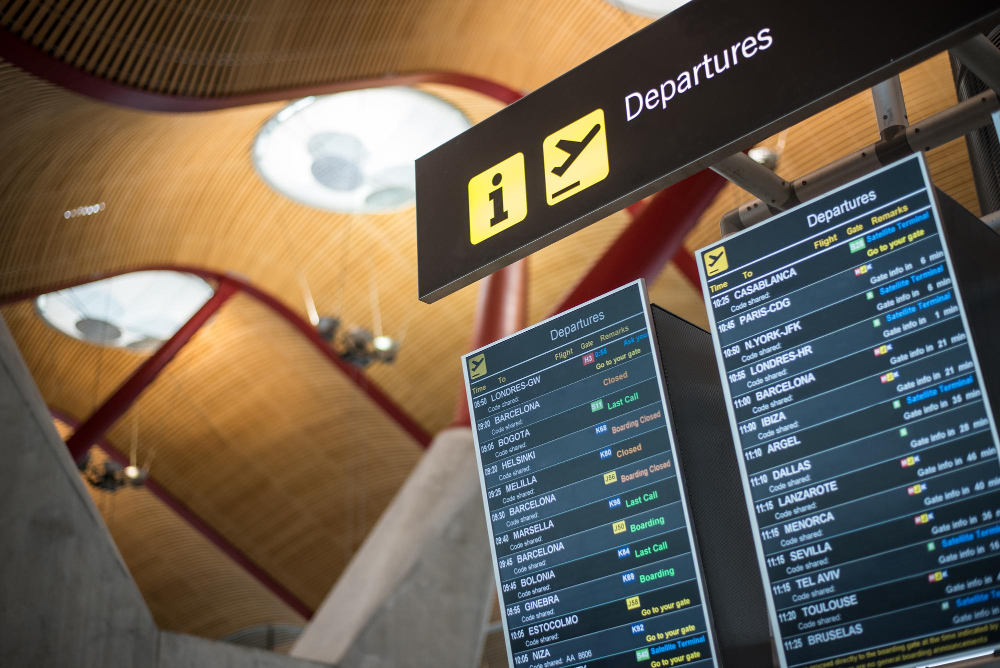
Every airport has short codes. They appear on boarding passes, baggage tags and screens. Ground staff must read them quickly and correctly.
There are two main types of airport codes. One is IATA. The other is ICAO.
IATA Airport Codes
An IATA code has three letters. It names an airport in a simple way. Passengers see it on tickets and bag tags.
Ground staff use IATA codes all the time.
- They read them on baggage tags to send bags to the right place
- They type them into the DCS to check in a passenger
- They see them on flight screens
- They use them when they talk about flights, like “the BLR flight”
Here are some examples from major Indian airports.
| Airport | IATA code |
|---|---|
| Delhi | DEL |
| Mumbai | BOM |
| Bengaluru | BLR |
| Chennai | MAA |
| Kolkata | CCU |
| Hyderabad | HYD |
| Kochi | COK |
| Ahmedabad | AMD |
Some codes look odd. Mumbai is BOM because its old name was Bombay. Chennai is MAA because it was once Madras. So the code does not always match today’s name.
ICAO Airport Codes
An ICAO code has four letters. It is more detailed. It is used mainly by pilots, air traffic control and flight planning teams.
Ground staff may see ICAO codes in flight plans, weather reports and NOTAMs. In India, ICAO codes usually start with the letter V. Here are some examples.
| Airport | ICAO code |
|---|---|
| Delhi | VIDP |
| Mumbai | VABB |
| Bengaluru | VOBL |
| Chennai | VOMM |
| Kolkata | VECC |
| Hyderabad | VOHS |
| Kochi | VOCI |
IATA vs ICAO at a glance
| Code type | Format | Example | Common use | Who uses it |
|---|---|---|---|---|
| IATA | 3 letters | BLR | Tickets, bag tags, screens | Passengers, airlines, ground staff |
| ICAO | 4 letters | VOBL | Flight plans, weather, NOTAMs | Pilots, ATC, operations teams |
IATA vs ICAO vs Other Aviation Abbreviations
Not all short forms are the same. Some are codes. Some are job terms. It helps to know which is which.
| Type | What it represents | Example | Ground staff relevance |
|---|---|---|---|
| IATA | Airport, airline and travel industry codes | BLR | High |
| ICAO | Aviation identification and standards | VOBL | Operational |
| Airline codes | Airline identification | AI | High |
| Operational abbreviations | Airport processes | DCS | High |
A few more points
- IATA codes are the ones you see most at the counter.
- ICAO codes matter more in the control room and the cockpit.
- Airline codes come in two types. IATA uses two characters, like AI for Air India and 6E for IndiGo. ICAO uses three letters, like AIC for Air India and IGO for IndiGo.
- Operational abbreviations are the working terms, like DCS, ULD and PNR.
You will use the high-relevance ones daily. The operational ones help you understand more of the airport world as you grow.
How Ground Staff Use Aviation Abbreviations in Daily Work
Let us see how these terms show up in a normal shift. Each team uses them in its own way.
At the check-in counter
The agent asks for the passenger’s PNR or name. They open the booking in the DCS. They check the SSR for special needs. They then tag the bag with the right IATA code for the final stop.
At the boarding gate
The gate agent watches the STD and the ETD. If the flight is late, the agent updates the passengers. The agent also checks that the DCS shows the right boarding count.
In the baggage hall
Staff watch the BHS to see that bags move well. If a bag does not arrive, they file an AHL. If they find a bag with no owner, it becomes an OHD.
On the ramp
Ramp staff load bags into ULDs. They connect the GPU to give power to the plane. They also pick up any FOD they see. And they wear PPE all the time.
In operations control
The duty manager checks the ATA and ATD for each flight. They read NOTAMs for runway news. They talk with ATC when needed.
A short example
A flight to Delhi is delayed.
- The STD was 09:00.
- The ETD moves to 09:45.
- The gate agent tells passengers the new time.
- The ramp team delays the loading plan.
- The flight finally leaves at 09:50. That is the ATD.
Everyone used the same short terms. So the news spread fast and without confusion.
✈️ Start Your Aviation Career Today
Explore career-focused insights on airport jobs, ground staff roles, and aviation training. Learn about salaries, skills, certifications, and hiring trends to start and grow your career in the aviation industry.
Join NowCommonly Confused Aviation Abbreviations
Some pairs look close, and beginners often mix them up. Here are the common ones.
| Term 1 vs Term 2 | One-line difference |
|---|---|
| ETA vs ETD | ETA is when a flight is expected to land. ETD is when it is expected to leave. |
| ATA vs ATD | ATA is the real arrival time. ATD is the real departure time. |
| STA vs STD | STA is the planned arrival. STD is the planned departure. |
| IATA vs ICAO | IATA uses 3-letter airport codes. ICAO uses 4-letter codes. |
| AHL vs OHD | AHL is a delayed bag report. OHD is a bag found with no owner. |
| ETA vs ATA | ETA is a guess. ATA is what really happened. |
Easy ways to avoid the mix-up
- Look at the last letter. A means arrival. D means departure.
- Look at the first letter. S is scheduled. E is estimated. A is actual.
- Count the letters in the code. Three letters mean IATA. Four mean ICAO.
- Think about the bag. AHL means the passenger is waiting for a bag. OHD means the bag is waiting for a passenger.
Why Learning Aviation Abbreviations Is Important for Airport Jobs
If you want to work at an airport, these terms are part of the job. Almost every role uses them.
They help you in interviews
Airlines and ground handling firms often ask basic questions. For example, they may ask what PNR stands for. Or they may ask the difference between ETA and ETD. A quick and clear answer shows you are ready.
They help you learn the job faster
When you know the terms, training feels easier. You follow what trainers say. You understand screens and forms from the first day.
They help you avoid mistakes
A wrong tag code or a mixed-up time can cause problems. Knowing the terms helps you stay careful.
They help you work with other teams
Airports run on teamwork. Check-in, ramp, baggage and control all pass messages to each other. Shared terms keep that flow smooth.
They help you grow
Many ground staff move up to roles like duty manager, load controller or station manager. Strong basics help you take those steps.
Jobs where they matter
- Check-in agent
- Boarding gate agent
- Baggage handler
- Ramp agent
- Customer service executive
- Load controller
- Airport duty manager
Tips to Learn Aviation Abbreviations Faster
You do not need to memorize hundreds of terms. A simple plan works well.
1. Start with a small list
Pick ten terms. Learn them well. Then add ten more. Good starters are STA, STD, ETA, ETD, PNR, SSR, DCS, ULD, AHL and OHD.
2. Learn them by group
Study flight terms first. Then passenger terms. Then baggage terms. Groups are easier to remember than a long A to Z list.
3. Use flashcards
Write the short form on one side. Write the full form and meaning on the other. Check yourself a few minutes each day.
4. Link each term to a real moment
Do not just memorize. Picture it. For PNR, imagine a passenger at the counter. For ULD, imagine a container being loaded. Pictures stick longer.
5. Practice with airport codes
Read the codes on a flight board or a boarding pass. Try to name the city. Do this for the main Indian airports first.
6. Say them out loud
Say the full form once. Then say the short form. Saying it helps you recall it in a real conversation.
7. Keep a small notebook or phone note
Add new terms as you meet them. Review the list every week.
Join Entri Airport Management Course in Kerala
Conclusion
Nobody learns all these short forms in one day. Even people who have worked at airports for years still check a term now and then.
So begin small. Learn how flight times work first, because STA, STD, ETA and ETD show up in every shift. PNR and DCS come next, since you will need them at the counter. Baggage terms and airport codes can wait a little.
One thing is worth remembering. Pairs like ETA and ETD, or AHL and OHD, look almost the same, and new staff mix them up often. If you get stuck, go back to the first and last letters. That alone clears up most of the confusion.
✈️ Start Your Aviation Career Today
Explore career-focused insights on airport jobs, ground staff roles, and aviation training. Learn about salaries, skills, certifications, and hiring trends to start and grow your career in the aviation industry.
Join NowFrequently Asked Questions
What are aviation abbreviations?
Aviation abbreviations are short forms used in the aviation industry. They help airport and airline staff share information quickly. These terms are used in flight updates, passenger records, baggage handling and daily airport work.
Why should ground staff learn aviation abbreviations?
Ground staff deal with passengers, flight details and other airport teams. Knowing common abbreviations helps them understand instructions and manage their duties. It also helps them communicate clearly with other staff members.
What are some common aviation abbreviations used by ground staff?
Ground staff may come across many abbreviations during their work. Some common examples are:
- ETA: Estimated Time of Arrival
- ETD: Estimated Time of Departure
- PNR: Passenger Name Record
- ATC: Air Traffic Control
- DCS: Departure Control System
- BHS: Baggage Handling System
These terms are useful for understanding flight schedules and airport activities.
What is the difference between IATA and ICAO?
IATA stands for International Air Transport Association, while ICAO stands for International Civil Aviation Organization. Both play important roles in aviation. IATA airport codes usually have three letters, such as CCJ for Calicut International Airport. ICAO airport codes have four letters and are mainly used in flight operations.
What does DCS mean in aviation?
DCS stands for Departure Control System. Airlines use this system to manage passenger check-in, boarding and other departure tasks. It helps ground staff handle passenger details before a flight leaves.
Do ground staff need to learn aviation abbreviations?
Yes, knowing common aviation abbreviations is useful for ground staff. These terms help them understand flight updates, passenger information and work instructions. They should first learn the abbreviations related to their daily duties.
How can beginners learn aviation abbreviations easily?
Beginners can start by learning five to ten abbreviations each day. They can write down each short form with its full meaning and revise it regularly. Flashcards, simple quizzes and examples from airport work can also make learning easier.
Are aviation abbreviations the same at all Indian airports?
Many aviation abbreviations are commonly used across Indian airports. However, some terms may differ based on the airline, department or type of operation. Ground staff should follow the terms and instructions used by their employer.