Table of Contents
A balance sheet tallies when both of its sides show the same total. On one side you have what the business owns. On the other side you have what it owes and what the owners have put in. The rule is simple: Assets = Liabilities + Equity.
To tally it, add up all assets. Then add up all liabilities. Next, work out the owner’s or shareholders’ equity. Add liabilities and equity together and compare that total with the assets. If the two totals match, the sheet tallies. If they do not, look for the error before you move on.
Quick Answers
What does a balanced balance sheet mean?
It means the total assets are equal to the total of liabilities and equity. Every rupee the business owns is matched by a rupee it owes or a rupee that belongs to the owners.
What formula is used?
Assets = Liabilities + Equity
What should you do if it does not tally?
Find the difference first. Then check your totals, look for missing or one-sided entries, and compare with the trial balance. Do not force the numbers to match. Find the real cause.
Key Takeaways
- A balance sheet tallies when assets equal liabilities plus equity.
- Total each side on its own first. Then compare.
- A small gap is often a typing slip. A ₹900 gap can be two digits swapped.
- Do not put in a made-up number to close the gap. Find the real cause.
- Check the trial balance when you get stuck.
- Even a tallying sheet can hide errors, like a wrong account.
Become an Accounting Pro – Learn from Industry Experts!
What Does It Mean When a Balance Sheet Tallies?
A balance sheet is a statement that shows the money position of a business on one date. It is like a photo. It does not show a period of time. It shows one day.
When we say a balance sheet “tallies,” we mean the two sides agree. The left side total is the same as the right side total. There is no gap.
The Three Parts
Every balance sheet has three main parts.
Assets are things the business owns. They have value.
- Cash and bank balance
- Money customers still have to pay (receivables)
- Stock or inventory
- Furniture, machines and buildings
Liabilities are things the business owes to others.
- Money owed to suppliers (payables)
- Bank loans
- Unpaid expenses
- Tax to be paid
Equity is what belongs to the owners. It is the money they put in, plus the profit the business has kept.
- Capital from the owner or shareholders
- Retained earnings (profit kept in the business)
- Reserves
The Rule Behind It
The formula is:
Assets = Liabilities + Equity
Think about how a business gets its assets. Someone must pay for them. Either the business borrows the money (liabilities) or the owners put it in (equity). There is no third way. So the two sides must always be equal.
Why It Always Matches in Theory
Accounting uses double entry. This means every transaction is recorded twice. One entry goes on one side and the other goes on the opposite side.
Say a business buys a machine for ₹50,000 in cash. The machine goes up by ₹50,000. Cash goes down by ₹50,000. Both are assets, so the total does not change.
Now say it buys the same machine on a loan. The machine goes up by ₹50,000. The loan (a liability) also goes up by ₹50,000. Both sides rise by the same amount.
Since each entry has two equal parts, the sheet should always balance. When it does not, someone has made an error somewhere.
How to Tally a Balance Sheet Step by Step
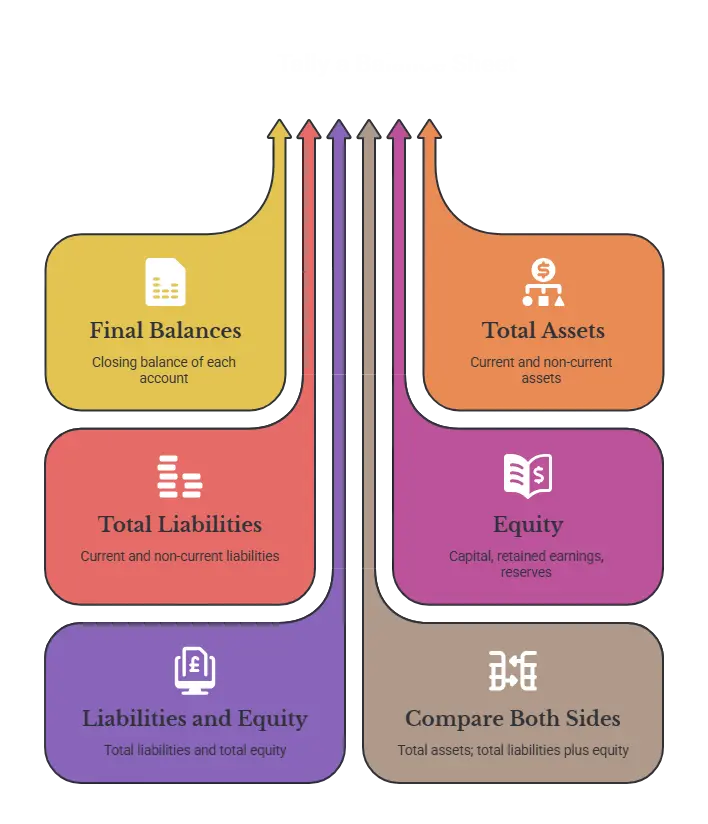
1: Accounting provides information on
You can do this by hand, in Excel or in accounting software. The steps are the same.
Step 1: Collect the Final Balances
Start with the closing balance of each account on the date of the sheet. You need these before you can add anything.
- Cash book and bank balance
- Customer and supplier accounts
- Stock value
- Fixed asset values after depreciation
- Loan balances
- Capital and profit figures
Make sure all entries up to that date are posted. A missing bill can throw off the whole sheet.
Step 2: Total All Assets
Group assets into two types and add each group.
Current assets are things that turn into cash within a year.
- Cash
- Bank balance
- Accounts receivable
- Stock
Non-current (fixed) assets are things the business keeps for a long time.
- Land and buildings
- Machinery
- Furniture
- Vehicles
Add the two groups. This is your total assets.
If you use depreciation, subtract it from the fixed assets first. Use the value after depreciation, not the original cost.
Step 3: Total All Liabilities
Again, split them into two groups.
Current liabilities are due within a year.
- Accounts payable
- Outstanding expenses
- Short-term loans
- Taxes due
Non-current (long-term) liabilities are due after a year.
- Long-term bank loans
- Debentures
Add both groups. This is your total liabilities.
Step 4: Work Out the Equity
Equity is what is left for the owners. It has a few parts.
- Capital put in by the owner or shareholders
- Retained earnings, which is profit kept in the business
- Reserves
For a small business, a common way to find it is:
Closing capital = Opening capital + Profit for the year − Drawings
Drawings is money the owner takes out for personal use. For a company, dividends paid take the place of drawings.
This step is where many errors hide. If the profit does not flow into equity, the sheet will not balance.
Step 5: Add Liabilities and Equity
Add total liabilities and total equity together. This gives you the total of the right side.
Step 6: Compare Both Sides
Put the two totals next to each other.
- Total assets
- Total liabilities plus equity
If they match, the balance sheet tallies. You are done.
Placement Oriented PWC Business Accounting Course
PWC Certified Business Accounting Course by Entri App: Master in-demand skills, ace interviews, and secure top-tier jobs.
Join Now!Example of a Tallying Balance Sheet
Let us take a small trading business. Here is its balance sheet on 31 March.
Assets
| Particulars | Amount (₹) |
|---|---|
| Current Assets | |
| Cash in hand | 50,000 |
| Cash at bank | 1,50,000 |
| Accounts receivable | 80,000 |
| Inventory | 1,20,000 |
| Total current assets | 4,00,000 |
| Non-Current Assets | |
| Furniture | 1,00,000 |
| Equipment | 3,00,000 |
| Total non-current assets | 4,00,000 |
| Total Assets | 8,00,000 |
Liabilities and Equity
| Particulars | Amount (₹) |
|---|---|
| Current Liabilities | |
| Accounts payable | 70,000 |
| Outstanding expenses | 30,000 |
| Total current liabilities | 1,00,000 |
| Non-Current Liabilities | |
| Bank loan | 2,00,000 |
| Total liabilities | 3,00,000 |
| Equity | |
| Owner’s capital | 4,00,000 |
| Retained earnings | 1,00,000 |
| Total equity | 5,00,000 |
| Total Liabilities and Equity | 8,00,000 |
Checking the Balance
- Total assets: ₹4,00,000 + ₹4,00,000 = ₹8,00,000
- Total liabilities: ₹1,00,000 + ₹2,00,000 = ₹3,00,000
- Total equity: ₹4,00,000 + ₹1,00,000 = ₹5,00,000
- Liabilities plus equity: ₹3,00,000 + ₹5,00,000 = ₹8,00,000
Both sides come to ₹8,00,000. So the balance sheet tallies.
Check the Formula
Assets (₹8,00,000) = Liabilities (₹3,00,000) + Equity (₹5,00,000)
It works. The owners have put in or kept ₹5,00,000. Outsiders have lent or are owed ₹3,00,000. Together, they have funded assets worth ₹8,00,000.
What If One Number Changes?
Say the business buys stock worth ₹20,000 on credit.
- Inventory goes up by ₹20,000
- Accounts payable goes up by ₹20,000
New total assets are ₹8,20,000. New liabilities plus equity are ₹3,20,000 + ₹5,00,000 = ₹8,20,000. It still tallies.
What to Do If the Balance Sheet Does Not Tally
A gap between the two sides is common, and the gap itself usually tells you where to start looking. Go through these steps one by one.
Step 1: Find out how big the gap is
Take the smaller total away from the bigger one and note it down. Say assets are ₹8,00,000 and liabilities plus equity are ₹7,99,100. You are short by ₹900.
Step 2: Add everything again
A lot of gaps are just small slips. Add each column once more, by hand or in a spreadsheet.
- Did any line get skipped?
- Did any line get counted twice?
- Are the subtotals right?
Step 3: Look at the number
The size of the gap can point to the cause.
- If you can divide it by 9, two digits may have been swapped. ₹5,400 typed as ₹4,500 leaves a ₹900 gap.
- If half the gap matches an entry, that entry may be on the wrong side. A ₹1,000 entry on the wrong side makes a ₹2,000 gap.
- If the gap equals one entry, that entry may be missing, or posted on one side only.
- If it is a round number like ₹10,000, a whole entry may be missing.
Step 4: Check that every item is on the right side
Go line by line and ask where it belongs.
- Is a loan shown under assets by mistake?
- Is a customer balance shown under payables?
- Is an expense counted as an asset?
Step 5: Check the equity
Equity is where mistakes often hide.
- Was this year’s profit or loss added?
- Were drawings or dividends taken out?
- Is the opening capital correct?
Step 7: Check the trial balance
If the trial balance does not tally, the mistake is in the ledgers. If it does tally, the mistake is probably in how the balance sheet was put together.
Step 8: Check the year-end entries
These are easy to forget.
- Depreciation
- Outstanding and prepaid expenses
- Accrued income
- Closing stock
- Bad debts
Step 9: Match your books with outside records
Compare what you have with papers from outside.
- Bank balance with the bank statement
- Payables with supplier statements
- Receivables with customer statements
- Stock record with a physical count
Balance Sheet vs Trial Balance: What Is the Difference?
These two get mixed up often. Both involve debit and credit totals. But they serve different purposes.
What Is a Trial Balance?
A trial balance is a list of all ledger account balances on a date. It has two columns, debit and credit. The totals of both columns should be equal. It is a working tool for checking the books.
What Is a Balance Sheet?
A balance sheet is a final statement. It shows the assets, liabilities and equity of the business. Banks, owners, investors and tax officers read it.
Simple Comparison
| Point | Trial Balance | Balance Sheet |
|---|---|---|
| Purpose | To check that debits equal credits | To show the financial position |
| Type | Working paper | Final financial statement |
| What it lists | All ledger balances | Assets, liabilities and equity |
| Columns | Debit and credit | Assets and liabilities with equity |
| Prepared | Before the final accounts | After the profit and loss account |
| Used by | Accountants | Owners, banks, investors, tax officers |
| What must match | Debit total = credit total | Assets = liabilities + equity |
How They Work Together
You prepare the trial balance first. If it tallies, you move on to the profit and loss account and then the balance sheet. If the balance sheet does not tally, the trial balance helps you go back and find the problem.
A Limit of the Trial Balance
A trial balance can tally even when there are errors. It will not catch these:
- An entry left out completely. Both sides are missing, so the totals still match.
- A wrong account used. Money goes to the wrong account but on the right side.
- A wrong principle. For example, a capital item treated as an expense.
- Errors that cancel each other. A ₹500 mistake on one side is cancelled by another ₹500 mistake.
- A wrong amount entered on both sides. The books balance, but the figure is wrong.
So a tallying trial balance is a good sign. It is not proof that everything is right.
Placement Oriented PWC Business Accounting Course
PWC Certified Business Accounting Course by Entri App: Master in-demand skills, ace interviews, and secure top-tier jobs.
Join Now!Why Is It Important to Tally a Balance Sheet?
A balance sheet is read by many people. Each of them expects it to be right.
It Shows That the Books Are Reliable
If the sheet tallies, it points to well-kept books. If it does not, no one can trust the numbers.
It Helps Catch Errors Early
A gap tells you something is wrong. You can fix it before the report goes out. Finding a mistake after it reaches the bank or the tax office is much harder.
Banks and Lenders Need It
When a business asks for a loan, the bank checks the balance sheet. A sheet that does not tally can lead to delays or rejection.
It Matters for Tax and Audits
Auditors and tax officers expect a balanced sheet. A gap raises questions. It can lead to extra checks and even penalties.
It Supports Better Decisions
Owners use the sheet to decide on buying, borrowing and saving. Wrong numbers can lead to wrong decisions.
Investors Rely on It
Investors look at the sheet to see how strong the company is. A balanced sheet builds trust.

Advantages and Concerns of a Balanced Balance Sheet
A balanced sheet is a good thing. But it is only one check. Let us look at both sides.
Advantages
1. You can trust the numbers more
When both sides match, you know at least the basic math is right.
- Totals add up
- The accounting equation holds
- Fewer doubts for readers
2. It gives a quick check on the books
A gap shows up at once.
- Errors come to light early
- You save time on later checks
- Fixing is easier
3. It builds trust with outsiders
Banks, auditors and investors prefer clean sheets.
- Loans move faster
- Audits go more smoothly
- Investors feel safer
4. It helps with planning
Owners can see what they own and owe.
- Spot too much debt
- See how much cash is on hand
- Plan buying and saving
5. It supports good record keeping
The habit of tallying keeps books neat.
- Entries are posted on time
- Accounts are checked often
- Records stay clear
6. It works with software too
Tools like Tally Prime or Zoho Books show a balance sheet from your entries.
- The software warns of gaps
- Less manual work
- Easy to review
Concerns
1. Balanced does not mean correct
A sheet can tally and still hold mistakes.
- Wrong account used
- Entries that cancel each other
- A wrong amount on both sides
2. It shows only one day
A balance sheet is a snapshot. It does not show how the business did during the year.
- Cash may look strong on one date and weak next week
- You need the profit and loss account and cash flow too
3. Values may not be fair
Many assets are shown at cost less depreciation. That may be very different from what they are worth today.
- Land may be worth more
- Old machines may be worth less
4. Estimates can be wrong
Some numbers depend on judgment.
- Depreciation
- Bad debt provisions
- Stock value
5. Numbers can be dressed up
Some businesses try to make the sheet look better on the last day. It still tallies, but the picture is not true. This is called window dressing.
Become an Accounting Pro – Learn from Industry Experts!
Conclusion
A balance sheet tallies when assets equal liabilities plus equity. To get there, total the assets, total the liabilities, work out the equity and compare both sides. If there is a gap, find the exact amount and look for the cause. Check additions, wrong sides, missing entries and the profit that goes into equity. The trial balance is a good guide when you are stuck.
Keep in mind that a tallying sheet is a good sign, not a full guarantee. Some errors do not show up in the totals. So it is wise to check key accounts against outside records too.
With steady practice, tallying a balance sheet gets easier. Start with small examples. Do each step in order. Soon you will spot gaps quickly and fix them with confidence.
Placement Oriented PWC Business Accounting Course
PWC Certified Business Accounting Course by Entri App: Master in-demand skills, ace interviews, and secure top-tier jobs.
Join Now!Frequently Asked Questions
What does it mean to tally a balance sheet?
Tallying a balance sheet means checking whether total assets equal total liabilities and equity. Both sides should have the same value.
Why is my balance sheet not tallying?
A balance sheet may not tally because of missing entries, wrong amounts, calculation errors or transactions recorded under the wrong account.
How do I make a balance sheet tally?
Check the totals of assets, liabilities and equity. Then review the entries, find any mistakes and correct them.
What is the balance sheet formula?
The basic balance sheet formula is:
Assets = Liabilities + Owner’s Equity
This means the value of assets must equal the total of liabilities and owner’s equity.
Can a balance sheet tally if there are accounting errors?
Yes. Some errors may not affect the final totals. So, even if a balance sheet tallies, all entries should be checked for accuracy.
What should I check if the balance sheet does not match?
Check for missing transactions, duplicate entries, incorrect figures and mistakes in calculations. Also, make sure each transaction is recorded in the correct account.
Can accounting software help tally a balance sheet?
Yes. Accounting software such as Tally can calculate totals and prepare balance sheet reports. However, users must enter correct data and review the reports.
How often should a balance sheet be checked?
Businesses should check their balance sheet regularly, usually at the end of an accounting period. Regular checks help find mistakes early and keep financial records accurate.