

Table of Contents
Non-commerce grads can become US CMAs. Commerce background is optional. If eligible, graduates from engineering, science, arts, computer applications, and other fields can apply for the CMA program.
- A bachelor’s degree from an authorized institution or university in any field is required.
- Work experience: Candidates must have two years of relevant managerial accounting or financial management experience.
- Engineers, BSc graduates, BA graduates, and other corporate finance, financial analysis, and management accounting professionals profit most.
Never studied accounting and finance? You can still become a CMA, even if you’re not from commerce. To know more, please read this article.
Enroll in Entri’s USA CMA course now!
Key Takeaways
- Graduates not in business with a recognized bachelor’s degree can pursue the CMA US.
- Qualification: BTech/BSc/BA/BCA.
- Candidates must pass two parts of an exam and have had two years in a related job.
- Students who are not commerce majors may need more practice in the fundamentals of accounting.
- The CMA US can help you land a position in management accounting, financial analysis or FP&A.
Introduction
Many engineering, scientific and arts graduates wish to seek employment beyond their own sector. There are various interesting positions in finance and management accounting and the US CMA certificate is one you might wish to consider.
Some finance courses may demand a solid business background. CMA US accepts graduates from many academic backgrounds. However, before applying, it is vital to know about its eligibility restrictions, exam structure and topic requirements.
This tutorial is for non-Commerce grads on how to get into CMA US, prepare for the examinations and start a career in finance.
What Is the CMA US?
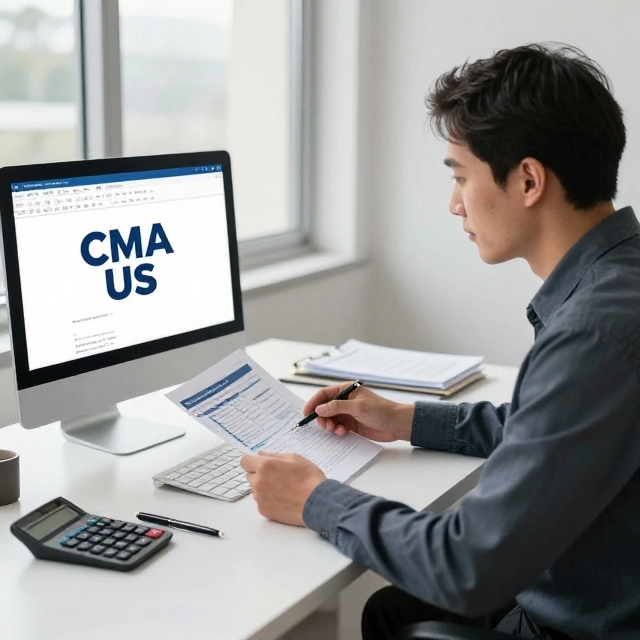
This is a professional designation awarded by Institute of Management Accountants (IMA), USA. It is mainly financial planning, business analysis, management accounting and strategic financial management.
CMA US focuses on teaching people how to use financial information to plan and make decisions for business, rather than focusing on financial reporting and auditing like most other credentials.
Certifying Body: IMA and What It Covers
The qualification helps people to learn more about and improve areas like
- Creating a budget and planning your money
- Performance and cost management
- Financial statement analysis- Business-Finance
- Business decision analysis
- Risk Management — Big Data & Technology
These lectures will be useful if you wish to work in corporate finance, financial planning and analysis (FP&A), management accounting or company management.
CMA US Exam Structure at a Glance
CMA US exam consists of two parts. Candidates may take them in any sequence.
- Part 1: Financial Planning, Performance and Analytics – This section covers financial reporting, budgeting, forecasting, cost management, performance management, internal controls and technology.
- Part 2: Strategic Financial Management – It covers examination of financial statements, corporate finance, decision analysis, risk management, investment decisions and professional ethics.
Each portion is a four-hour test of 100 multiple choice questions and two sets of case-based questions.
Start Your CMA Journey Today
Kickstart your CMA preparation with expert mentorship, structured learning, and a clear roadmap from basics to exam readiness.
Know MoreCMA US Eligibility for Non-Commerce Graduates
CMA US is that candidates don’t require a BCom, BBA or any other commerce-related degree to pursue it.
The IMA recognizes bachelor’s degrees from authorized colleges and institutions in a wide range of academic subjects. Candidates must meet the academic, examination and professional experience requirements to earn the certification, however.
Educational Requirement: Bachelor’s Degree in Any Discipline
A bachelor’s degree from an authorized college or university is the minimum.
- Possible eligible academic backgrounds are:- Bachelors of Technology (B.
- Bachelor of Science (B.Sc.)
- BA (Bachelor of Arts)
- Bachelor in Computer Applications (BCA)
- Bachelor of Engineering (BE)
- Bachelor of Business Administration (BBA)
- BCom (Bachelor of Commerce
Candidates who hold degrees from other countries will be required to produce academic documents for verification. If there is any uncertainty regarding the accreditation status of the school, they should go ahead and confirm acceptance with IMA.
Work Experience Requirement and Timing
In addition to the required educational qualifications, the candidate must have had two consecutive years of relevant professional experience.
Key points are:-
- Experience in managerial accounting and/or finance management.
- The experience can be completed before or after the candidate has passed both examination stages. The experience requirement must be met within 7 years of passing the examination.
- Duties may include financial planning, budgeting, financial analysis, cost control and management reporting.
Can Final-Year Students or Those Still Studying Pursue CMA US?
Students can start their CMA journey before earning their bachelor’s degree.
- They can study and register and take the CMA tests.
- Eventually they have to finish their bachelor’s degree requirement.
- They also have to meet the two-year relevant work experience criteria to be eligible to obtain the certification.
Eligibility by Degree
| Degree | Eligible? | Notes |
|---|---|---|
| BTech | Yes | Engineering graduates can apply |
| BSc | Yes | Science background accepted |
| BA | Yes | Arts graduates can apply |
| BCA | Yes | Computer applications graduates can apply |
| BE | Yes | Engineering background accepted |
| BBA | Yes | Business background |
| BCom | Yes | Commerce background |
Is CMA US Difficult Without a Commerce Background?
The CMA US can be a little bit tougher for those who don’t have a commerce background, especially at the earlier phases of your preparation. But it is not unachievable.
More often than not, the challenge is not the academic background of the candidate but the lack of knowledge with accounting principles, financial terms and commercial calculations.
Subjects can be learned gradually by those who have a good base and a systematic study plan.
Topics Non-Commerce Students May Find Tough
There are several things that may deserve greater attention than others:
- To be good at financial accounting you need to know a lot about log entries, financial accounts, assets, liabilities and equity.
- Cost accounting: This is the branch that looks at how companies work out their profits and how they spend money on things like manufacturing and other expenses.
- Both include creating a budget and making forecasts about how much the company will produce and spend in the future.
- Financial statement analysis: To undertake financial statement analysis, you need to know a lot about balance sheets, income statements and cash flow statements.
- Corporate finance is about how to make decisions on investments, how to raise money and how to manage financial risk.
Realistic Preparation Time
The time required for preparation will depend on the candidate’s level of study, study schedule and knowledge of accounting.
| Candidate background | Suggested preparation approach |
|---|---|
| Commerce graduate | Study according to the normal CMA study design |
| Engineering graduate | Spend more time on the fundamentals of accounting |
| Science graduate | Develop accounting and finance basics |
| Arts graduate | Begin with basic accounting and business concepts |
How Non-Commerce Graduates Can Prepare for CMA US
It is much simpler to make the transition to management accounting if preparation is done in a methodical manner. In order to pass the Certified Management Accountant (CMA) exam, graduates who are not in the business field need to demonstrate a strong command of the fundamentals.
What you should do is:
1. Familiarize yourself with the fundamentals of business, including debit and credit card transactions, journal entries, financial statements, cost accounting, and other related topics. Consequently, this makes it simple to comprehend the CMA curriculum.
2. Make use of a well-known CMA preparation service or website that provides instruction from the primary level onward. When it comes to guiding this topic, the new IMA syllabus is utilized.
Regularly practice multiple-choice questions, numerical questions, and case-based questions. You will be able to comprehend topics and perform computations more quickly if you practice regularly.
4. Create a study plan: Divide the course into pieces that you can learn about and then study those sections. Review the chapters once more and make a list of objectives for the upcoming week.
5. Register for both Part 1 and Part 2 during the hours of the examination that are convenient for you. In the beginning, either one will be sufficient.
6. Make sure you keep track of your progress by taking practice exams, identifying the areas in which you are not performing well, and devoting more time to improving in those areas before the actual test.
Start Your CMA Journey Today
Kickstart your CMA preparation with expert mentorship, structured learning, and a clear roadmap from basics to exam readiness.
Know MoreAdvantages Non-Commerce Graduates Bring to CMA US
A non-business experience might be helpful in a variety of ways in understanding management accounting. The skills and knowledge that students learn in school can be used in the fields of business and finance.
Some of the advantages are here:
- Analytical skills: Most people who have degrees in science, engineering or math are used to looking at problems, figuring out what they mean and working with numbers.
- Technical knowledge: If you’re a computer science or IT background, you might be interested in technology, data analytics, and financial systems in general.
- Problem-solving skills: students with a technical background apply logic to create budgets, analyze costs and make business judgments.
- Industry knowledge: Engineering graduates may have the knowledge of how to make things, build things and manage costs in terms of how to make things.
- Communication skills:Arts graduates may be adept at talking to people, writing, performing research and making presentations.
- New perspectives: Graduates of diverse disciplines might offer new perspectives to financial planning and company analysis.
Career Scope After CMA US for Non-Commerce Graduates
Non-commerce graduates might find work in management accounting and corporate finance with the help of CMA US. This certificate is very valuable for businesses that require someone to review their finances, keep expenses down and help with decision making.
But, there is more to job chances than just the qualification, of course. They also depend on experience, technical skills, communication skills and the requirements of the organization.
Roles Open to You
Once CMA US is completed, with relevant experience, candidates can apply for opportunities like:
- As an FP&A analyst you support business planning through the development of budgets, projections and financial reports.
- Cost analysts look at the costs of running and producing a business, and find ways to make them more cost-effective.
- A financial analyst interprets financial data and provides reports that help firms in decision making.
- Management accountants provide managers with financial information to assist them in planning and evaluating staff.
- Business Finance Analysts work with business teams to determine the financial health of the business and if it’s profitable.
- A financial controller is a highly experienced person who handles budgeting, financial reporting, internal controls and accounting tasks.
Salary Outlook
CMA US does not guaranty a specific income. How much you can earn depends on the job you do, where you work, your experience and your professional talents.
The table given below shows the salary levels of finance & accounting positions in India. Starting salaries are based on Adecco India’s Salary Guide 2026. These are only preliminary guesses based on positions, not guarantyd incomes for CMA holders.
| Role | Indicative entry range (India) | Growth path |
|---|---|---|
| Financial Analyst | ₹4–7 LPA | Senior Financial Analyst |
| Accountant | ₹3–5 LPA | Management Accountant |
| FP&A Analyst | Varies by employer | FP&A Manager |
| Cost Analyst | Varies by employer | Cost Manager |
| Finance Manager | Experience-dependent | Financial Controller |
CMA US vs Other Finance Courses for Non-Commerce Students
Students who are non-commerce can also choose other foreign financial degrees. But each course has a different focus, grade and career path.
| Course | Eligibility | Typical duration | Difficulty | Best for |
|---|---|---|---|---|
| CMA US | Bachelor’s degree in any discipline for certification | Around 6–12 months for exam preparation | Moderate to high | Management accounting and corporate finance |
| CFA | Bachelor’s degree, qualifying student status or work-experience pathway | Usually 2.5–4 years or more | High | Investment analysis and portfolio management |
| ACCA | Entry routes vary by academic qualification | Around 2–3 years or more | Moderate to high | Accounting, audit and financial reporting |
| US CPA | Depends on state board education and credit requirements | Varies by jurisdiction and candidate | High | US accounting, auditing and taxation |
Which course should non-commerce graduates choose?
- If you are interested in learning more about budgets, cost management and financial planning for business then go for CMA US.
- If you are interested in stock research, investment analysis and portfolio management, then go for CFA.
- If you want a qualification that is not limited to accounting and auditing in one country, go for ACCA.
- If you wish to work in US taxation, auditing and accounting and you can meet the requirements of the applicable jurisdiction then consider obtaining a CPA.
- You cannot swap between these courses. The ideal choice depends on the job route you intend to pursue.
Common Mistakes to Avoid
If you’re a non-commerce graduate, here are some pitfalls to avoid when arranging your trip to the CMA US:
If you require a business degree.
- Start with advanced CMA topics when you don’t know the basics of accounting.
- Failing to understand the importance of cost accounting and financial statements.
- Picking study tools without verifying that they are in sync with the latest course outline.
- Memorizing numbers without knowing how to use them in real life.
- Not doing practice tests/case-based question practice.
- Assuming the CMA will instantly earn them a high paying job.
- Failing to meet the two years of relevant job experience criteria.
- The paperwork and degree recognition of IMA was not verified.
Is CMA US Right for You?
CMA US can benefit graduates from many schools, but it’s crucial to make sure the course is in line with your interests and future goals.
You may be a good fit for CMA US if:
- Are interested in business and making money.
- Like working with statistics & figuring out what they imply .
- Looking to transition from science, engineering or the arts to business finance?
- Interest in setting budgets, organizing their finances, and tracking costs.
- Are you ready to start at the beginning and learn about accounting
Enroll in Entri’s USA CMA course now!
Conclusion
Having a commercial background is not a bar to doing CMA US. This professional qualification can be explored by graduates in engineering, science, arts and computer applications who match IMA’s eligibility standards.
Though non-commerce students may require more time to grasp the foundations of accounting, a good study plan and regular practice can help you tackle the learning curve. If you are interested in corporate finance, budgeting, financial analysis and business management, then CMA US can be a helpful qualification to consider while planning your career shift.
| Related Articles | ||
| CMA Course Details | How to Prepare for the CMA Exam? | Career Opportunities After CMA |
| CMA USA vs CMA India | Top Indian Companies Hiring CMA USA | Top Reasons to be a CMA USA |
Start Your CMA Journey Today
Kickstart your CMA preparation with expert mentorship, structured learning, and a clear roadmap from basics to exam readiness.
Know MoreFrequently Asked Questions
Can non-commerce graduates do CMA US?
Yes. CMA US is open to non-commerce graduates of engineering, science, arts, or computer applications. IMA does not require commerce degrees. To acquire certification, candidates must have a bachelor’s degree, pass both exams, and have two years of relevant professional experience.
Are engineers eligible for CMA US?
Yes, BTech or BE engineering graduates can pursue CMA US if their university meets IMA standards. They can apply their arithmetic, reasoning, and problem-solving skills for financial analysis, budgeting, and cost control. They may need accounting basics before starting the main program.
Does CMA US require commerce experience?
No. A commerce background is not needed for CMA US. Students from several fields can apply. The main qualification is a recognized bachelor’s degree. Financial statements, cost accounting, and basic finance should be studied more by students without accounting experience.
How long does it take to complete CMA US without a commerce background?
Depending on their academic schedule and accounting knowledge, non-commerce grads may need 6–12 months to prepare and pass both exams. IMA’s two-year work experience requirement can be fulfilled before or after passing the exams within the stated timeframe.
Is CMA US worth it for BSc or BA graduates?
CMA US may appeal to BSc and BA graduates interested in corporate finance, management accounting, or financial analysis. It offers managerial accounting expertise and helps applicants improve professional abilities. Career success also depends on practical experience, technical skills, and work possibilities.
Do I need work experience to start CMA US?
No. Preparing for the CMA exams does not require two years of professional experience. You can register, prepare, and pass both exams first. The CMA certification requires two years of relevant professional experience in management accounting or financial management.