
Table of Contents
Children begin to build early thinking abilities by observing similarities and contrasts between objects as they begin to organize objects according to the colors they contain.
Toys, household materials, colored paper, and natural elements can be easily incorporated into the preparation of these activities because of their versatility.
A toddler can make the activity of sorting colors into a delightful element of their everyday play with a little bit of imagination.
Start your journey to becoming a certified Montessori teacher! Get free Demo Here!
Key Takeaways:
- Hands-on color sorting is an activity that toddlers may participate in.
- Children are able to recognize and label colors more accurately.
- Focus and observation are both improved by sorting.
- Early mathematical skills can be developed through activities such as matching and grouping.
- Learners are encouraged to learn on their own and to discover using the Montessori method.
- The utilization of common home items allows for the creation of color-sorting games.
- Activities must to be age-appropriate, straightforward, and supervised in order to ensure safety.
Why is Color Sorting Important for Toddlers?
Toddlers have a strong interest in discovering new colors, particularly when they can touch, move, and interact with colorful objects. A straightforward method for transforming this innate interest into a learning experience is to engage in activities that involve sorting colors.
Simply placing red objects next to other red objects does not complete the process of color sorting. Thanks to this characteristic, toddlers are encouraged to closely investigate objects, compare them, and develop inferences about what they see.
These tasks introduce early classification skills, and there is a positive association between these skills and later learning in the disciplines of mathematics and science.
Why is sorting colors good for kids?
Here are some reasons:
- Understand and identify the main colors.
- Learn to be attentive and to concentrate on what you are doing.
- You need to be aware of the parallels and distinctions between the two.
- Practice a few drills to build on your hand-eye coordination.
- It is helpful to exercise your skill in following straightforward directions.
- It is crucial to learn the skill of solving issues at a young age.
- Picking up and arranging objects can build your fine motor abilities.
Simple Color Sorting Activities for 2-Year-Olds
1: What is the primary focus of the first plane of development in the Montessori method?
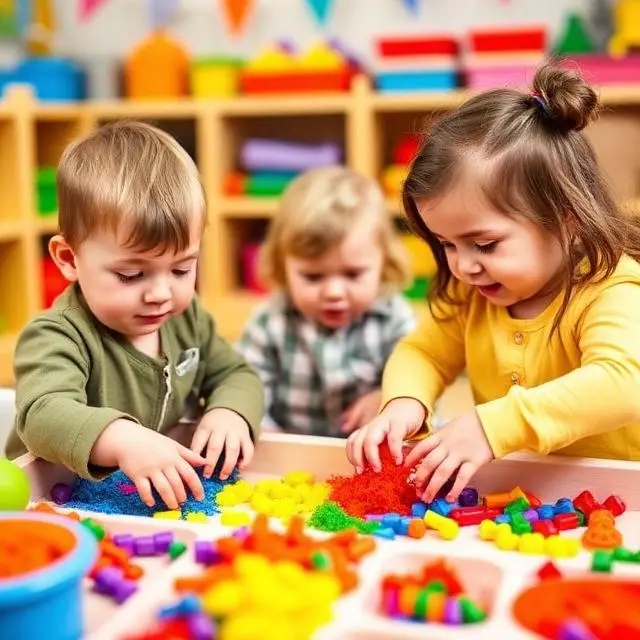
As children of this age are just beginning to notice the primary colors, it is essential that activities be simple and use only a few colors at a time. This is because children are just beginning to recognize the colors.
1. Arranging Bowls in Accordance with Their Color
You should apply a sticker of a different color to each of the bowls if you have three or four of them respectively. You should make sure that your child has access to long-lasting toys that they can play with, such as large blocks, balls, or toy animals. Instruct them to place each item in the bowl that matches to the color of the object, and get them to do so.
2. Labeling of Pom-Pom Colors and Their Categories
Pom-poms of varied sizes and colors that are well-suited for children should be placed inside of a container. In order to encourage your toddler to insert each pom-pom into the appropriate cup, you should give them with cups of the same hue and encourage them to do so.
3. An Endeavor to Find Colors
After deciding on a single hue, you should then search the entire area for that color. Your child should be tasked with finding safe objects that are the same color as the one that was selected. “Are you able to find something that is blue?” is an example of a question that you could ask.
4. Sorting of Colored Paper
Using a wide range of colors, the papers ought to be cut into enormous squares or disks. Following the completion of the combination, you should then request that your child arrange the pieces in a manner that corresponds to the colors.
5. Toy car sorting
Your toy cars should have a range of colors you may choose from. On the ground, spread out sheets of paper in a range of colors, and instruct your kid to place each car on the sheet of paper that corresponds to the color that they are using.
Activities that involve a greater number of colors and instructions that are slightly more challenging are often within the capabilities of youngsters who are three years old.
Get Certified & Start Your Montessori Career
Montessori Teacher Training Course by Entri App: Gain expert skills, earn certification, and kickstart your teaching career.
Join Now!Fun Color Sorting Activities for 3-Year-Olds
In general, children who are three years old are able to handle activities that involve more colors and instructions that are slightly more difficult.
1. Sorting the Button Colors
The youngsters should be given large, safe craft buttons in a variety of colors, and they should be provided with containers that match. Request from them that the buttons be arranged in a color-based order. Ensure that children are always properly supervised, and steer clear of any little things that could pose a choking hazard.
2. Sorting of Rainbows
Objects should be prepared in a variety of colors, and children should be asked to stack them in the sequence of the rainbow. Through the use of this activity, color sequences are shown while also encouraging thorough attention.
3. Sorting of color trays
To make divisions on a tray, use colored paper to create sections. Mix a variety of objects and then give the youngsters the task of sorting each item into the appropriate category.
4. A memory game based on matching colors
Position the colored cards so that they are facing down. Children should be allowed to turn over two cards at a time and attempt to locate colors that are a match. Color recognition and memory training are both combined in this activity.
5. Categorizing nature colors
As you play outside, you should gather natural objects that are safe to touch, such as leaves, flowers, or pebbles. Have the youngsters organize them into groups based on the colors they are. Take precautions to prevent children from putting the items in their mouths.
DIY Colour Sorting Games for Toddlers
In order to build games that include sorting colors, you do not require pricey educational toys. Uncomplicated educational resources can be derived from materials that are commonly used.
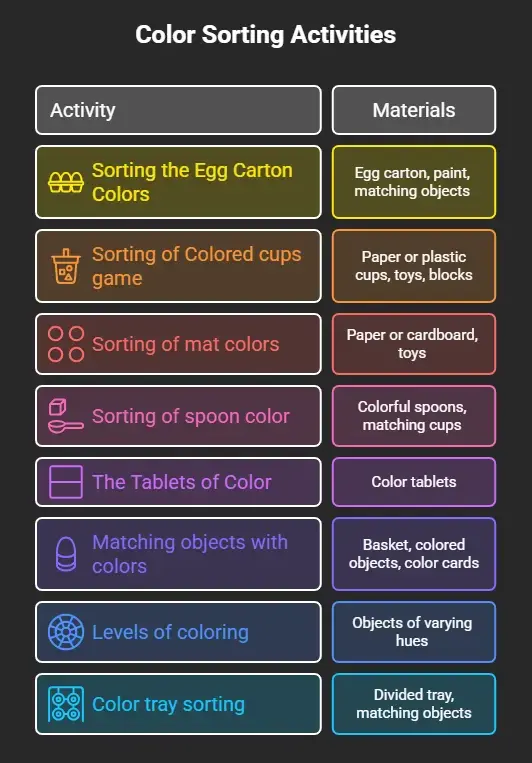
Sorting the Egg Carton Colors
Paint or cover the portions of an empty egg carton with a variety of colors depending on your preference. You should provide your child with objects that are a match and then ask them to place each item in the appropriate section.
Sorting of Colored cups game
Make use of cups made of paper or plastic in a variety of colors. Children should be given toys, blocks, or other large objects that are matched, and they should be allowed to sort them into the cups.
Sorting of mat colors
Circles of varying sizes and colors should be drawn on a piece of paper or cardboard. Toys that are a match can be placed on each circle by the children.
Sorting of spoon color
Make use of colorful spoons and cups that are matched. The children should be encouraged to associate each spoon with the cup that is of the same color.
Various Activities for Sorting Colors in Montessori
Children are encouraged to learn via hands-on exploration and autonomous discovery through the use of color activities that are influenced by Montessori practices. For the purpose of allowing youngsters to concentrate on one skill at a time, the activities might be given in a straightforward and well-organized manner.
The Tablets of Color
One of the most traditional Montessori materials is the color tablet. Tablets of the same color can be matched by children, making it possible for them to progressively learn to differentiate between different hues.
Matching objects with colors
You should put a small assortment of colored objects in a basket and then present color cards that correspond to those objects. In an independent manner, children are able to match each object to the appropriate card.
Levels of coloring
Introduce youngsters to a variety of hues of the same color once they have reached a level of comfort with fundamental color matching responsibilities. You should request that they arrange the shades in descending order of lightness.
Color tray sorting
Make sure to include objects that match to each color, and prepare a tray with several portions that are clearly divided from one another. While you observe and provide assistance when it is required, children should be allowed to work independently.
Montessori Color Sorting Activities
Toddlers are provided with the chance to learn about colors through hands-on inquiry using the Montessori method of color sorting activities.
Children are able to independently touch, compare, match, and organize things, offering them an alternative to merely memorizing the names of colors.
Simple Montessori materials or commonplace objects can be used to modify these activities so that they are suitable for children aged two and three years old.
1. Cards used for color matching
It is recommended that you make cards in fundamental colors such as red, blue, yellow, and green. It is important to provide the child with objects of the same color and urge them to place each object on the card that indicates the same color. With the help of this straightforward game, youngsters may improve their ability to recognize and match colors.
2. Color tablets developed by Montessori
One of the most successful Montessori materials is the color tablet. Begin with a few fundamental colors, and then ask the youngster to locate pairs of colors that are a match.
As the youngster develops more comfortable with the activity, you should eventually offer other colors and a variety of tints.
3. Sorting of colored bowls
On a tray, arrange three or four bowls of different colors and things that are a match for each bowl. Offer the youngster the opportunity to place each item in the bowl that corresponds to the same color.
The task is presented on a tray, which not only encourages individual work but also provides a distinct beginning and end to the activity.
4. The Grading of Colors
Introduce a variety of shades of the same color to children who are prepared to take on increased levels of difficulty. You should request that they arrange the shades in descending order of lightness.
Because of this practice, youngsters are able to enhance their visual discrimination skills and become more aware of the small changes between colors.
5. Categorizing nature colors
Spend time outside with your children and have them collect natural objects that are safe to handle, such as flowers or leaves.
Children should be given colored cards and encouraged to match the things on the cards to the color that is nearest to them. In this way, Montessori education is linked to the natural environment in which the child is immersed.
6. Sorting of Flowers in a Basket
Put together a basket that contains a wide range of colorful and huge goods. It is important to have separate containers for each color, and the youngster should be allowed to sort the things on their own.
It is best to refrain from correcting every error right away; instead, give the youngster some time to observe and rectify themselves.
7. The Process of Matching Colors with Daily Things
Utilize objects that are already familiar to you, such as huge blocks, cups, toy vehicles, or pieces of fabric.
Get Certified & Start Your Montessori Career
Montessori Teacher Training Course by Entri App: Gain expert skills, earn certification, and kickstart your teaching career.
Join Now!Benefits of Color Sorting for Early Childhood Development
The act of categorizing colors is useful to the development of a variety of features that occur during the early stages of parenting.
Children should be encouraged to engage in tasks such as observing, comparing, categorizing, and making decisions to improve their development.
Some of the most important benefits include the following
- Children acquire the ability to perceive patterns, similarities, and differences as they progress through the process of cognitive development known as cognitive development.
- In order to develop fine motor abilities, it is necessary to train the small hand muscles through tasks such as picking up and arranging objects.
- The practice of describing colors and using descriptive phrases is something that youngsters should do in order to develop their understanding of language.
- When adults give children opportunities to sort, children typically focus their attention on a specific task.
- When children solve problems, they think about where to place each object correctly.
- Children develop early mathematical skills by grouping and categorising objects, which introduces concepts they will use later in mathematics.
- When adults provide toddlers with simple sorting materials, toddlers can complete the activities independently.
Start your journey to becoming a certified Montessori teacher! Get free Demo Here!
Conclusion
One of the most straightforward and enjoyable ways to encourage children to learn via play is through the use of color sorting games. Parents and educators can make learning more colourful and engaging by using a variety of activities, from simple colour searches for two-year-olds to Montessori-inspired colour matching and grading activities for three-year-olds.
Using readily available items, parents and instructors may easily and inexpensively put together these activities for their children. Above all else, make sure that the activities are enjoyable, suitable for the children’s age, and free of any pressure so that they can choose their own pace when it comes to exploring colors.
Get Certified & Start Your Montessori Career
Montessori Teacher Training Course by Entri App: Gain expert skills, earn certification, and kickstart your teaching career.
Join Now!Frequently Asked Questions
What are easy colour sorting activities for 2-year-olds?
Simple activities include sorting coloured blocks, matching toys to coloured bowls, using coloured cups and playing colour hunt games.
How can I teach my 2-year-old to recognise colours?
Start with two or three basic colours and use familiar toys and household objects. Name each colour as your child sorts and matches the objects.
What are fun colour sorting activities for 3-year-olds?
Three-year-olds can try rainbow sorting, colour matching games, button sorting with safe large materials and sorting objects by different shades.
What are Montessori colour sorting activities?
Montessori colour sorting activities include colour tablets, matching objects to colour cards, colour grading and organised sorting trays.
How do colour sorting activities help child development?
These activities support cognitive development, fine motor skills, concentration, observation, language development and early mathematical thinking.
Can I make DIY colour sorting games at home?
Yes. Parents can create simple games using coloured paper, cups, cardboard, blocks and other safe household materials.
At what age can children start colour sorting?
Children can begin simple colour matching and sorting activities around the age of two. Parents can gradually increase the difficulty as their skills develop.
How can I make colour sorting fun for toddlers?
Use colourful toys, everyday objects, songs, colour hunts and playful challenges. Keep activities short and allow children to explore at their own pace.